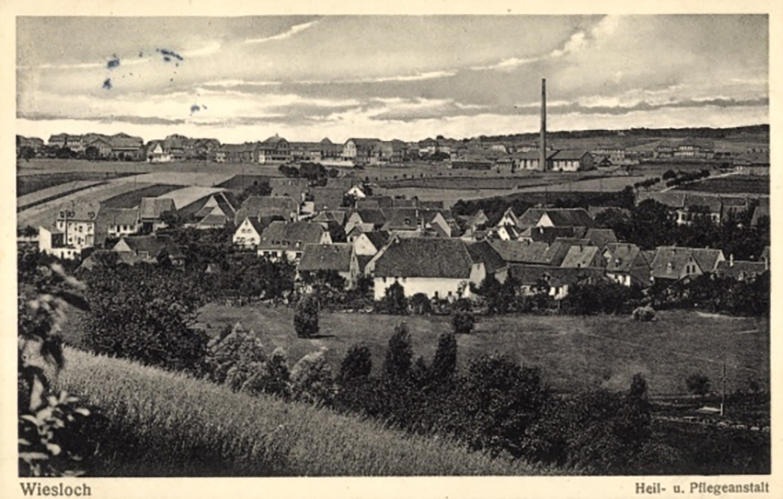
Postcard of the Wiesloch sanatorium and nursing home.
Copy in ArEGL.
WIESLOCH
The »children’s ward« at the Wiesloch sanatorium and nursing home began operating in November 1940, moving into House 59 with 16 beds in December. Medical Director Wilhelm Möckel brought psychiatrist Arthur Schreck to Wiesloch to head the ward. In January 1941, two NSV nurses arrived from Berlin, as no one in Wiesloch had any experience in caring for children with disabilities.
The children and adolescents came from Baden, Hesse, the Palatinate and Württemberg. Schreck murdered three of them. Another nine children were killed by Fritz Kühnke, who travelled from the Eglfing-Haar (Munich) »children’s ward« for this purpose. In August 1941, the »Wiesloch children’s ward« was closed. Many children and adolescents were transferred to other »special children’s wards«, including Eglfing-Haar, Eichberg, and the newly established »special children’s ward« in Kaufbeuren. In Wiesloch, brain examinations were performed on children and adolescents in 1943 in the »research department« run by Carl Schneider in House 50. One boy died during such an examination.
Arthur Schreck confessed to the murders in 1947 and was sentenced to twelve years in prison. Due to his inability to serve his sentence, the sentence was suspended in 1951. In 1958, Schreck was pardoned by Gebhard Müller, then Minister President of the State of Baden-Württemberg.
The arrest warrant issued against Fritz Kühnke in 1947 was not enforced, and after the war he ran a paediatric practice in Hamburg. In 1963, criminal proceedings were brought against him for manslaughter, but these were discontinued in 1969 without a verdict. The murders, which were treated as »manslaughter«, were time-barred. The criminal investigations against the institution’s director, Möckel, were dropped after he was classified as a »resistance fighter« in the course of his denazification in 1948.

back