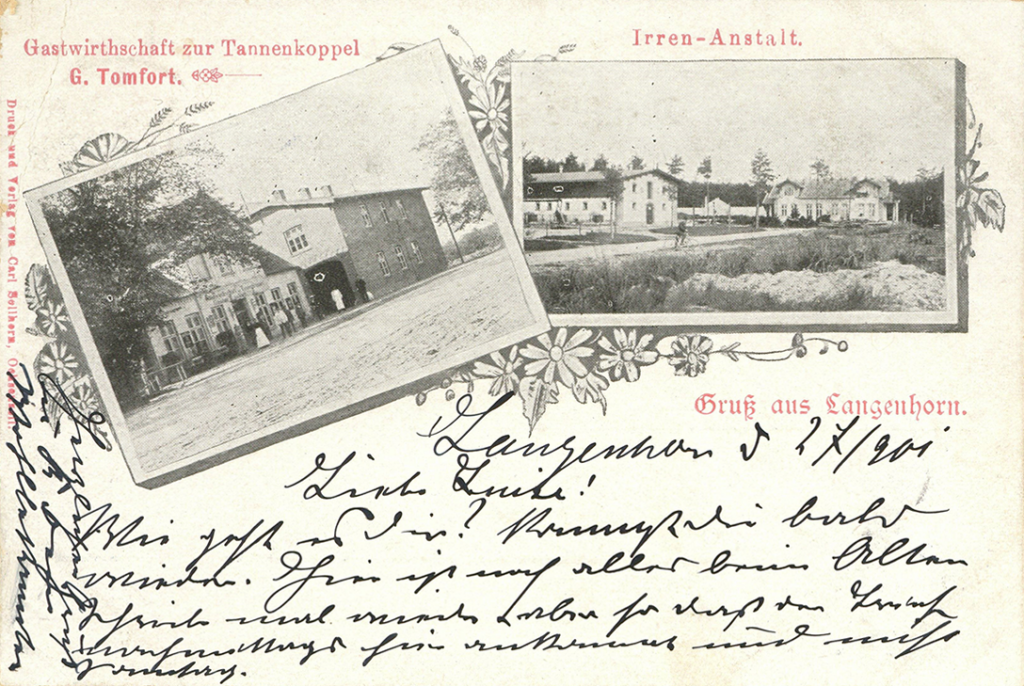
Postcard, Langenhorn Institution and Nursing Home (Hamburg), 1901.
ArEGL 99.
HAMBURG-LANGENHORN
In December 1940, a meeting of the »Reich Committee« was held in Berlin, after which Friedrich Ofterdinger, Commissioner General for Health in Hamburg, gave the order to set up a »children’s ward« at the Hamburg-Langenhorn mental hospital. It began operating on 1 February 1941. It was housed successively in Building 7 on the women’s side and in Buildings 10 and 6 on the men’s side. The ward was under Ofterdinger’s personal authority. He signed the death certificate of the first murdered child because the director of the Institution, Heinrich Körtke, refused to do so.
From early February 1941 until its dissolution in July 1943, the neurologist and psychiatrist Friedrich Knigge, who had already participated in the meeting of the »Reich Committee« in December 1940, headed the »Children’s ward«. Before its establishment, there were no underage patients in Langenhorn. There was also no expertise in paediatric medicine. As a result, the »Children’s ward« was only temporary. The last killing of a child is said to have taken place in June 1943.
Of the 69 children and adolescents admitted to Langenhorn, 22 were murdered through lethal medication and inadequate nutrition, 15 children were transferred to other institutions (six to Rothenburgsort, one to Leipzig-Dösen, four to the Alsterdorf institutions, one to Lüneburg, three to Meseritz-Obrawalde) and 32 children were released. Knigge performed autopsies on six of the murdered children, and their brains were examined at the Neuroanatomical Institute of the University Medical Centre Hamburg-Eppendorf. In 2012, the remains of five murdered children were buried at the Ohlsdorf Cemetery in Hamburg.
From early December 1943 until shortly after the end of the war, Knigge was Medical Director of the Langenhorn General Hospital. On 25 August 1945, he was relieved of his duties in the course of an initial criminal investigation. Although he confessed to participating in the murders of children, the proceedings were discontinued. A second trial followed in 1946, this time concerning his involvement in transfers to killing centres. These proceedings were also discontinued.
Friedrich Ofterdinger was interned in Neumünster-Gadeland, where he died as a result of hunger oedema.

back