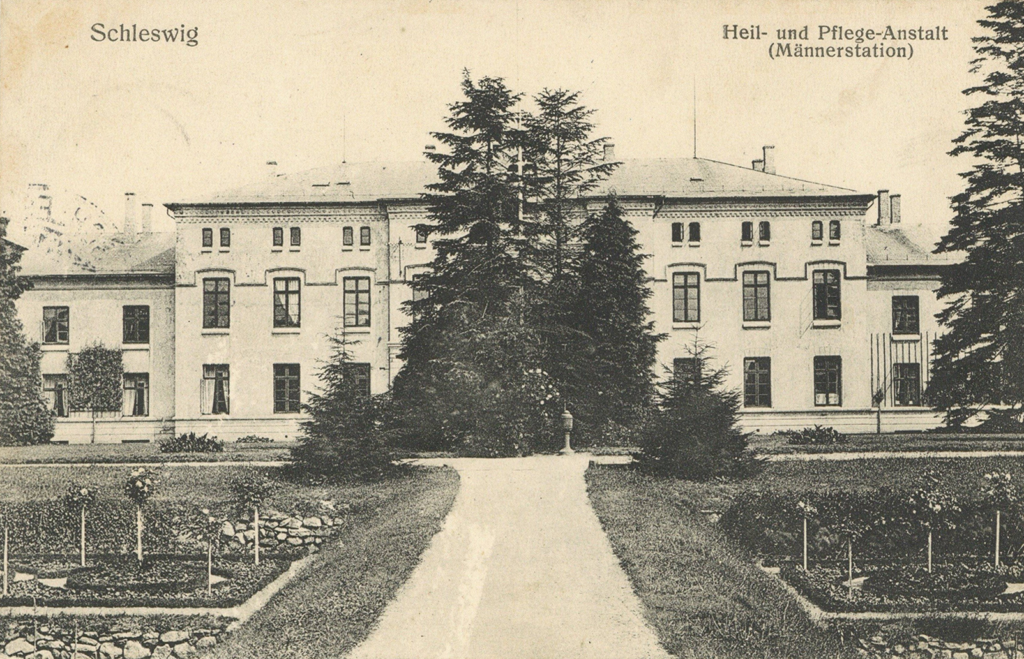
Postcard, Schleswig-Hesterberg Institution and Nursing Home, 22 November 1915.
ArEGL 99.
SCHLESWIG-HESTERBERG
There were two institutions in Schleswig: one for adults in Schleswig-Stadtfeld and one for children and young people in Schleswig-Hesterberg. An institution for children and young people with disabilities was opened as early as 1852 and moved into the buildings on Hesterberg in 1872. During the Second World War, the administrative officer Alfred Hartwig was director of the Hesterberg State Reception and Education Home. The medical director was Erna Pauselius.
From autumn 1939 onwards, overcrowding and inadequate supplies led to increased mortality in the reformatory. To relieve the pressure on Hesterberg, more than a hundred children were transferred to the Schleswig-Stadtfeld Institution and nursing home in April 1941.
In autumn 1941, Hesterberg became the location of a »Children’s ward«. It was not a separate ward, but rather the »Reich Committee children« were housed in various wards. The »Reich Committee children« were under the exclusive and special supervision of the medical director, Erna Pauselius.
When the Hesterberg institution was used as a reserve military hospital from February 1942 onwards, the »Children’s ward« with 242 children and adolescents moved to Schleswig-Stadtfeld. As early as May 1940, a prisoner-of-war camp had been set up in individual buildings of the Hesterberg reformatory. With the military hospital, the remaining buildings were also used for military purposes.
Erna Pauselius and the nursing staff working in the »Children’s ward« also moved to Stadtfeld. In mid-1942, Johannes Krey took over as head of the newly established »Children’s ward«. His successor from November onwards was Hans Burkhardt, who was initially reluctant but ultimately agreed to take on the role.
A total of 216 children and young people died in Schleswig-Stadtfeld and Hesterberg during the Second World War, most of them due to a lack of nursing and medical care. It is not known how many of them were deliberately murdered.
All investigations against those involved in the murder were dropped.

back