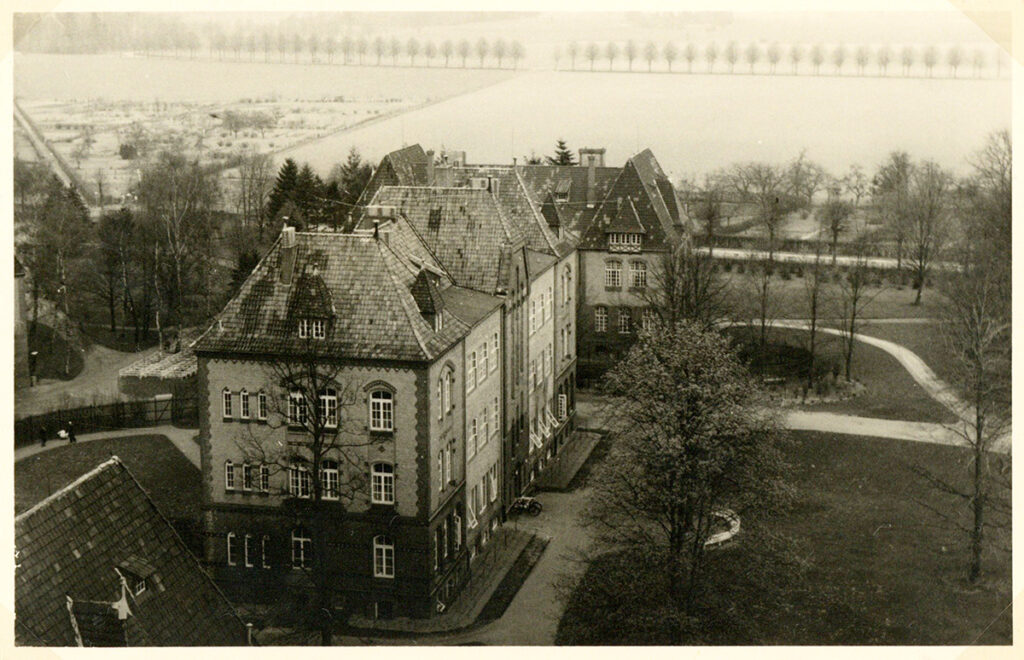
House 13 and House 15 (in the background). Photo album of the Lüneburg Institution and Nursing Home, circa 1950.
ArEGL 109.
LÜNEBURG
During the war, the number of foreign patients at the Lüneburg sanatorium and nursing home increased. As early as 1943, »Eastern labourer wards« were created. The men were housed in building 15 and the women in building 16. From 1944 onwards, an increasing number of forced labourers suffering from tuberculosis were also admitted.
From September 1944 onwards, Lüneburg was the central »collection point for foreigners« for Bremen and Lower Saxony. However, sick forced labourers from Schleswig-Holstein and Hamburg were also housed here.
By August 1945, well over 300 sick people from at least 23 countries had been admitted to Lüneburg. One in ten was a war refugee. Most came from Russia, Ukraine and Poland. They had been deported for forced labour. But refugees from Belgium and the Netherlands were also housed in Lüneburg. By 1950, 143 foreign patients had died as a result of malnutrition and lack of treatment.
The Lüneburg »foreigners‘ collection centre« was not only the final destination for sick forced labourers who were no longer able to work, but also a stopover. On 11 June 1944, ten female forced labourers were transferred to an unknown location, followed by at least 28 on 20 November 1944 and at least 67 on 20 December 1944. It can be assumed that they were murdered in the German-occupied part of Poland.

back