Welcome!
This is an offer from the Lüneburg Euthanasia Memorial.
Here you have the opportunity to learn about the history of the Lüneburg Psychiatric Clinic and find out about the work of the memorial site.
You can visit our special digital exhibitions.
You can search for people and topics using keywords. You can conduct research in our databases.
LEBENSWERT – WORTH LIVING
To this day, the Nazi view of people with disabilities and mental illnesses continues to shape medical treatment and healthcare. The question of which lives are ‘worth living’ and which are not determines life-sustaining measures, and thus life and death.
There is ongoing discrimination in society that has its roots in the history of National Socialism.
Under National Socialism, people with disabilities and mental illnesses were considered ‘unworthy of life.’ They were deprived of their rights and murdered. Around 2,000 people who were patients in Lüneburg fell victim to euthanasia and inadequate care during the Second World War and afterwards. Among these victims were more than 440 children and young people with disabilities and hundreds of mentally ill people of non-German origin. They died from overdoses of medication, starvation, deliberately induced illnesses or neglect. Mass transfers also led to certain death for patients in Lüneburg. Over 820 people became victims of forced sterilisation and forced abortion as a result of rulings by the Lüneburg Hereditary Health Court.
This exhibition documents this violence and questions the thinking, decisions and actions of the time that led to the crimes described and did not end after the Second World War.

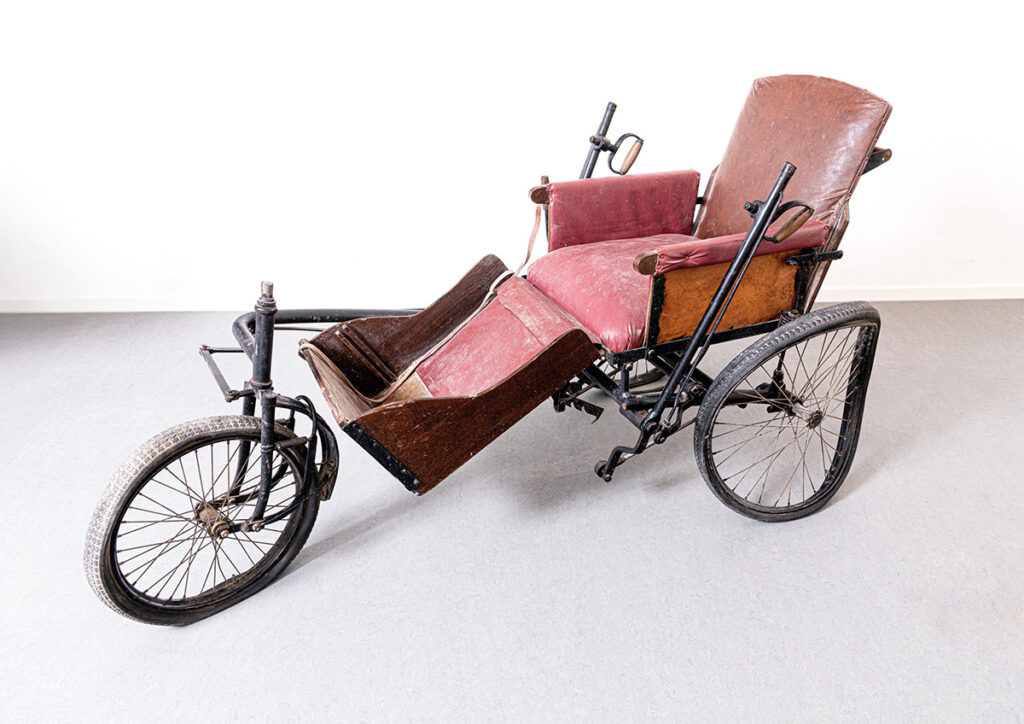
Hand lever hospital lift, circa 1900.
ArEGL 177.
This hand-lever hospital wheelchair from the Lüneburg sanatorium and nursing home was not pushed, but allowed patients to move around independently. The levers enabled independence and participation. The broken wheels symbolise the fact that these aspirations were not fulfilled during the Nazi era. Between 1933 and 1945, the treatment of people with disabilities and illnesses went ‘off track’. The chair was recovered from the crawl space of House 17 in 2024.
In order to win the competition for the construction of the sanatorium and nursing home, it was necessary to demonstrate a very good water supply. In Lüneburg, this was only achieved by secretly pumping the water back in after it had been pumped out. This deception enabled them to prevail over the city of Uelzen as a competitor. However, as the water level was actually too low, a 42-metre-high water tower with a pumping station had to be operated. The valve regulated the water supply. Part of the water boiler has been preserved in the attic of the tower.
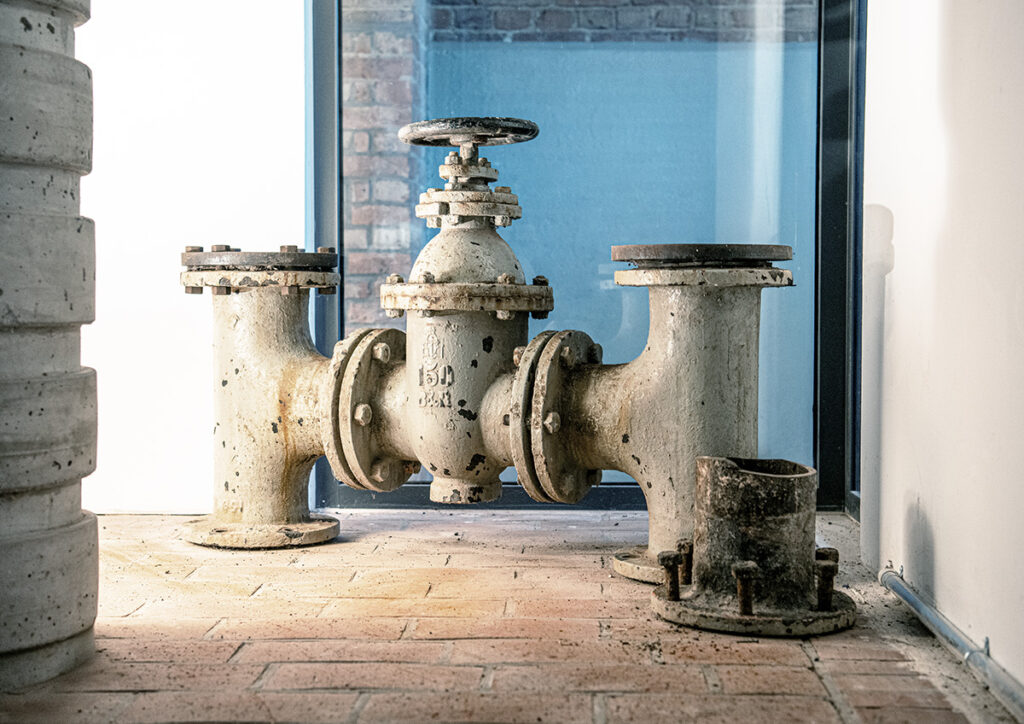
Valve, 150 kilograms, iron, circa 1900.
ArEGL 213.
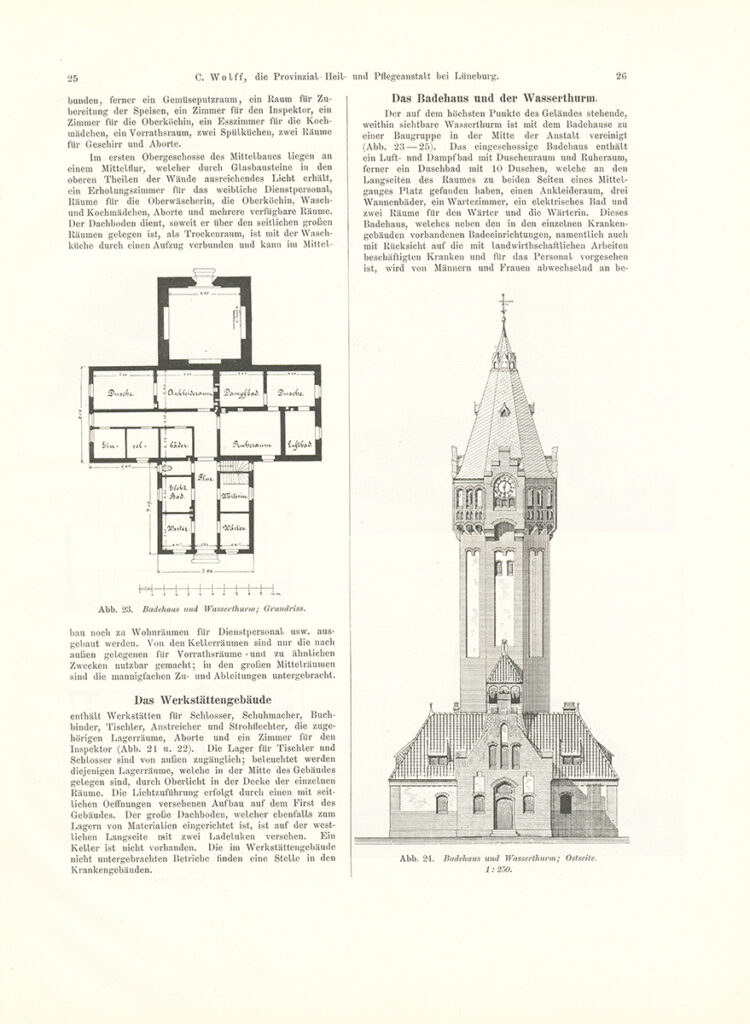
ArEGL 97.
These are construction drawings of the water tower at the Lüneburg mental hospital from Carl Wolff: The Provincial Mental Hospital near Lüneburg. Special reprint from the Journal of Architecture and Engineering 1901 and 1902. Columns 25 and 26.
Although it no longer served any purpose after a new clockwork mechanism was installed, the old clockwork mechanism remained in the water tower. Like many of the items on display in this exhibition, it remained in the place where it had been stored or placed decades ago.The tower clock has been telling the time at a height of 29 metres since 1901. It towers above all the buildings on the clinic grounds. The water tower with the adjacent bathhouse is the clinic’s landmark, visible from afar.
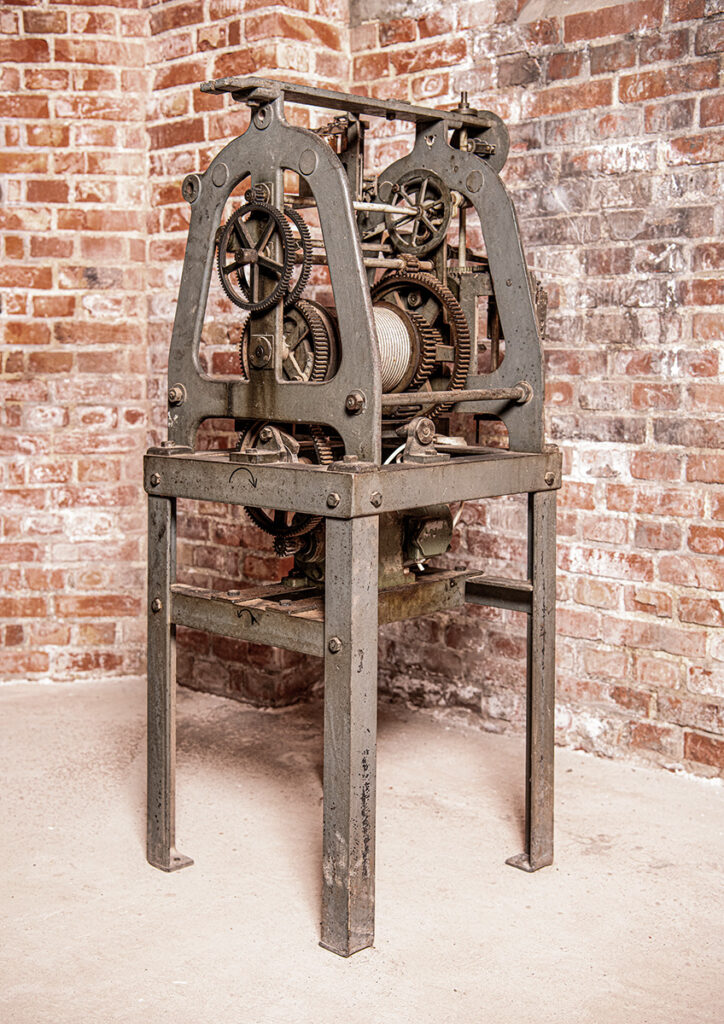
Clockwork from the former tower clock of the Lüneburg sanatorium and nursing home, before 1901.
ArEGL 179.
THANK YOU
The documentation centre at the Lüneburg »Euthanasia« Memorial, with its permanent exhibition entitled LEBENSWERT (WORTH LIVING), was planned, designed and realised between 2015 and 2025.
We would like to thank the following for their support:
The film production was supported by:

The following individuals contributed to the establishment of the documentation centre and the permanent exhibition:
(in alphabetical order):
Concept | Project management
Dr Carola Rudnick
Design
Cogneus Design Studio
Hinz & Kunst GmbH Concept. Design. Workshop.
Kleineberg GmbH & Co. KG Architects and Engineers
Curators | Authors
Dr Jule von Hertell, Alexander Krüger, Marcus Rischmüller, Dr Carola Rudnick, Hedwig Thelen
Collection | Databases
Danny Kolbe, Alexander Krüger, Marcus Rischmüller, Dr Carola Rudnick
Video production
Dr Jule von Hertell
Image description
Dr Carola Rudnick, Birte Wiebe
Speakers
Dr Jule von Hertell, Mathias Mensch, Maria Müller, Dr Carola Rudnick
Editing
Alicja Lebski, Angela Wilhelm
Translations
Office for Easy Language | Lebenshilfe Bremen e. V., Alicja Lebski, Dr Carola Rudnick, Ihor Tymko, Birte Wiebe, Natalia Wollny
Object Photography
Studio Mensch
Administration
Andrea Kabasci, Michel Kusack, Natalia Wollny
Architect
Henryk Reimers henschke schulze reimers
architects partnership mbb
Consultancy on historic preservation
Cornelia Abheiden
Restorer
Petra Novotny
Braille printing
Kreye Siebdruck GmbH
Guideway system
Deutsche Blindenleitsysteme GmbH
Replicas
PAL Preservation Academy GmbH, Occupational Therapy
Printing/Bookbinding Psychiatric Clinic Lüneburg
3D models
Rapidobject GmbH
Interior design
Holger Schütte Media Technology & Electronics
Stövesandt Carpentry Ltd.
The following trades were involved in the construction project
(in alphabetical order):
Allgemeine Fernsprech- u. Datenanlagen Deutschland (AFD) GmbH
Baubetrieb Reiner Böhnstedt
Brandmeldeunternehmen AFD Deutschland GmbH
Herder & Plötz Elektrotechnik GmbH
Fliesenarbeiten Grabowski Bevensen GmbH
HEKO Metallbau GmbH
Ingenieurgemeinschaft Dr. Maack GmbH
Hermann Witte Painting Company
Oliver Bohm Civil Engineering and Road Construction
Ortmann Floor Coverings
Schweitzer Locksmith’s Shop
Schneider & Steffens GmbH & Co. KG
Jürgen Holst Carpentry
WE-Technik Stade Ronald Westphal
ZZ-Trockenbau GmbH
Special thanks go to the Psychiatric Clinic Lüneburg gGmbH for providing the former bathhouse with water tower for the establishment of this documentation centre.
Special thanks go to those employees of the clinic, Gesundheitsholding Lüneburg GmbH and Service Plus Lüneburg GmbH who supported the implementation of the construction project and the setting up and inauguration of the exhibition, in particular the technical, IT, gardening, printing, cleaning and public relations departments.
The Lüneburg »Euthanasia« Memorial
is institutionally supported by:



More than 130 nursing students from the two vocational schools for nursing professions in Lüneburg participated in the implementation and reopening
(in alphabetical order):
Besmir Aga, Mohamad Ahmad, Litrand Ferdinand Oyie Assiga, Sükran Aytan, Mia Zoe-Lynn Bäger, Sarah Barkow, Simone Behrens, Vanessa Bergmann, Mercedes Bianchi, Mieke Böckmann, Amelie Boelter, Nicholas Brandes, Finja Brauneck, Esther Burkhardt, Fine Luise Büttner, Chantalle B., P. B., Yara Claußen, Simran Dahal, Johanna Dahle, Lea Dammann, Lara Demlang, Nina Dierkes, Liv Dohrmann, Julia Joanna Dubowska, Jordie Eichfeld, Amber Maria Elliger, Andrea Erben, Jan Erbuth, Lindsay Ermantraut, Evin Esmeray, Mia-Marie Fischer, Fiona Fischer, Mihaela Floria, Lea Joulene Gasch, Luisa Geertz, Fynn Gehricke, Elisa Gehrke, Jonas Gehrke, Martin Gruhn, Jana Gutjahr, Bent Hager, Jasmin Hanke, Michelle Harms, Katherine Hedder, Tony Heise, Lena Hemm, Oskar Henke, Jaquline Hensel, Nathalie Heuer, Marlon Hiecke, Emely Hirsch, Marius Hurjui, Leonie Huschenhöfer, Mona Ibrahim, Leonie Jacobs, Elise Jens, Emily Jeßen, Malin Karp, Ferman Kartal, Julia Klingel, Aleksandra Kmiec, Emily Köppe, Kiara Kroeger, Frida Krumböhmer, Philip Kuhn, Joris Labatz, Lisa Lackmann, Fabian Leben, Aimeé-Sue Letzas, Leonard Lindooren, Nele Litschner, Maha Loukrissi, Lea Löwinger, Ronja Lübberstedt, Ubeida Masto, Leonie Sophie Meyer, Maximiliane Moll, Katharina Mühle, Fortune Ngaffa Ngandeu, Amelie Sophie Nielinger, Evans Nierenz, Eila Norden, Valentina Pachl, Leonie Pope, Santatra Rabarison, Isabel Radtke, Nisha Rai, Amelie Rambau, Karina Rath, Emily Ravens, Rebecca Reinecke, Sara von Rekowski, Ben Riepenhausen, Corina Rohde, Emily Roth, Jolina Rüdiger, Tania Samara, Nikolas Sander, Pauline Scherer, Hanna Schildt, Angelina Schlee, Lale Schondorf, Lydia Schrader, Luisa Schubert, Romy Schultz, Amira Schulz, Anastasia Schumacher, Nico Schwanbeck, Jana-Sophie Schwaneberg, Sidar Sido, Ermin Sinanović, Dawid Stockhaus, Lara Stransky, Hannah Stuike, Juline Skrzypek, Vivienne Anjulie Steinke, Evelina Stumpf, Emely Tänzer, Marie Thiemann, Julia Thinius, Jonah Thomas, Marlon Trilck, Kamil Uscinski, Annkathrin Viebrock, Matti Voigt, Frauke Waag, Lena Marie Wibrow, Otylia Wiecek, Ella Wilcke, Lana Winkler, Laura Witten, Zoé-Renée Zander
The seminars with the nursing students were conducted by (in alphabetical order):
Dr. Jule von Hertell, Nora Liman, Antje Pauleweit, Dr. Carola Rudnick, Katrin Schwier, Hedwig Thelen
The project received technical advice on a voluntary basis from
(in alphabetical order):
Specialist Committee
Prof. Dr. Michele Barricelli (until 2018)
Dr. Gudrun Fiedler
Prof. Dr. Gerrit Hohendorf (until 2021) †
Dr. Uwe Kaminsky
Dr. Astrid Ley (Chair)
Dr. Jürgen Lotze (until 2020) †
Prof. Dr. Rita Müller
Stefan Olmützer (until 2024)
Prof. Dr. Michael Sauer
Prof. Dr. Detlef Schmiechen-Ackermann
Prof. Dr. Claudia Schomaker
Prof. Dr. Andreas Spengler (until 2024)
Dr. Sebastian Stierl (until 2022)
Prof. Dr. Jens-Christian Wagner
Advisory Board
Robert Baumann
Nina Fresenius
Christoph Fuchs
Berend Haus
Ulrike Haus
Johann Huismann
Susanne Kracht (until 2024) †
Michal Korhel
Sebastian Poerschke
Stefan Schliephake
Michael Schuhr
Uta Wehde
Umair Wiebeck
Executive Committee
(in chronological order)
Henry Schwier (Chair)
Jan-Hendrik Kramer
Gabriele Lukoschek
Kathrin Schaefer
Stefan Olmützer (until 2024)
Rolf Sauer (until 2023)
Dr Sebastian Stierl (Chair until 2022)
Maren Hansen (until 2022)
Egbert Bolmerg (until 2022)
Dr Jürgen Lotze (until 2020) †
Special thanks go to the relatives for providing documents, photos and interviews.
Special thanks go to the public and private collections and archives for providing and transmitting documents and files.
We would like to thank everyone involved for their support.
The memorial site team, August 2025


back