WHY LÜNEBURG?
The Lüneburg Hereditary Health Court handed down more than twice as many rulings on forced sterilisation as elsewhere. This was partly because all the facilities needed to implement »racial hygiene« were located there: a special school, barracks, the health department, a institution and nursing home, a hereditary health court and a hospital. The institutions worked hand in hand.
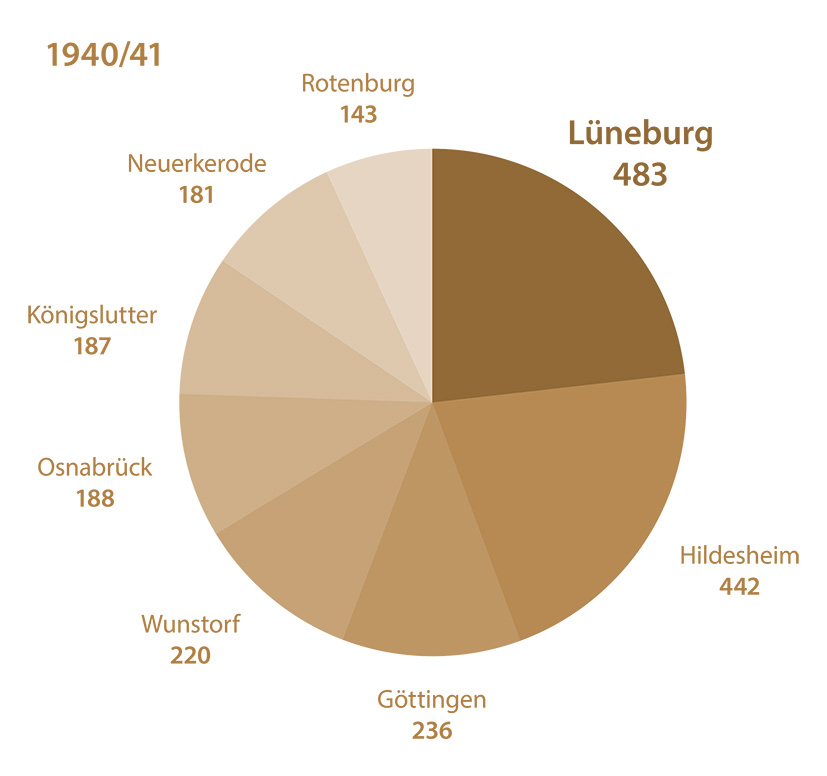
In total, more than 2,000 patients from hospitals and nursing homes in the province of Hanover were transferred to »Aktion T4«. Only a few survived.
Transfers of patients from the province of Hanover in 1941.
Most institutions in the province of Hanover transferred fewer than 200 patients on average. A total of 483 patients were transferred from the Lüneburg mental hospital to the »T4« institutions. That was more than twice as many as from almost all other institutions in the province of Hanover. The reason for this was that in the spring of 1941, 476 patients were to be transferred from the Langenhorn institution in Hamburg to Lüneburg, and free beds were needed.
In 1939, Lüneburg’s urban planning did not initially envisage the expansion of Lüneburg into the »Gaustadt«. The Lüneburg institution and nursing home was still untouched in the legend (number 7). That changed between 1939 and 1941.
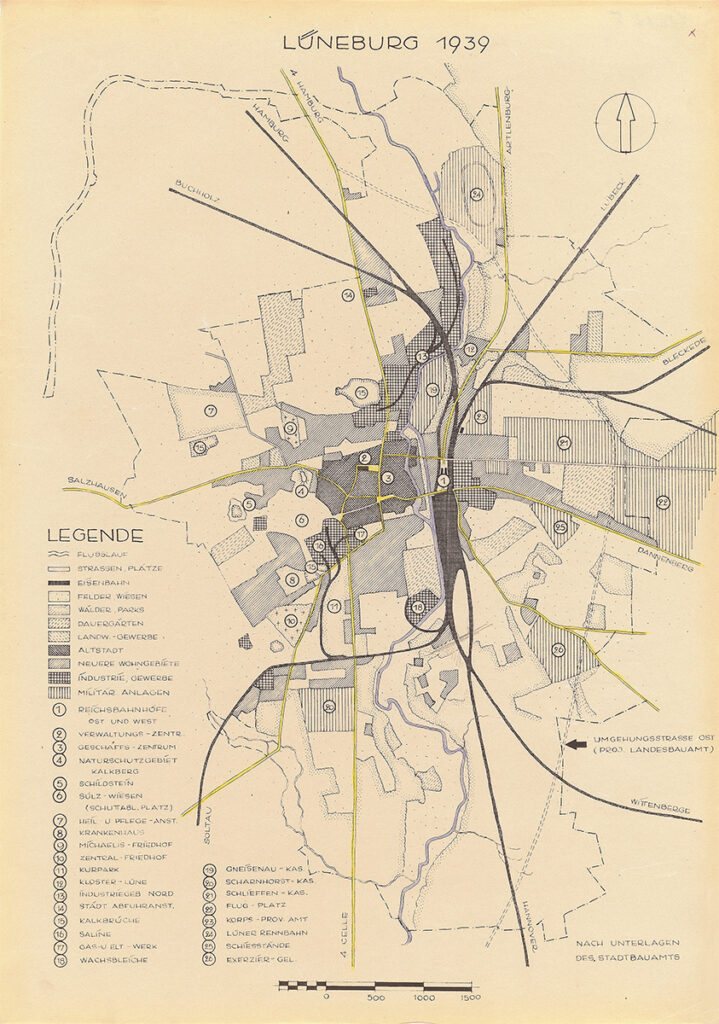
Lüneburg 1939, Pinnekamp Collection, from: Werner Preuß: Urban development and architecture. Lüneburg in the 20th century, Husum 2001, p. 73.
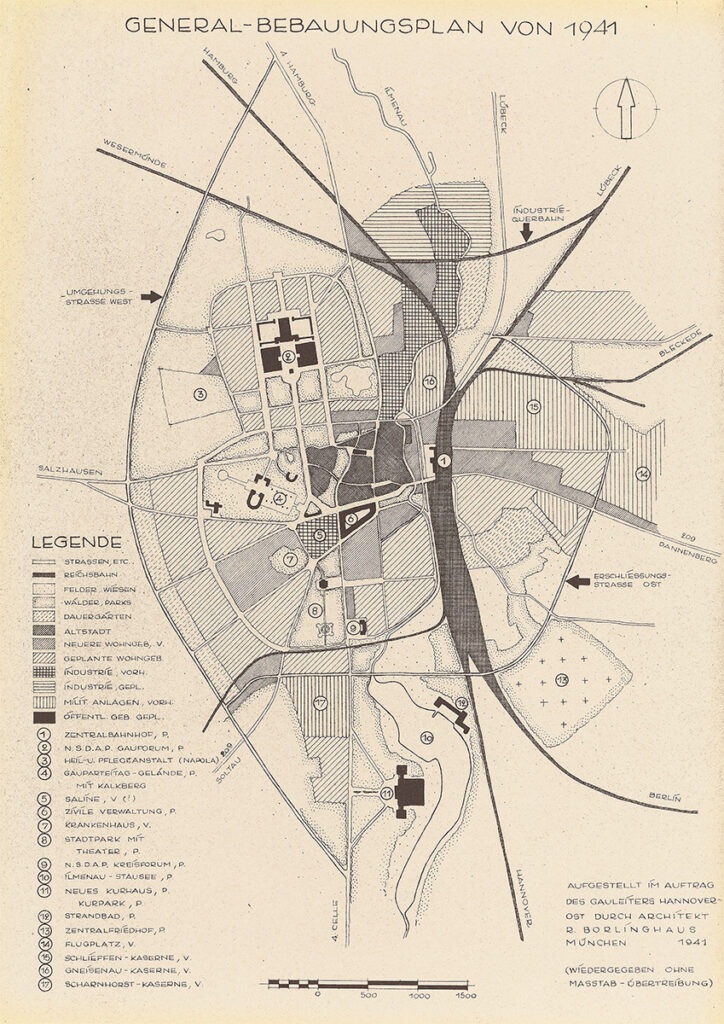
Lüneburg 1939, Pinnekamp Collection, from: Werner Preuß: Urban development and architecture. Lüneburg in the 20th century, Husum 2001, p. 74.
The general development plan from 1941 shows that a gigantic Gauforum was planned to the north-east of the Lüneburg institution and nursing home, which would have been more than four times the size of the grounds of the institution and nursing home. A party conference centre was to be built to the south of the asylum. A »National Political State Institution« (NAPOLA) was planned for the use of the institution and nursing home.
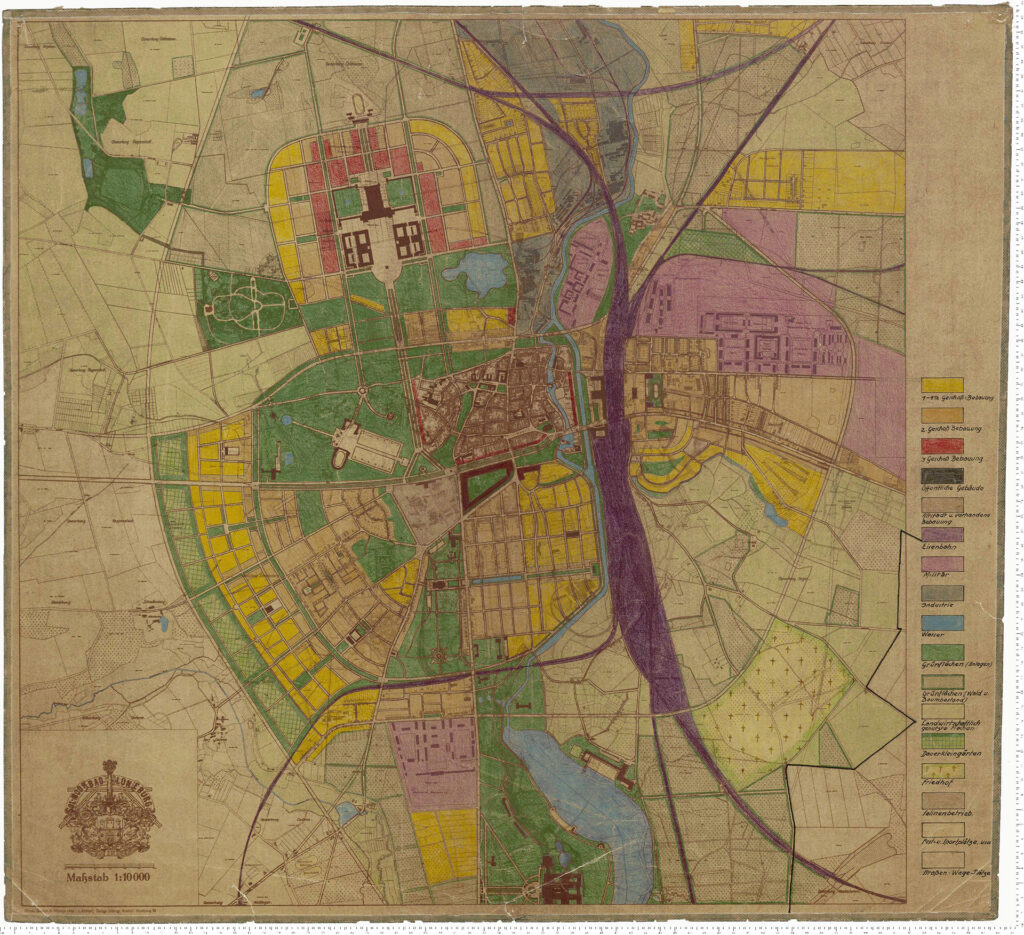
Map of Lüneburg with markings indicating planned Nazi buildings, circa 1941.
StadtALg K 10-H-6-1.
The institution was to fall victim to Lüneburg’s expansion to become the Gau capital. Max Bräuner prevented this.
In addition to using the institution for a NAPOLA, there are also said to have been plans to move an SS training centre or barracks into the institution. Parts of the Gau administration were also to be housed in the institution buildings. Max Bräuner was able to avert the closure of the institution and nursing home by setting up a »Specialised children’s ward«.
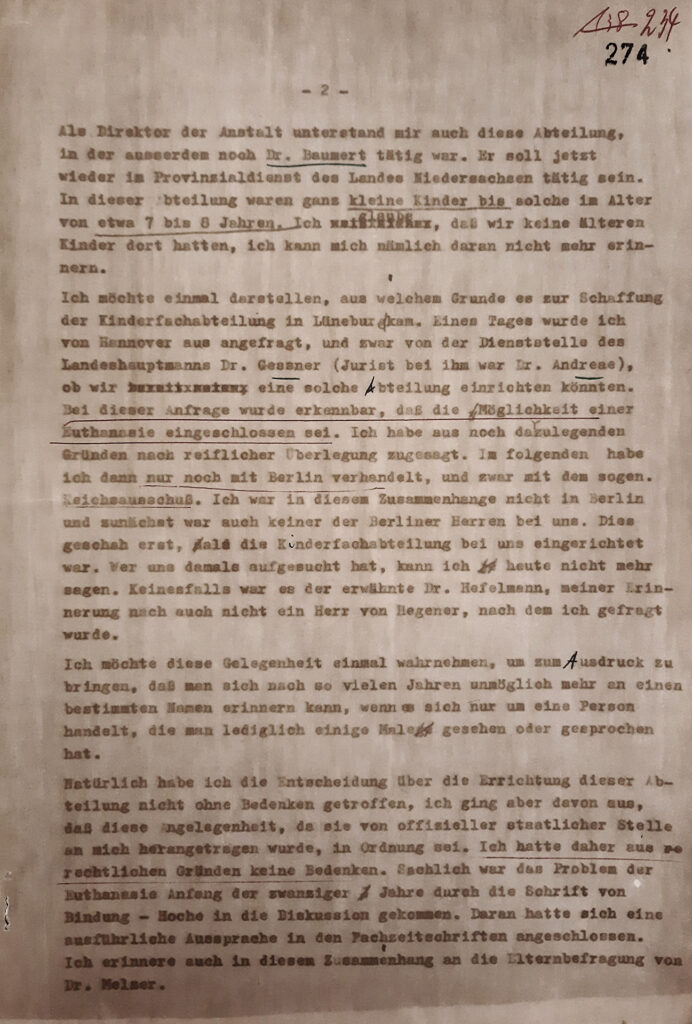
Extract from a statement by Max Bräuner dated 30 November 1961.
NLA Hannover Nds. 721 Lüneburg Acc. 8/98 Nr. 3.
»All this has now persuaded me to accept the Reich Committee’s proposal to set up a specialised children’s department. In this way at least, I could count on being able to preserve the institution for my patients.«
NLA Hannover Nds. 721 Lüneburg Acc. 8/98 Nr. 3.
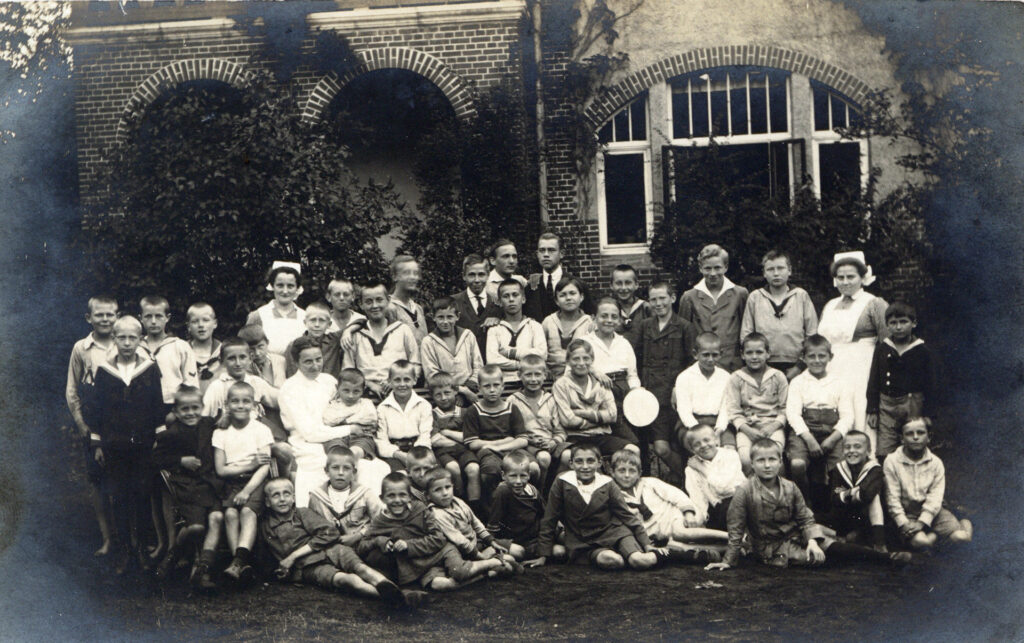
Group photo of children and young people with their carers in the holiday home on the grounds of the Lüneburg institution and nursing home, 26.7.1920.
ArEGL 118.
There were already facilities for the establishment of a »Children’s special wards«. By the summer of 1920, individual buildings were already being used for a »Holiday home« for children. In spring 1922, a »Children’s holiday home« was set up in houses 12, 14, 16, 20 and 26. It was run by the Landesverein für Volkswohlfahrt Hannover. Priority was given to children from the province of Hanover. Medical care for the children was provided by the first senior physician of the institution and nursing home.
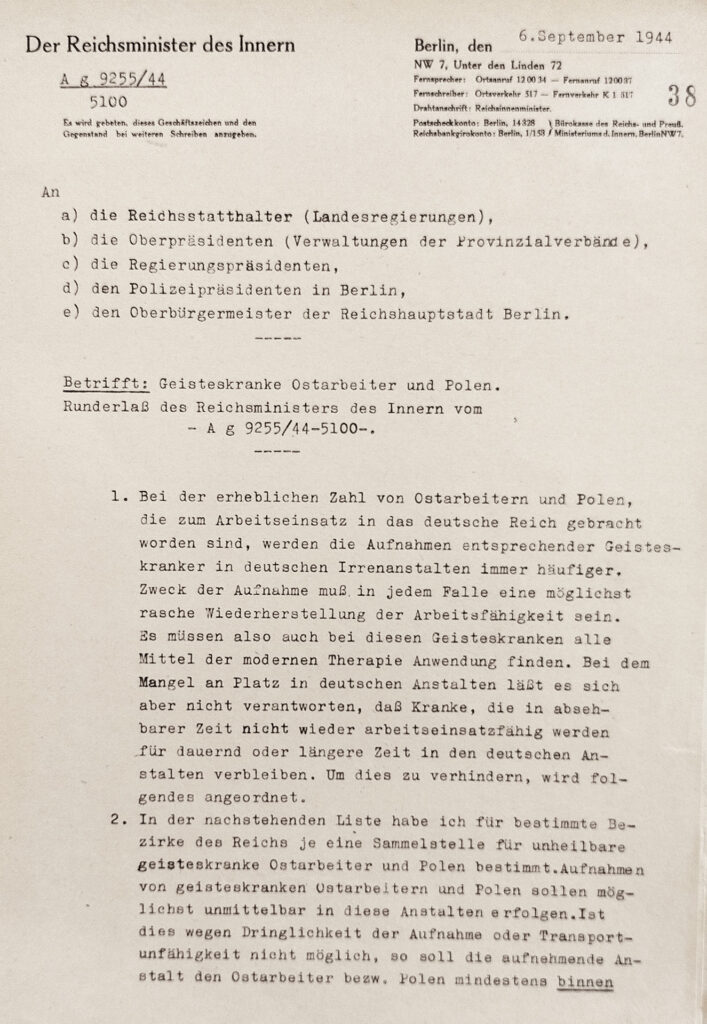
Excerpt from the circular of the Reich Minister of the Interior dated 6 September 1944.
BArch R 1501/3768.
Because the Lüneburg institution and nursing home had experience in the selection and murder of patients through the »Children’s special wards«, it was later suitable as one of eleven »collection centres for mentally ill Eastern workers and Poles« (»foreigners’ collection centre«). In addition, there were already many patients of foreign origin in the Lüneburg institution and nursing home. They were housed in separate wards from 1943 onwards.
