WHO TOOK PART?

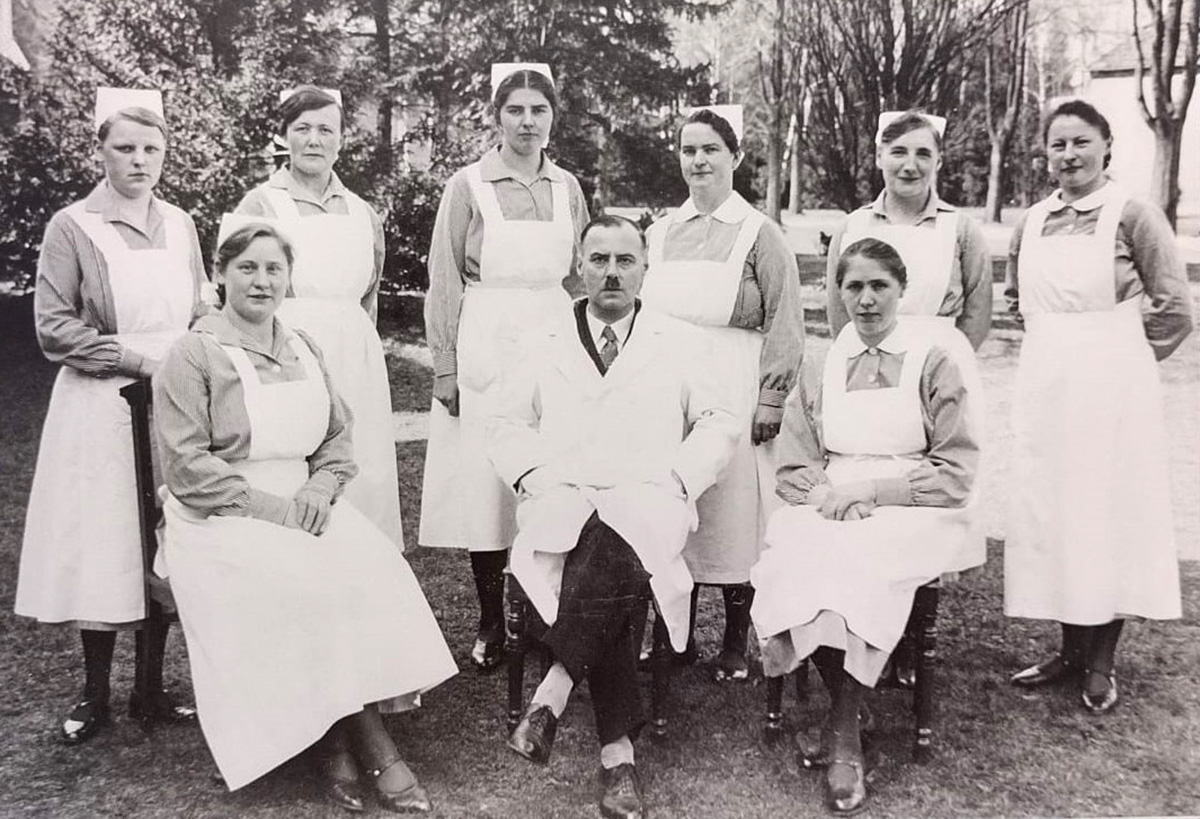
It is a black-and-white group photo. Max Bräuner is sitting in the middle. He has a Hitler moustache and his dark hair is combed back. He is wearing a white doctor's coat, underneath which a white shirt, tie and dark waistcoat are visible. He has his legs crossed. He is wearing black lace-up shoes and white socks. His hands are hidden in the pockets of his coat. To his right and left sit two uniformed nurses wearing striped blouses, white aprons and white caps. They have their legs crossed and their hands folded in their laps. Behind them and Max Bräuner stand six more nurses in the same uniform. They look seriously into the camera, with only one nurse smiling slightly. The photo was taken outdoors.
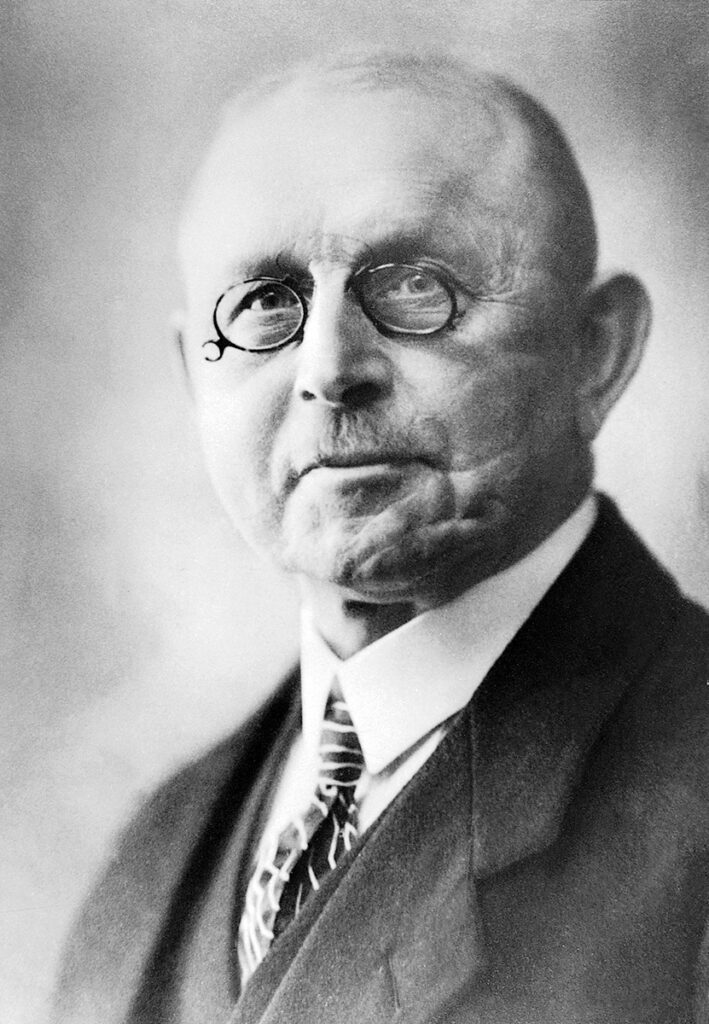
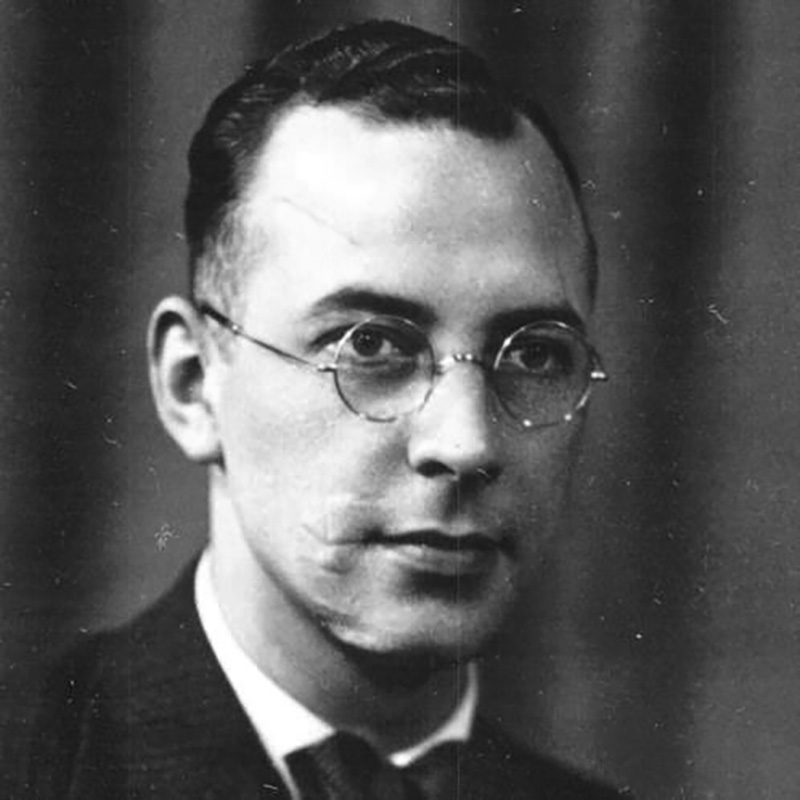
It is a black-and-white portrait of Heinrich Behr. He has a trimmed moustache and wears rimless nickel-rimmed glasses. He is wearing a dark suit, shirt and striped tie. He has hardly any hair left. His face is furrowed by two scars.

Heinrich Behr, around 1924.

ArEGL.

HEINRICH BEHR
(1871 – 1938)
Heinrich Behr came from Celle. He studied in Göttingen. In 1902, he applied to the Lüneburg sanatorium and nursing home to work there as an assistant doctor. A year later, he was promoted to 4th doctor. He was given an official flat on the grounds of the institution. In addition to his work, he published scientific papers on dementia. This made him interesting for a managerial position at the Langenhagen mental hospital in Hanover in 1904. However, Otto Snell refused to let him go and promoted him to 3rd doctor in 1905. The promotion was revoked after an incident in 1907 in which Behr became violent. Behr then applied for the post of 1st senior physician in Langenhagen and became deputy director there in 1908.

In the meantime, Heinrich Behr had married his wife Marie (née Henkel). Three children were born in 1905, 1906 and 1908: Liselotte, Heinrich and Gertrud.

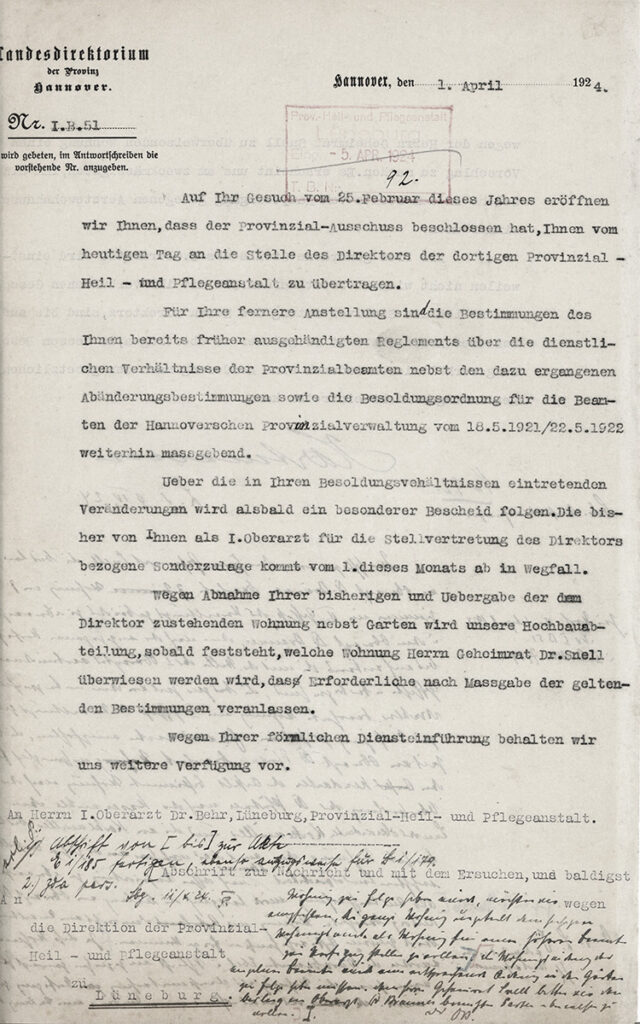
The Behr family returned to Lüneburg on 1 April 1919, when Behr was also able to become the first senior physician there. Once again, they moved into a flat with a garden on the grounds. On 1 April 1924, Heinrich Behr became Medical Director of the Lüneburg Sanatorium and Nursing Home. Max Bräuner became his deputy.

From 1934, Heinrich Behr was involved in »hereditary biology registration« and reported sick people for sterilisation. However, he refrained from being seconded to the hereditary health court in Lüneburg. After suffering several heart attacks in the summer of 1935, he was declared unfit for duty and took early retirement at the end of the year. He had to vacate his official residence before the end of his service and moved to Am Werder 17. He died two years later, in January 1938, his wife in February 1947.

It is a yellowed piece of paper with the letterhead of the provincial directorate. The text of the letter is typed on a typewriter. There is a handwritten note in the lower third of the paper. A red receipt stamp confirms that the letter was delivered on 5 April 1924.

Letter from the Provincial Directorate of Hanover to the Lüneburg Mental Hospital dated 1 April 1924.

ArEGL.

CLARA SCHMIDT
(1891 – 1969)
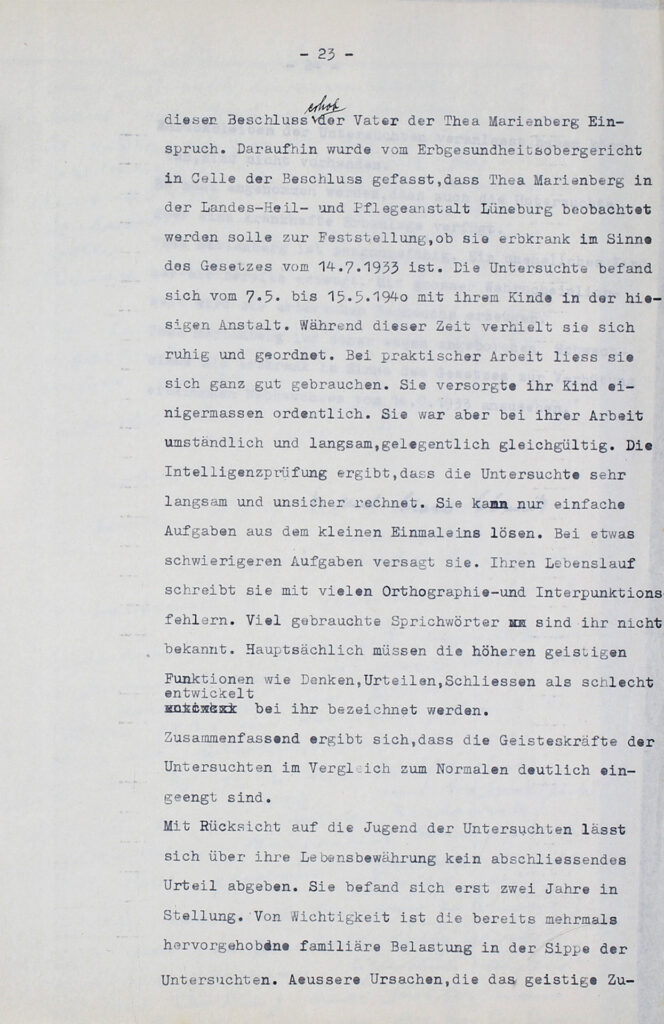
Clara Schmidt came from Stettin. Her parents were Heinrich and Emilie Schmidt. She studied medicine in the 1910s. She was one of the few female doctors in sanatoriums and nursing homes and worked at the Königslutter institution in 1928. Four years later, she moved to Göttingen and Osnabrück. On 1 July 1939, she began working at the Lüneburg sanatorium and nursing home. In May 1942, she was transferred to Osnabrück and returned to Lüneburg after a year. She lived on the grounds of the institution until 1954 and then moved into a flat in Heinrich-Heine-Straße in Lüneburg. She died there on 31 March 1969, remained unmarried and had no children.

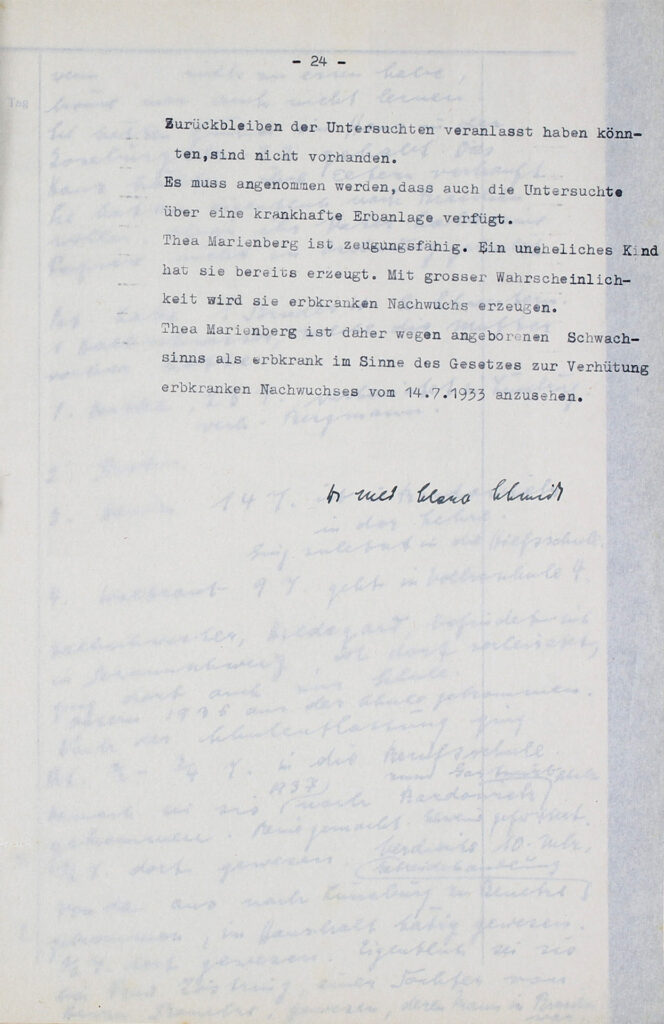
Clara Schmidt examined women and men for the Hereditary Health Court in Lüneburg and the Higher Hereditary Health Court in Celle. She recommended preventive sterilisation without any legal basis. She also selected the sick for »planned economic transfers« to »Aktion T4«. At weekends, she was on duty in the »Children’s special wards«. After the end of the war, numerous adult patients died under her medical care due to inadequate and insufficient care. After Max Bräuner was decommissioned, she took over the management of the »Children’s special wards«. She was given early retirement in June 1946. She was never questioned about her involvement in the crimes.

Expert opinion for the Higher Hereditary Health Court of Celle [extract] on Thea Marienberg dated 29 May 1940, pp. 23 and 24.

NLA Hannover Hann. 155 Lüneburg Acc. 2004/066 Nr. 09169.

WILLI BAUMERT (1909 – 1984)
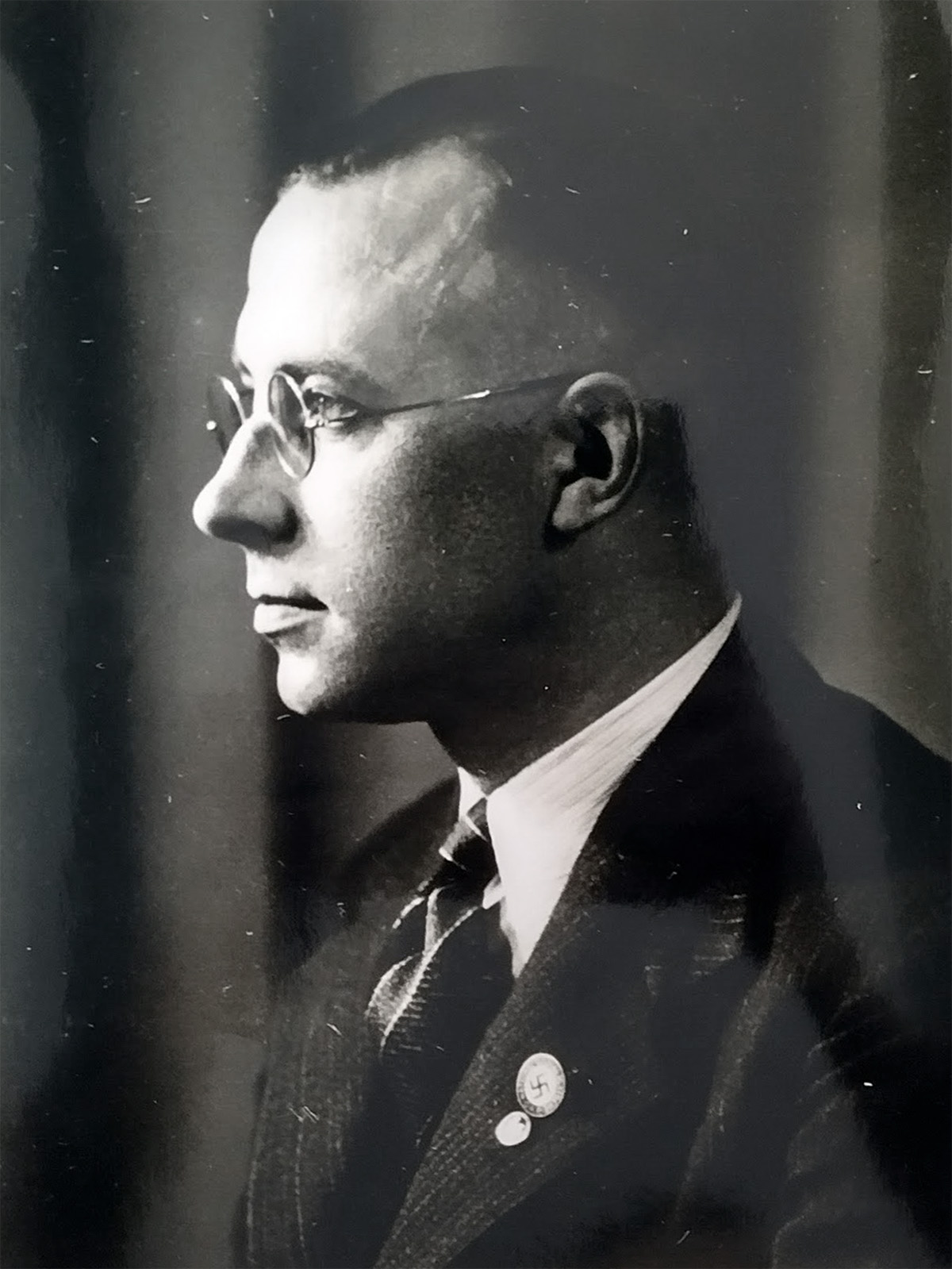
It is a black-and-white portrait of Willi Baumert. He is sitting sideways to the camera and looking out of the picture to the left. He is wearing a dark suit with a light-coloured shirt and tie. On his lapel he wears the NSDAP party badge with a swastika. He has dark, short hair combed back and wears nickel-rimmed glasses.

Rudolf Redepenning (left) with his wife Lili and their eight grown-up children, November 1943.

Kopie ArEGL.

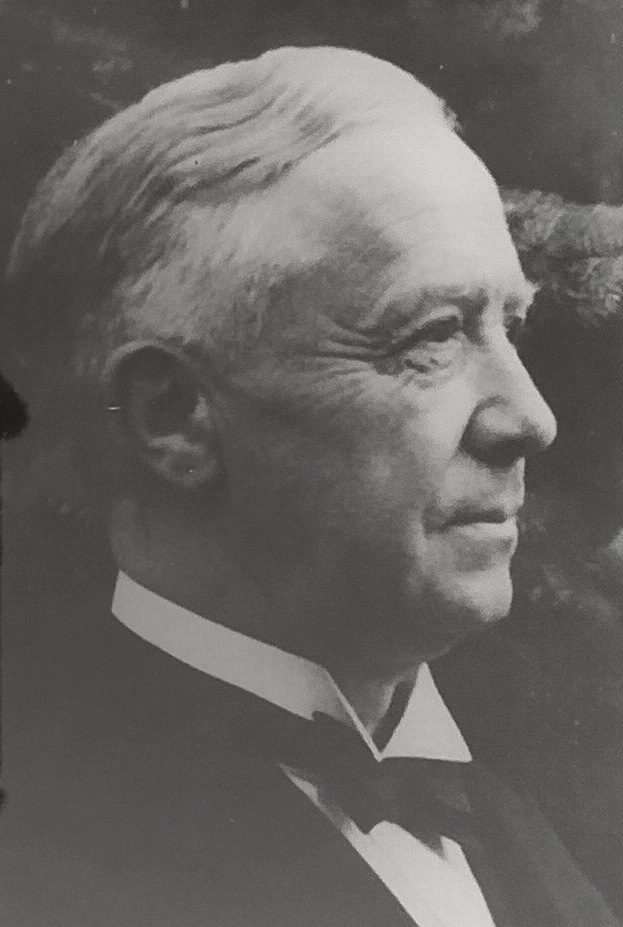
RUDOLF REDEPENNING (1883 – 1967)

Rudolf Redepenning from Wiedensahl was senior physician at the Provinzial-Erziehungsheim from 1913 and medical director of the Provinzial- Heil- und Erziehungsanstalt Göttingen from 1927. From there he moved to the »Volksnervenheilstätte« near Göttingen in 1930. He converted to Catholicism in 1920 and was active in the Centre Party. This and his criticism of the NSDAP led to him losing his job in 1934 due to the »Law for the Restoration of the Professional Civil Service«. In order to support his extended family with eight children, he decided to adapt to the National Socialists from then on. In 1934, he worked at the Hildesheim sanatorium and nursing home. At the beginning of 1937, he was transferred against his will to the Lüneburg sanatorium and nursing home. From 1944, he was in charge of the »foreigners’ collection point« for men there, where forced labourers and other sick people of foreign origin were murdered. Redepenning was involved in the collection centre’s transfers to death.

WILHELMINE WOLFF (1903 – 1962)

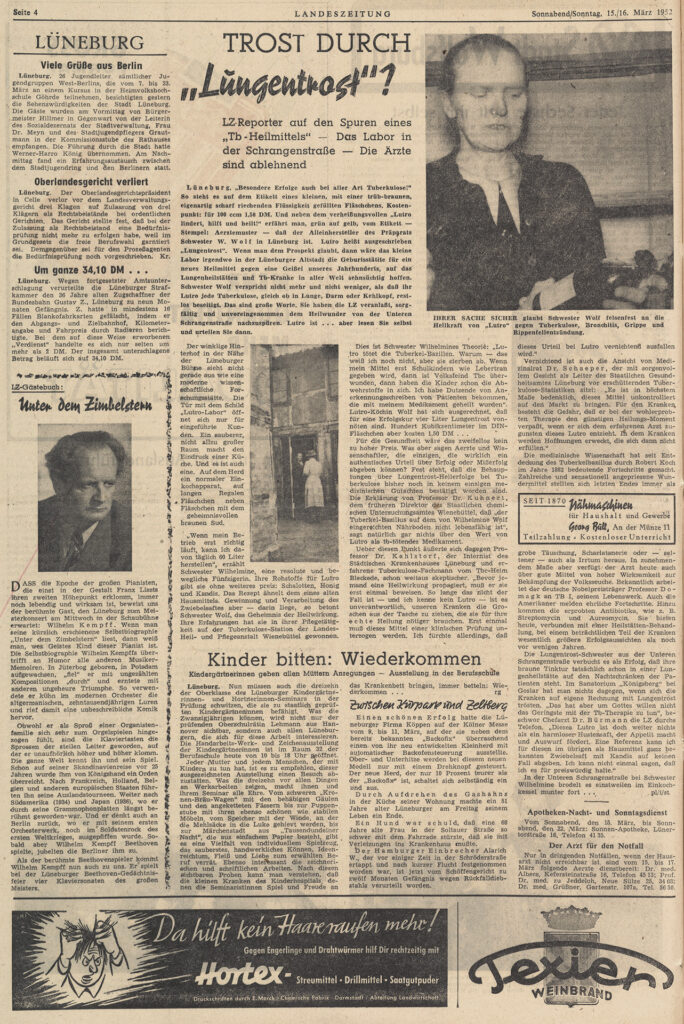
It is a four-column newspaper article that takes up almost an entire page. Two black-and-white photos are printed alongside it. The larger picture is a portrait of Wilhelmine Wolff. Her hair is tied back tightly and she is looking down. The second, smaller picture shows Wilhelmine Wolff in front of a house, offering her remedy at a door.
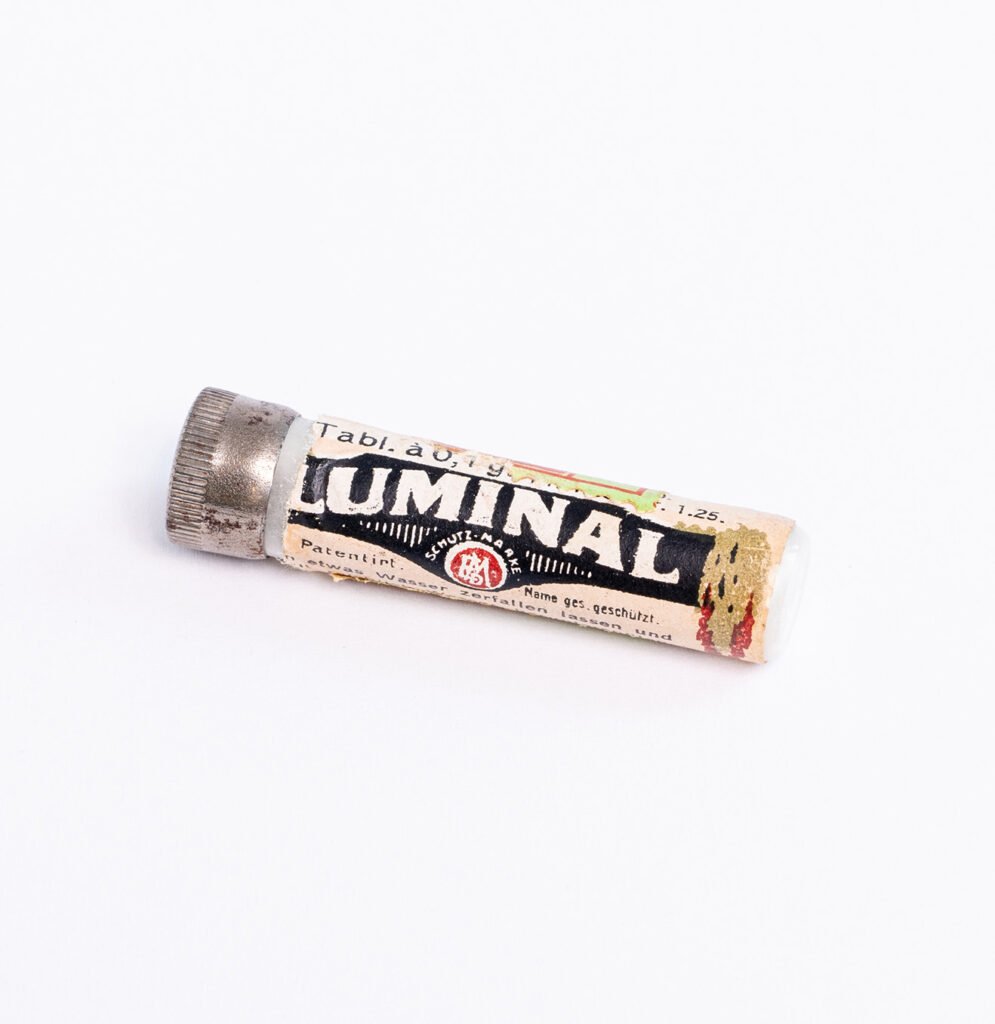
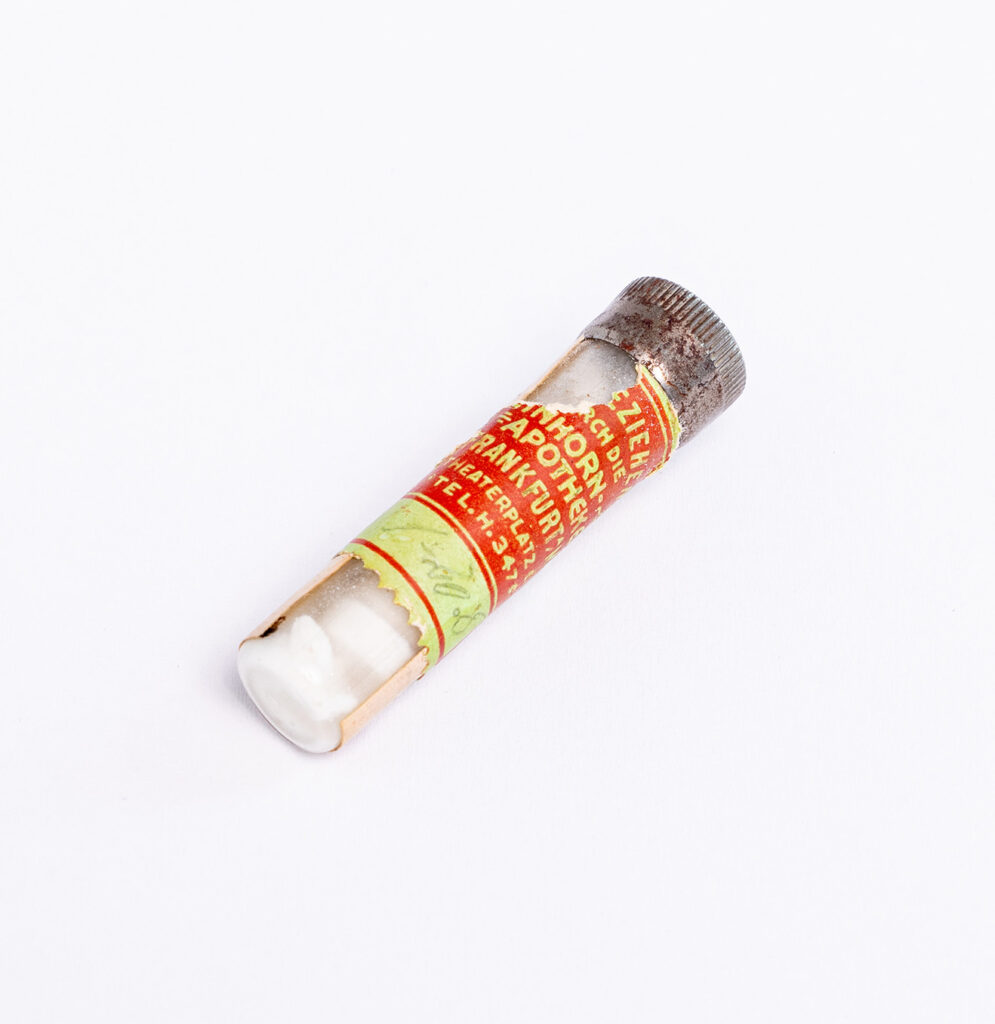
The tin is a small tube sealed with a screw cap. It has a label with large letters in white on a black background. The label reads: Tabl. a 0.1g.

DORA VOLLBRECHT (1906 – 1984)

Dora Vollbrecht came from Hanover. She was a trained and civil servant institutional carer. On 1 October 1941, she and her colleague Ingeborg Weber were seconded to the Lüneburg »Children’s department« for »Special use«. Vollbrecht decided to accept the secondment and take part in the »Euthanasia« measures. In 1942, she agreed to her permanent transfer to Lüneburg. From then on, she frequently fell ill for several months, but always dutifully returned to work. In January 1945, she was certified as being too ill for the nursing profession. It was not until October 1945 that she left the Lüneburg sanatorium and nursing home and moved to Hanover. Her actions shaped the rest of her life. She died on 29 October 1984 in Bremervörde.

back