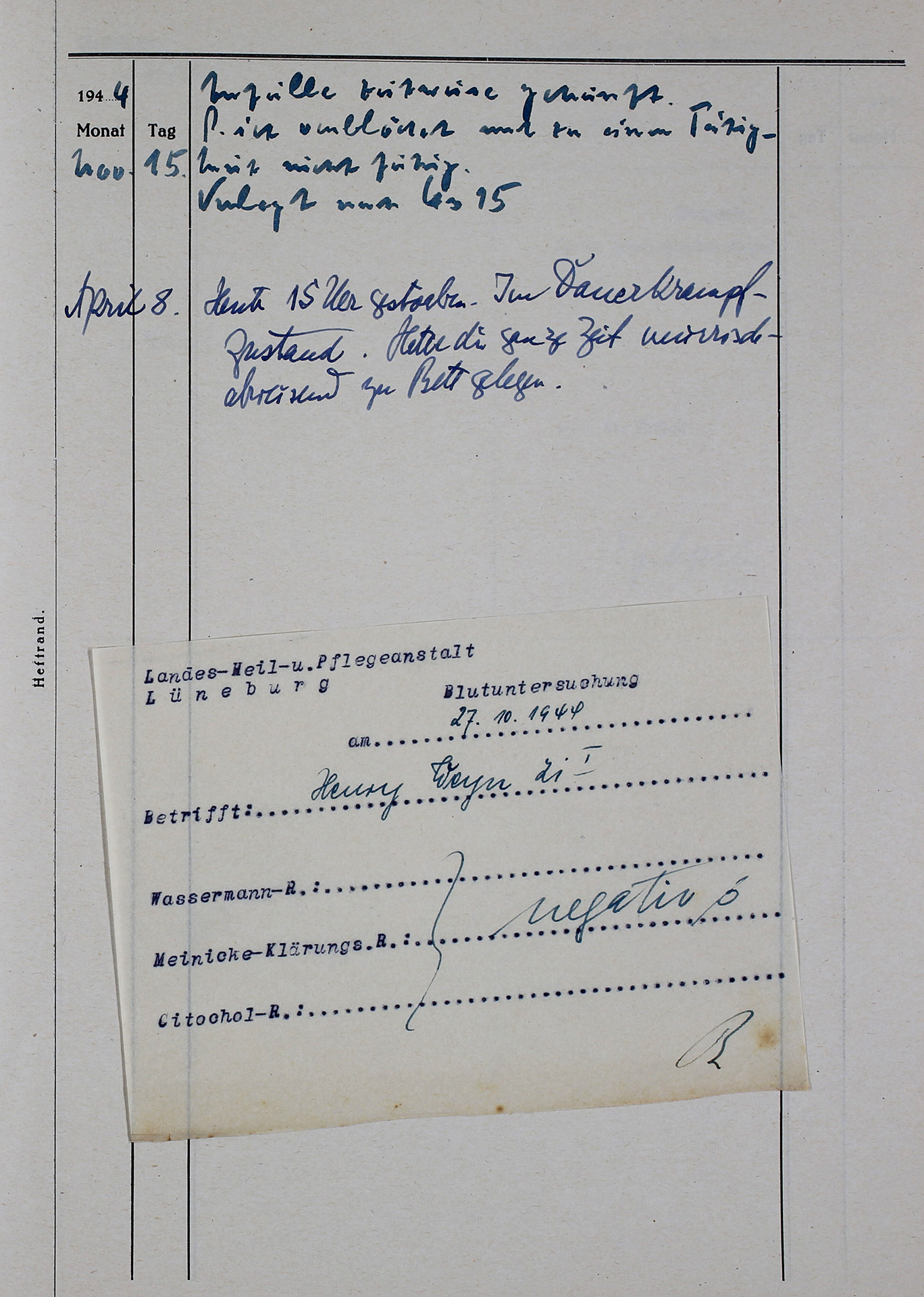
Excerpt from Henry Weyn’s medical history.
NLA Hanover Lower Saxony 330 Lüneburg Acc. 2004/134 No. 02100.
HENRY WEYN (1924 – 1945)
STEFAN LAPIKOW (1907 – 1945)
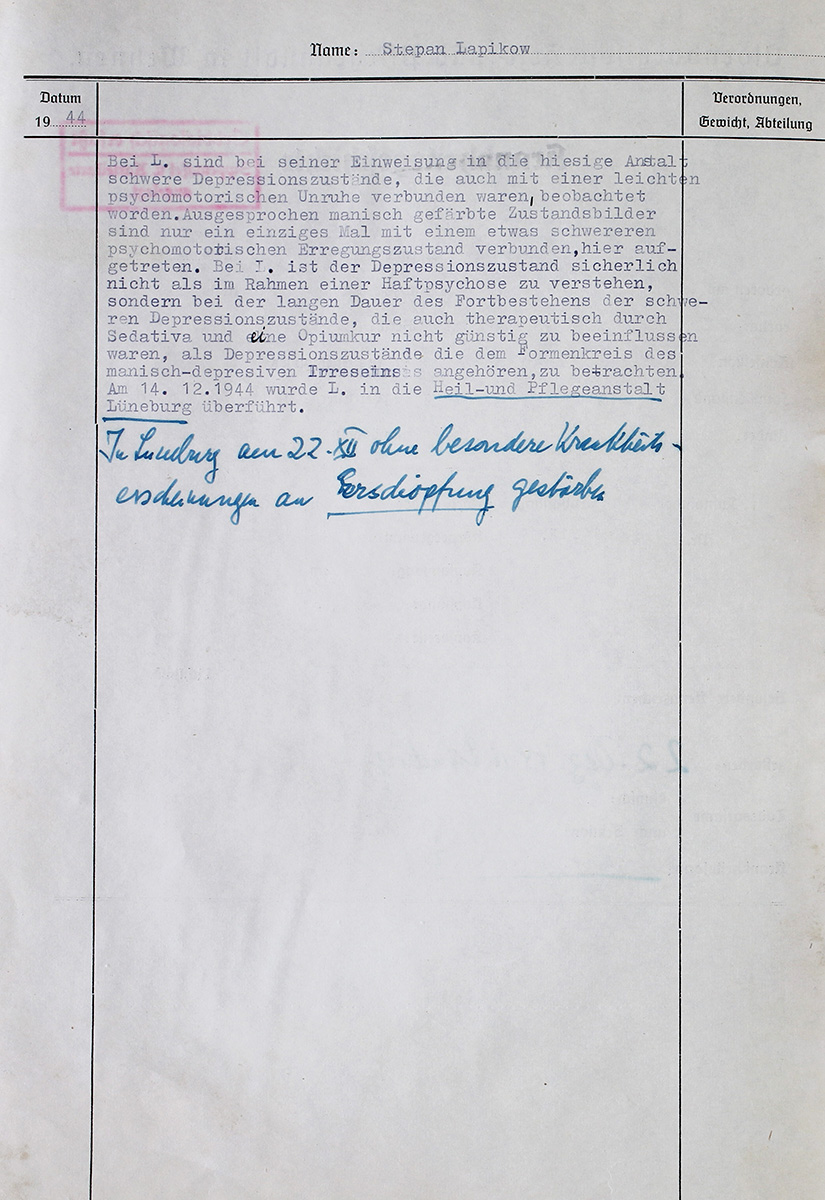
Excerpt from Stefan Lapikow’s medical history.
NLA Hanover Lower Saxony 330 Lüneburg Acc. 2004/134 No. 00683.
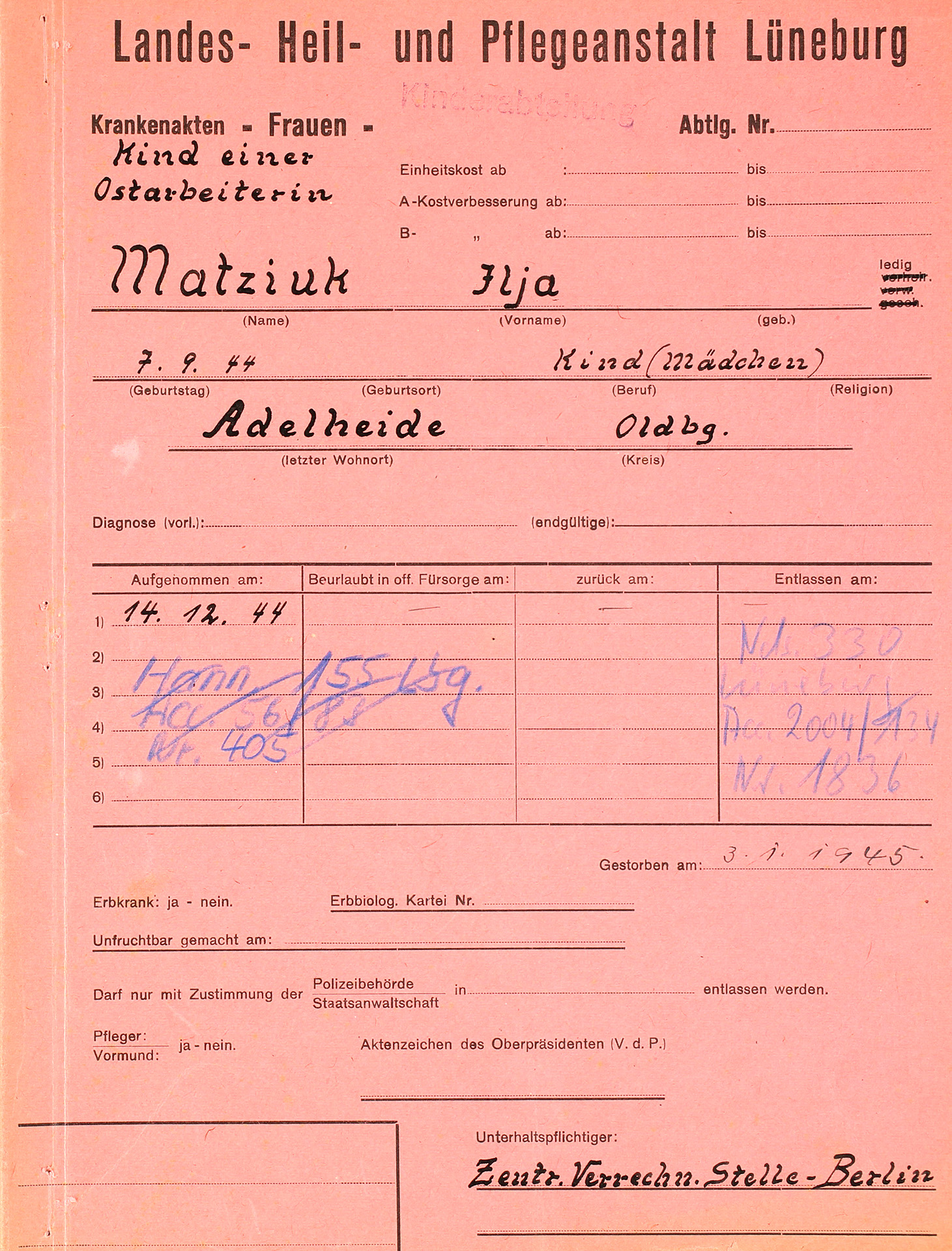
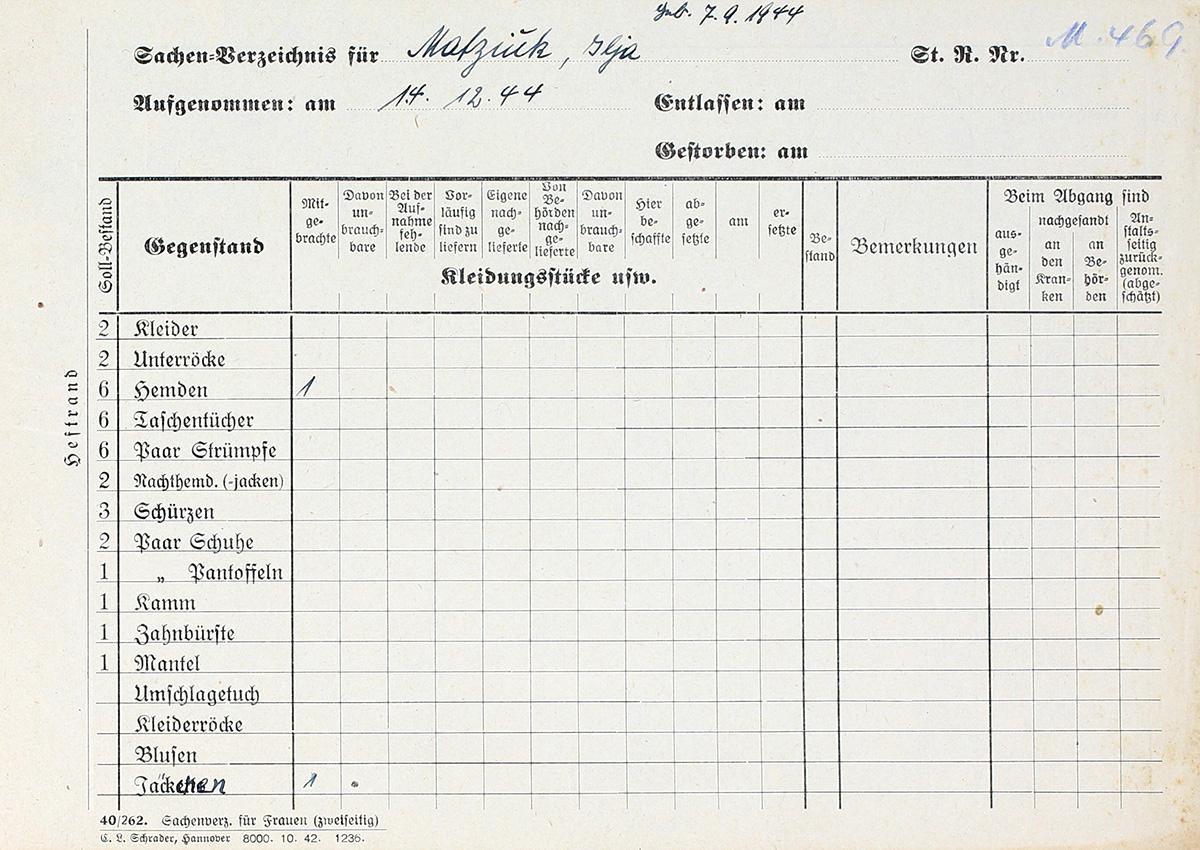
File cover and table of contents of Ilja Matziuk’s medical file, front side.
NLA Hanover Hann. 330 Lüneburg Acc. 2004/134 No. 01836.
ILJA MATZIUK (1944 – 1945)
TADEUSZ CEBULA (1927 – 1945)
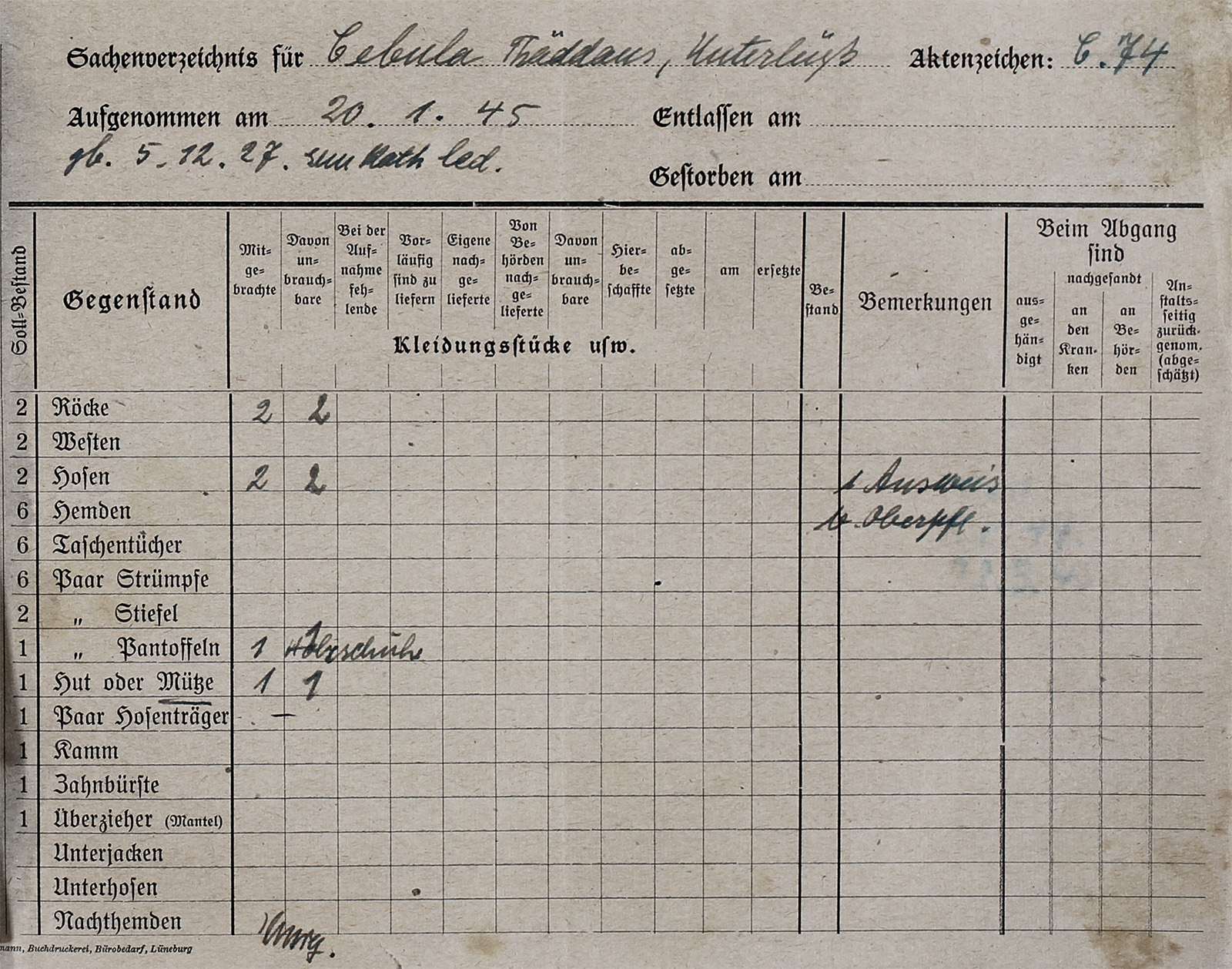
Table of contents by Tadeusz Cebula, front page.
NLA Hanover Hann. 155 Lüneburg Acc. 2004/085 No. 01701.
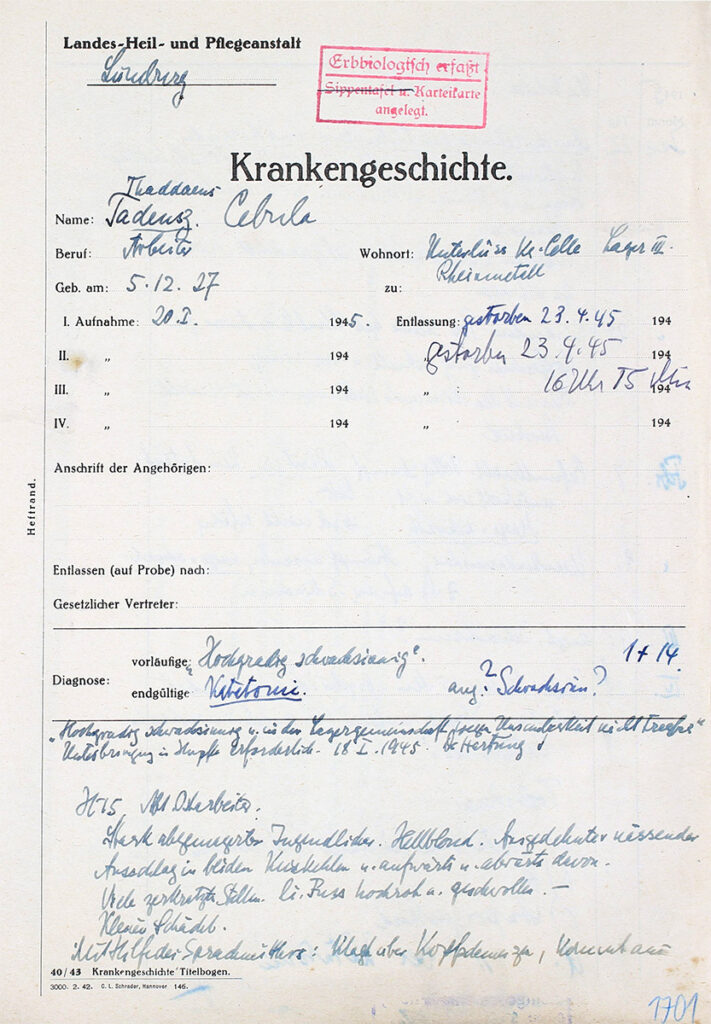
Excerpt from the medical history of Tadeusz Cebula.
NLA Hanover Hann. 155 Lüneburg Acc. 2004/085 No. 01701.
Tadeusz Cebula was severely emaciated. His file contains no references to life-saving measures, such as additional food or tube feeding. Although another Polish forced labourer was able to confirm as a translator that Tadeusz Cebula had a good school education and was very good at arithmetic, Rudolf Redepenning considered him to be »congenitally feeble-minded«. Tadeusz was denied any kind of therapy.
Tadeusz Cebula was only 17 years old when he died on 23 April 1945 in the Lüneburg sanatorium and nursing home.
KATHARINA KUNKA (1910 – 1947)
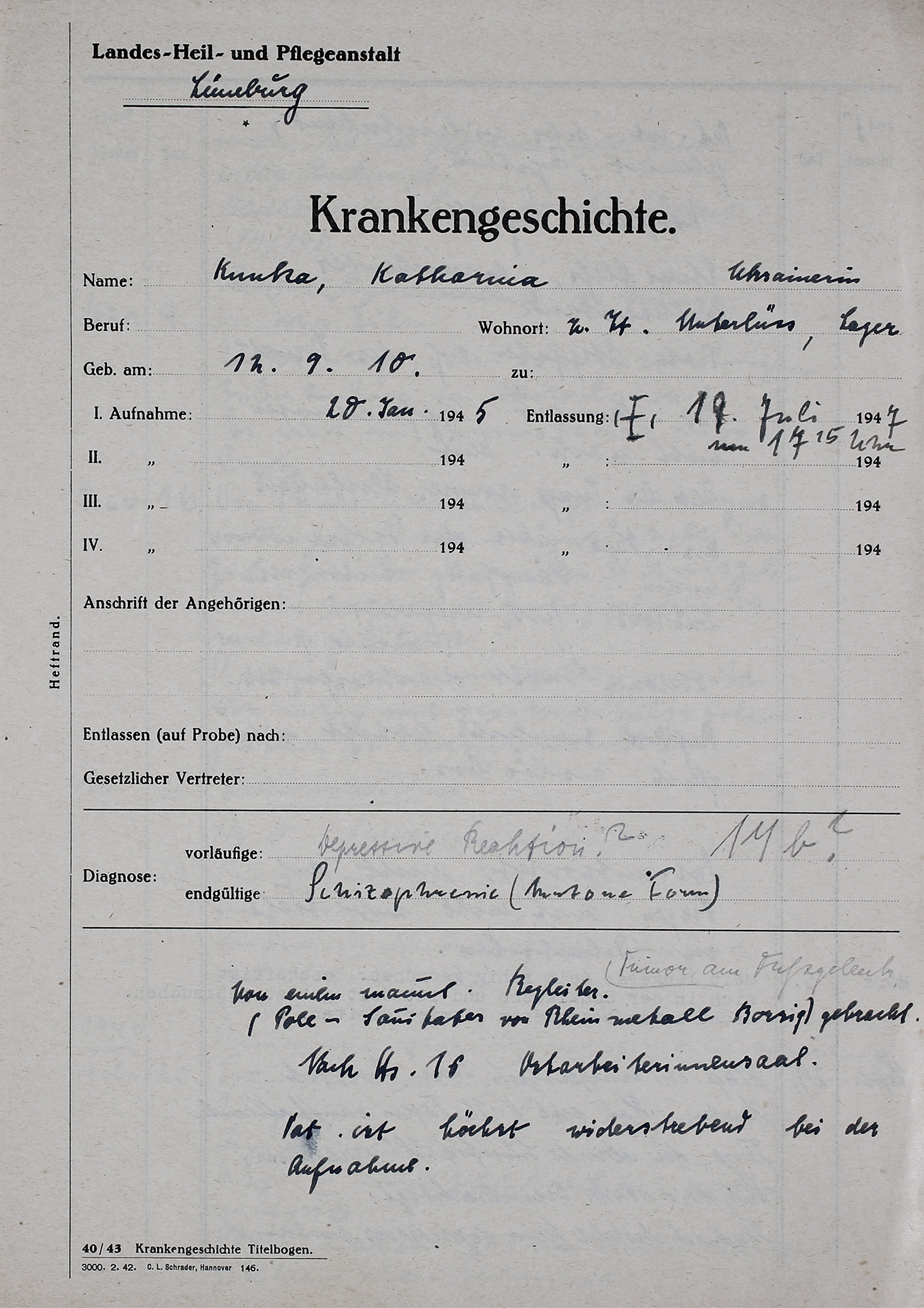
Excerpt from Katharina Kunka’s medical history.
NLA Hanover Lower Saxony 330 Lüneburg Acc. 2004/134 No. 02058.
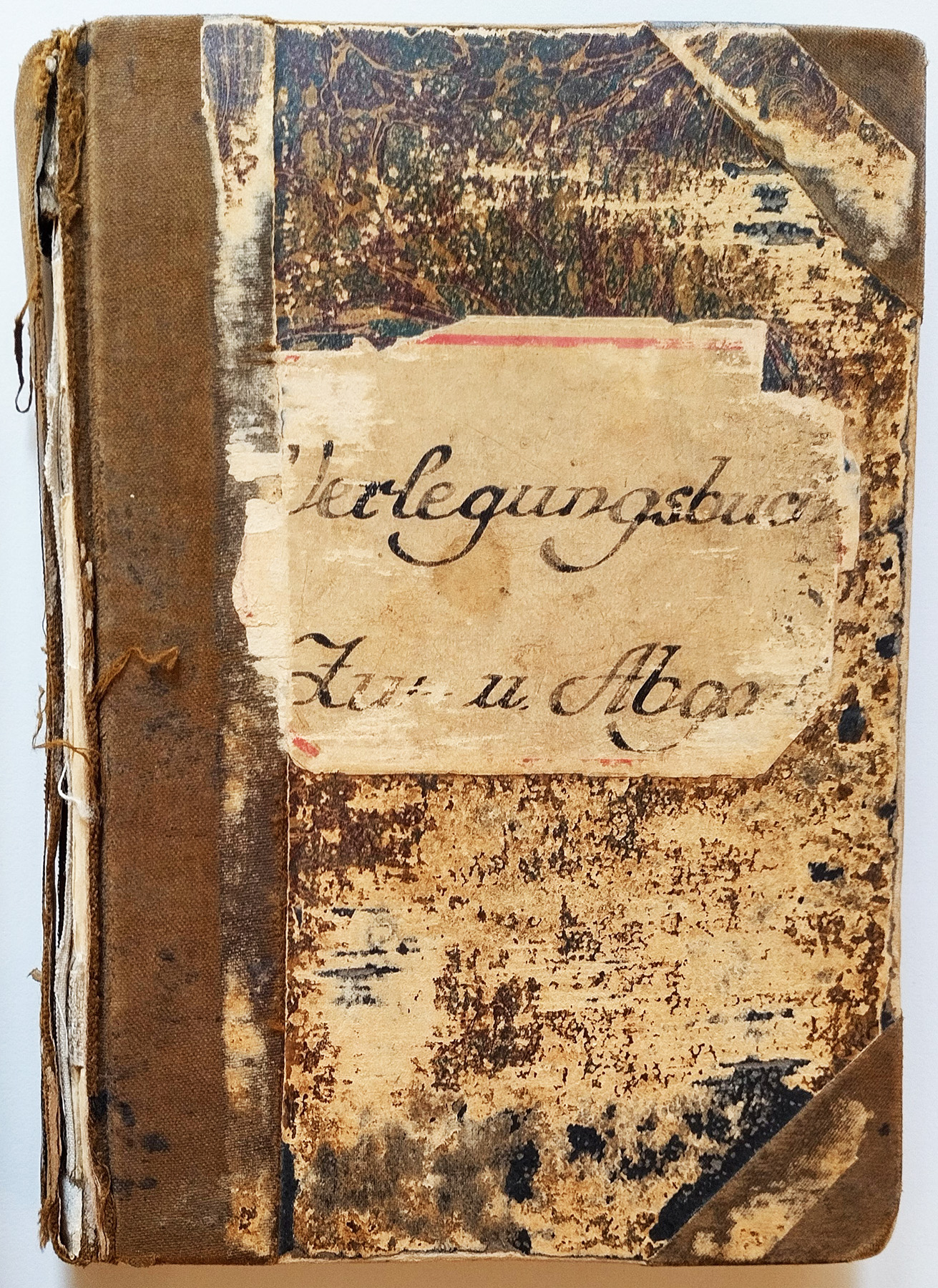
Transfer book of admissions and discharges (House 15), Lüneburg Mental Hospital, from 1 October 1930 to 23 June 1950.
ArEGL 46.
This ward register lists patients who were admitted to House 15 of the Lüneburg Mental Hospital between 1 October 1940 and 23 June 1950, or who were transferred or discharged from there. The book illustrates the various phases of »Euthanasia«. At the same time, it bears witness to the creeping habituation or brutalisation and indirect participation in disenfranchisement and violence.
Until 1941, the patients and their belongings were recorded in detail. With the beginning of »euthanasia«, only surnames were usually noted. In the spring of 1941, the collective transfers to killing centres were documented. From 1944 onwards, there are anonymous entries, such as »10 Russians«. House 15 had meanwhile become the so-called »Eastern Workers‘ Ward«. In 1945, the dead were only recorded as tally marks. On one page is the entry »20/1 | Cebula | Admission | 151«. This refers to Tadeusz Cebula.
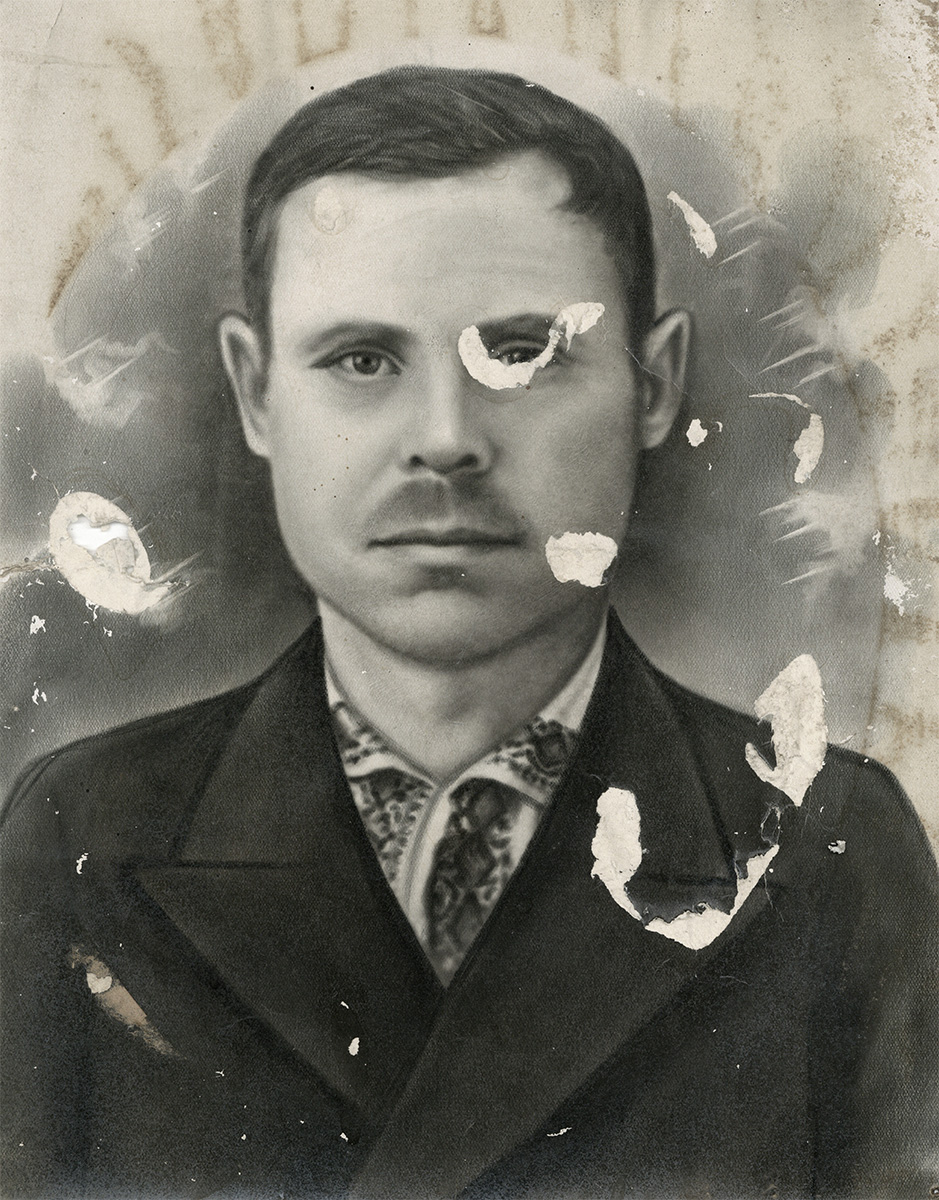

»It was impossible to reach an understanding with Sch.[nal] Sch. completely isolated himself from his own compatriots and eventually became increasingly isolated.«
NLA Hanover Lower Saxony 330 Lüneburg Acc. 2004/134 No. 00381.
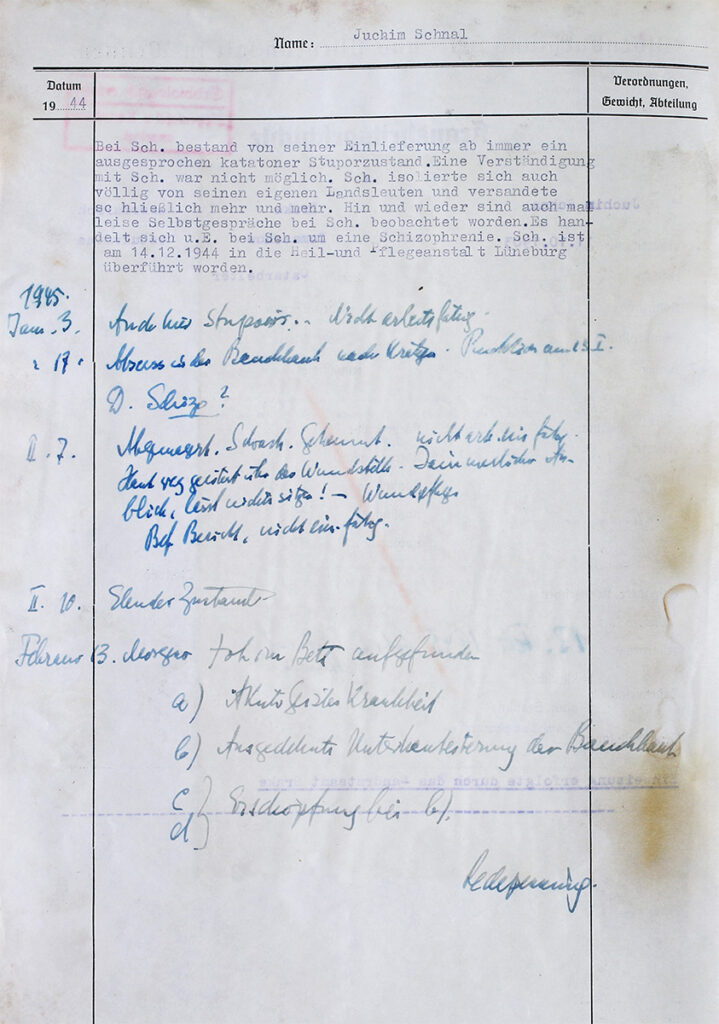
Excerpt from the medical history of Juchim Schnal.
NLA Hanover Lower Saxony 330 Lüneburg Acc. 2004/134 No. 00381.
On 14 December 1944, Juchim Schnal was transferred to the Lüneburg sanatorium. It was not until 3 January 1945 that he was examined by Rudolf Redepenning, by which time he was in a completely weakened physical condition. After that, there were only a few entries in his medical records. The choice of words used leaves no doubt as to how little regard Redepenning had for him.
»Emaciated. Weak. Inhibited. Unfit for work. Skin festering over the wound site. Pitiful sight, can’t sit still! – Wound care. Findings report, unfit for work.«
NLA Hanover Lower Saxony 330 Lüneburg Acc. 2004/134 No. 00381.
Three days later, Redepenning simply noted, »Miserable condition«. Another three days later, Juchim Schnal was dead. On the morning of 13 February 1945, he was found lifeless in his bed. The official cause of death was »exhaustion due to extensive subcutaneous oedema of the abdominal skin«. Juchim Schnal was 41 years old. He is said to have been a deeply religious man.

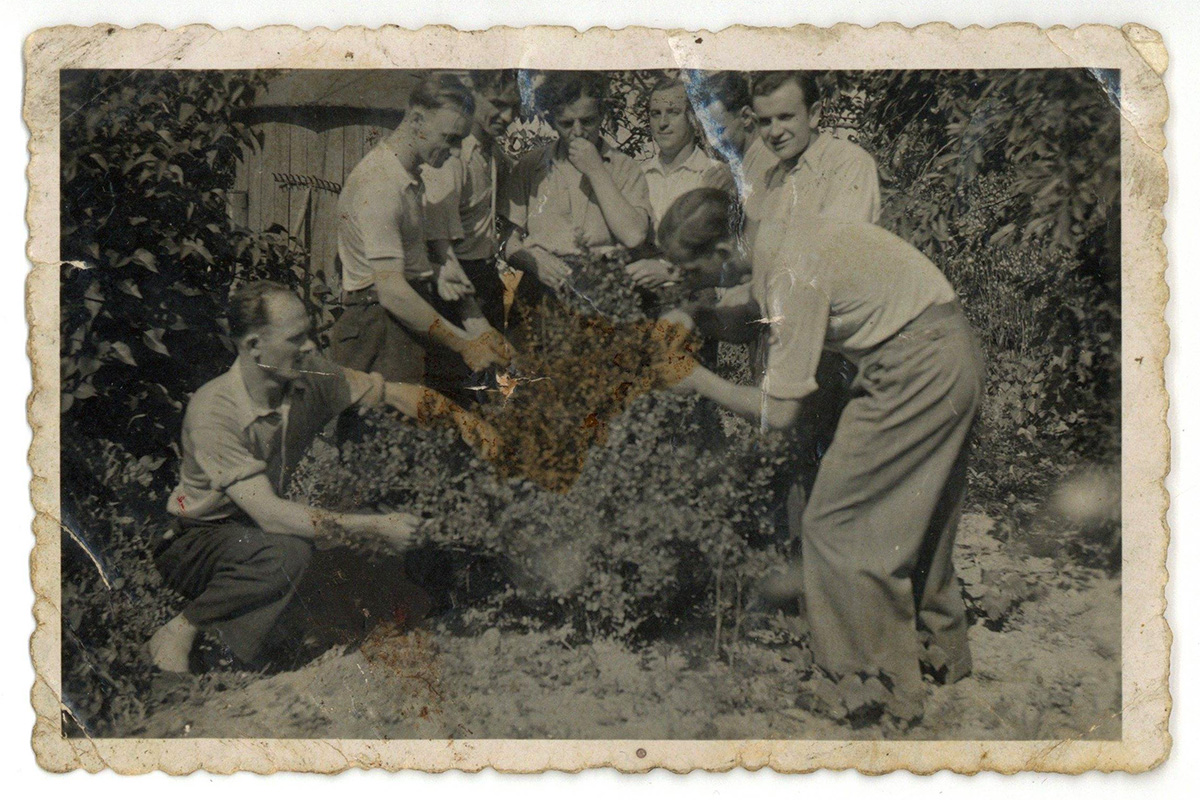
Kazimierz Wajsen (2nd from left?) with fellow forced labourers, before April 1944, Hamburg.
Private property of Magda Wajsen.
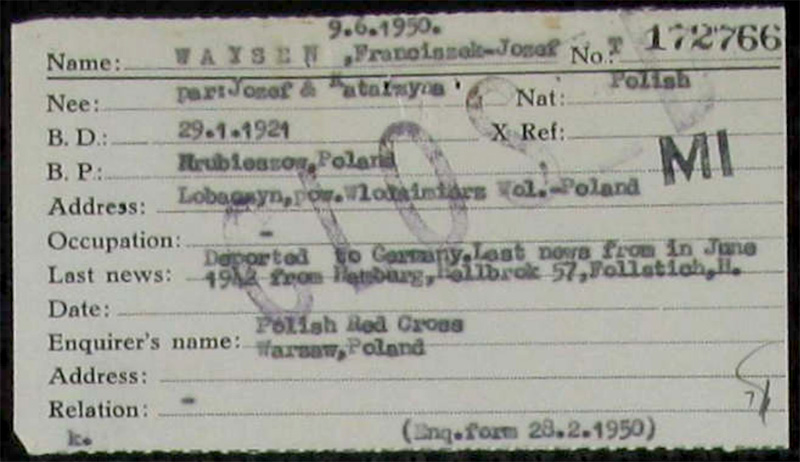
In May 1942, brothers Kazimierz and Franciszek Wajsen were deported to Hamburg for forced labour. They were sent to two different »work education camps«, Franciszek for attempting to escape and his brother Kazimierz for »illegal gatherings«. Kazimierz survived the Neuengamme concentration camp and was liberated in May 1945 on the ship »Athen«.
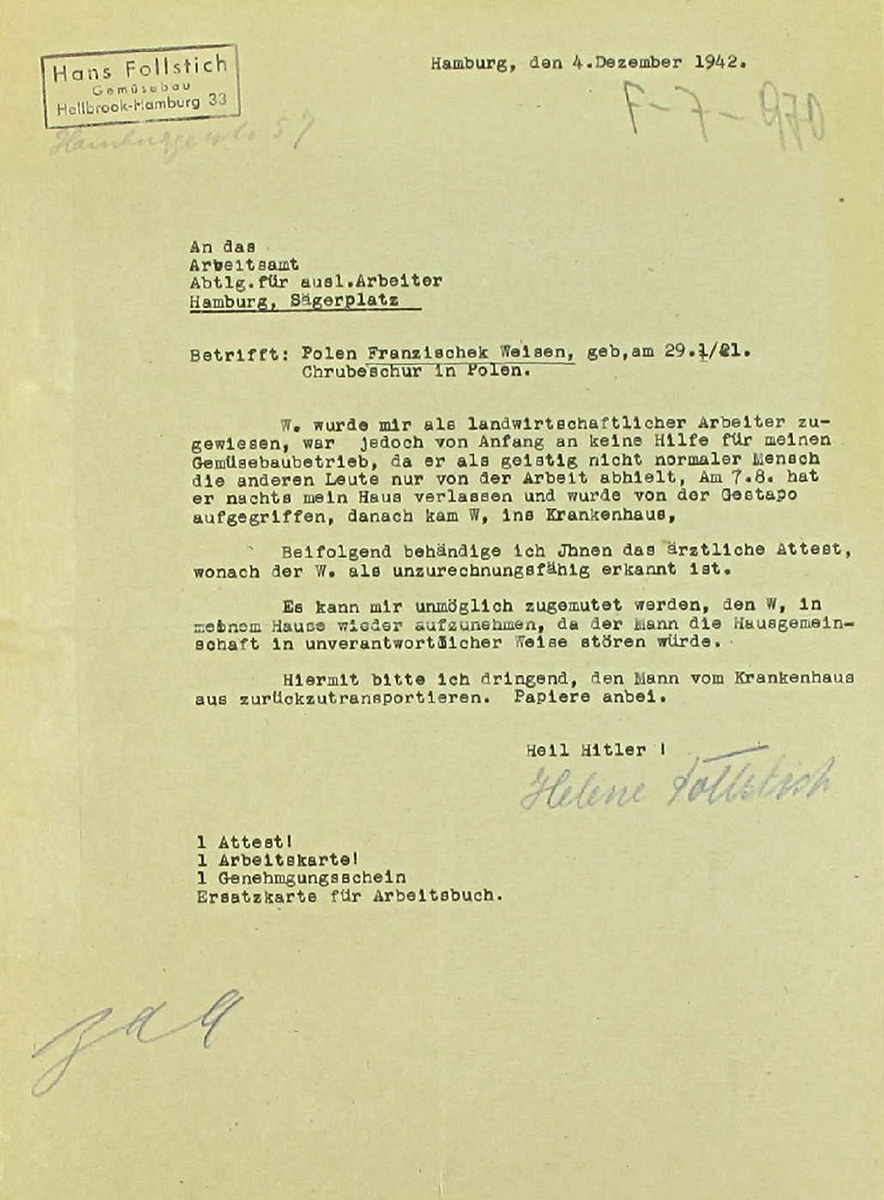
Letter from Hans Follstich to the Hamburg Employment Office dated 4 December 1942.
Arolsen Archives.
Franciszek Wajsen was unable to withstand the strain of forced labour. He was picked up by the Gestapo and admitted to the psychiatric ward of the University Medical Centre Hamburg-Eppendorf on 2 September 1942. Because he was classified as »unfit for work« and the company did not want him back, the employment office approved the doctor’s recommendation that he return home. But he did not return.
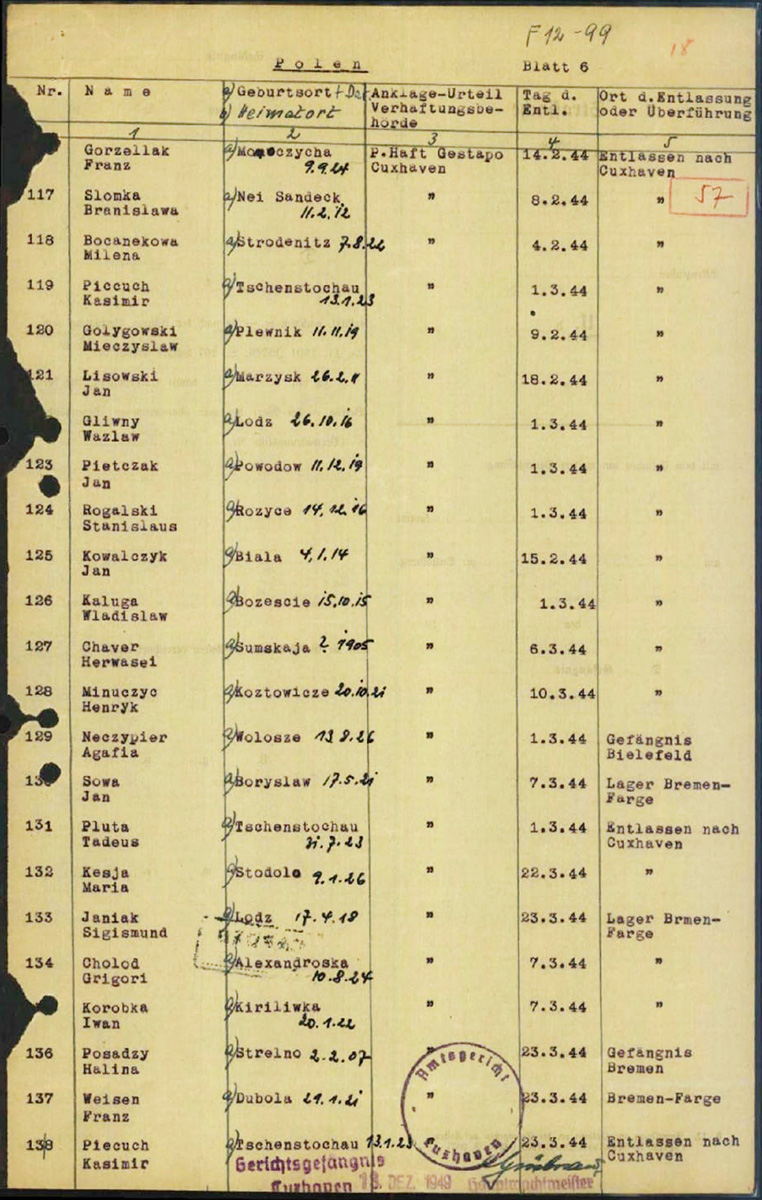
List of Polish forced labourers who were transferred from the Cuxhaven court prison to other places of detention, 1944.
Arolsen Archives.
In December 1943, Franciszek worked for a farmer in Greversdorf-Oste. In March 1944, he was released from Cuxhaven court prison to Gestapo custody in the Bremen-Farge »work education camp« due to the risk of him fleeing. From there, he was transferred to the Lüneburg mental hospital on 26 June 1944. Franciszek’s mother, Katarzyna Wajsen, fled with Stanisław to Warsaw. She left her husband behind. Józef is said to have gone to Germany afterwards.
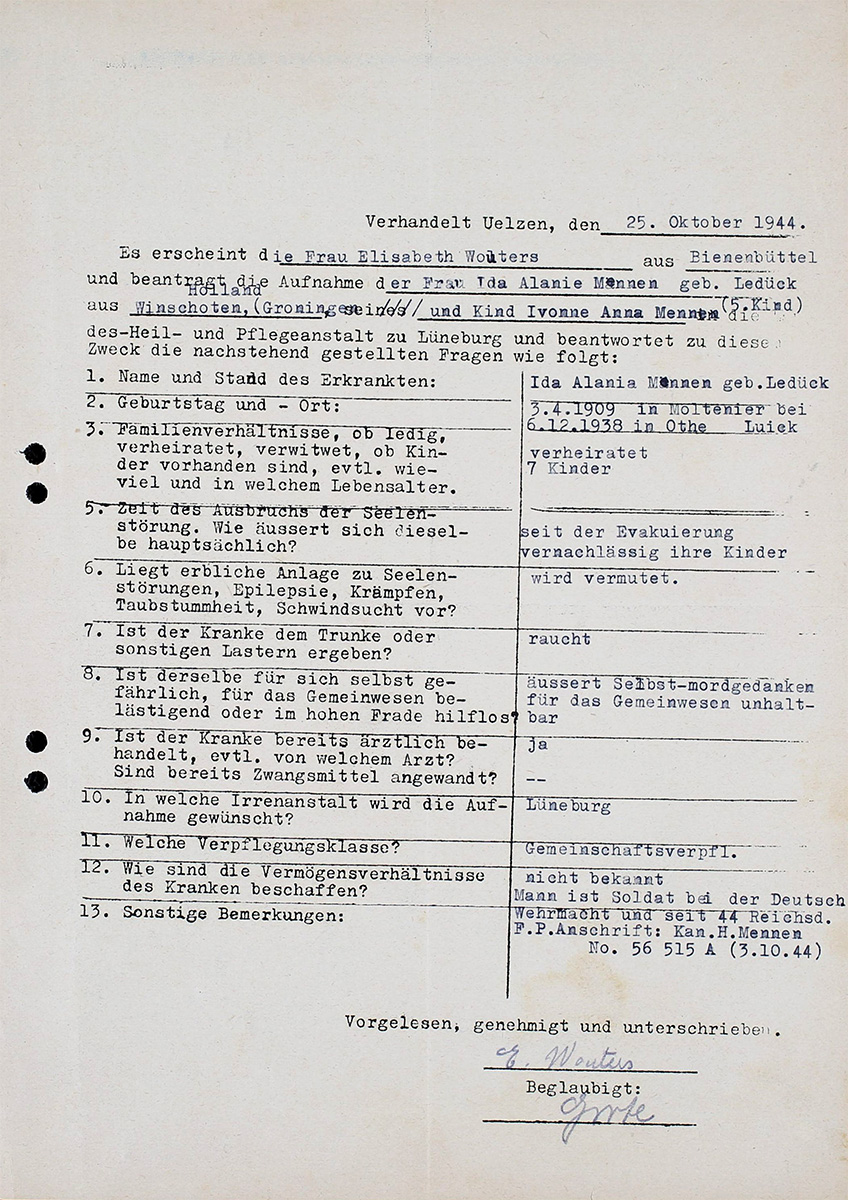
Application by Elisabeth Wolters for the compulsory admission of Ida Mennen and her daughter Yvonne, dated 25 October 1944.
NLA Hanover Hann. 155 Lüneburg Acc. 56/83 No. 132.
YVONNE MENNEN (1938 – 1944)
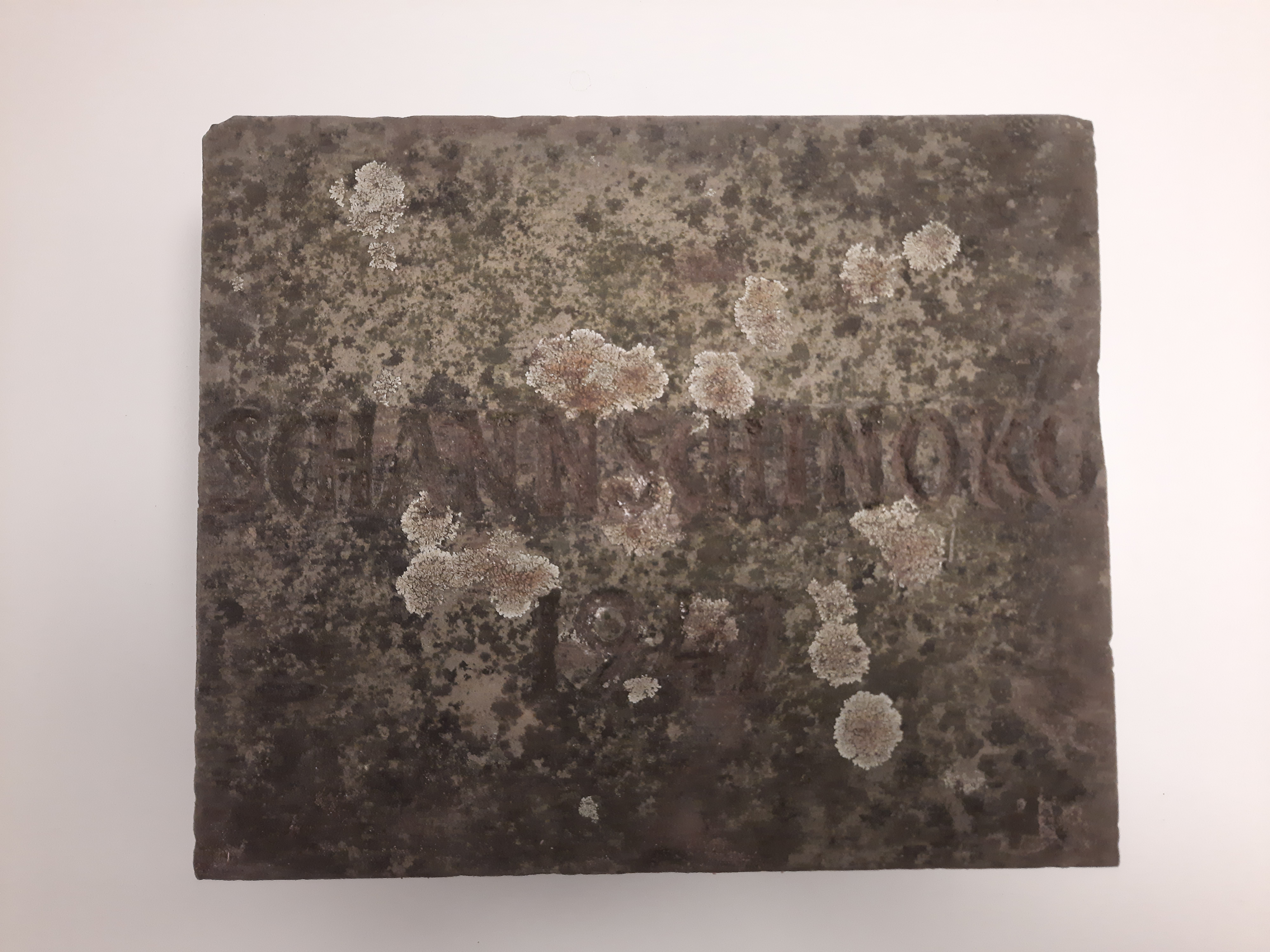
This is the gravestone of Timofey Thomachinko. Instead of his real name, »Schannschinoko« was engraved. Timofey Thomachinko did not even seem to be worthy of having his dates of birth and death added. Often, incorrect dates of death were given on gravestones and names were not spelled correctly. This was contrary to the War Graves Act.
ArEGL.
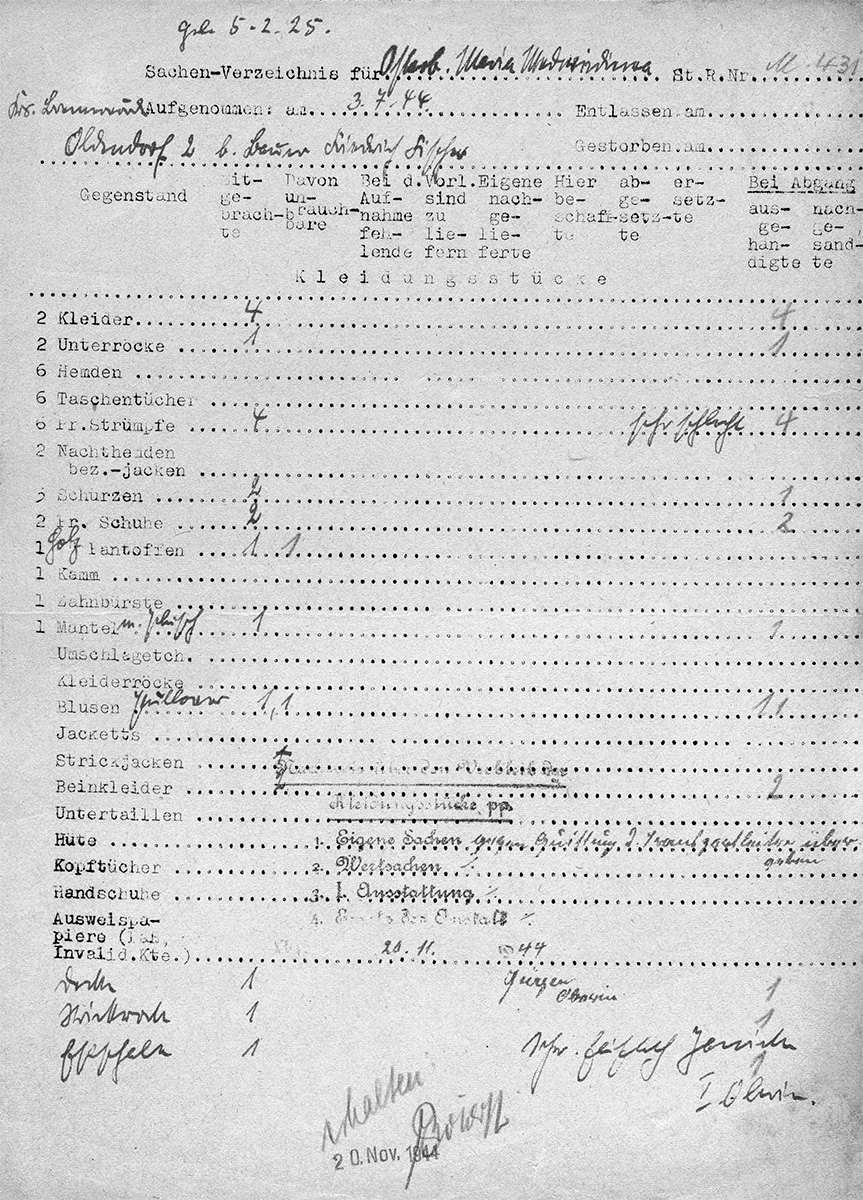
There are hardly any photos of female »Eastern European workers«. The identification card with a photo of Maria Medvedieva was given to her when she was transferred on 20 November 1944. Her medical file consists solely of a personnel form and a list of belongings.
Inventory of Maria Medvedeva’s belongings, 3 July 1944.
NLA Hanover Hann. 155 Lüneburg Acc. 2004/085 No. 01028.
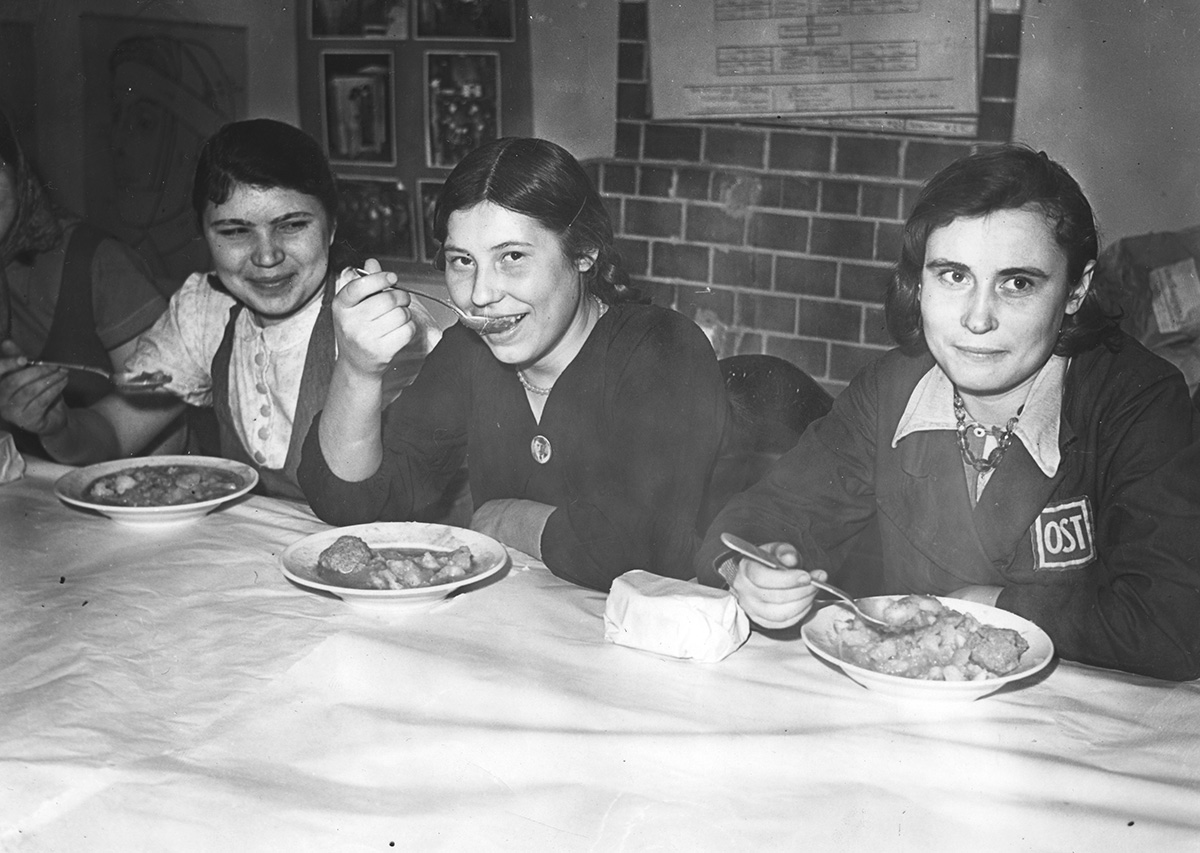
The photo shows »Eastern European female workers« at a table set with filled plates. It is a propaganda image from February 1943.
BArch Image 183-J05126.
MARIA MEDWEDIEWA (1925 – 1944)
ADAM RABSCHICK (1862 – 1942)
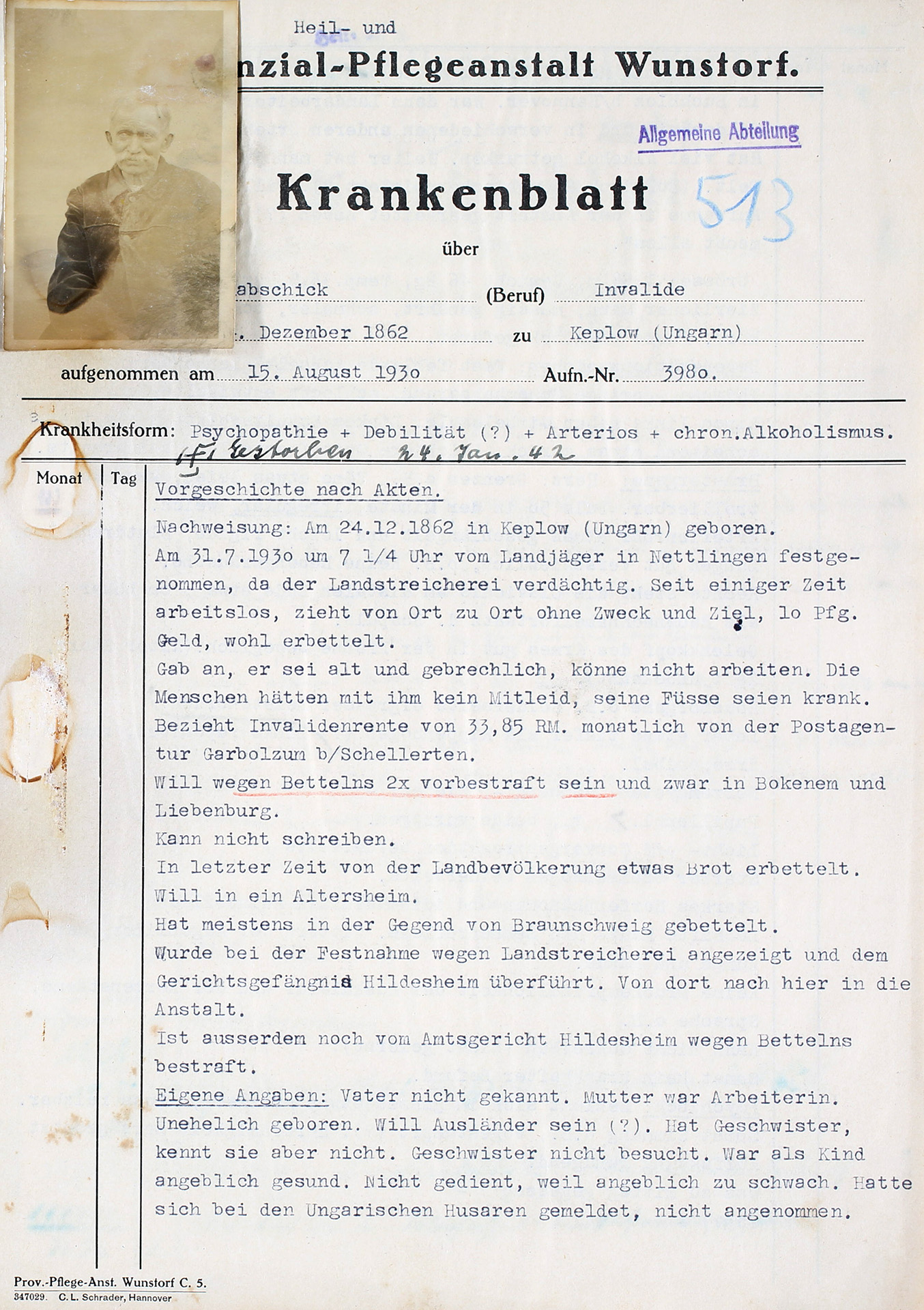
Medical records of Adam Rabschick.
NLA Hanover Lower Saxony 330 Lüneburg Acc. 2004/134 No. 00513.
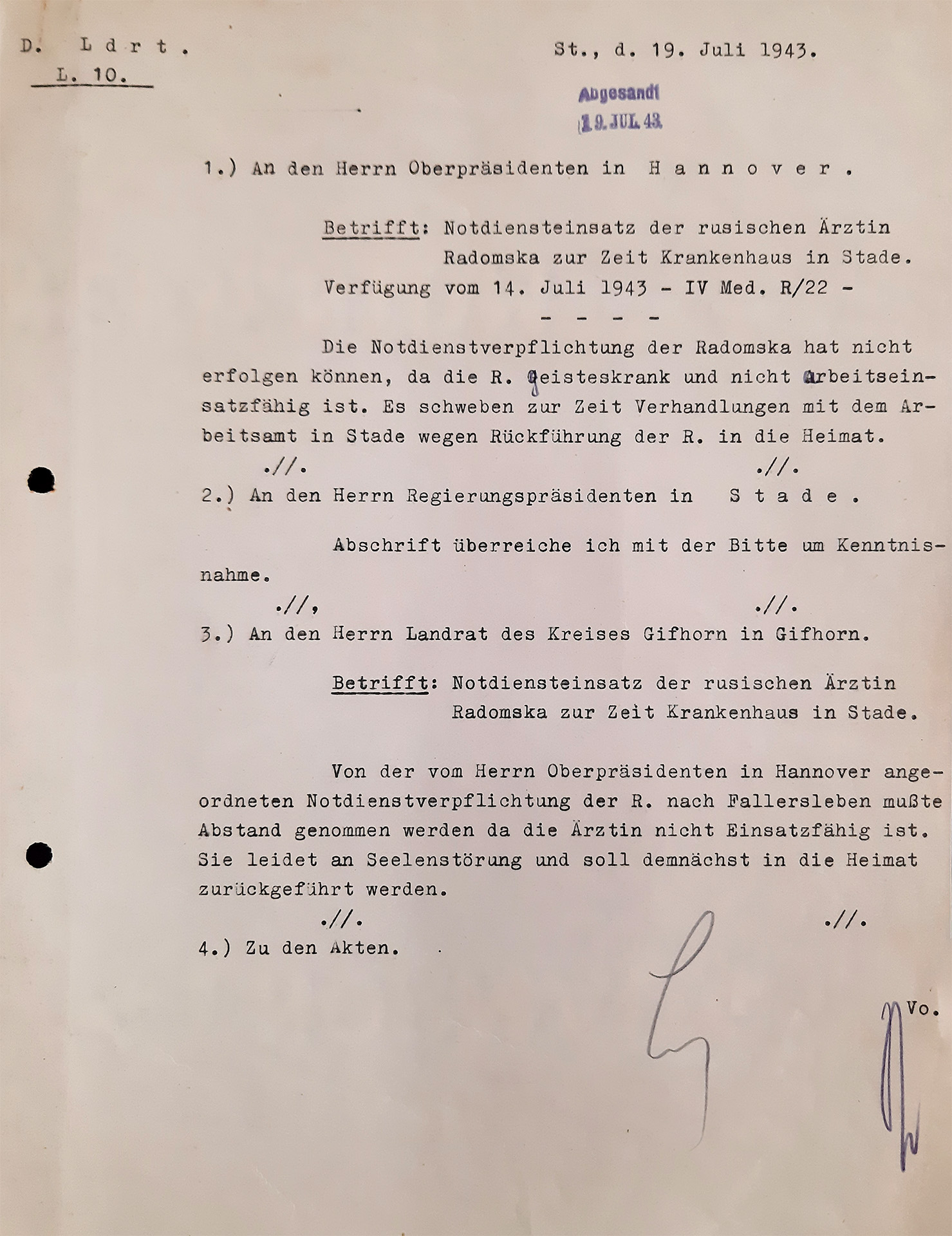
Letter from the District Administrator of Stade to the Chief President of Hanover dated 19 July 1943.
NLA Stade Rep. 274 Stade No. 80.
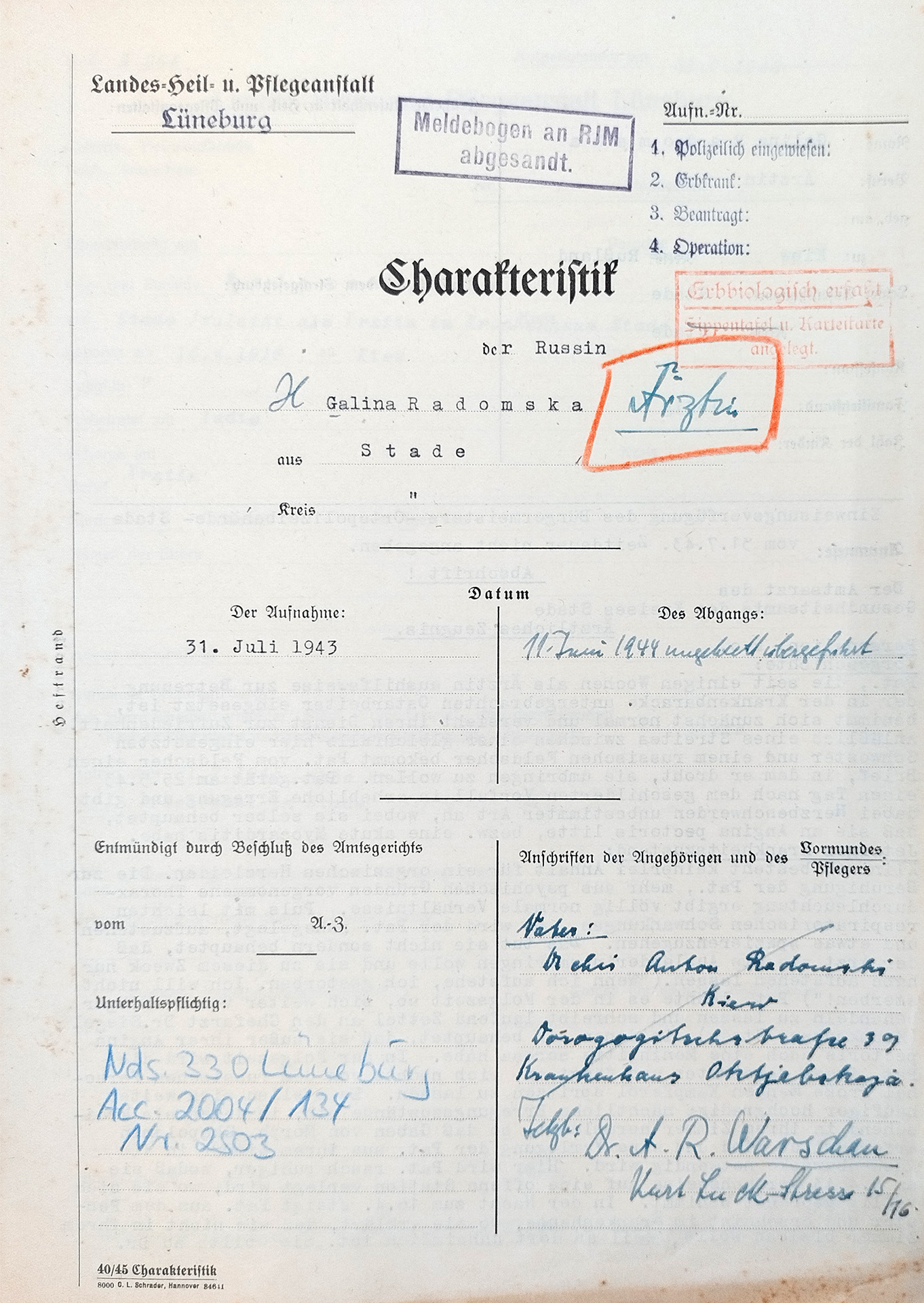
Excerpt from Galina Radomska’s medical records.
NLA Hanover Lower Saxony 330 Lüneburg Acc. 2004/134 No. 02503.
GALINA RADOMSKA (1918 – 1944)
GJURAGI SOKCEVIC (1907 – 1944)
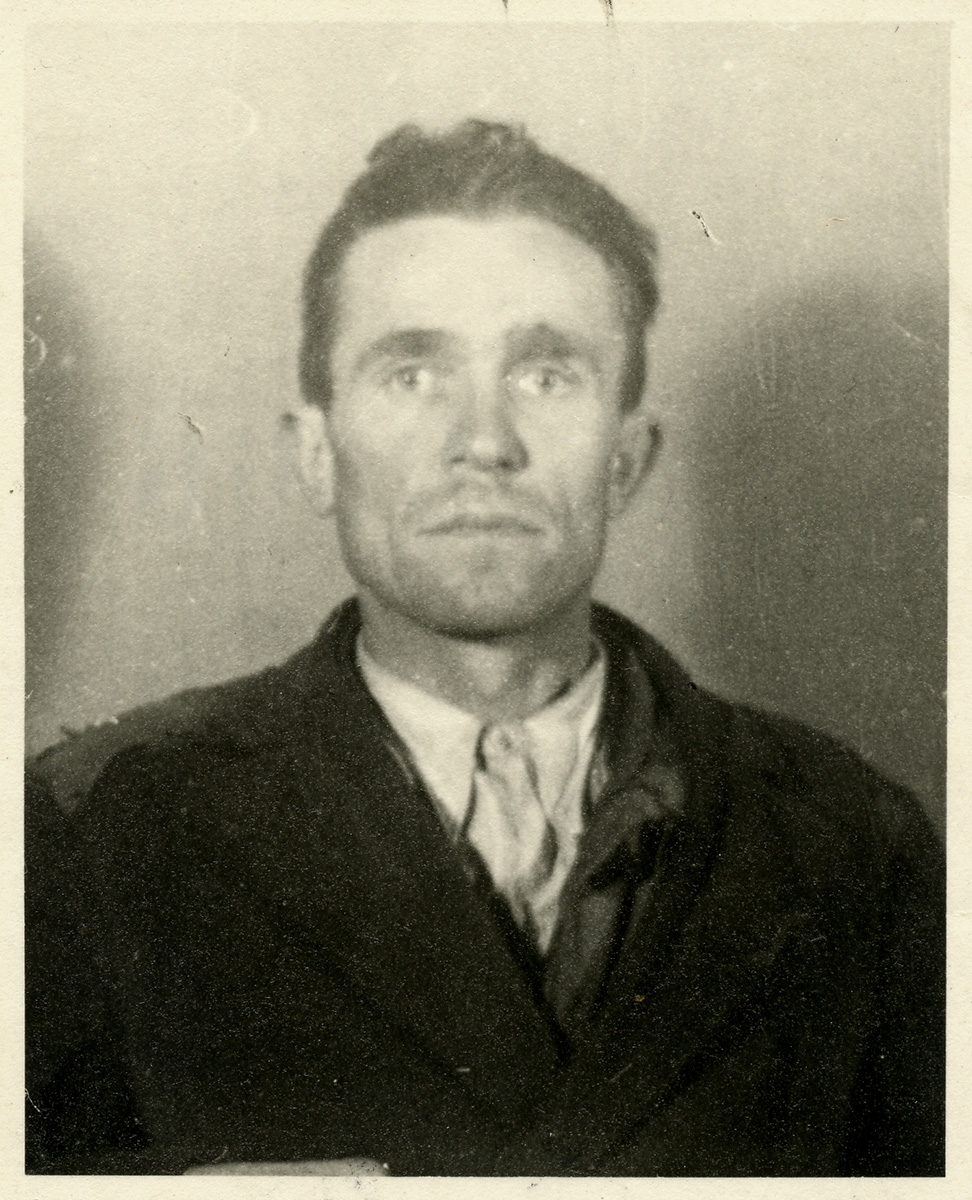
Gjuragi Sokcevic, around 1943.
StadtALg, PSLG-S, 95.
