SECURE EVIDENCE
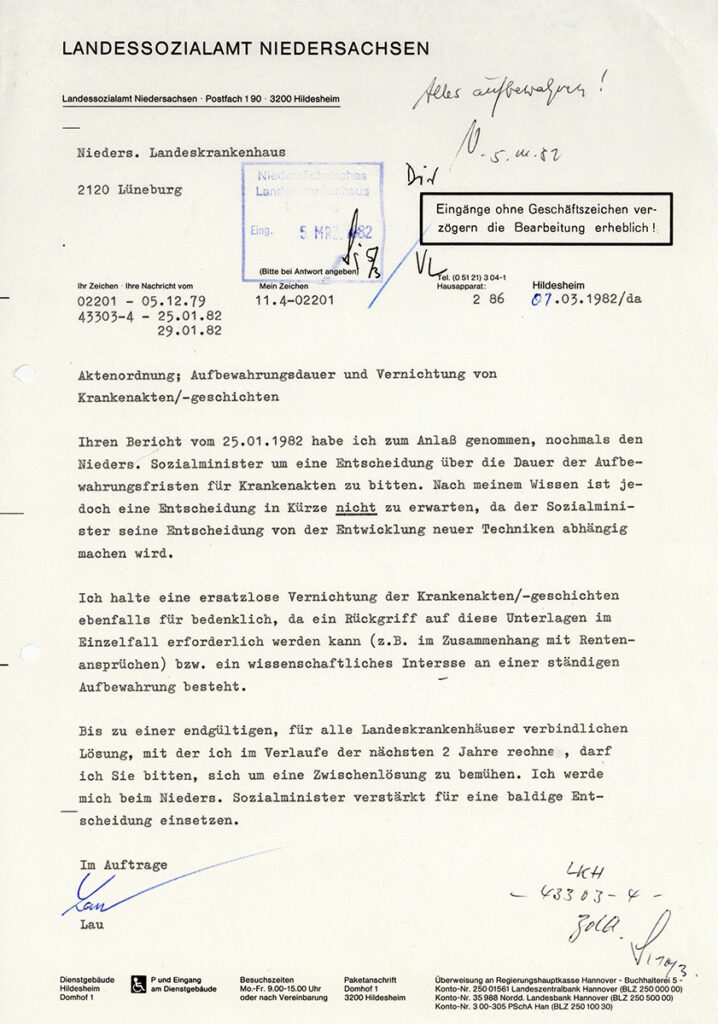
Letter from the State Social Welfare Office to the former Lüneburg Sanatorium and Nursing Home dated 1 March 1982.
ArEGL 19.
After 1979, the Lüneburg clinic planned to destroy all documents that were older than 30 years. An offer for this had already been made. This also applied to all existing files from the National Socialist era. Archiving the files was not considered for reasons of personal privacy (medical confidentiality). Neither the clinic nor the superior authority thought that they could be used to come to terms with crimes.
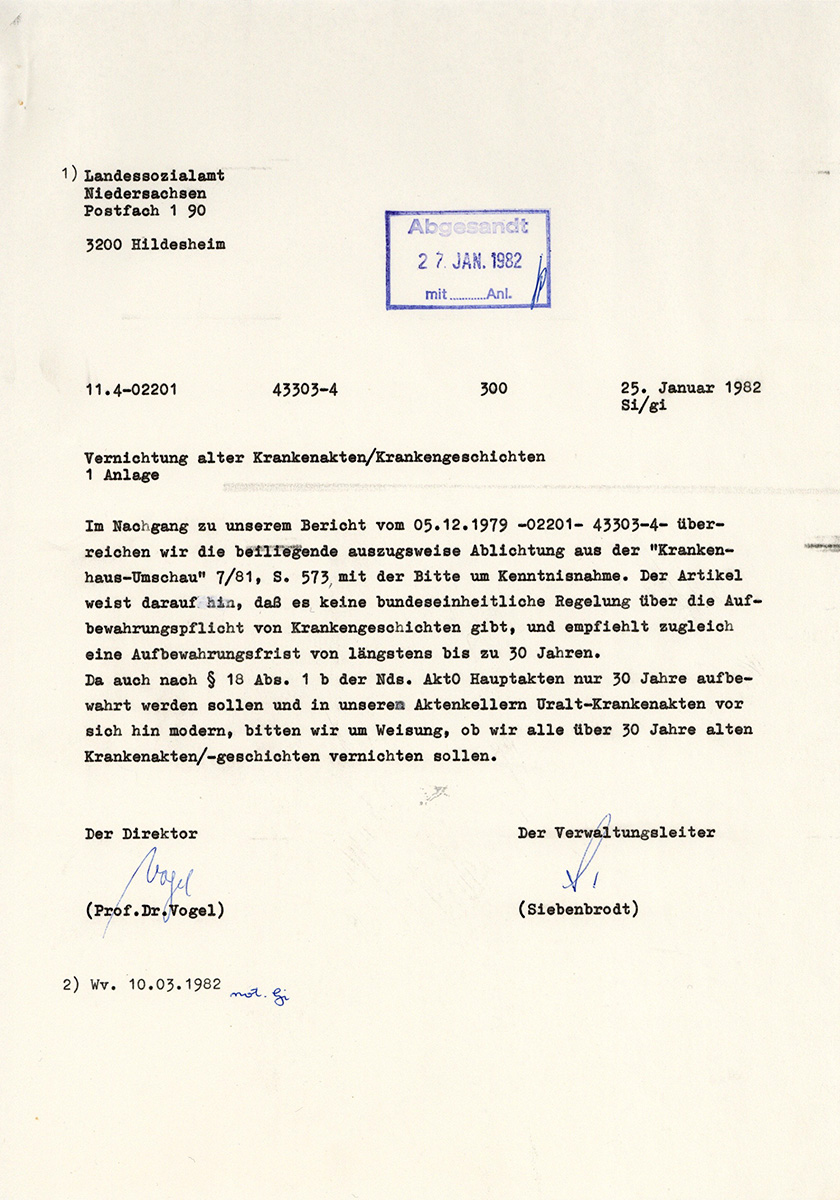
Letter from the former Lüneburg sanatorium and nursing home to the Hildesheim State Social Welfare Office dated 25 January 1982.
ArEGL 19.
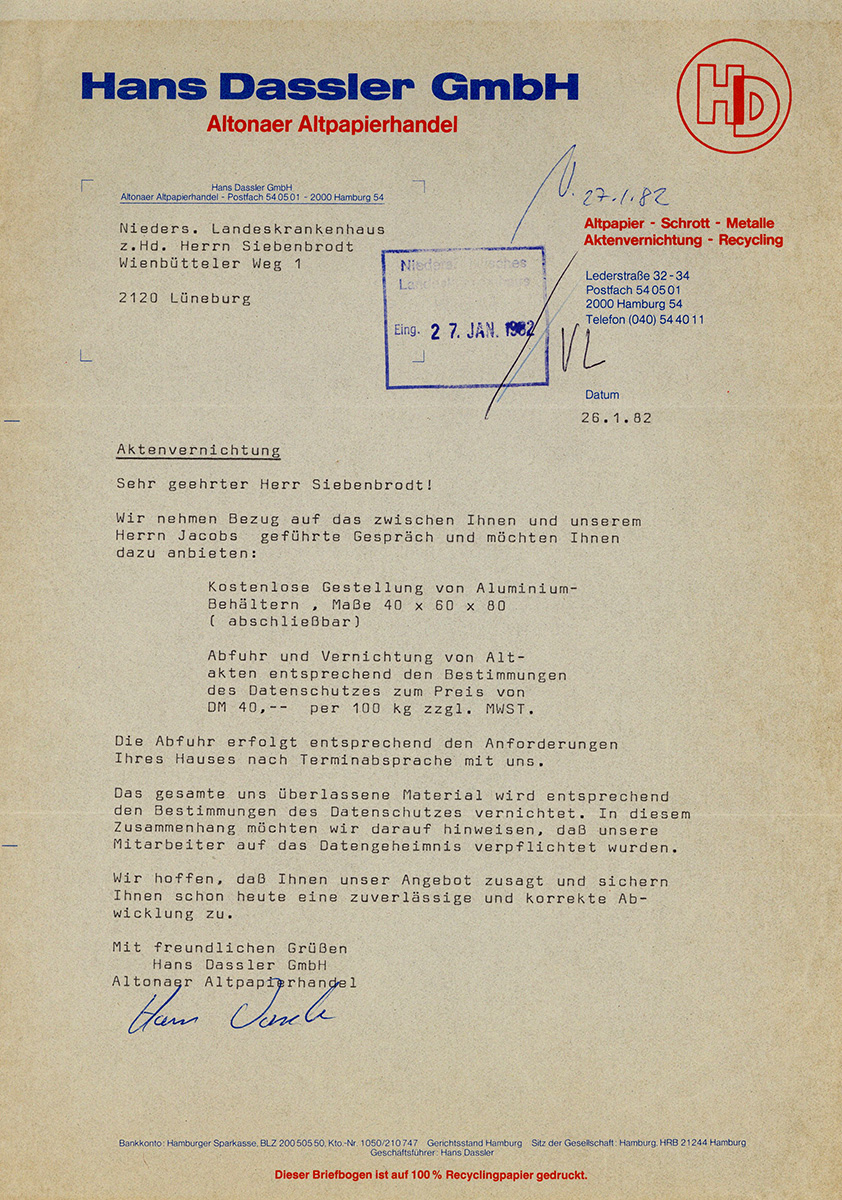
Offer from Hans Dassler GmbH for the destruction of files dated 26 January 1982.
ArEGL 19.
31 January 1983 marked the 50th anniversary of the »seizure of power«. A special exhibition was held in Lüneburg’s Glockenhaus. As Medical Director of the former Lüneburg Sanatorium and Nursing Home, Theo Vogel was due to give a lecture on »Euthanasia in the Third Reich«. His new superior did not authorise the lecture. He assumed that, due to a lack of files, there was no information available.
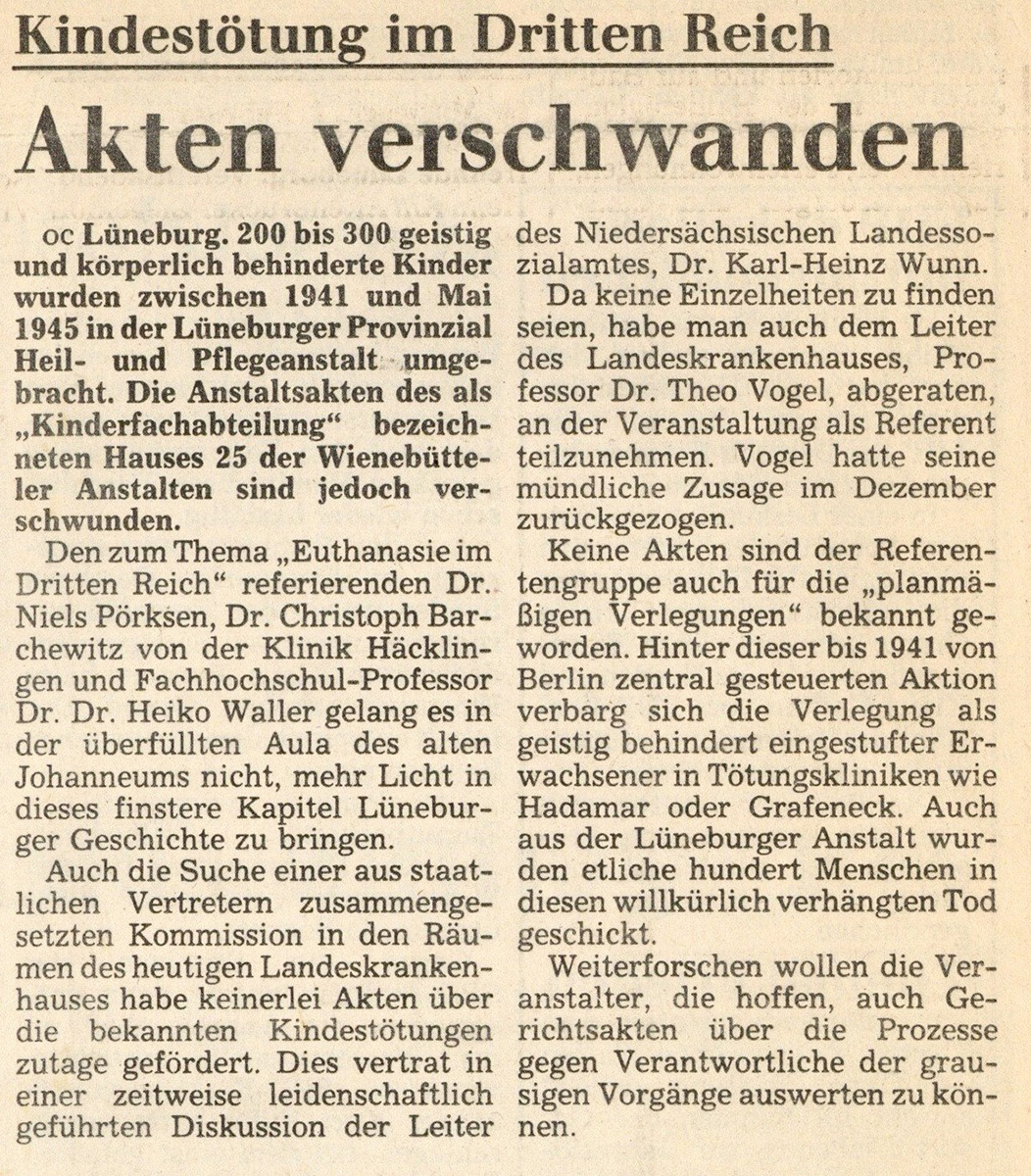
Newspaper report entitled »Infanticide in the Third Reich – files disappeared«. Lüneburger Landeszeitung of 2 February 1983, page 5.
ArEGL 19.
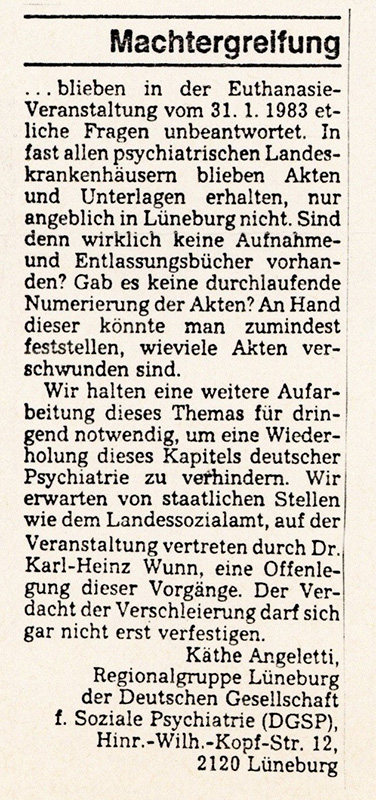
Letter to the editor in the Lüneburger Landeszeitung by Käthe Angeletti from 15 February 1983, page 5.
ArEGL 19.
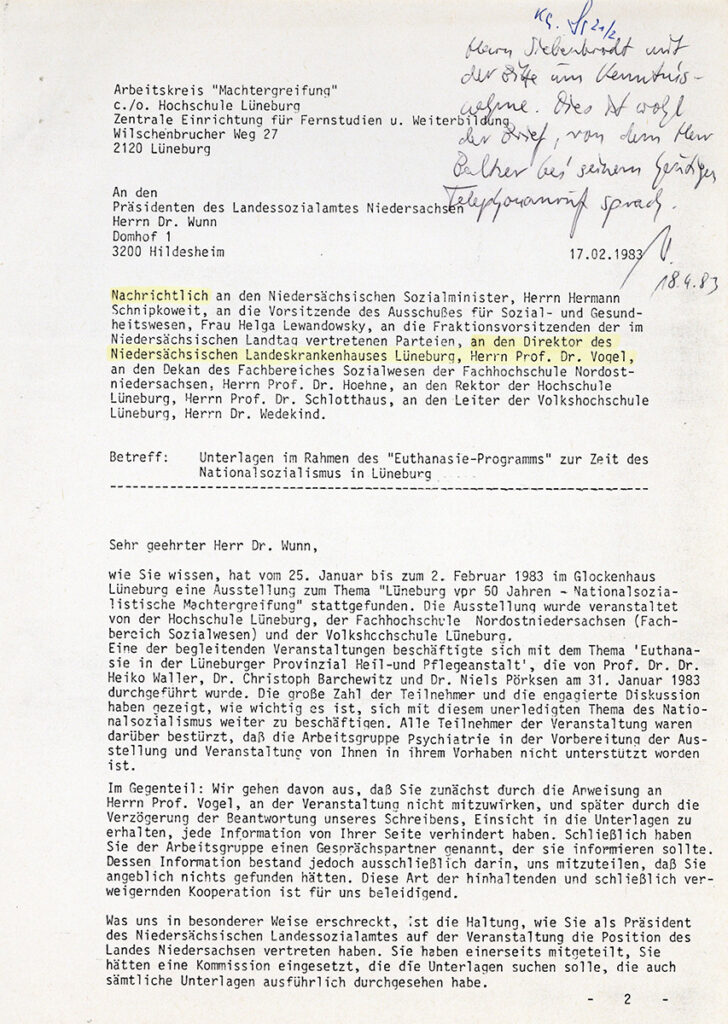
Letter from the »Machtergreifung« working group (c/o Lüneburg University of Applied Sciences) to Karl-Heinz Wunn, Head of the State Social Welfare Office of Lower Saxony, dated 17 February 1983.
ArEGL 19.
The opening of the exhibition was moved to another room due to the large number of visitors and took place without a lecture in the auditorium of the former Johanneum grammar school. For the first time, the »Psychiatry in the Third Reich« working group and the »Seizure of Power« working group publicly called for the crimes of »euthanasia« to be investigated. The head of the authorities took a stand and promised to take on the investigation.
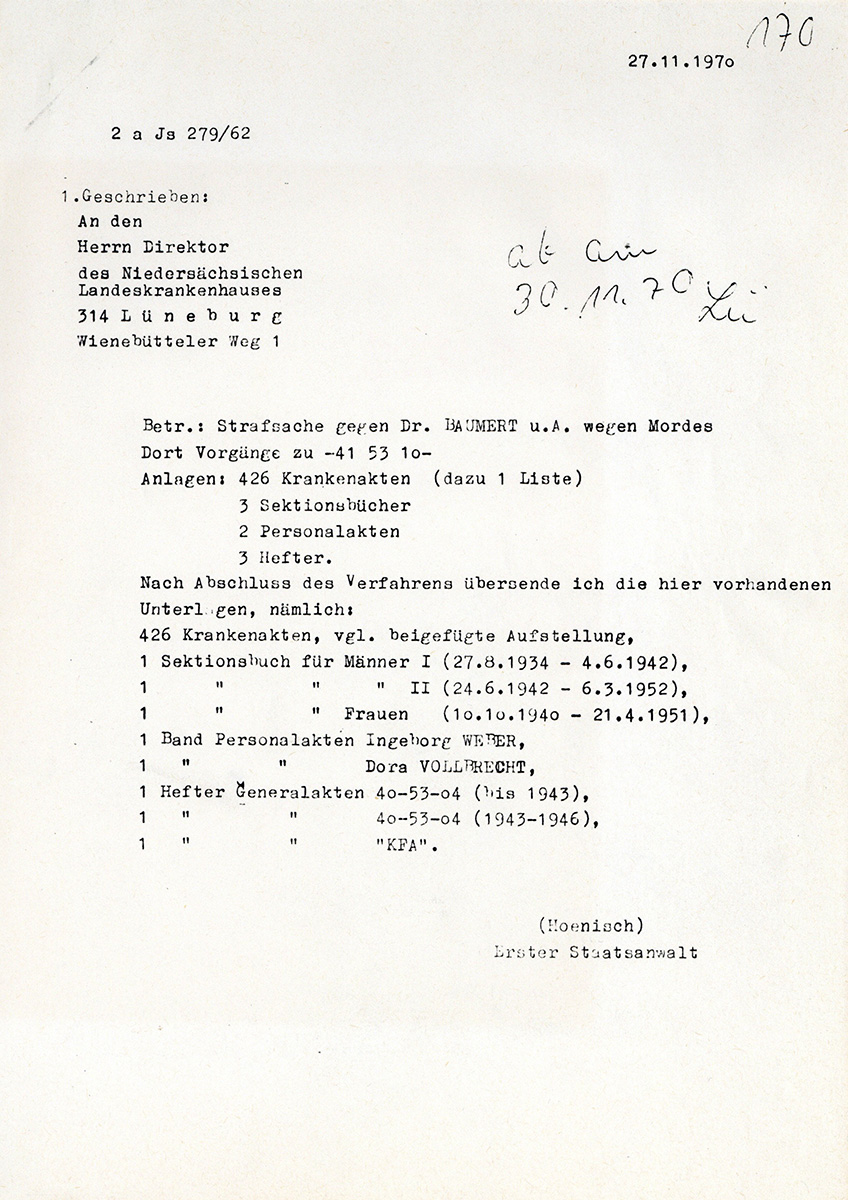
Letter from the public prosecutor’s office in Lüneburg to the Lower Saxony State Hospital in Lüneburg dated 27 November 1970.
ArEGL 19.
The State Social Welfare Office commissioned experts with the task of searching for and thoroughly examining the documents from the Nazi era that were returned by the Lüneburg public prosecutor’s office in 1970. It also initiated a scientific reappraisal of the crimes. Theo Vogel, in turn, suggested hanging a memorial plaque or erecting a memorial stone in the cemetery so that.
»[…] the victims can be appropriately commemorated.«
Letter dated 4 February 1983 from Theo Vogel to Karl-Heinz Wunn, Head of the State Social Welfare Office of Lower Saxony, dated 4 February 1983.
ArEGL 19.
The investigation of the Lüneburg crimes prompted the State Social Welfare Office to analyse the National Socialist period in all psychiatric institutions in Lower Saxony. The results were incorporated into the dissertation by Thomas Sueße and Heinrich Meyer. There was no biographical information about the victims, all names were abbreviated so that the people could not be recognised.
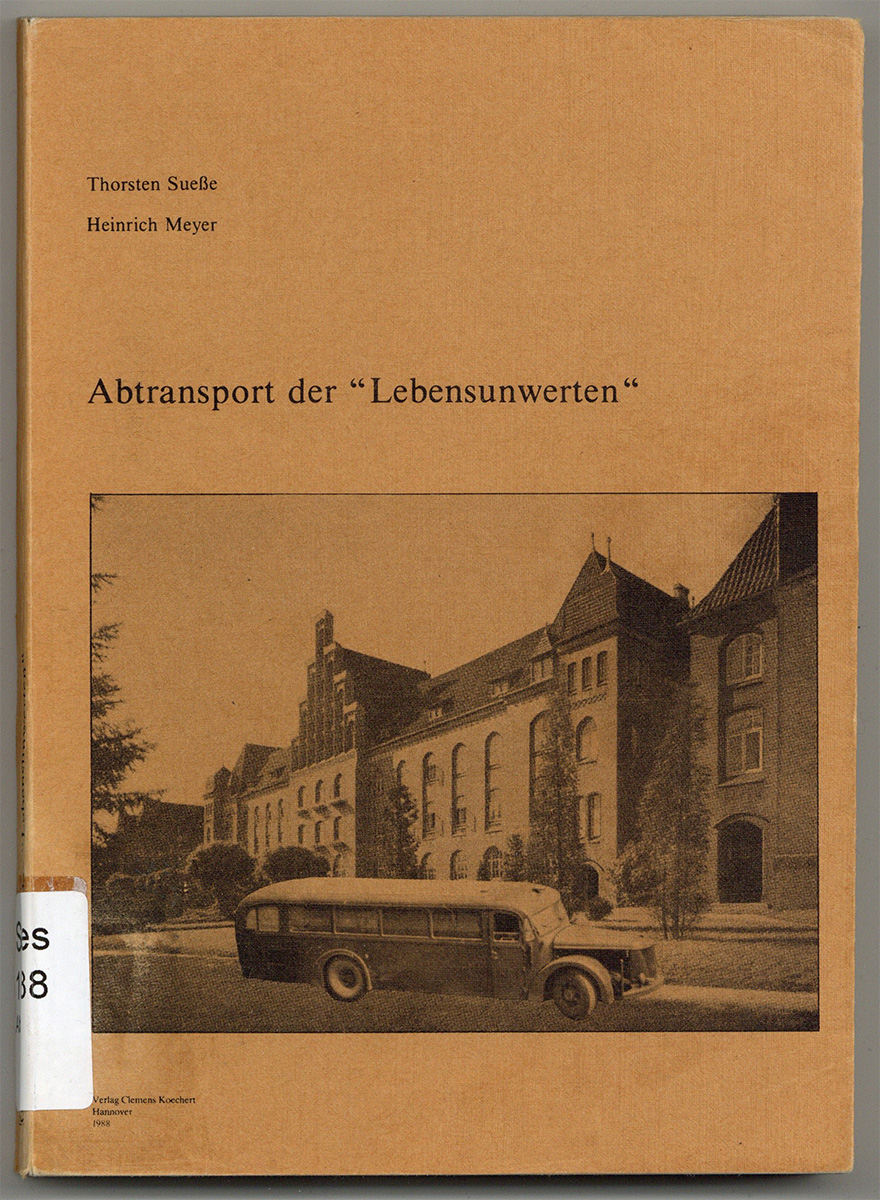
Thomas Sueße | Heinrich Meyer: Removal of the »unworthy of life«. Hanover Medical School, 1984.
The State Social Welfare Office promised to make all files available for preservation. Hundreds of files from the Lüneburg sanatorium and nursing home from 1933 to 1946 were found under a cellar staircase in the main building. The employees of all Lower Saxony state hospitals were instructed to report files relating to »euthanasia« by the end of March 1983. The Lüneburg hospital handed over its files to the state archives in April 1983. At first it was still called.
»Medical records are generally to be excluded from transfer [to the archive].«
Letter from the State Social Welfare Office to the Lower Saxony State Hospitals dated 22 April 1983.
ArEGL.
After the extent of the crimes finally became apparent, the assessment of medical histories from the National Socialist era changed in July 1984.
»The medical records […] are completely taken over by the archives in the interest of medical research.«
Letter from the Lower Saxony State Social Welfare Office to the Lower Saxony State Hospitals dated 30 July 1984.
ArEGL.
