»CHILDren’s EUTHANASIA«
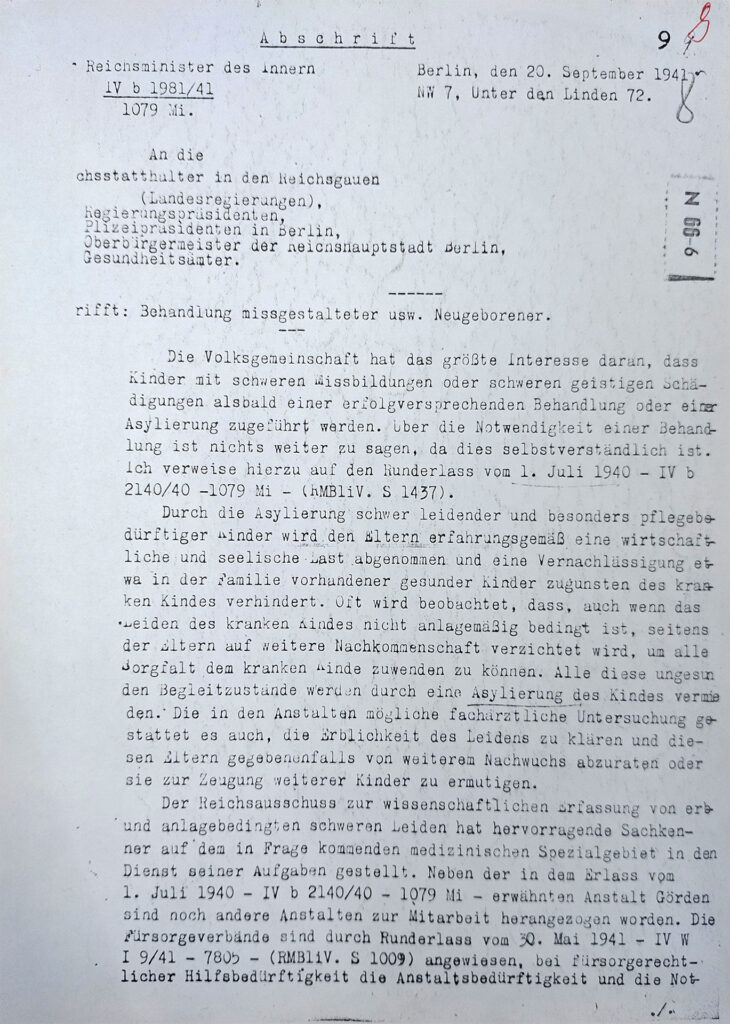
Excerpt from the decree of the Reich Ministry of the Interior dated 20 September 1941.
NLA Hanover Nds. 721 Lüneburg Acc. 8/98 No. 3/9.
The relevant authorities were emphatically instructed to fulfil their reporting obligations. They were to convince parents that the measure was good for the community and for families. Apparently, the results of a survey conducted by Ewald Meltzer in 1920 were not accurate. The study, which was not published until 1925, stated that 78 percent of parents wanted their children with disabilities to be »saved.« But that was not true.
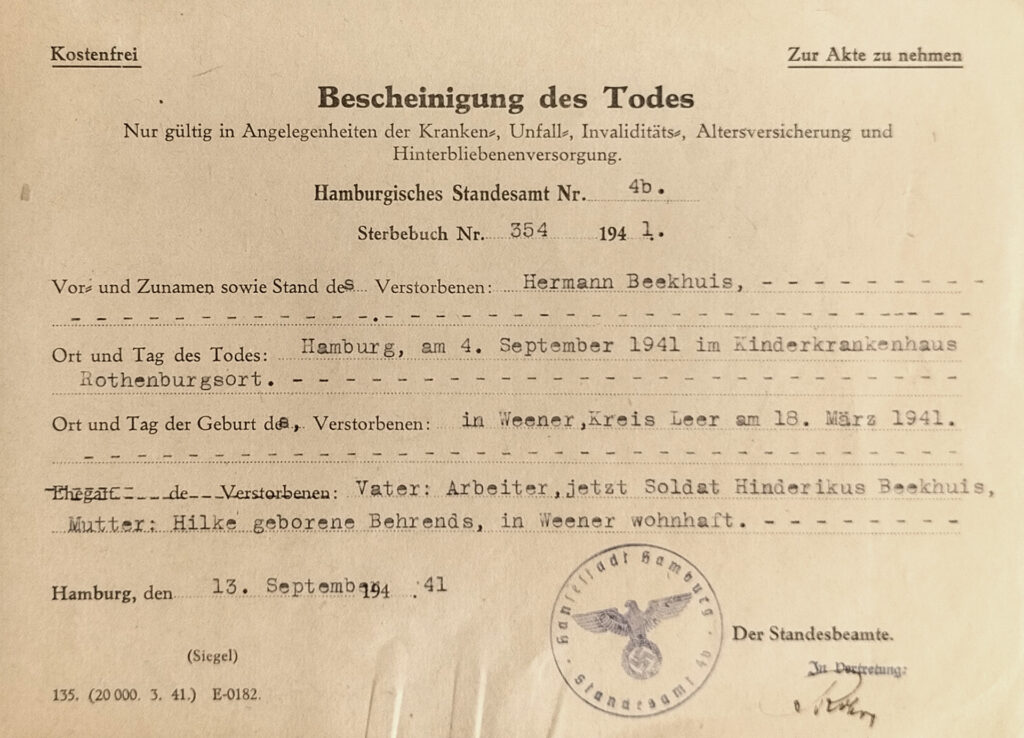
Certificate of death dated 13 September 1941.
Hamburg State Archives 352-8/7 Langenhorn State Hospital No. 86294.
Before the »children’s ward« in Lüneburg was established, at least ten children from the future catchment area were admitted to the two »children’s wards« in Hamburg, Rothenburgsort (1) and Langenhorn (9):
- Hermann Beekhuis (Leer)
- Helmuth Beneke (Bremervörde)
- Gerda Cordes (Uelzen)
- Marianne Harms (Bardowick)
- Hillene Hellmers (Leer)
- Irmgard Jagemann (Bremen)
- Rosemarie Kablitz (Wilstedt)
- Edda Purwin (Lüneburg)
- Günther Schindler (Wilhelmshaven)
- Hans-Ludwig Würflinger (Bremen)
Five returned home between 1942 and 1943, while the others were murdered. The youngest victim was Hermann Beekhuis. He was murdered at the age of three and a half months in the Rothenburgsort Children’s Hospital. The official date of death is falsified.
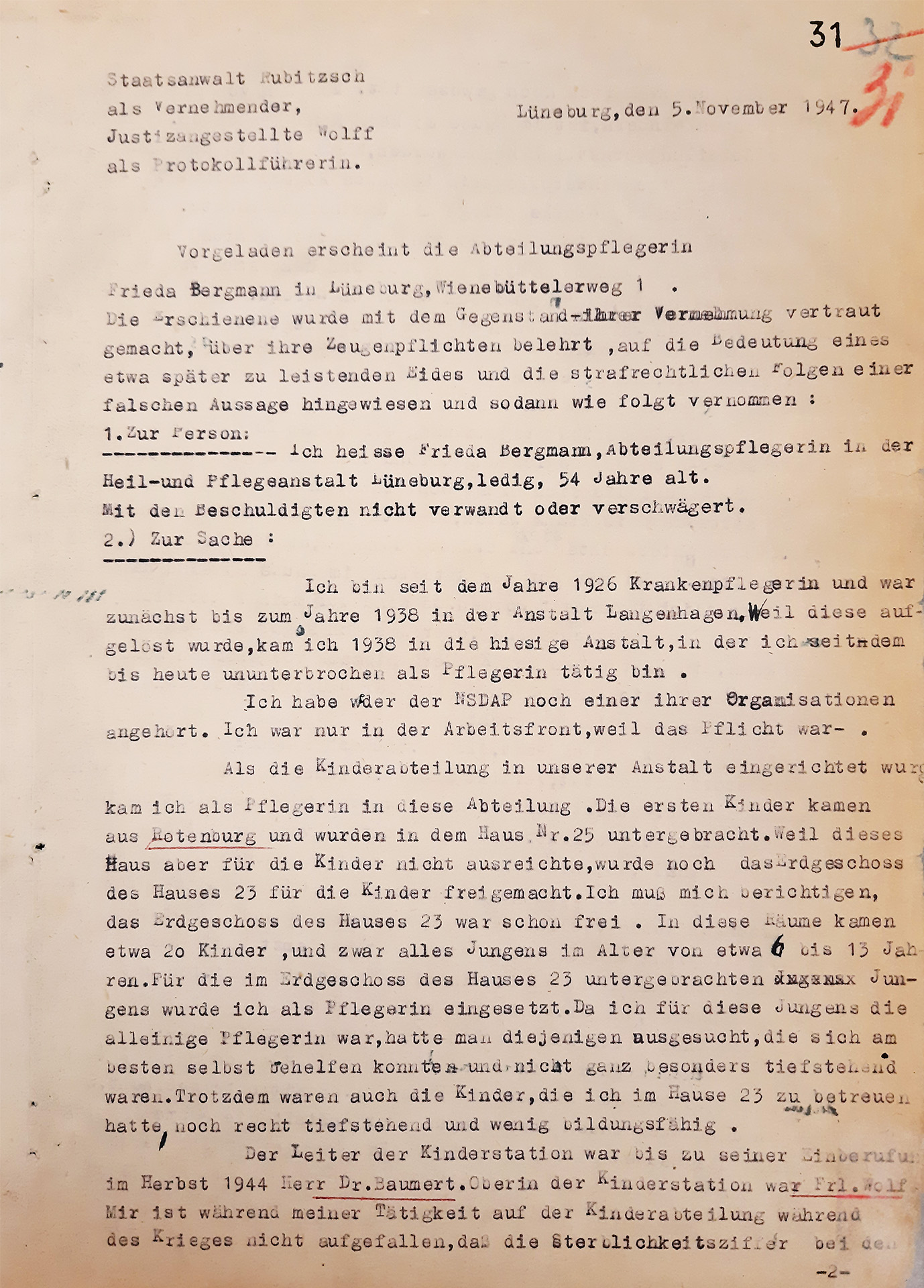
Excerpt from the interrogation of Frieda Bergmann on 5 November 1947.
NLA Hanover Lower Saxony 721 Lüneburg Acc. 8/98 No. 3.
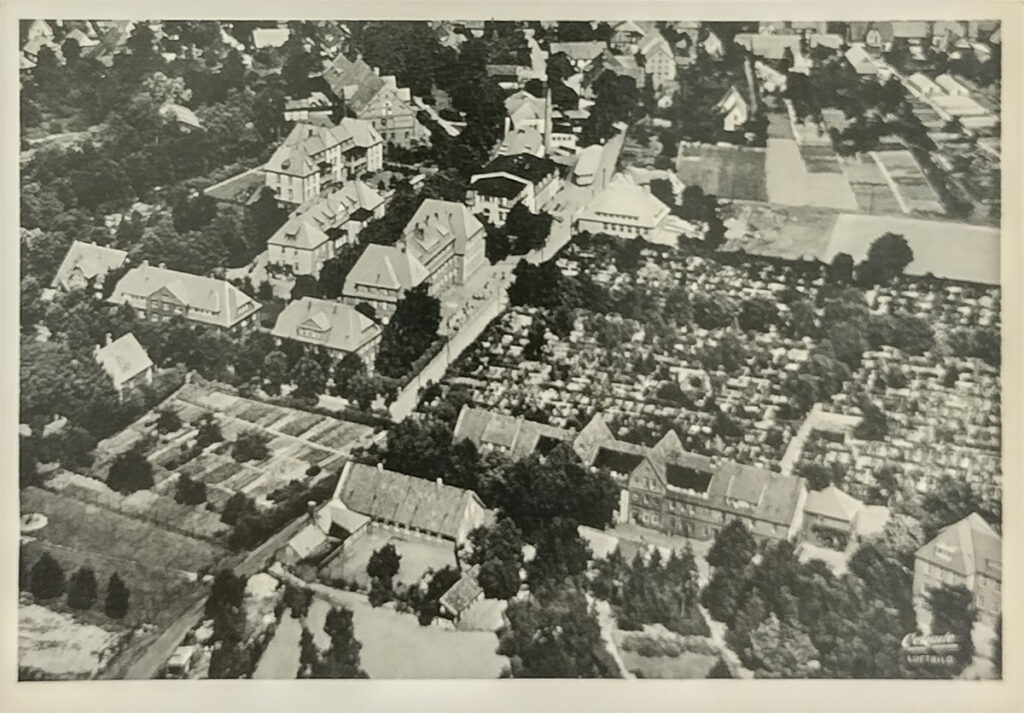
Aerial view of the Rotenburg institutions of the Inner Mission, postcard, before 1945.
ArEGL 99.
The Rotenburg institutions of the Inner Mission were to be used as an auxiliary hospital for Bremen victims of the air war. To this end, the children’s ward was closed and the children being treated there were divided up. Ninety-nine children were sent to the von Bodelschwingh institutions in Bethel, Bielefeld, and 24 children were sent to the Eben-Ezer Foundation in Lemgo. The children who were unable to attend school were transferred to the »children’s ward« in Lüneburg.
For many children and young people with disabilities from the province of Hanover, the Rotenburg institutions of the Inner Mission were a large home. The photos shown here certainly include children and young people who were later murdered in Lüneburg. In the picture of the boys in front of the Wichernhaus, for example, Eckart Willumeit from Celle can be seen on the left.
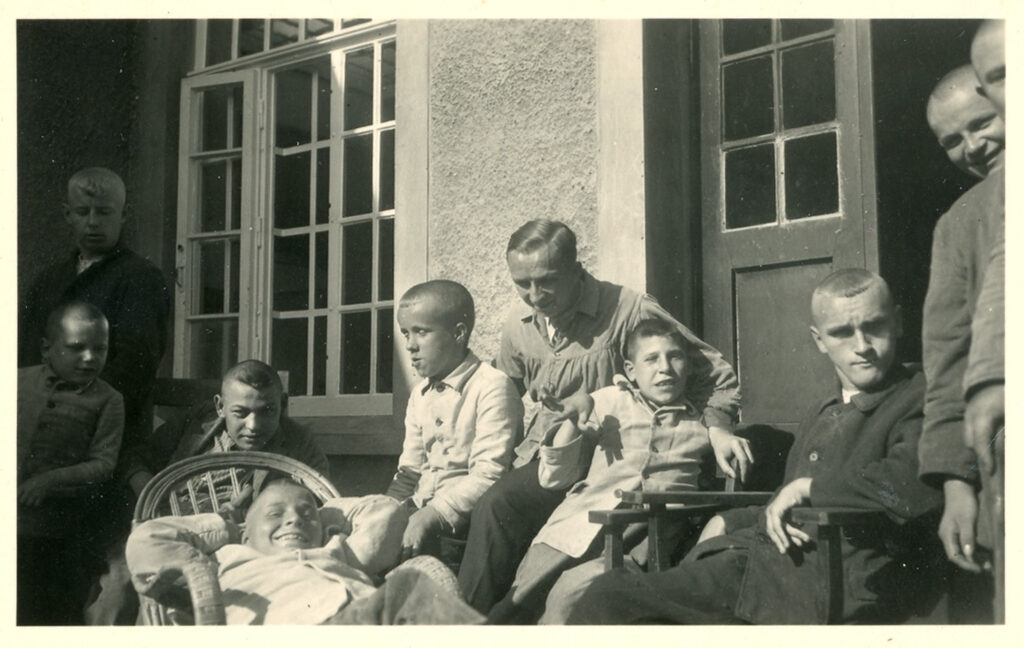
Young people with Brother Karl Stallbaum in front of the Wichernhaus of the Rotenburg Works of the Inner Mission, around 1938. Photographer Kurt Stallbaum.
Archive of the Rotenburg Works of the Inner Mission.
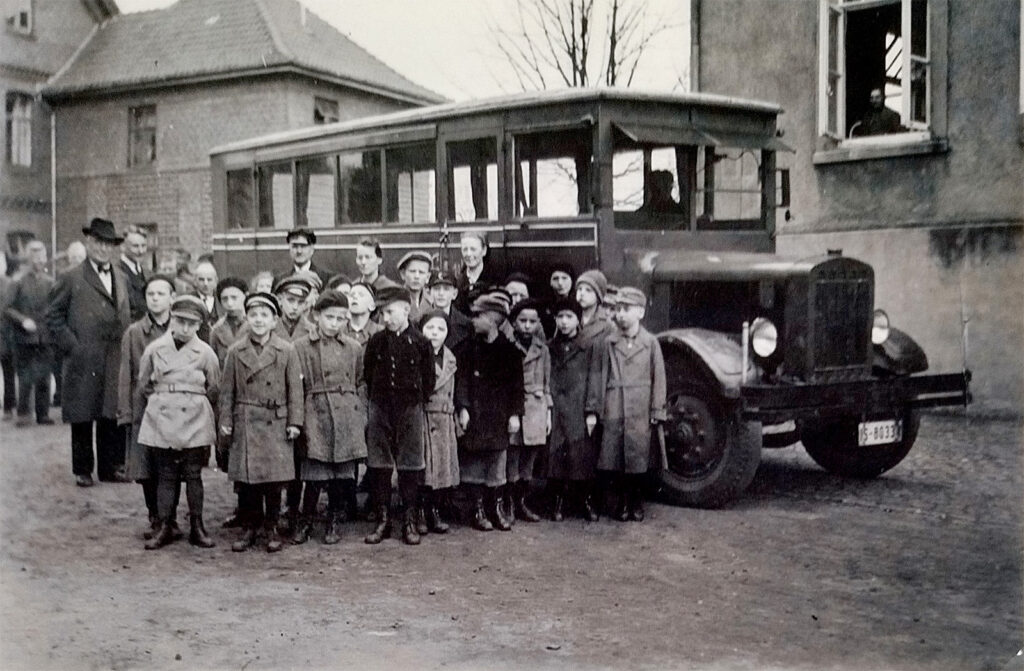
Group photo of the children’s transport from Hanover-Langenhagen. On the left is the director from Rotenburg, Pastor Johannes Buhrfeind. Behind him on the right is the ward nurse or »house father« Grützmacher.
Archive of the Rotenburg Works of the Inner Mission.
Among the children who were transferred to Lüneburg were 25 who had been moved from the Hanover-Langenhagen mental hospital to Rotenburg on 18 March 1938 after the children’s clinic in Langenhagen had been closed. In addition to Eckart Willumeit, these included Friedrich Daps, Waldemar Borcholte and Hans-Herbert Niehoff. They must be four of the children in the photo.

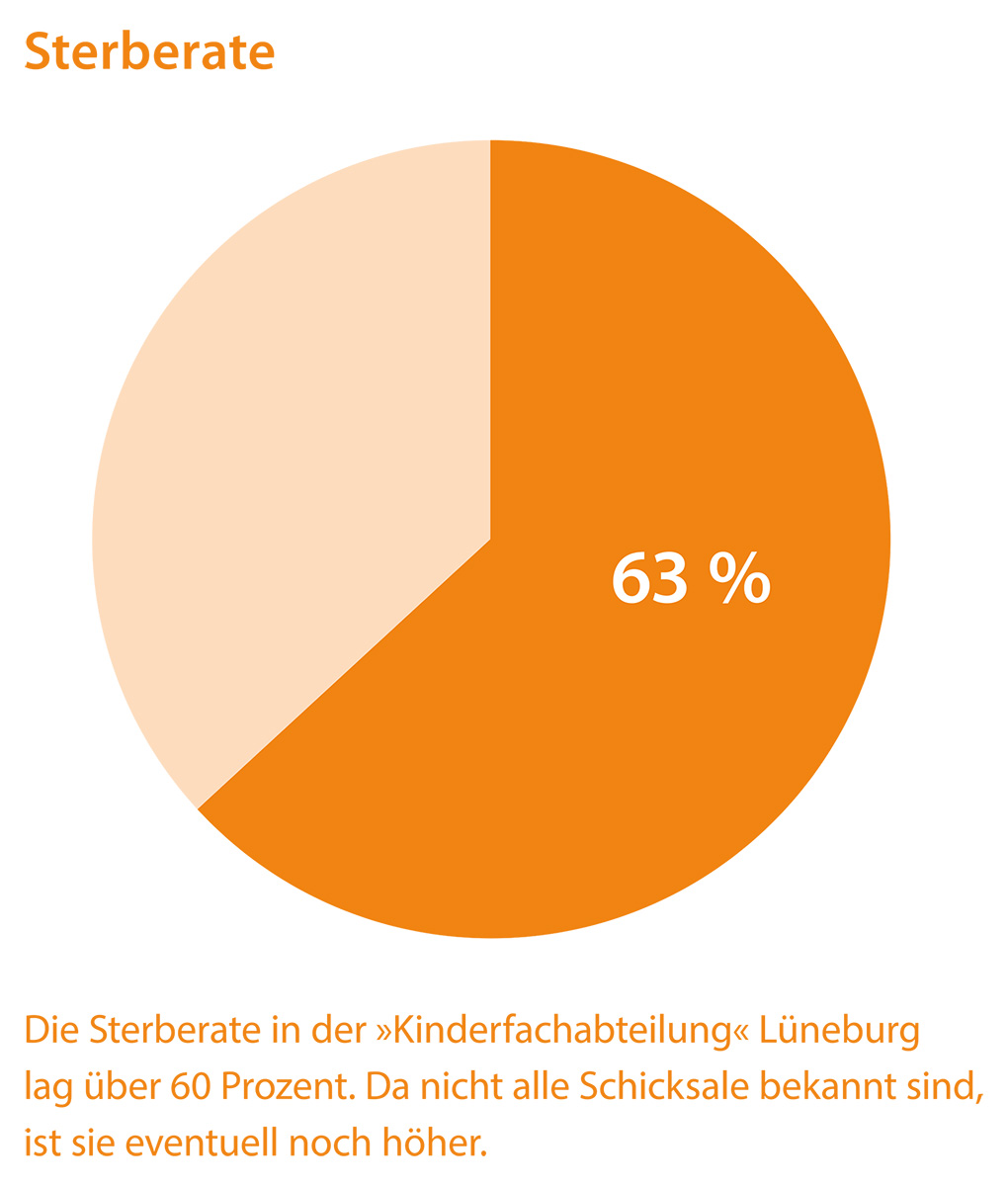
The mortality rate in the »children’s ward« in Lüneburg was over 60 percent. Since not all fates are known, it may be even higher.
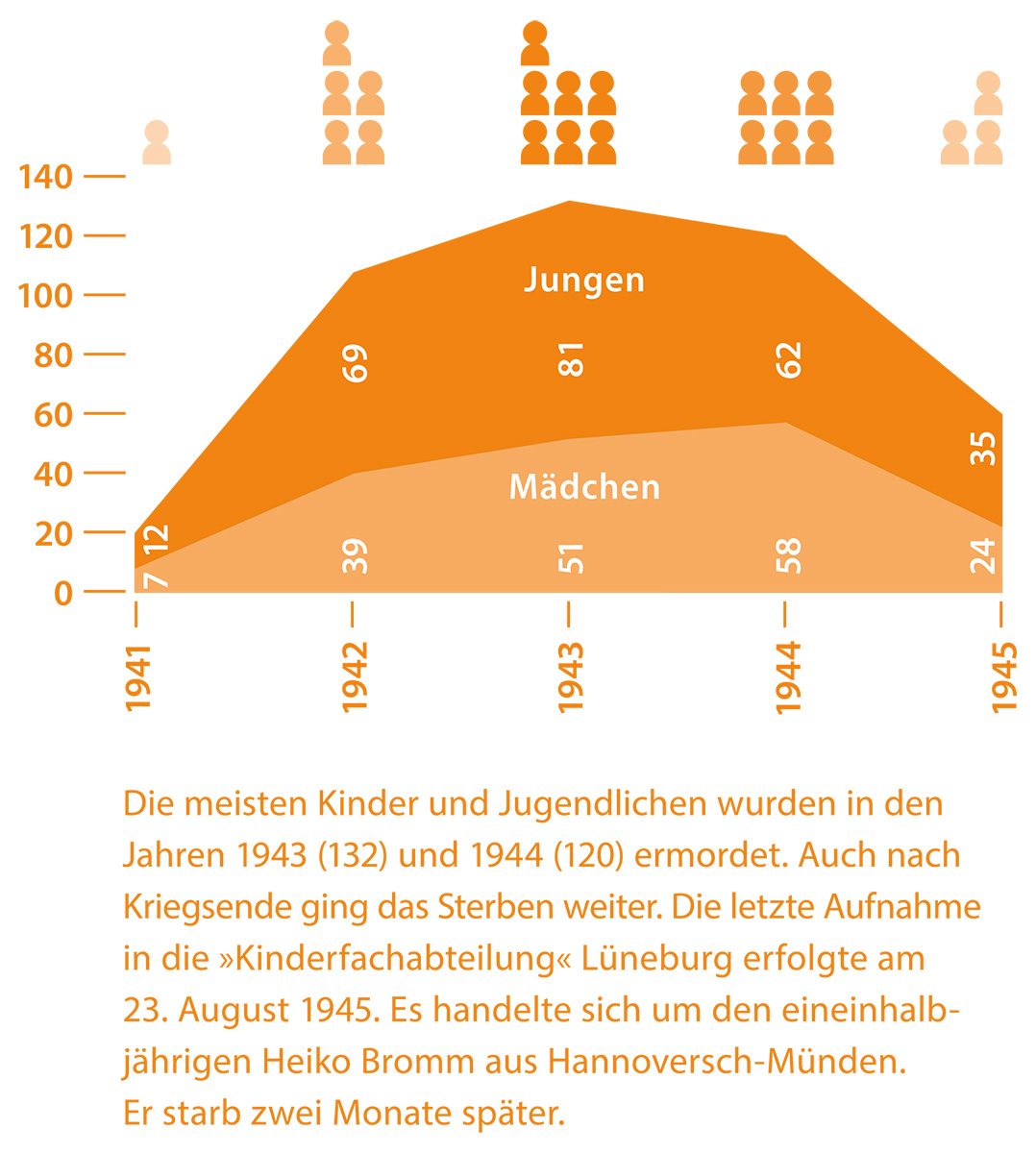
Most of the children and adolescents were murdered in 1943 (132) and 1944 (120). Even after the end of the war, the deaths continued. The last admission to the »children’s ward« in Lüneburg took place on 23 August 1945. The patient was one-and-a-half-year-old Heiko Bromm from Hannoversch-Münden. He died two months later.
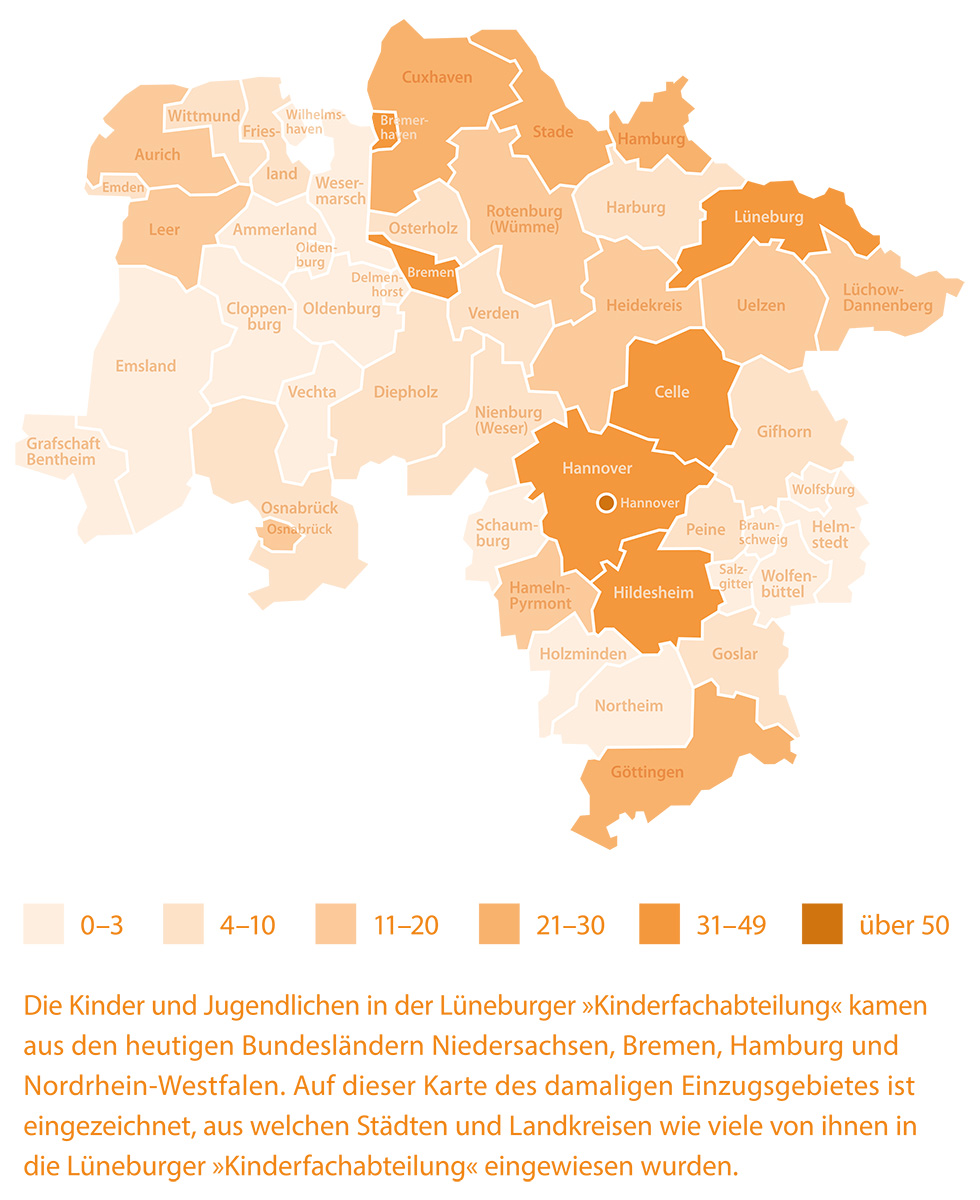
The children and adolescents in the Lüneburg »children’s ward« came from what are now the federal states of Lower Saxony, Bremen, Hamburg and North Rhine-Westphalia. This map of the catchment area at that time shows the cities and districts from which they were admitted to the Lüneburg »children’s ward« and how many of them there were.
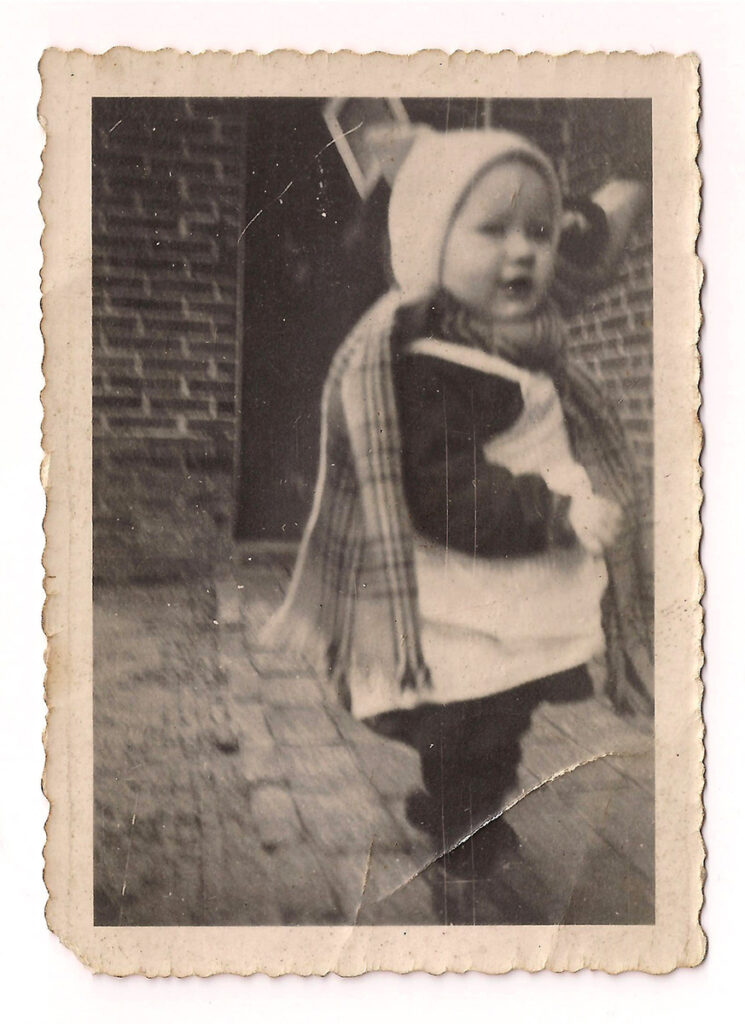
Herta Ley, around spring 1932.
ArEGL.
The Leer health authority had some very dedicated employees. Eight of the 13 children from Leer were murdered. Among them was Herta Ley from Westrhauderfehn. She arrived in Lüneburg on 9 October 1941 and was one of the first children to be murdered.
Young people who did not behave in an appropriate manner and were considered »uneducable« were reported by the youth welfare service for admission to a »special children’s ward«. As a doctor at the Wunstorf youth welfare institution, Willi Baumert personally admitted his charges to the »special children’s ward« in Lüneburg. Siegfried Eilers, who came to Lüneburg with his three siblings, also had to go through this experience. His younger brother Ernst did not survive his stay there.
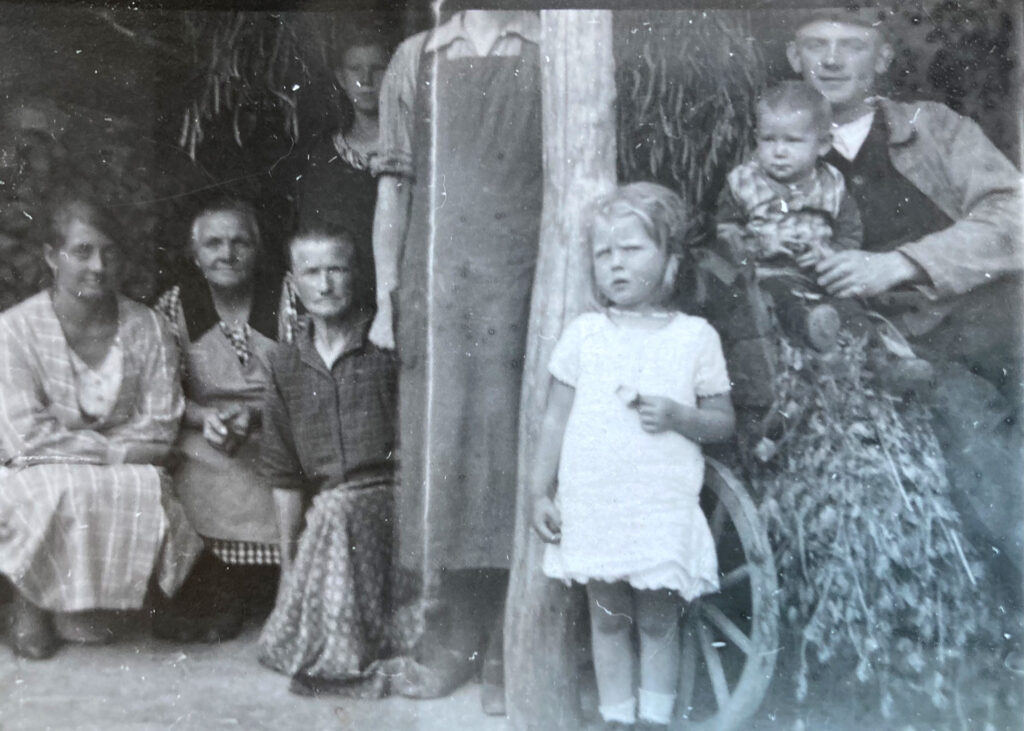
Ernst Eilers in the arms of his father Wilhelm Eilers, with his sister Hannelore standing to his left, Brünninghausen, around 1941.
Private property of Susanne Grünert.
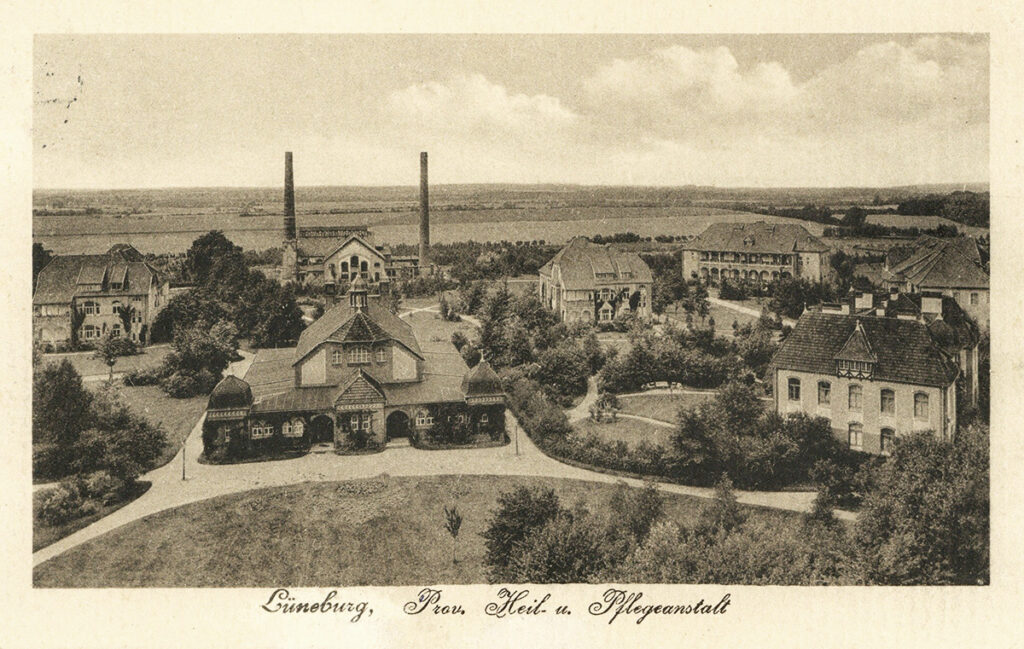
Postcard of the Lüneburg Institution and Nursing Home, 1915.
ArEGL 99.
The postcard shows the Lüneburg Institution and Nursing Home, with the clubhouse (House 36) in the foreground. In the background, you can see houses 24, 23 and 25 (from left to right), which housed the Lüneburg »children’s ward«. There are at least 13 different postcards with different motifs and views of the grounds and individual buildings. Only this card shows all the buildings of the »children’s ward«.
The girls were housed on the upper floor of House 25, while the boys were housed on the ground floor. Another 20 boys were housed on the ground floor of House 23. In autumn 1944, the »children’s ward« moved out of House 23. The boys were transferred to House 25. From the beginning of 1945, House 25 was used as a military hospital. The »children’s ward« moved to House 24 and remained there until 1946.
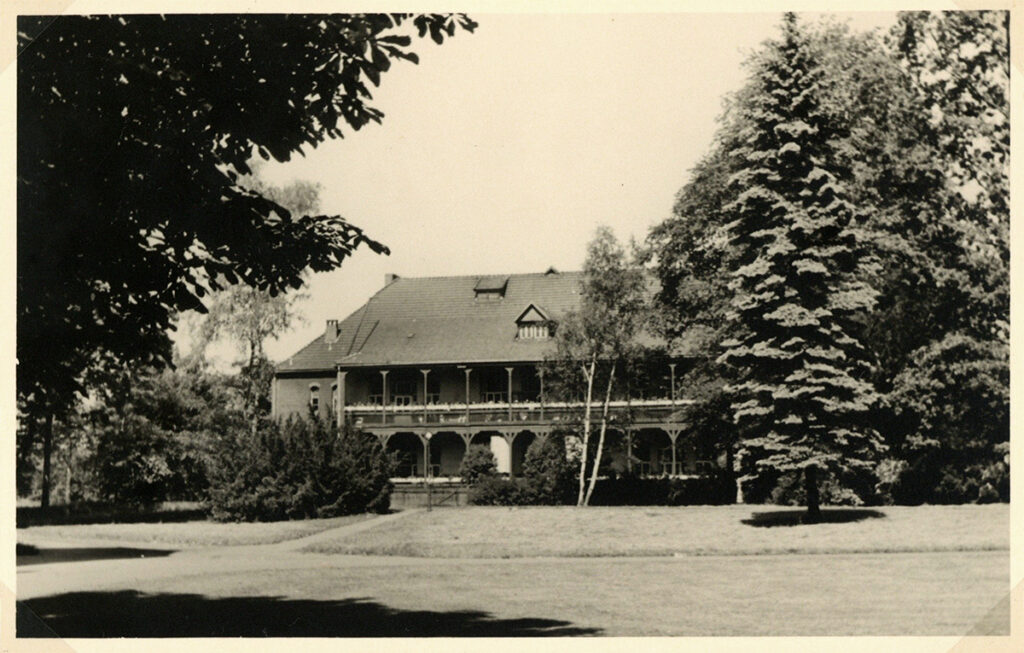
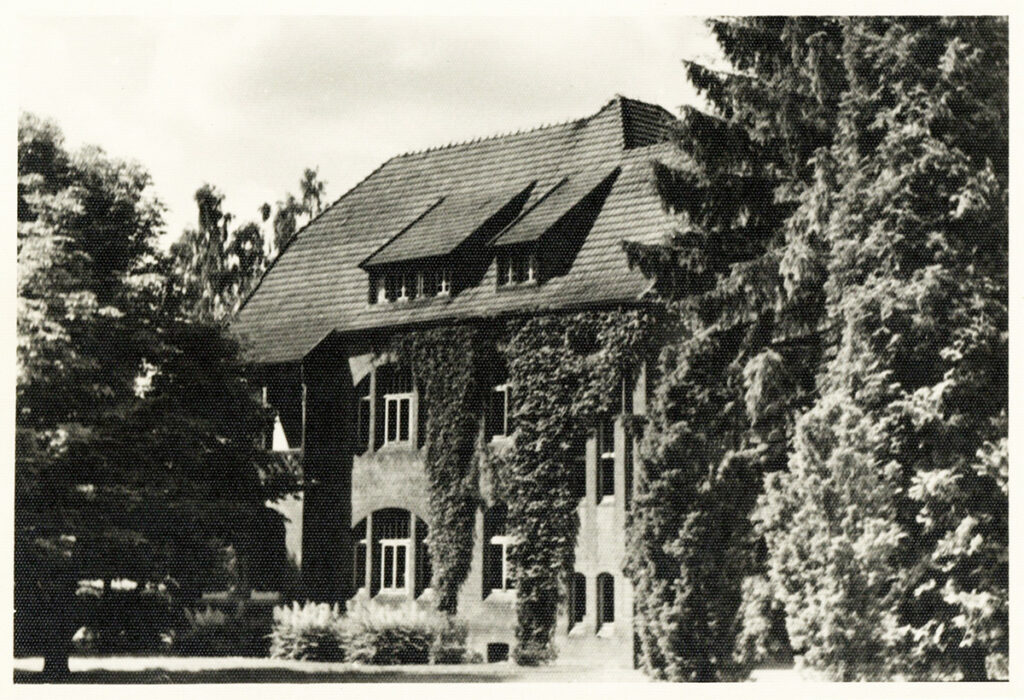
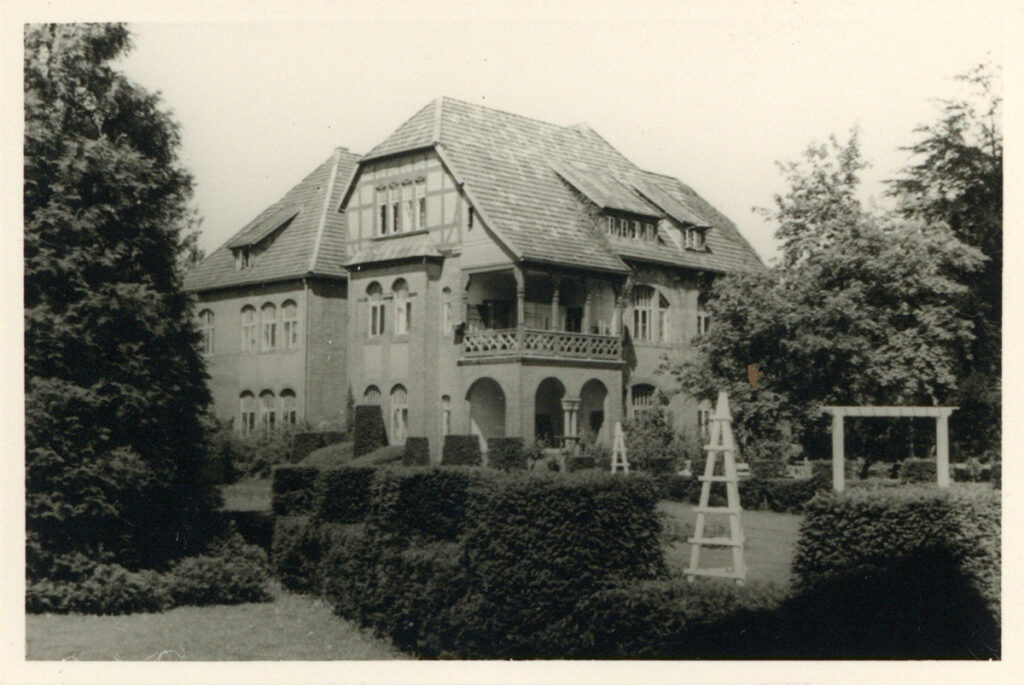
House 25, 24 and House 23, after 1950.
ArEGL 109.
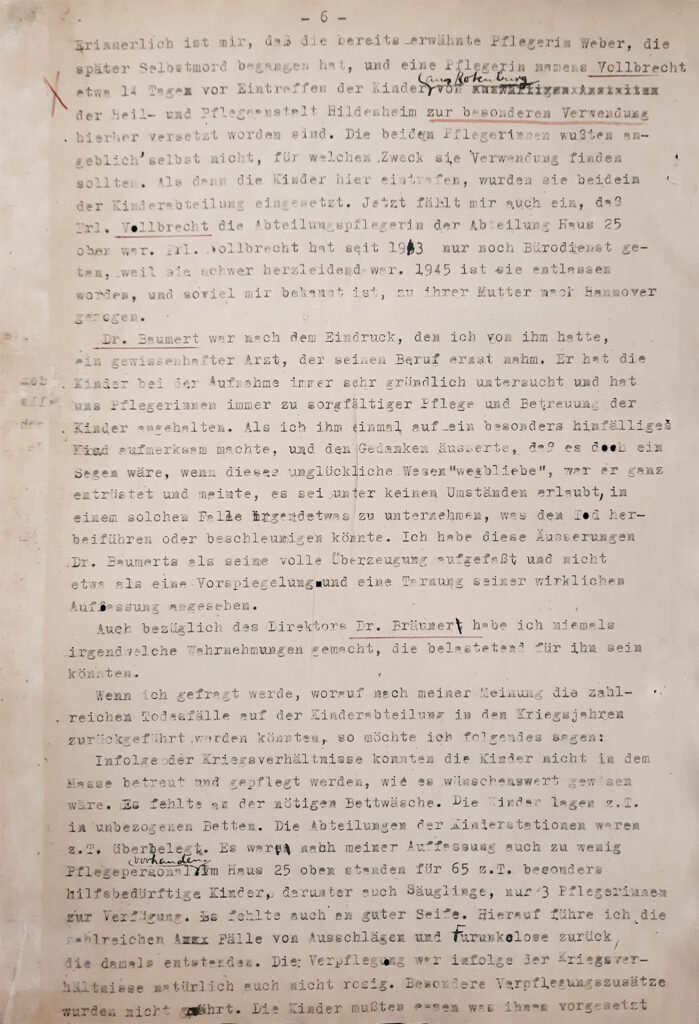
Excerpt from the transcript of the interrogation of nurse Marie-Luise Heusmann on 3 November 1947, p. 6.
NLA Hanover Lower Saxony 721 Lüneburg Acc. 8/98 No. 3.
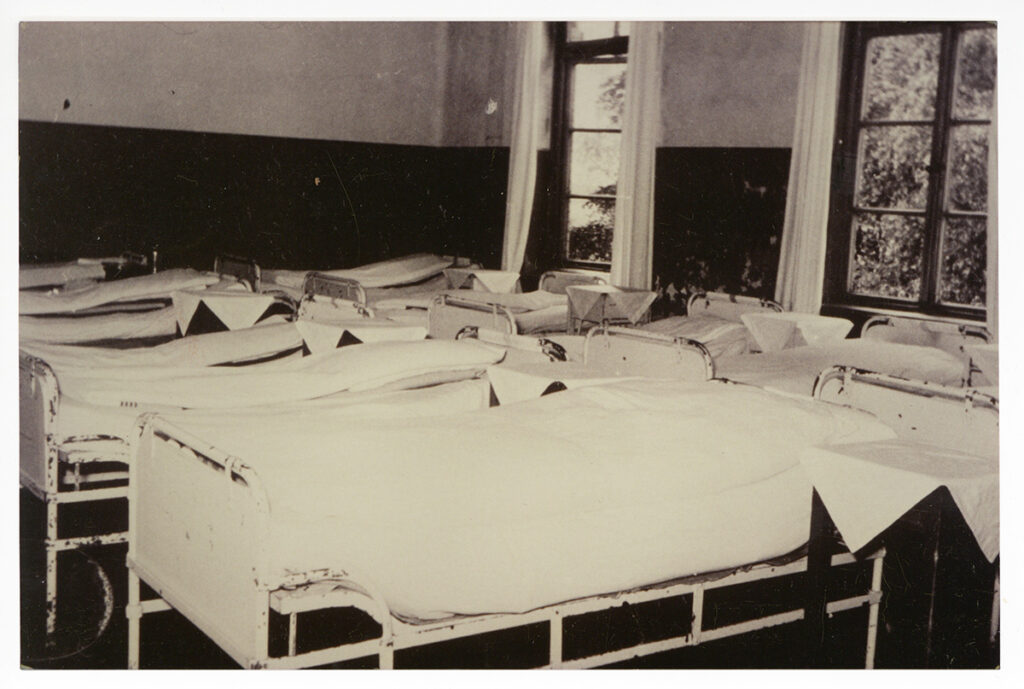
Photo taken in a dormitory at the Lüneburg mental hospital after 1945. The furnishings were basic. Only the bare essentials were provided.
ArEGL 122.
There were large bedrooms with too few beds. Children had to share beds or lie on mattresses on the floor. There was not enough laundry and toiletries. Children who could not use the toilet were not washed adequately. They often did not receive clean clothes. Beds were rarely changed, and children lay in their own excrement. Due to poor hygiene and inadequate nutrition, skin and intestinal diseases spread.
When Elly Endewardt wanted to visit her son Jürgen three days after he was admitted, she was not allowed to see him. The mother entered the room anyway and saw a nurse hiding dirty bed linen under the bed. Apart from a duvet that was much too thin, she saw that Jürgen was completely naked despite the winter temperatures. Two weeks later, she visited twice more to speak to the medical director. The next day, Jürgen was dead.
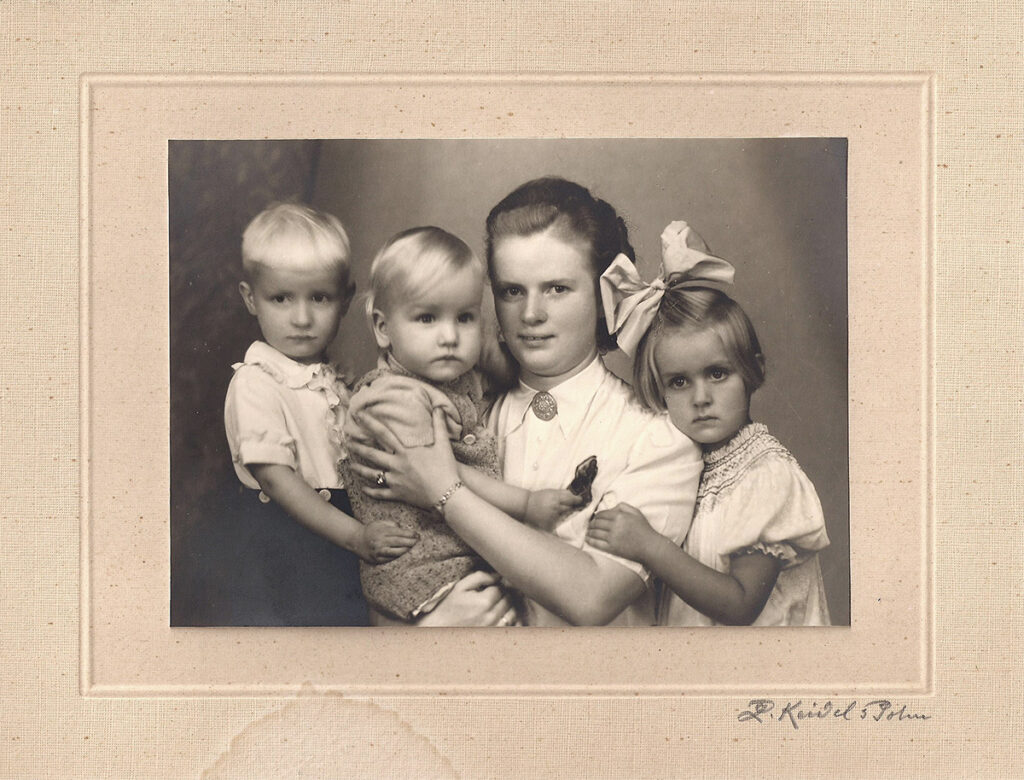
Elly Endewardt with her three children Dieter, Jürgen and Ute (from left to right), summer 1942.
Private collection Barbara Burmester | Helga Endewardt.
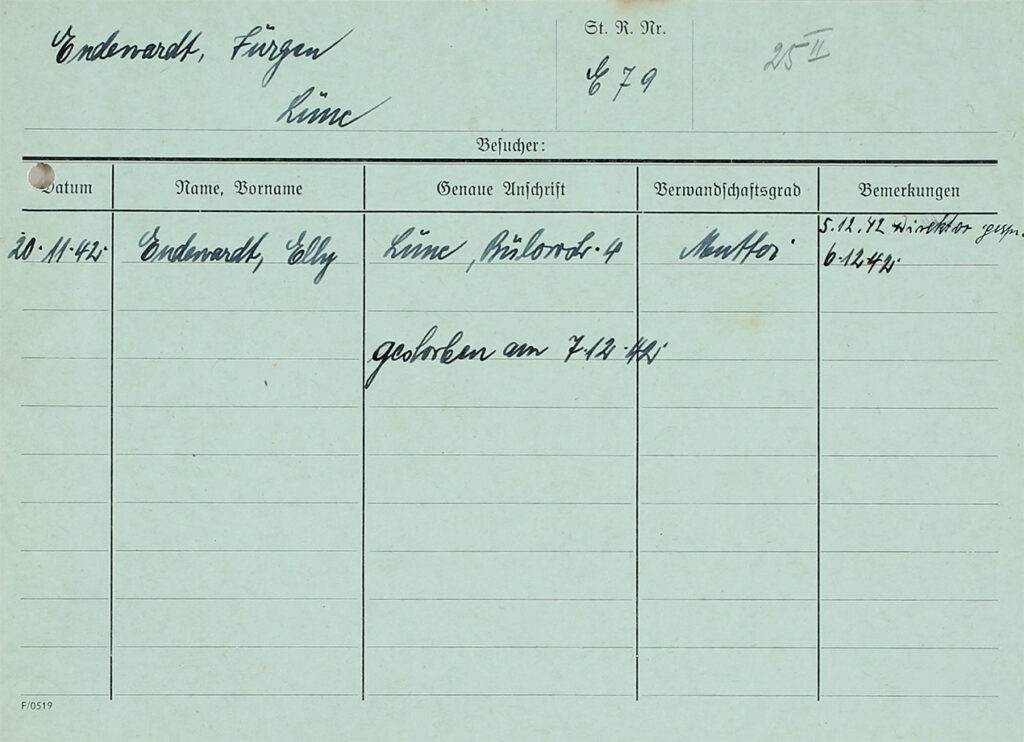
Visitor index card for Jürgen Endewardt.
NLA Hanover Hann. 155 Lüneburg Acc. 56/83 No. 234.
Many parents complained that toys they had given their children disappeared. There was no school and no therapy. Nothing was done for the children and young people. Those young people who were »fit for work« had to help with gardening or field work. No one took care of the younger children until they were murdered.
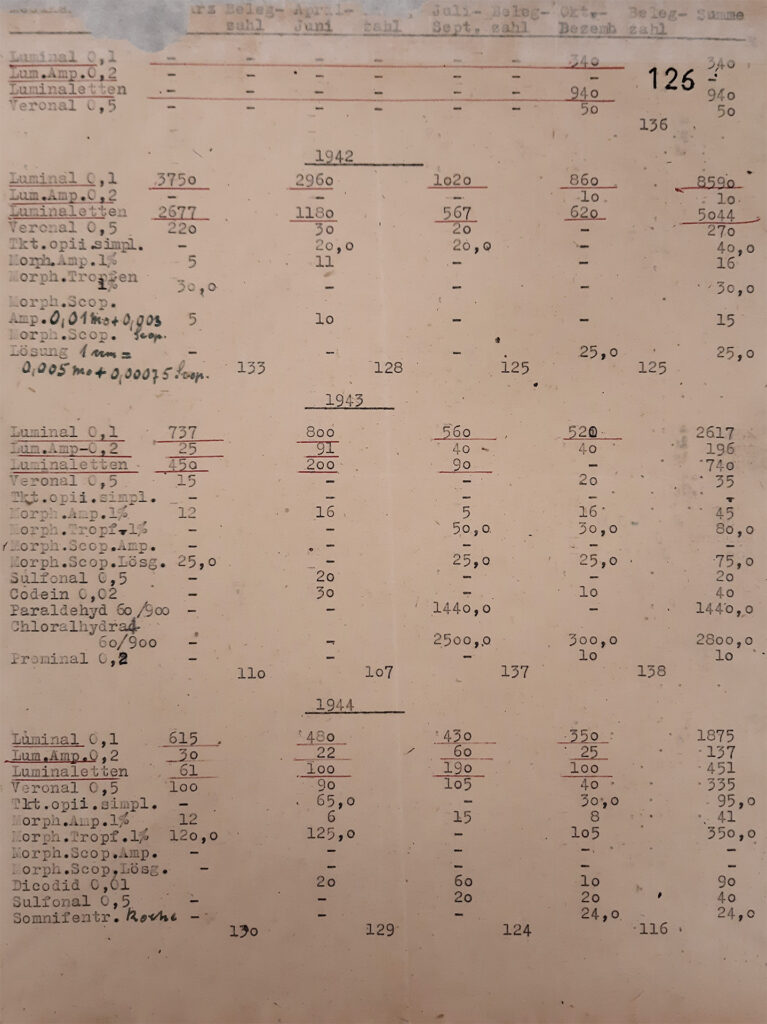
List of medication consumption 1941–1948.
NLA Hanover Lower Saxony 721 Lüneburg Acc. 8/98 No. 3.
The lives of children and young people depended on whether doctors assessed them as »capable of development« and »capable of education.« Poor development or low abilities were deemed »unworthy of life.« Even if extensive care was required, »treatment,« i.e., euthanasia, was considered. Doctors received so-called »authorisations« from the »Reich Committee.« Often, several were issued in a single day, as this list from Eglfing-Haar shows.
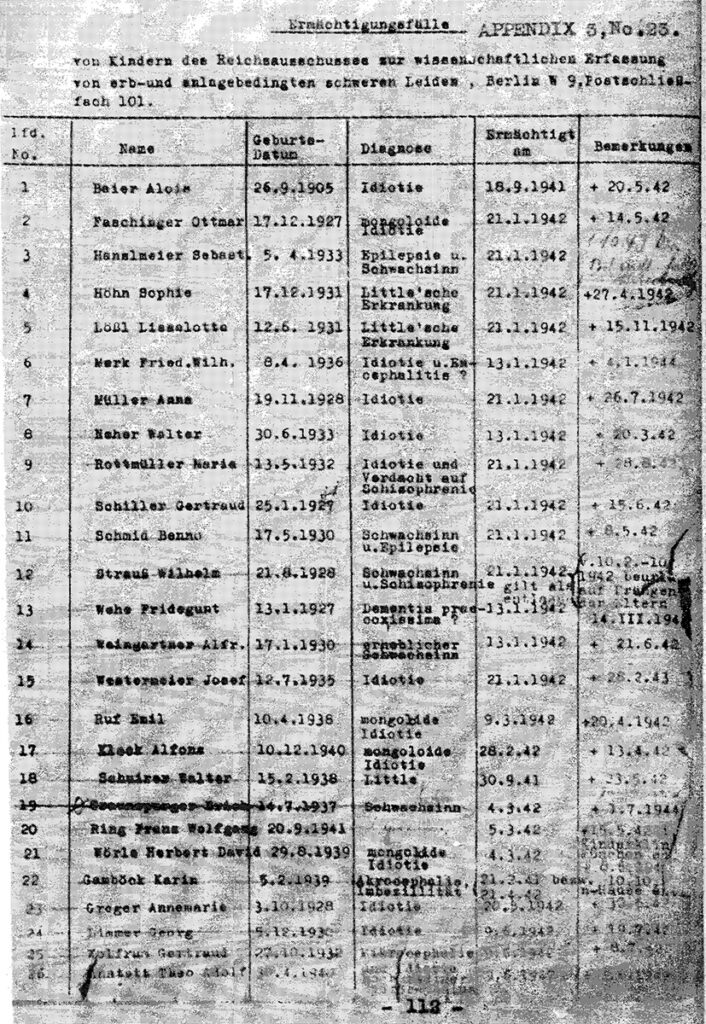
Excerpt from a list of authorisation cases from Major Leo Alexander’s report for the Nuremberg Doctors‘ Trial, in: Lutz Kälber: Kindermord in Nazi-Deutschland (Infanticide in Nazi Germany), in Gesellschaften 2, 2012.
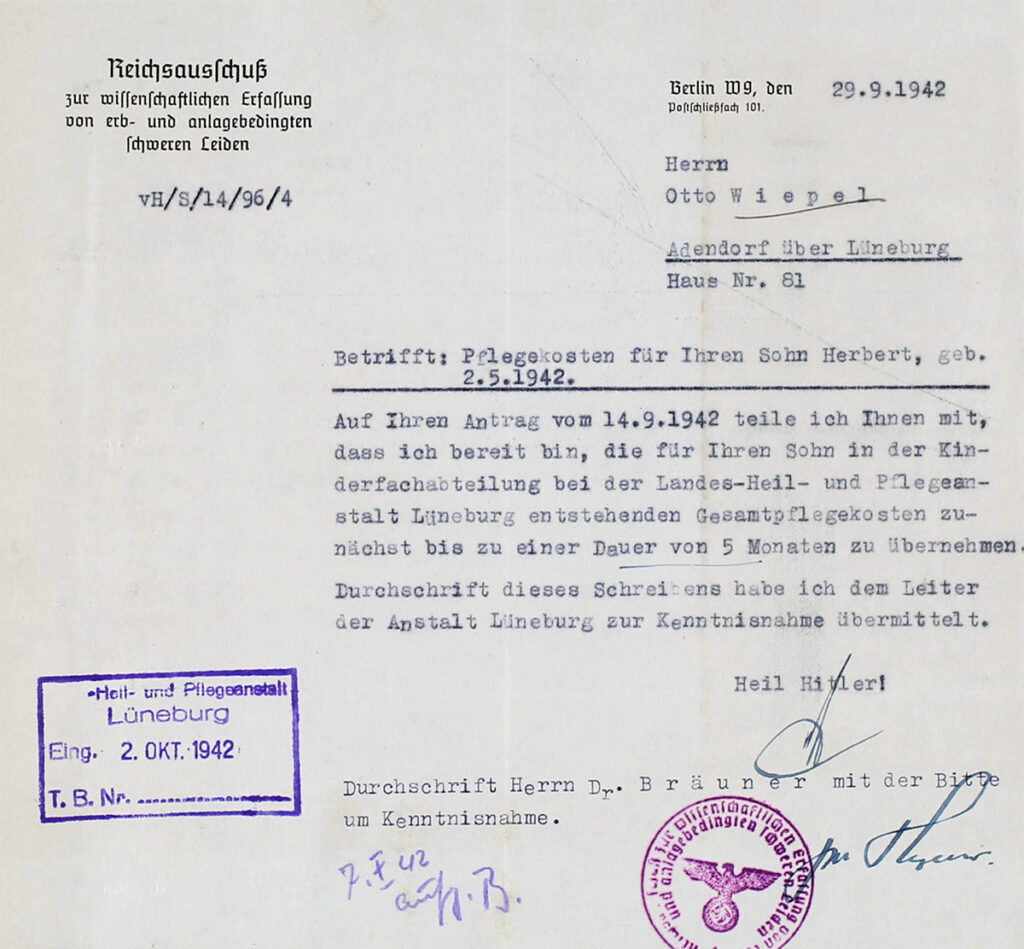
Letter from the Reich Committee to Otto Wiepel dated 29 September 1942.
NLA Hanover Hann. 155 Lüneburg Acc. 56/83 No. 428
Otto Wiepel was assured by the »Reich Committee« that it would cover the costs of Herbert’s care for five months. That was the calculated life expectancy, because that was all the time the doctors and authorities had to carry out and administer Herbert’s murder.
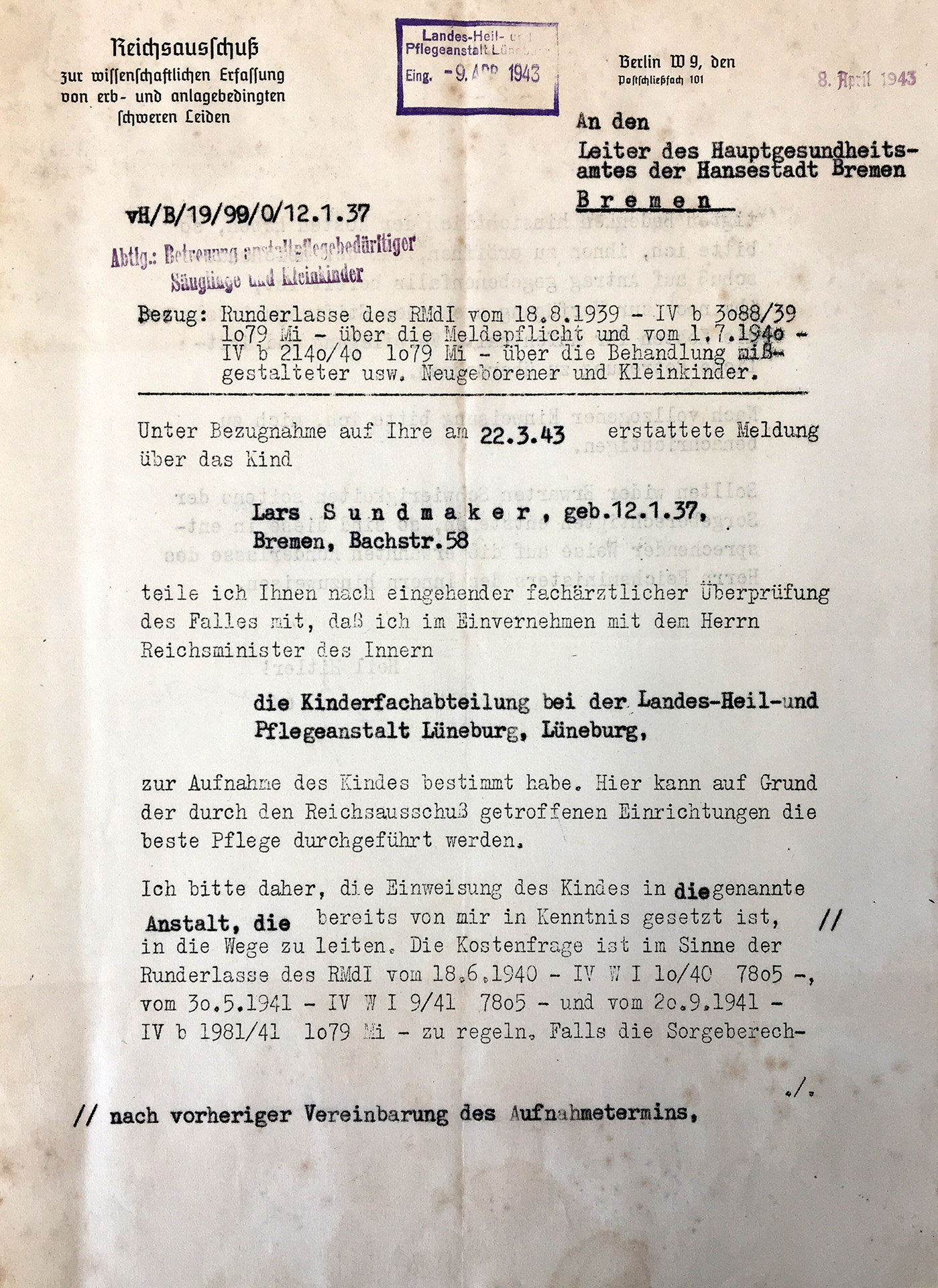
Admission order from the »Reich Committee« for the admission of Lars Sundmäker to the »Children’s Ward« in Lüneburg, 8 April 1943.
NLA Hanover Hann. 155 Lüneburg Acc. 56/83 No. 405.
The »Reich Committee« determined admission to a »specialised children’s ward.« It also issued a »treatment recommendation.« Without having seen or met the children and adolescents, the experts Catel, Wentzler and Heinze marked the form with a red cross, a blue minus sign or a »B.« The Lüneburg »children’s ward« received a corresponding »treatment recommendation« in return. The cross meant murder, the »B« stood for »observation« and meant deferral, and the blue minus meant no murder.
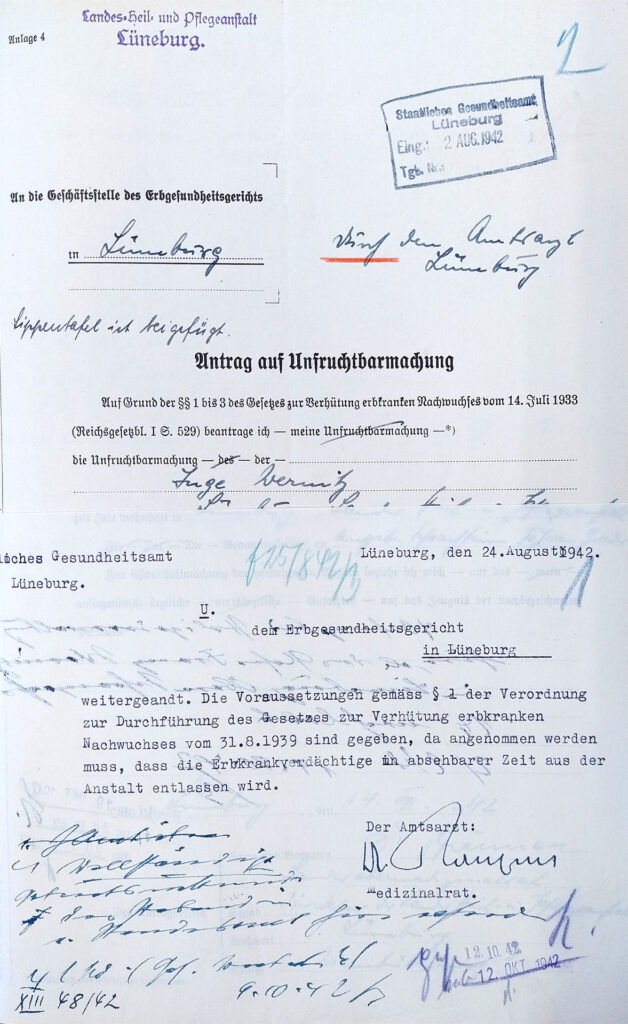
Applications for sterilisation by Max Bräuner and Hans Rohlfing from August 1942.
NLA Hanover Hann. 138 Lüneburg Acc. 103/88 No. 609.
For Ingeborg Wernitz, sterilisation was a mandatory requirement for her to be discharged from the »children’s ward«. The application was submitted four months before her 14th birthday. She was forcibly sterilised on 21 January 1943 and only discharged afterwards.
The young people murdered in Pfafferode are:
Ilse Allrütz (1928 – 1944)
Richard Bergmann (1926 – 1943)
Rolf Erbguth (1928 – 1943)
Harald Frandsen (1926 – 1944)
Kurt Nolte (1925 – 1944)
Gerda Plenge (1927 – 1945)
Otto Schulz (1927 – 1944)
Ekatharina Taranowa (1926 – 1944)
