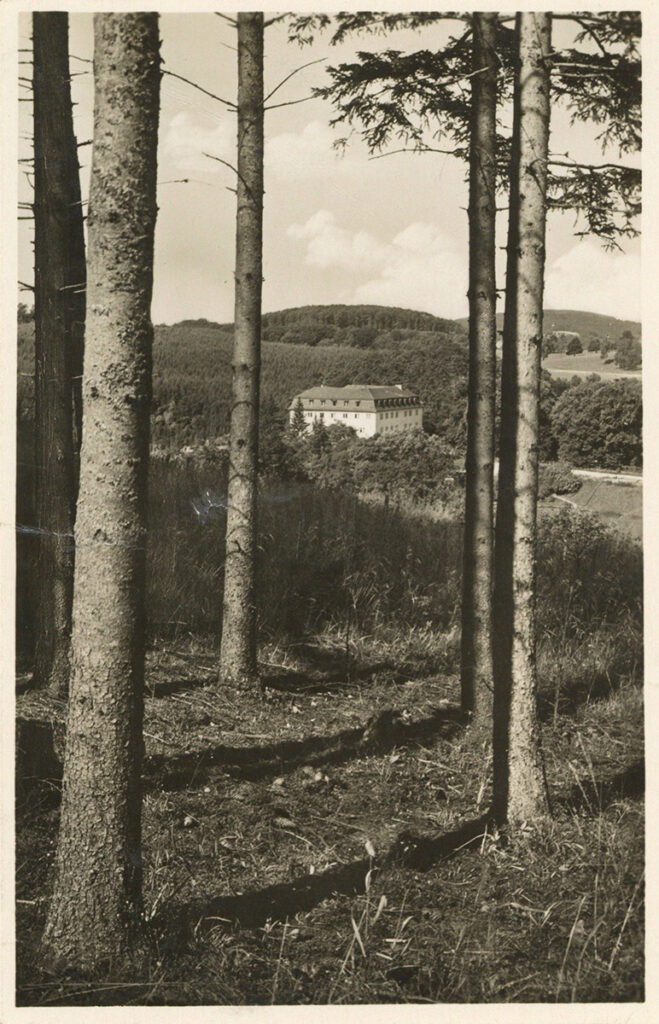
Postcard from the Samaritan Foundation in Grafeneck, before 1934.
ArEGL 99.
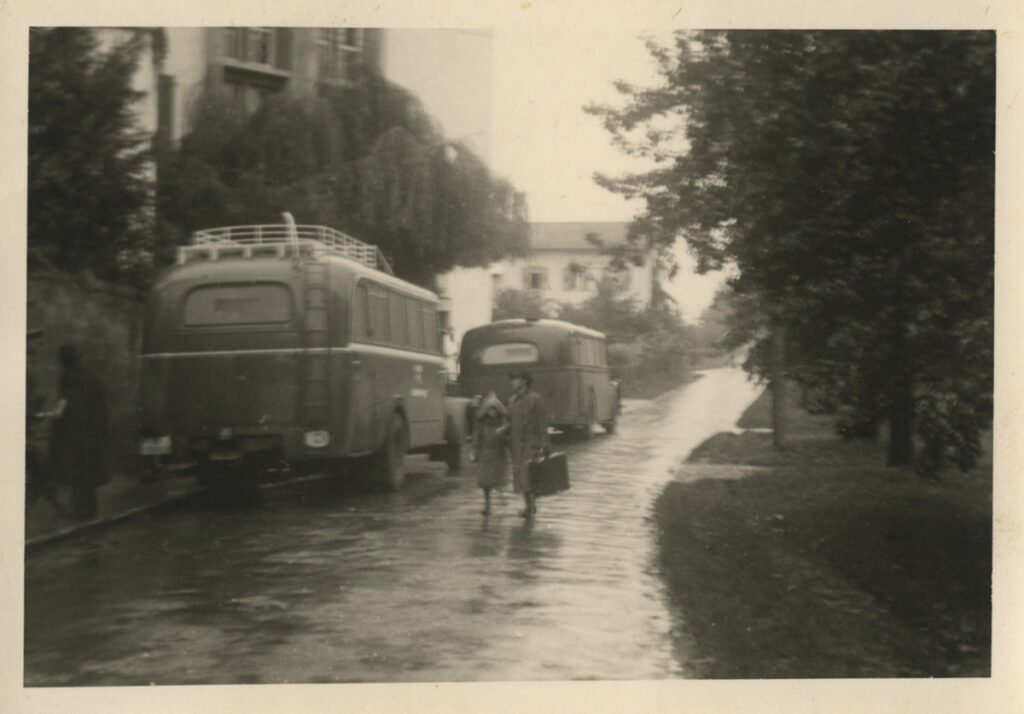
This photograph of the buses was taken between September and November 1940 at the Stetten institution. Only sick women were transferred from here to the Grafeneck killing centre. It shows a woman with a suitcase in front of Reichspost buses belonging to »Aktion T4«, holding a girl by the hand. The photograph was taken secretly.
HADS (Historical Archive of the Stetten Diakonie) 3675.
GRAFENECK
The Grafeneck killing centre was located in a former hunting lodge, which had been used by the Samaritan Foundation as a home for people with disabilities since 1929. In October 1939, it was confiscated and converted into a killing centre by January 1940. The killing of the sick began on 18 January 1940 in a gas chamber disguised as a shower room, which was located in a garage. The victims came from 48 institutions in Baden-Württemberg, Bavaria, Hesse and North Rhine-Westphalia. On 13 December 1940, the last victims were cremated in the crematorium. A total of around 10,000 sick people were murdered in Grafeneck as part of »Aktion T4«. After the closure, the staff were transferred to the Hadamar killing centre in Hesse. In the years that followed, the castle building was used for the so-called Kinderlandverschickung (children’s evacuation programme). In 1945, the home was used by the French occupation authorities and returned to the Samaritan Foundation in 1946 and 1947. People with disabilities who had survived the war moved back into the castle. Today, there is a memorial in Grafeneck.

back