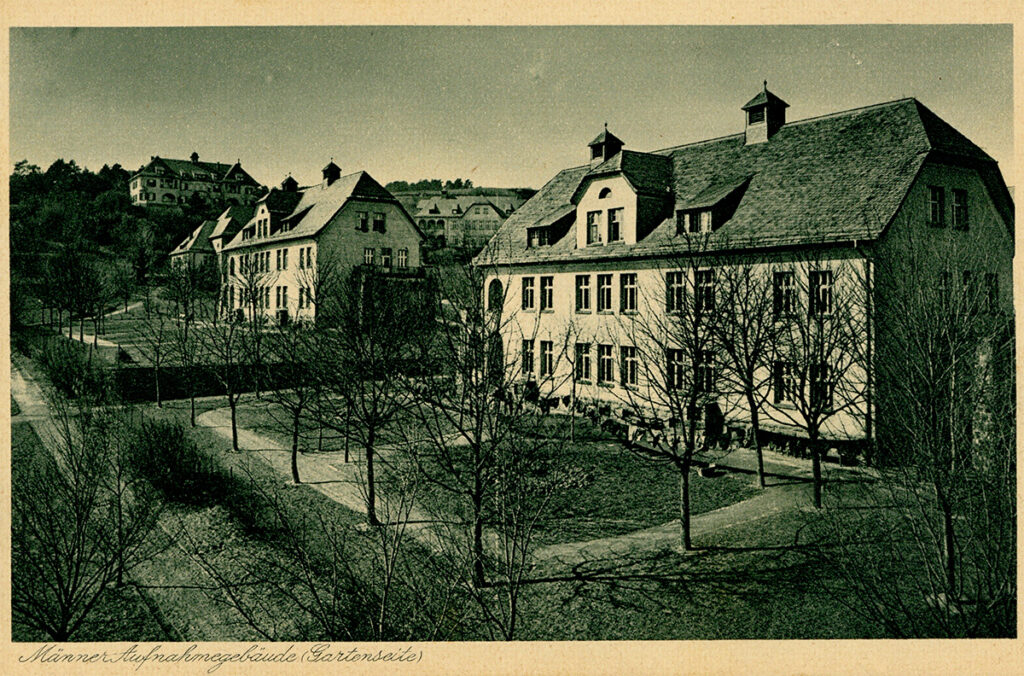
Intermediate institution Herborn mental hospital and nursing home, men’s admission building (garden side), undated.
ArEGL 99.
HERBORN
In 1906, the state parliament of the Wiesbaden administrative district decided to establish a institution and nursing home in Herborn in the Dillkreis district. The institution admitted its first patients in 1909. During the First World War, the mortality rate among patients increased due to malnutrition and the »Spanish flu«. From 1933 onwards, living conditions deteriorated due to overcrowding. Straw sacks replaced mattresses. The Herborn institution and nursing home was originally designed for around 1,000 patients, but by March 1940 their number had risen to over 1,600.
In eight collective transfers between January and March 1941, more than 770 patients were transferred from Herborn to the Hadamar killing centre and murdered there. From 8 April to 1 July 1941, Herborn served as a transit centre for the institutions in Aplerbeck, Lüneburg, Marburg, Merxhausen, Warstein and Lübeck-Strecknitz. A total of 885 patients were brought to Herborn from these six institutions. The largest group came from Lüneburg. Up to nine weeks passed between their arrival and their onward transport to the killing centre. 858 patients were transferred to the Hadamar killing centre, 18 died in Herborn and nine survived. Only rarely did patients return. In July 1941, the institution in Herborn ceased operations. The remaining patients were distributed to other facilities and the buildings were used as a military hospital until the end of the war.

back