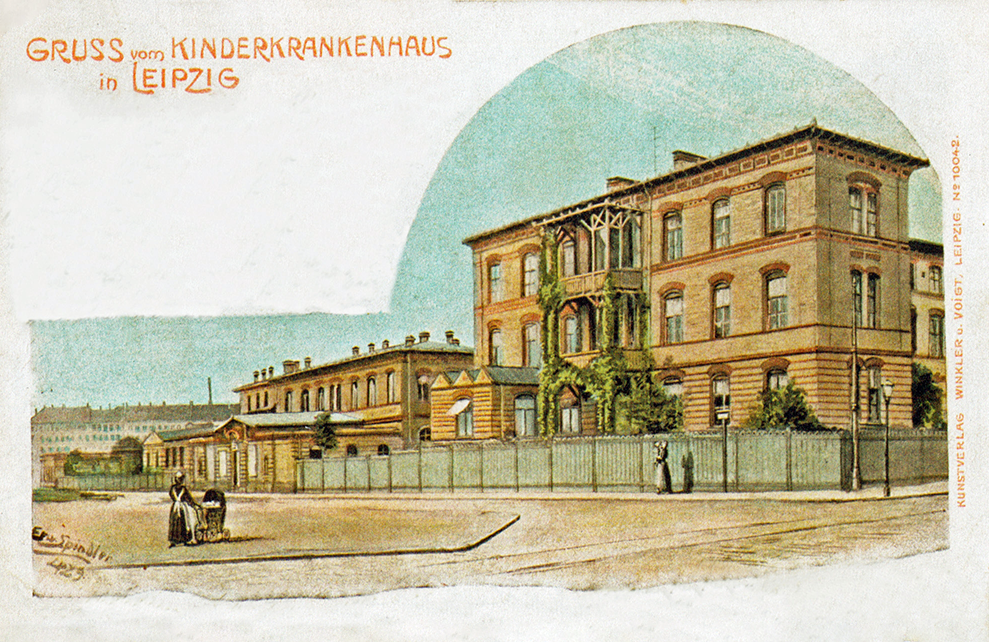
Postcard, Leipzig Children’s Hospital, around 1900.
Heinz-Jürgen Böhme | Günter Clemens: Picture Sheets – Leipzig Picture Postcard Series from 1895 to 1945, Pro Leipzig 2010.
LEIPZIG-KINDERKLINIK
The »Children’s ward« at Leipzig University Children’s Hospital began operating in 1941 as the second of three »Children’s ward« in Saxony. It was the only »Children’s ward« located at a university hospital. In December 1943, the hospital was bombed. The wooden barracks that housed the »Children’s ward« were completely destroyed. As a result, the ward continued to operate in the alternative hospitals in Klinga, Hochweitzschen and on Theresienstraße in Leipzig.
The medical director of the clinic was Werner Catel, chief assessor of the »Reich Committee«. The medical director of the »Children’s ward« was Hannah Uflacker. In addition, doctors Ernst Klemm, Hans Christoph Hempel and Hans-Joachim Hartenstein were involved in the murders.
The total number of children and adolescents admitted to the children’s hospital and murdered there is unknown. Estimates put the figure at several hundred. Among them is Gerhard Kretschmar, who, at the age of five months, became the first child victim of »euthanasia« on 25 July 1939.
Werner Catel conducted human experiments on children and adolescents under the guise of scientific research. He implanted hormone glands from calves and irradiated children. He also assigned himself those children whom he could exploit scientifically, such as children with cleft palates and children with so-called »water on the brain«.
After the war, Werner Catel was denazified as »unburdened«. He initially headed the Mammolshöhe children’s Institution, where he tested drugs on children, leading to their deaths. In 1954, he became a professor of paediatrics in Kiel. It was not until 1960 that he lost his position due to public pressure. Investigations against Hannah Uflacker were dropped in 1964. She worked at the Hanover Health Authority and at Justus Liebig University in Giessen, and wrote a well-known textbook on childcare. She took her own life after losing her medical licence as a result of the criminal investigations. After the war, Ernst Klemm became a doctor at the children’s hospital in Zeven. Hans Christoph Hempel became medical director of the hospital and children’s hospital in Karl-Marx-Stadt. Hans-Joachim Hartenstein worked as a paediatrician in private practice in Berlin.

back