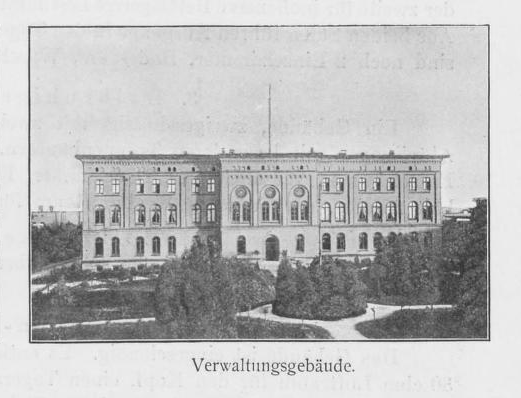
Illustration from Bresler, Johannes: German Hospitals and Care Facilities for the Mentally Ill in Words and Pictures, Halle a. S. 1910, p. 241.
TIEGENHOF | DZIEKANKA
The Polish institution Dziekanka near Gniezno (Poland) only became the German Tiegenhof Institution and nursing home after the German occupation. The »Children’s ward« there was established in early 1943 and existed until at least 1944.
Viktor Ratka had been medical director of Tiegenhof since 1934 and was involved in the killing of patients until 1945. From 1941 to 1943, he took on special tasks for the »T4« headquarters. During this time, the Baltic German Vladimir Nikolayev ran the sanatorium and nursing home. He had come to Tiegenhof in the course of the resettlement in 1939. From the summer of 1942, Warhold Ortleb ran the institution on an interim basis. Walter Kipper was the head of the »Children’s ward« at Tiegenhof.
The first children and adolescents were admitted in February 1943. By 1945, the »Children’s ward« had admitted 138 Polish, ethnic German and German children and adolescents aged between four months and 14 years. By 1945, 88 children and adolescents had been murdered. Tiegenhof was located in the central settlement area of the ethnic Germans.
In total, over 2,000 adult patients were murdered in Tiegenhof. Many patients were also murdered in Fort VII and in gas vans.
After the war, Nikolajew lived in Uelzen and worked as a private doctor. He died in 1975. Ratka was in the Pfafferode Institution in 1945 and fled to North Hesse in 1949. He died in Baden in 1966. Kipper went to Gmunden (Austria) and worked as a doctor. All investigations against the doctors were dropped.

back