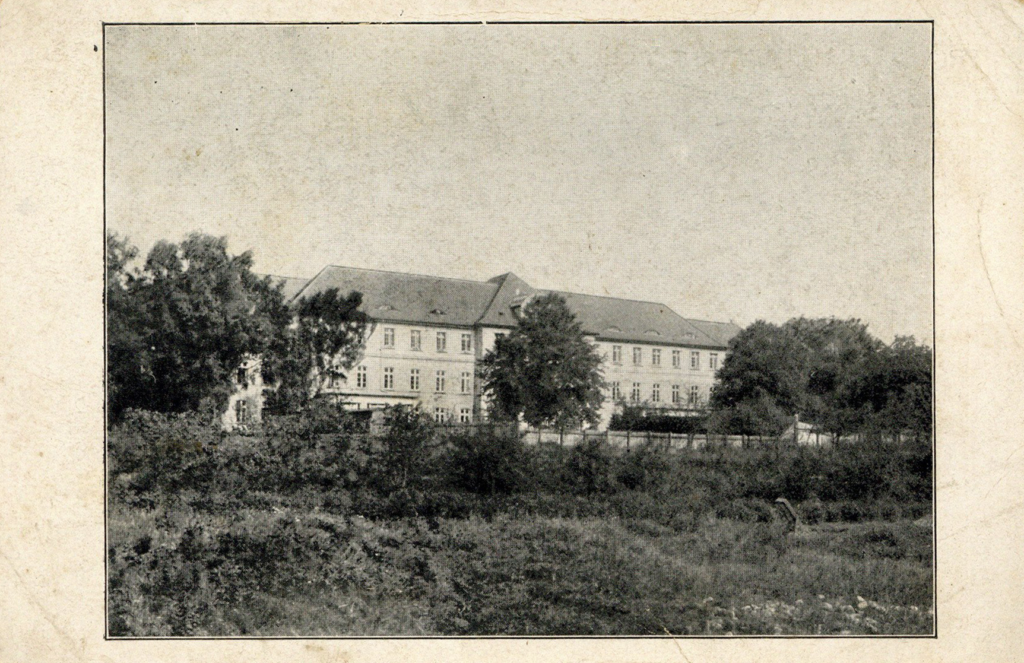
Postcard of the Schleswig (Stadtfeld) sanatorium and nursing home, before 1930.
ArEGL 99.
SCHLESWIG-STADTFELD
Carl Grabow was the medical director of the Schleswig-Stadtfeld institution and nursing home. He remained in this position until 1951 and died in 1965.
In 1941, the Stadtfeld sanatorium became the location of a ‘specialised children’s ward’ and, from February 1942, took in children and young people from the »Children’s ward« of the Hesterberg institution.
When the war began, a military hospital was set up. Space became even more limited when parts of Kiel University Hospital moved to Stadtfeld in 1944. To make room, more than 700 patients from Schleswig were transferred to the Meseritz-Obrawalde killing centre. Only 65 of them survived.
At the same time, the Reich Ministry of the Interior decided that a »foreigners‘ collection point« should be set up in Stadtfeld. In the months that followed, numerous foreign patients were transferred from Hamburg-Langenhorn and other institutions to Stadtfeld.
However, the forced labourers did not remain there long. As early as September 1944, the first transport carrying 27 sick foreign workers left Stadtfeld. Their destination is unknown. A second transport followed in November 1944. Twenty men and 28 women were transferred to the ‘foreigners‘ collection centre’ in Lüneburg.

back