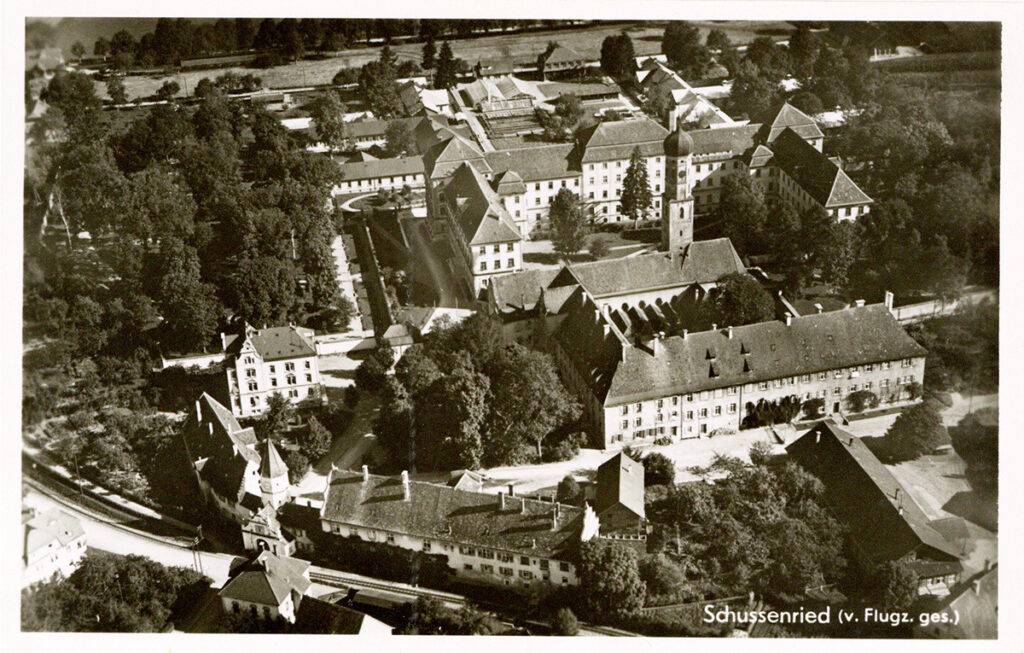
Aerial view of the Schussenried institution and nursing home, circa 1930s.
ArEGL 99.
SCHUSSENRIED
A institution and nursing home was established in the baroque monastery complex in Schussenried (Baden-Württemberg) in 1875.
With the outbreak of war in 1939, accommodation conditions in Schussenried deteriorated dramatically. From June 1940 onwards, numerous »planned transfers« took place, as Schussenried took on the function of a transit institution. More than 460 patients were transferred to Grafeneck and murdered there.
In September 1944, Schussenried was commissioned to set up a »foreigners‘ collection point«. The collection point was to be responsible for Baden, Württemberg and Hohenzollern. As a result, the institution took in about a hundred Polish and Soviet forced labourers.
Although the supply situation in the institution was very poor overall, very few forced labourers died in Schussenried. In view of the foreseeable end of the war, institution director Hugo Götz applied in March 1945 to have 55 sick foreign nationals transferred to Kaufbeuren in order to relieve himself and his institution and have the sick people murdered there. The transfer failed due to the refusal of the director of Kaufbeuren.
At the end of the war, an English and a French patient armed themselves. They briefly took over the management of the institution, had nursing staff arrested and released patients. Many of the forced labourers and prisoners of war returned to their home countries.

back