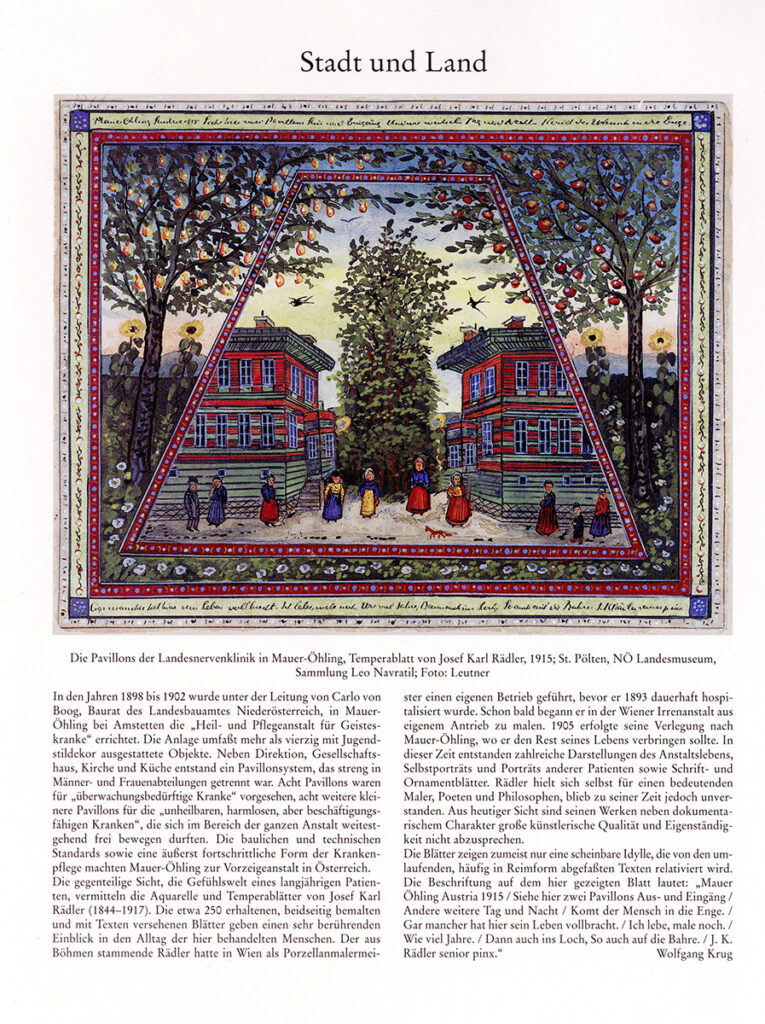
Lower Austrian Provincial Museum, St. Pölten. Leo Navratil Collection.
ArEGL 207.
MAUER-ÖHLING
The Mauer-Öhling institution and nursing home in Amstetten (Lower Austria) was founded in 1902. Until Austria’s »annexation« in 1938, it was considered Austria’s flagship institution.
In early summer 1940, a commission of experts recorded all patients at the institution. By August 1941, 1,269 patients had been transferred to the Hartheim killing centre and murdered there. Subsequently, individual buildings of the institution were used to house »ethnic German resettlers« (Bessarabia, Slovakia) and as a military hospital.
Many of the remaining patients died of malnutrition and neglect. Prisoners of war from the Stalag XVII B prisoner-of-war camp in Gneixendorf-Krems, 90 km away, were also sent to Mauer-Öhling, where they died.
The director of the institution was Michael Scharpf, who took up his post in Mauer-Öhling in 1938 and remained in office until 1945. In October 1944, he was joined by Emil Gelny, who had previously killed several hundred patients at the Gugging institution.
He was given the task of murdering the sick in Mauer-Öhling, among other things with a converted electric shock device. Gelny had developed this method of killing himself and presented it at a conference organised by the Führer’s office in July 1944. In front of the participating psychiatrists, he murdered a sick person to demonstrate the efficiency of his invention.
From September 1944 onwards, the Mauer-Öhling sanatorium and nursing home also took on the task of serving as a »collection point for mentally ill Eastern European workers and Poles« from the »Alpine and Danube regions«. Between July 1940 and April 1945, at least 204 forced labourers and prisoners of war were admitted. In November 1944, a transport with 21 foreign patients left the institution. It is very likely that this transport led to the Hartheim killing centre or the Linz-Waldegg barracks camp.
Emil Gelny received assistance in the murders from the institution’s doctor, Josef Utz. By April 1945, at least 45 patients had been murdered. In April 1945, with the Red Army already in the immediate vicinity, Gelny murdered 149 more patients, including numerous forced labourers from the »foreigners‘ collection point«. After the end of the war, none of those involved were held legally accountable.
The pavilions of the Mauer-Öhling State Psychiatric Hospital, tempera painting by Josef Karl Rädler, 1915.

back