POLITICAL THINKING
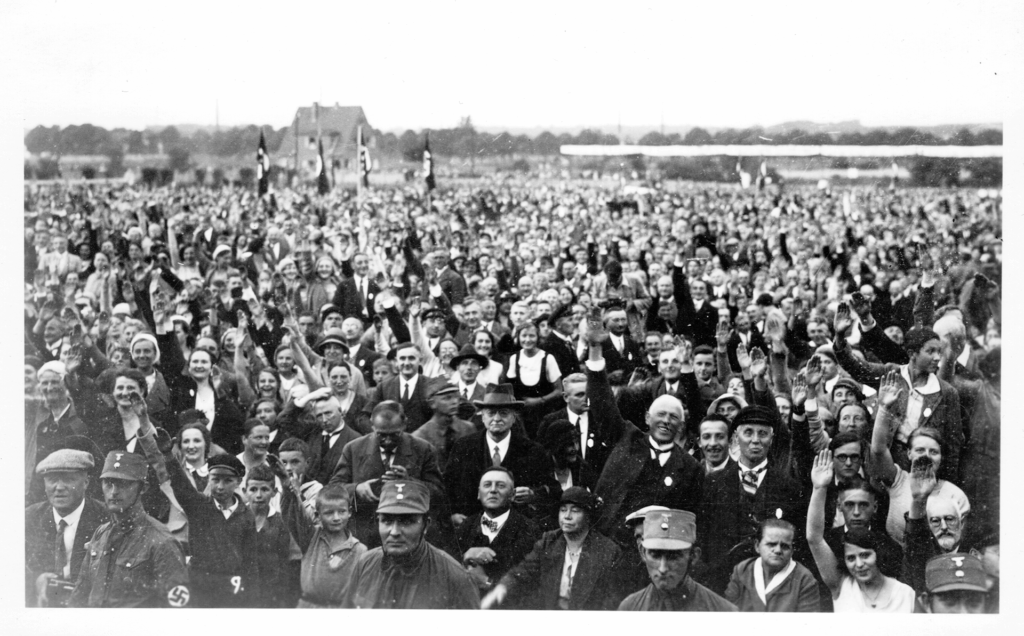
MTV-Platz, 20.7.1932.
ArML 4H046.
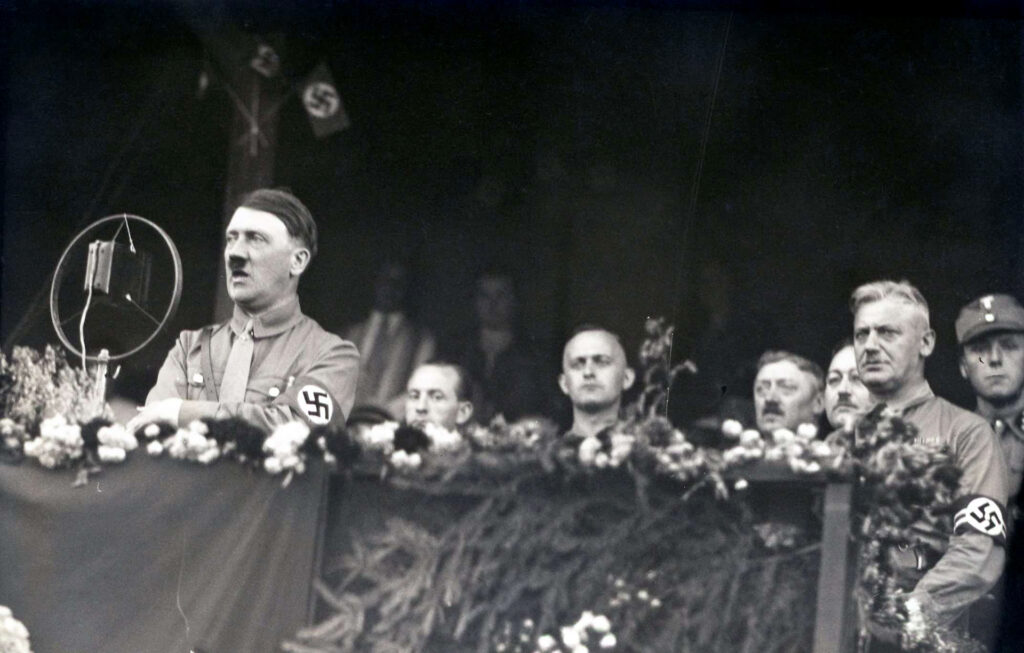
Adolf Hitler (left) in the stands of the MTV sports ground. Also in the picture are the later Gauleiter Otto Telschow (right) and the later Lord Mayor Wilhelm Wetzel (left of Telschow), 20 July 1932.
StadtALg BS 44422.
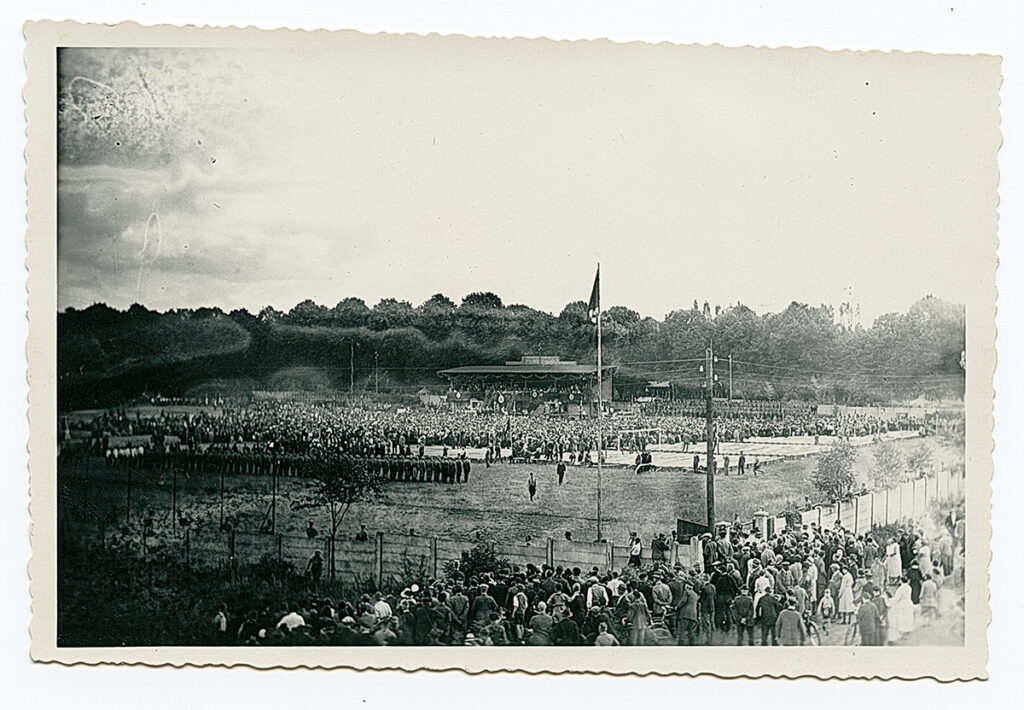
Eleven days before the Reichstag elections, Adolf Hitler visited Lüneburg on 20 July 1932 and spoke in the stands of the MTV sports ground. The NSDAP became the strongest party in the election with 39.9 per cent. It was almost ten per cent below the result for the Hanover provincial constituency, but two per cent above the national average.
It was claimed that 20,000 men and women had come to the election rally to hear Adolf Hitler. This corresponded to the population of the city of Lüneburg at the time. In reality, many benches remained empty. It is possible that many Lüneburg residents did not want to pay the entrance fee for the event.
StadtALg BS 29425 r.
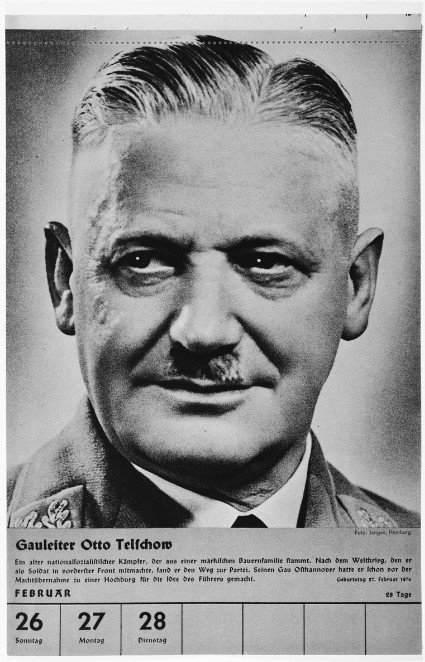
Tear-off calendar, February page with Otto Telschow, 1938.
USHMM.
Harburg was incorporated into the city of Hamburg in 1937 under the Hamburg Metropolitan Area Act. The administration of the Gau Ost-Hannover moved to Lüneburg. Gauleiter Otto Telschow’s birthday was 27 February, which is why his portrait is the February page of a tear-off calendar that the party issued once in 1938 for the year 1939. The other pages featured Heinrich Himmler (October calendar page) and Adolf Hitler (April calendar page), among others.
OTTO TELSCHOW (1876 – 1945)
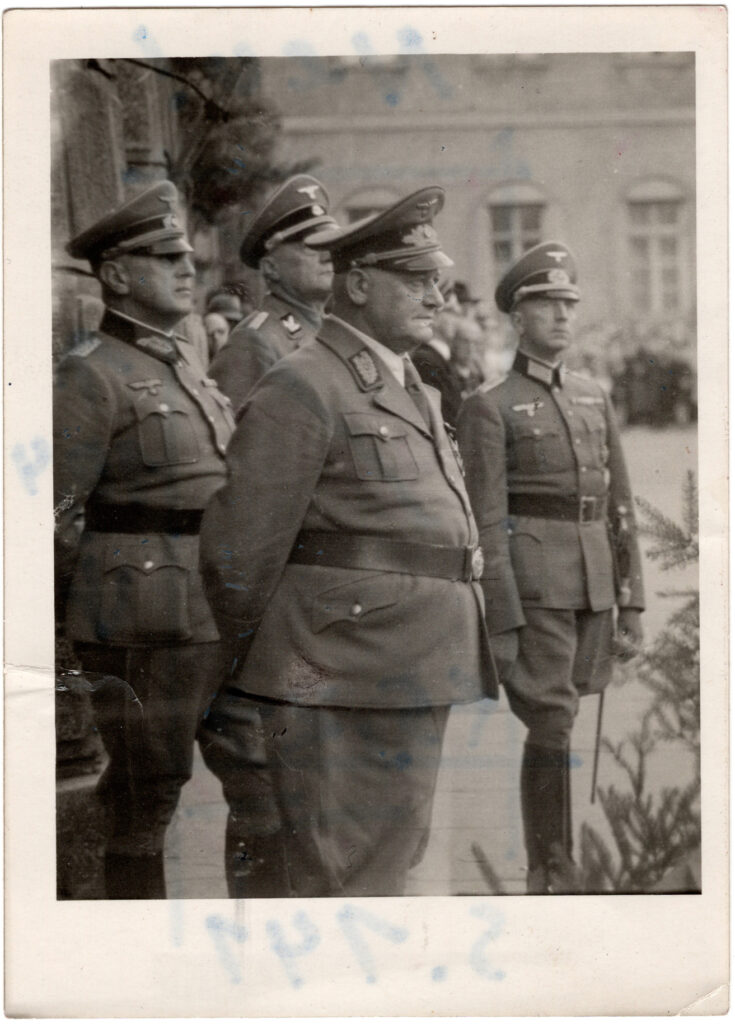
Otto Telschow at the height of his power in front of Lüneburg Town Hall, around 1936, photographer Friedrich Johns.
Archive of the Lüneburger Landeszeitung.
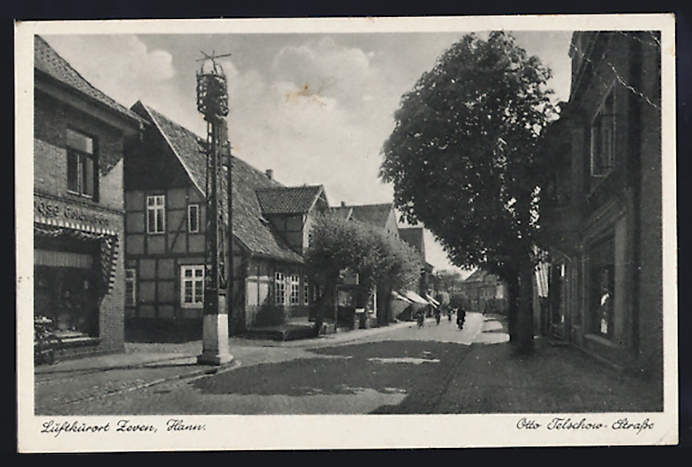
Postcard, Otto Telschow-Straße in Zeven, 1942.
ArEGL 99.
In 1928, the Gau Lüneburg-Stade was expanded to become the Gau Ost-Hannover. In the same year, Otto Telschow founded the weekly newspaper »Lower Saxony striker«. He became a member of the state parliament in 1929 and a member of the Reichstag from 1930 to 1945. He was therefore a leading Nazi.
From 1937, his district headquarters were located at Schießgrabenstraße 8/9 in Lüneburg. In the same year, the »Otto-Telschow-City« was built in Bremerhaven (now the Surheide district), a housing estate with 175 houses. Many streets were also named after Otto Telschow.
For his many years of loyalty, Adolf Hitler gave him the Lopau estate, which Telschow moved into with his family in 1942. In 1944, he failed as Reich Defence Commissioner. He was not up to the task.
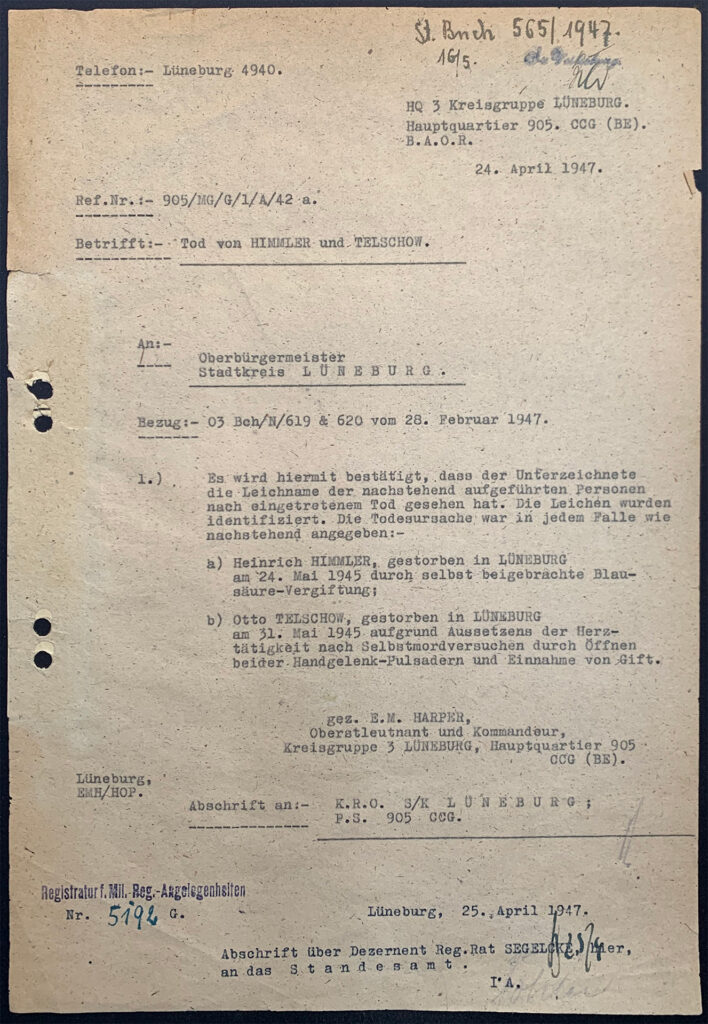
Telschow and Heinrich Himmler in Lüneburg by Headquarters 905, E. M. Harper, British Army of the Rhine, 24 April 1947.
StadtALg PSLG-S 121.
The British Army tracked Telschow down in a hunting lodge near Dahlenburg in May 1945. He had attempted suicide there. He was treated in Lüneburg Hospital and picked up by British Army soldiers on 30 May 1945. He made another suicide attempt, to which he succumbed on 31 May 1945. He was buried on the same day at Lüneburg Central Cemetery. The location of his grave is unknown.
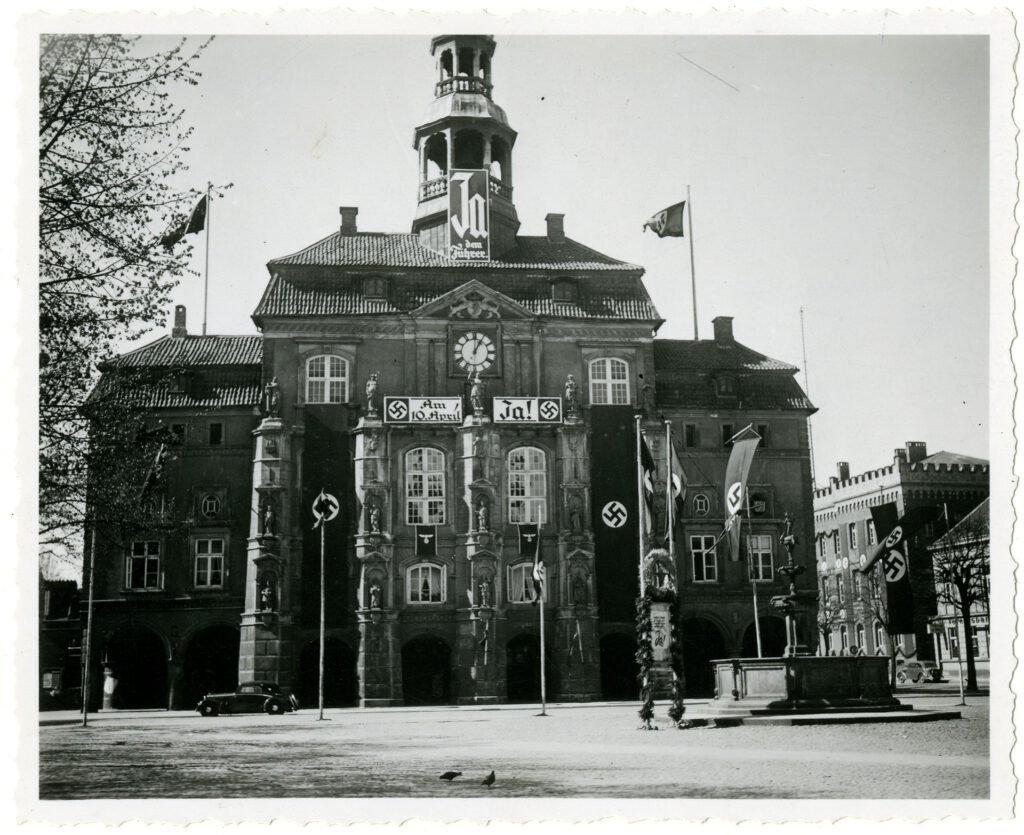
Rathaus Lüneburg, 1938.
StadtALg BS 4085.
The NSDAP was the only party running in the Reichstag elections on 10 April 1938. Lüneburg’s town hall Am Markt became a large advertising space. The election was accompanied by a subsequent referendum on the unification of Austria with the German Reich.
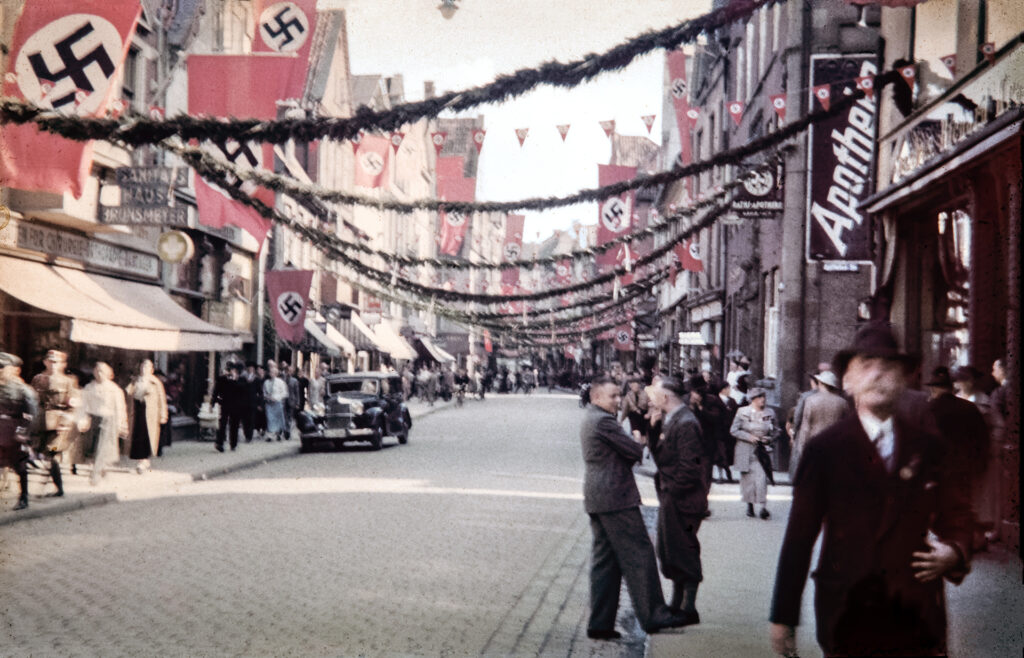
Große Bäckerstraße Lüneburg, without date.
StadtALg BS 44321.
The NSDAP and National Socialist thinking were omnipresent. Many Lüneburgers joined in. Even Große Bäckerstraße was flagged with swastika flags at every opportunity as a symbol of the »movement«.
The Hitler Youth and the League of German Girls were NSDAP organisations. There were leisure activities for healthy and well-adjusted children and young people. Uniforms were worn, songs were sung, community and traditions were cultivated. Girls and boys also learnt how to fight and survive in nature.
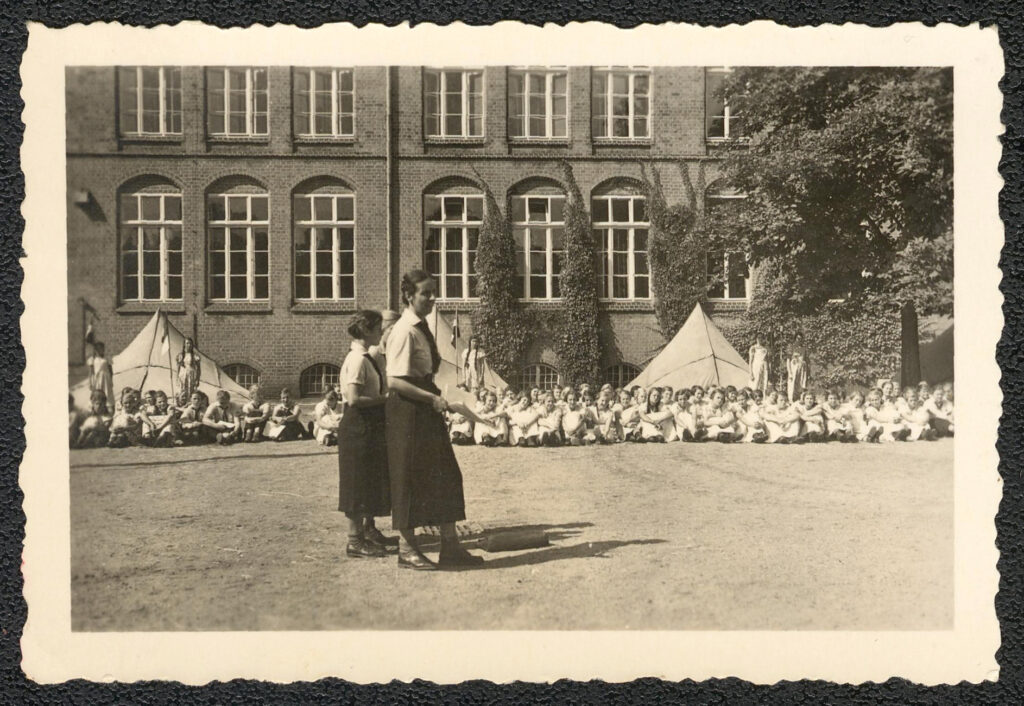
Event organised by uniformed girls in the schoolyard of the Wilhelm Raabe School. BDM annual meeting, after 1938.
StadtALg BS 47906 r.
REVALUATE AND DEVALUE
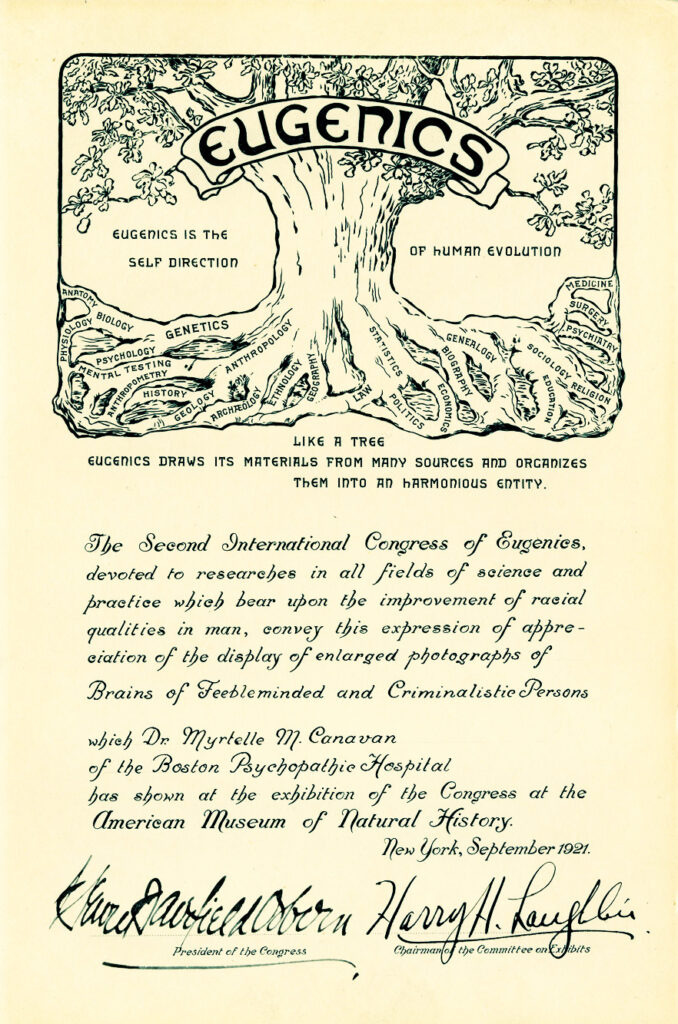
AWM, Canavan, Myrtelle M. papers, 1898-1945. GA 10.20.
Eugenics formed the scientific basis for the National Socialists‘ thinking. Eugenics pursued the goal of positively influencing human evolution as a »super science« by overcoming diseases and disabilities and increasing human abilities and performance. This was recognised internationally, particularly in the USA.
Various specialisms were incorporated into eugenics. This is symbolised by the logo of the Second International Eugenics Congress. Document signed by Henry Fairfield Osborn and Harry Hamilton Laughlin, September 1921.
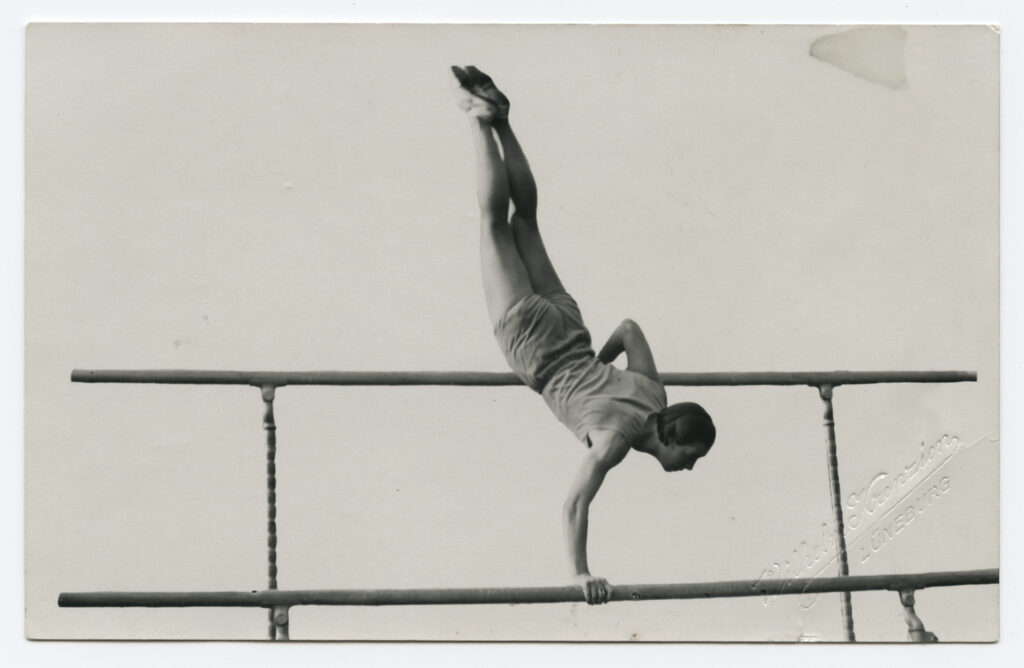
The picture shows Paula Pöhlsen, 1st winner in Stuttgart in 1933, doing a handstand on the uneven bars in the courtyard of the MTV hall in Lüneburg at the pre-Olympic qualifying tournament in autumn 1935.
StadtALg,BS, XX-MTV-Treubund-1044.
The National Socialists reinterpreted »eugenics« in ethnic terms. A supposed »Aryan race« was considered superior. People who did not belong to this »master race« in the eyes of the National Socialists were devalued. This included Jews in particular, but also people from lower social classes, offenders, dissidents, the sick and people with disabilities.
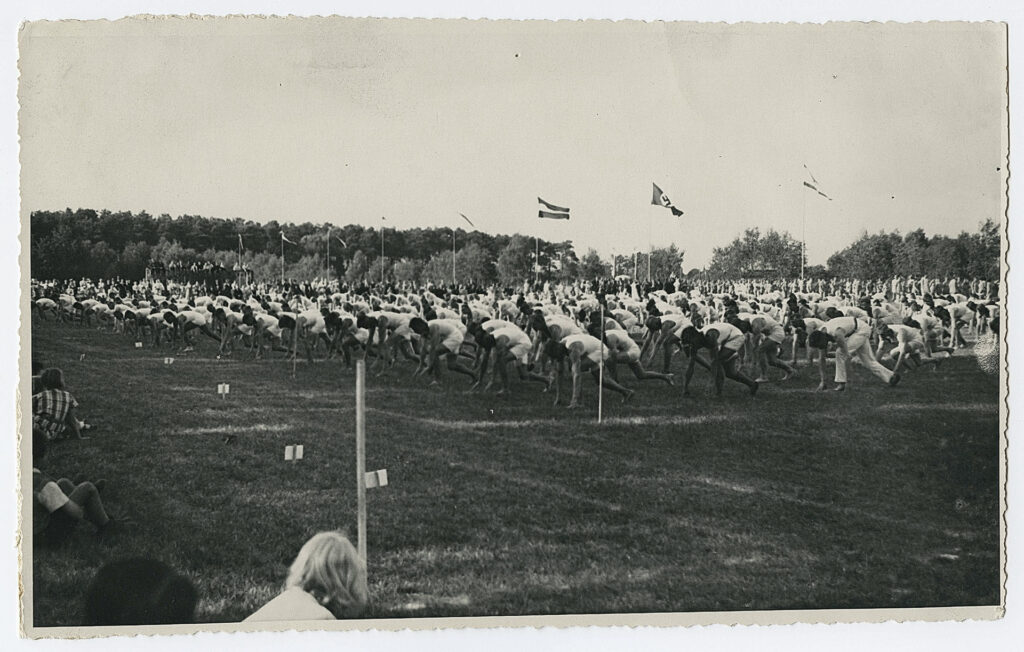
Open exercises on the sports field at the first district gymnastics festival in Winsen on 1 July 1934.
StadtALg, BS, XX-MTV-Treubund-1024.
At the centre of National Socialist thinking was the
creation of a »healthy, pure-blooded national body«. In the course of the gymnastics movement after 1850, there was already an awareness of the importance of maintaining a healthy body through sport. Under National Socialism, health care became a cult of the body with the aim of strengthening the »Aryan race«.
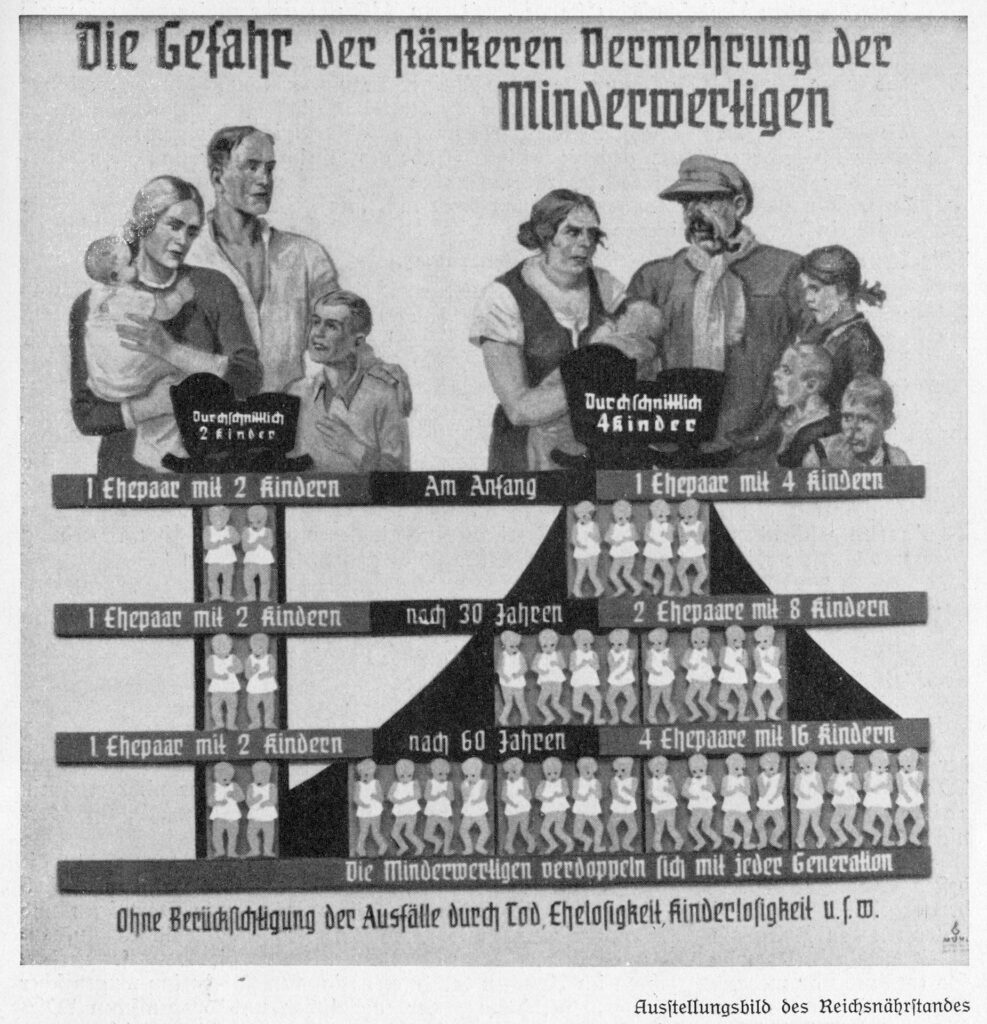
»The danger of a greater increase in the number of inferiors« from »Volk und Rasse«, Oktober 1936.
Bavarian State Library Munich | Picture Archive.
This is an exhibition picture of the »Reichsnährstand«. It is supposed to prove that healthy Germans are dying out. But the calculation is wrong.
Spending money on people in need of care was seen as »anti-social«. Those affected were devalued as »useless parasites«.
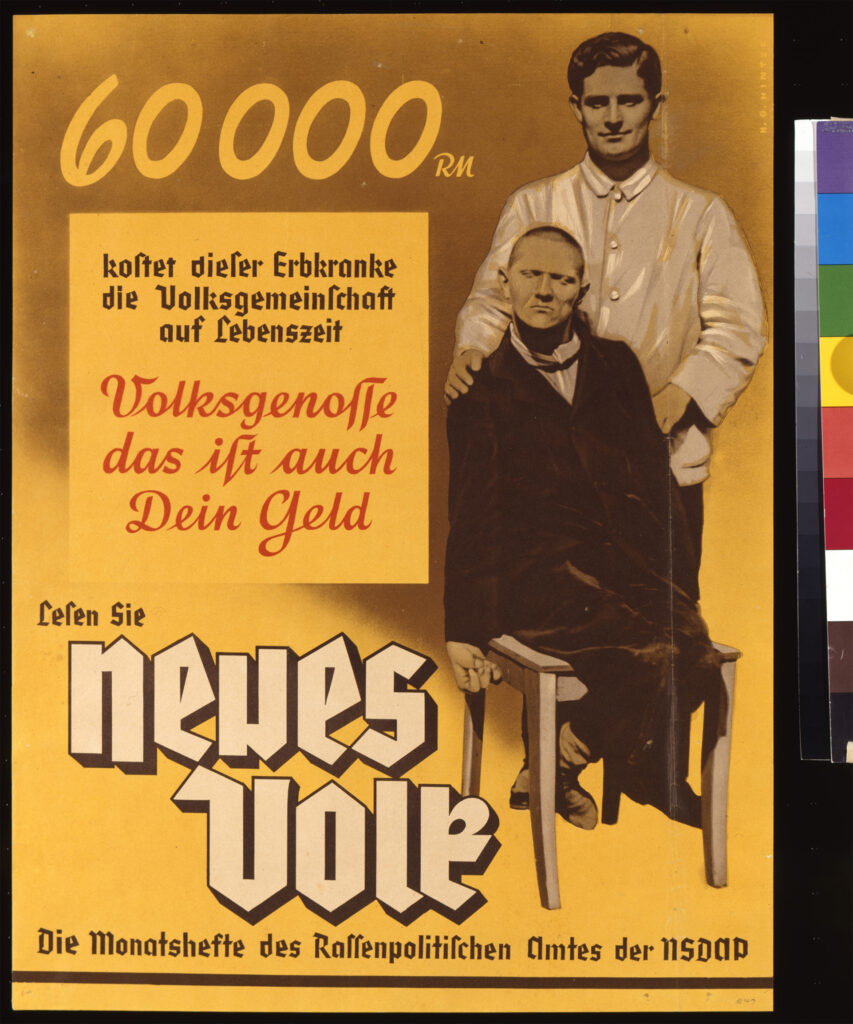
Poster for the monthly magazine »Neues Volk« of the NSDAP’s Racial Policy Office for the propagation of eugenics and »euthanasia«. German Reich around 1937.
bpk | German Historical Museum | Arne Psille.
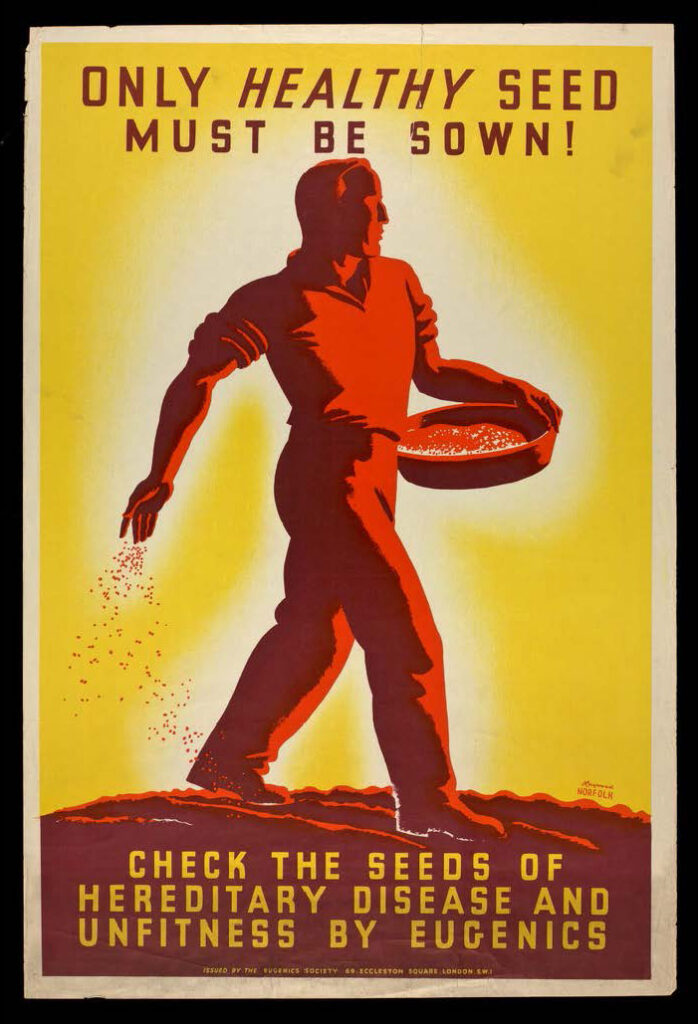
Poster of the Eugenics Society, Haywood Norfolk, Great Britain, around 1935.
Instytut Galtona/Archiv der Eugenics Society, Biblioteka Instytutu Wellcome.
There was also propaganda in favour of eugenics in other countries around the world. This is shown by the example from Great Britain.
»Only healthy seed may be sown«.
The postcard advertises that marriages should only be entered into with eugenically sound partners. Eugenics certificate. USA, around 1924.
Robert Bogdan Collection. Medical Historical Library, Harvey Cushing/John Hay Whitney Medical Library, Yale University.
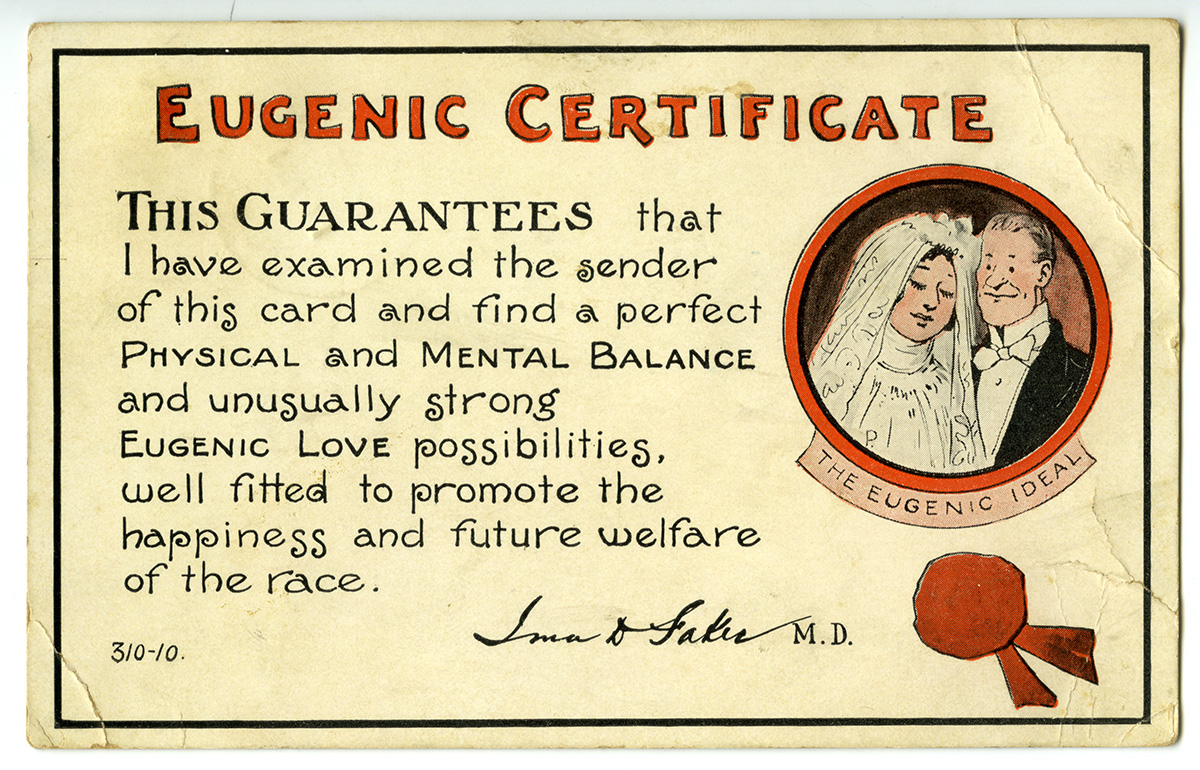
Robert Bogdan Collection. Medical Historical Library, Harvey Cushing/John Hay Whitney Medical Library, Yale University.
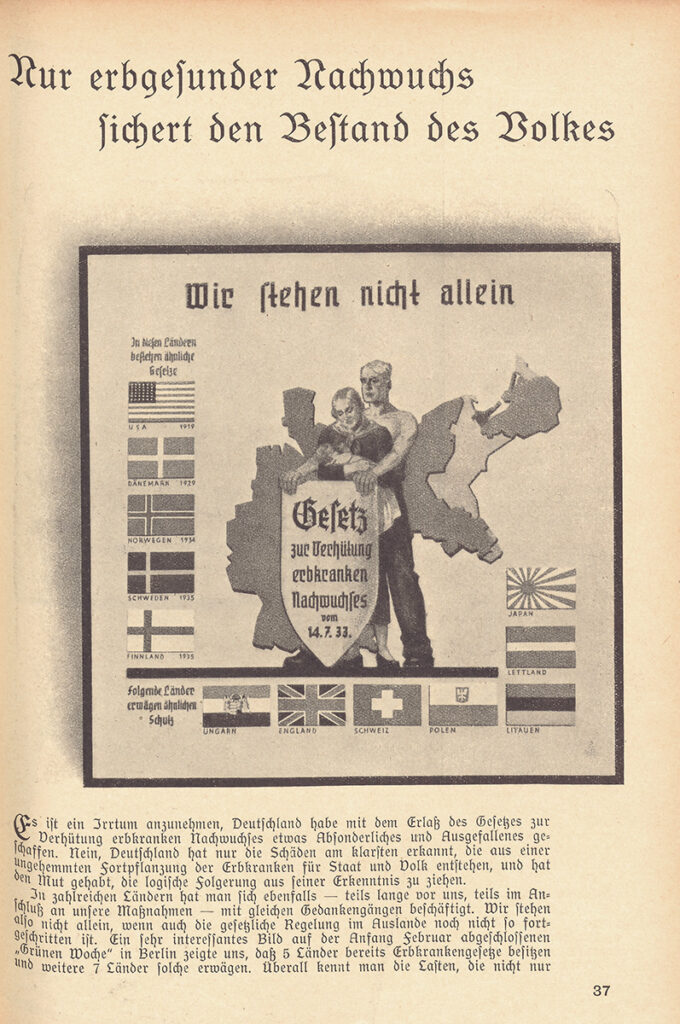
Poster for the monthly magazine »Neues Volk« of the NSDAP’s Racial Policy Office for the propagation of eugenics and »euthanasia«. German Reich around 1936.
Berlin State Library.
Many countries had »racial hygiene« laws. Other countries thought about it. Both were used by the National Socialists for their propaganda.
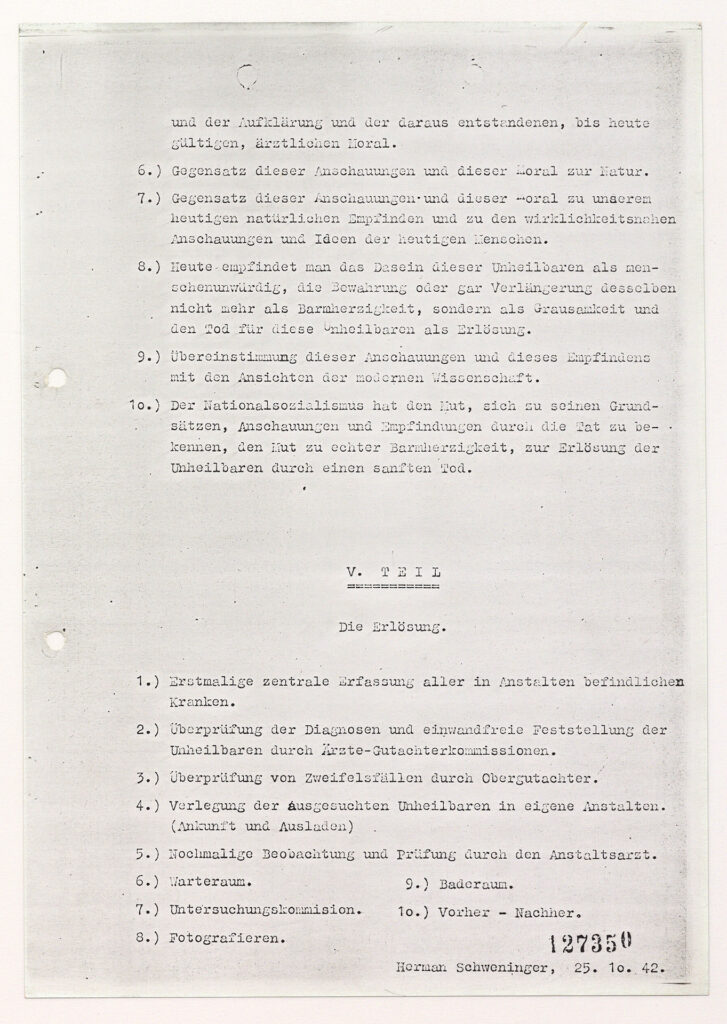
Page from the screenplay »Dasein ohne Leben« from 25 October 1942.
BArch R 96 I-8 p. 45.
For the documentary film »Existence without life« (1942) by Hermann Schweninger, the script envisages showing the gassing of people with disabilities in the scene »Die Erlösung« (The Redemption). The scene with the murder of people by gas was actually filmed in the Pirna-Sonnenstein killing centre.
The feature film »I accuse« was released in cinemas in 1941. Many people saw it. The film was based on the novel »Mission and Conscience« (1936) by Hellmuth Unger, who later planned and prepared the »child euthanasia«.
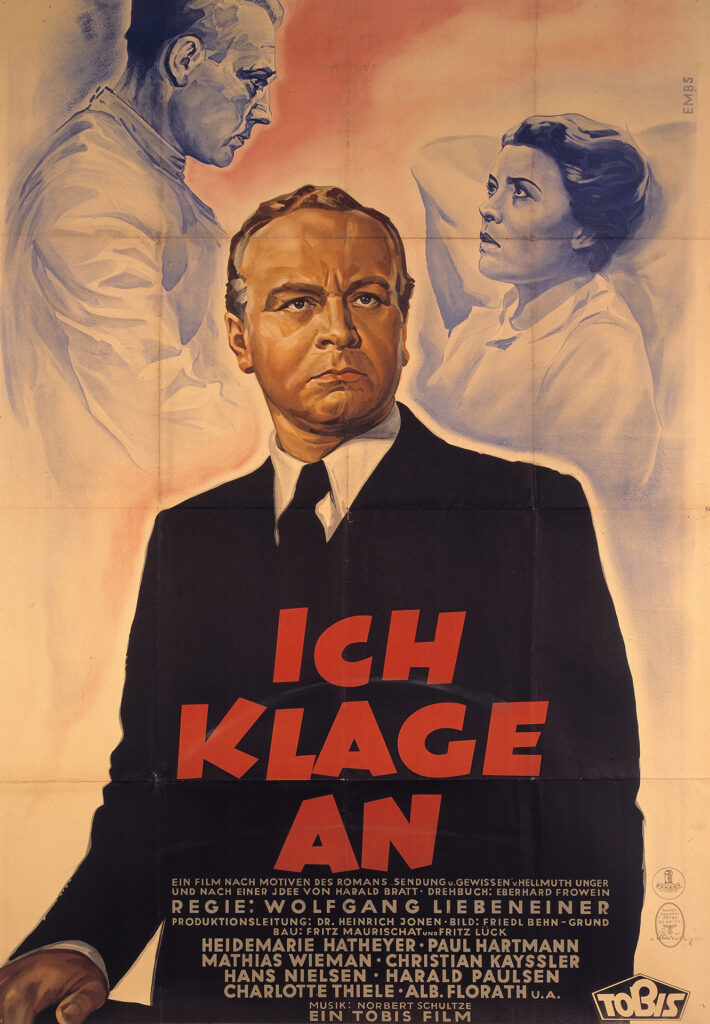
Kinoplakat »I accuse«, 1941.
German Film Institute & Film Museum.
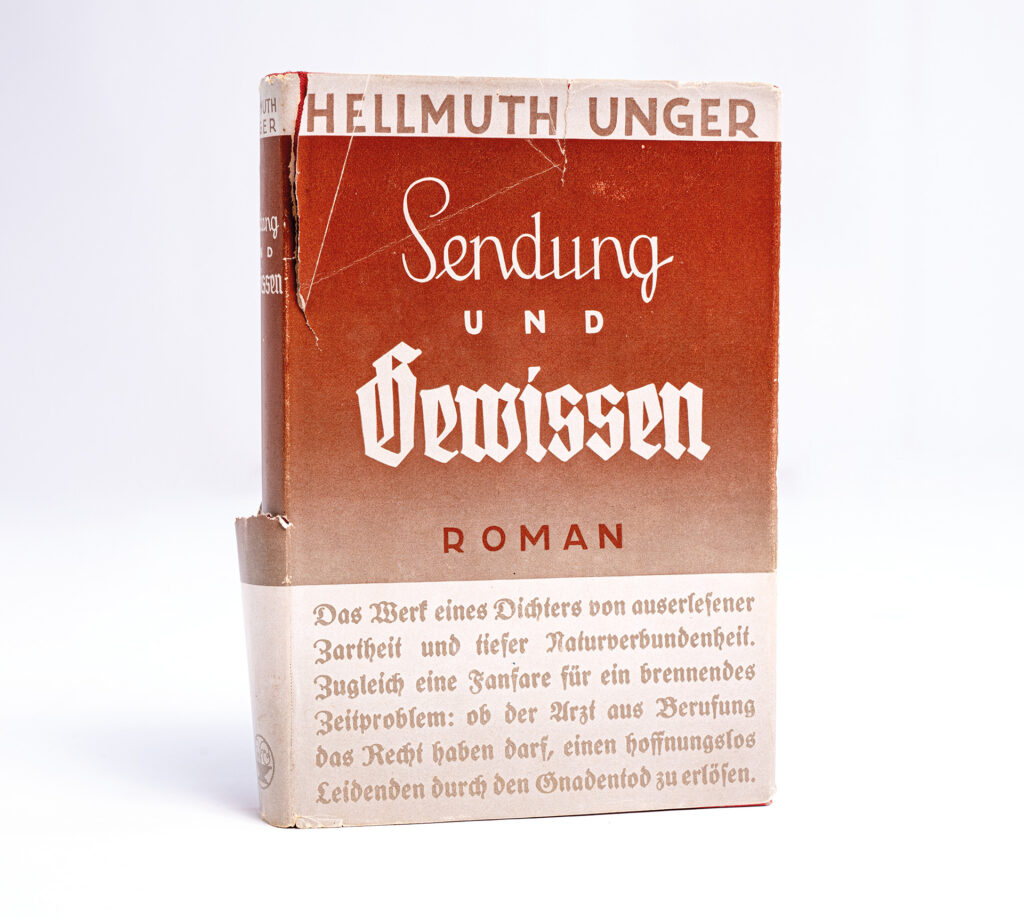
Hellmuth Unger: Mission and conscience. Oldenburg 1936.
ArEGL 183.
The novel published in 1936 »Mission and conscience« by Hellmuth Unger was the basis for the propaganda film »I accuse«.
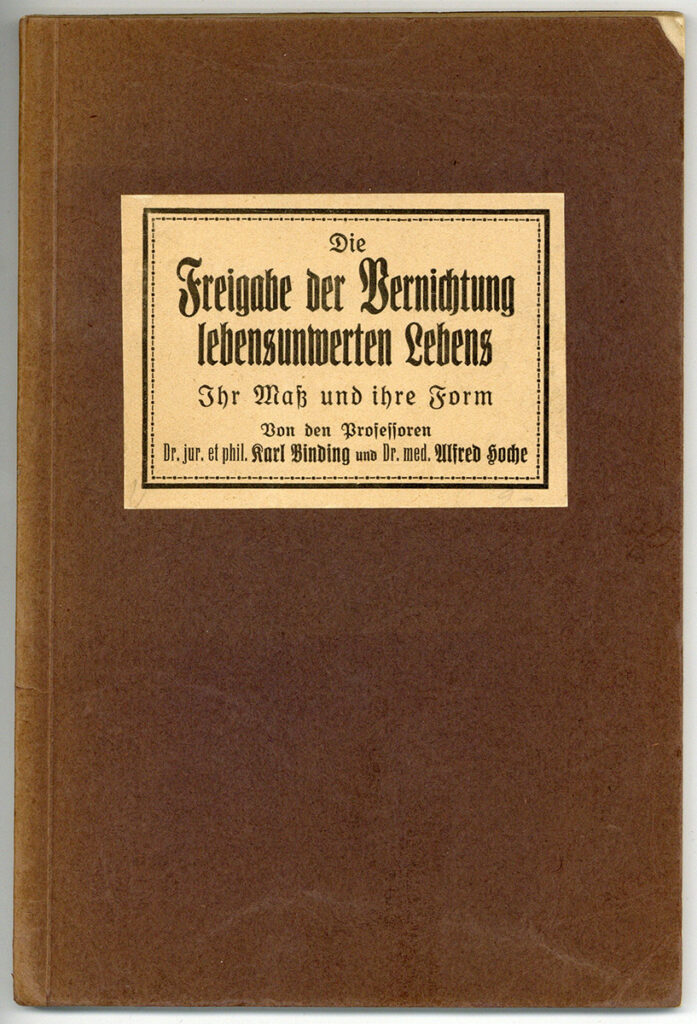
»The release of the destruction of life unworthy of life. Its measure and form« by Karl Binding and Alfred Hoche, 1920.
ArEGL 181.
In this book, criminal law professor Karl Binding and psychiatrist Alfred Hoche were the first to justify the non-punishable killing of patients and people with disabilities. They labelled them as so-called »Ballast existences« and considered it right to use them in favour of the Community »to redeem« resp. to assassinate him. What was only a pipe dream in 1920 became reality 20 years later.
»But not to grant the incurable, who longs for death, redemption through gentle death is no longer compassion, but its opposite.« (p. 38)
»In economic terms, therefore, these complete idiots […] would be those whose existence weighs most heavily on the community. […] In the case of the killing of a mentally dead person who […] is unable […] to lay claim to […] life, the subjective claim is therefore not violated either.« (p. 50 | 51)
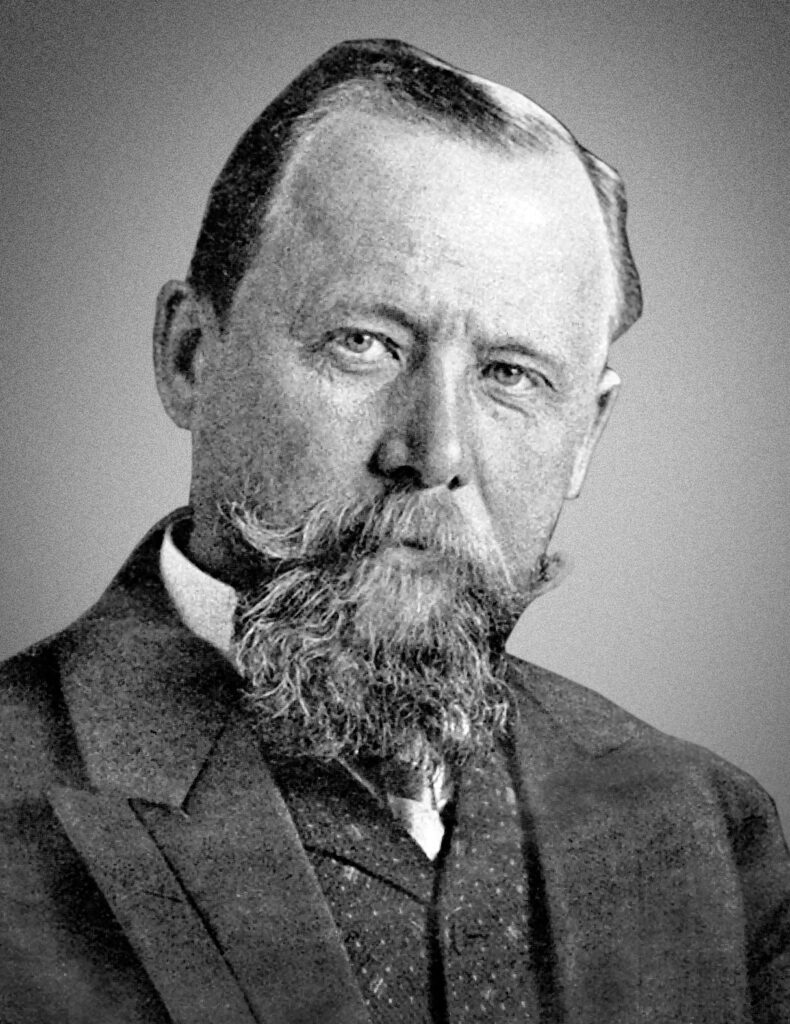
Alfred Hoche, around 1935.
From: Contemporary medicine in self-portrayals, Leipzig, 1923.
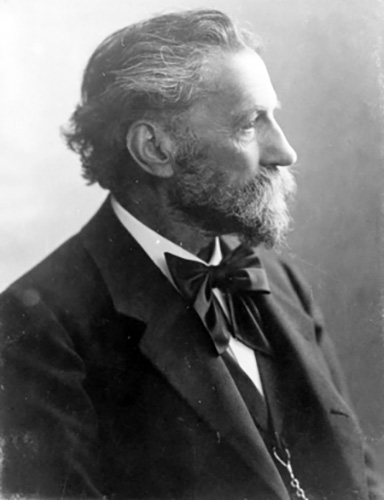
Karl Binding, around 1909.
Institute for City History Frankfurt am Main (ISG FFM), ISG FFM S7P No. 1245, photographer Georg Brakesch.
ALFRED HOCHE (1865 – 1943)
Alfred Hoche, around 1923.
From: Contemporary medicine in self-portrayals, Leipzig, 1923.
KARL BINDING (1841 – 1920)
Karl Binding, around 1909.
Institute for City History Frankfurt am Main (ISG FFM), ISG FFM S7P No. 1245, photographer Georg Brakesch.
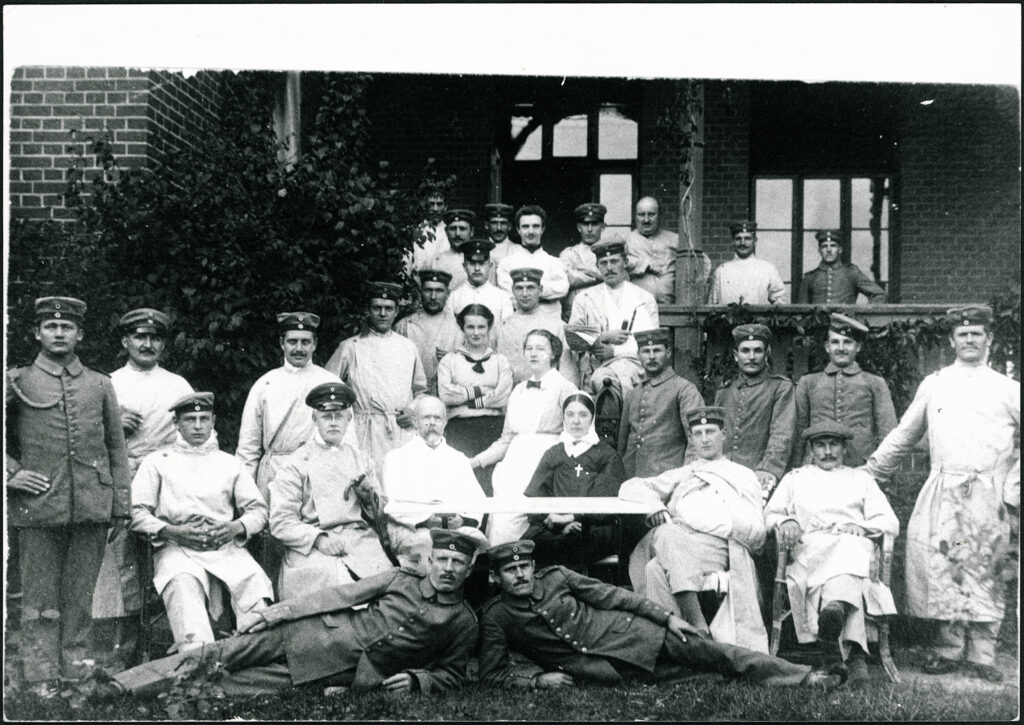
Otto Snell (2nd row, 3rd from left) surrounded by nurses and patients from the military hospital in the Lüneburg sanatorium and nursing home. Postcard, around 1917.
ArEGL 156-5.
Karl Binding and Alfred Hoche’s thinking was characterised by the First World War. Due to the wartime shortages, the mortality rate at the Lüneburg sanatorium and nursing home was 17 per cent in 1916 and 1918. In the hunger winter of 1917, almost one in four patients died. The occupancy rate fell to around 700 patients by 1918. Many buildings were then occupied by employees or used as military hospitals for war casualties.
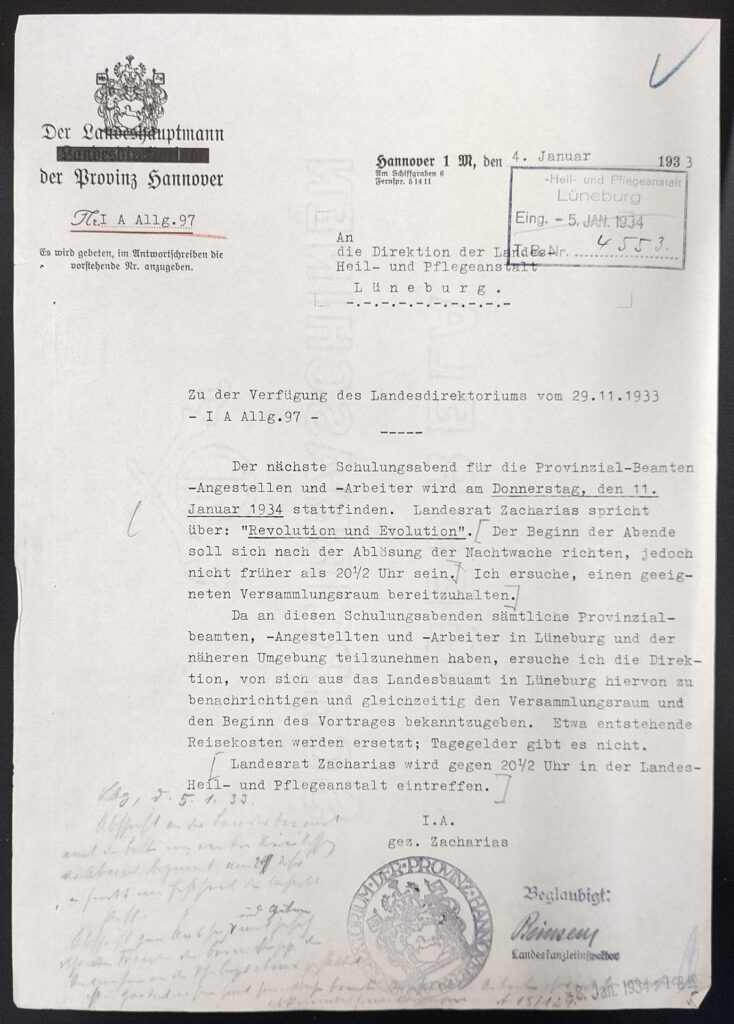
NLA Hannover Hann. 155 Lüneburg Nr. 81.
The thinking characterised by »eugenics« and »racial hygiene« also reached the Lüneburg sanatorium and nursing home. The social centre was used for corresponding training courses. The Medical Director Max Bräuner, as head of the Racial Policy Office, gave lectures on »hereditary health« and »racial hygiene«. He supported the health department, whose main task under National Socialism was to educate people about »hereditary and racial care«.
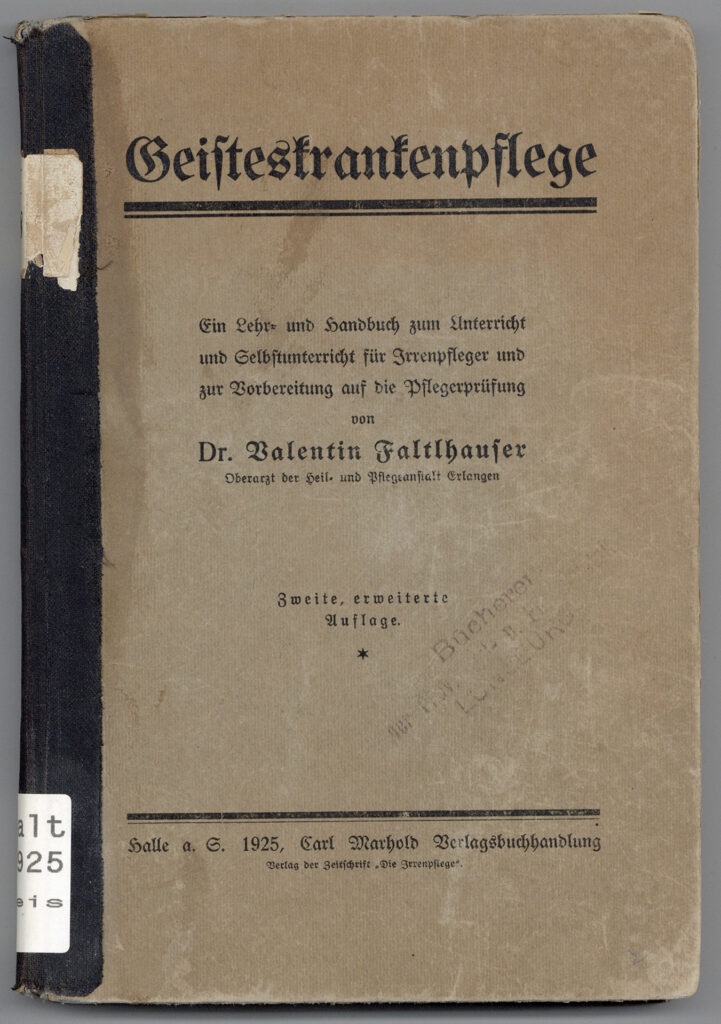
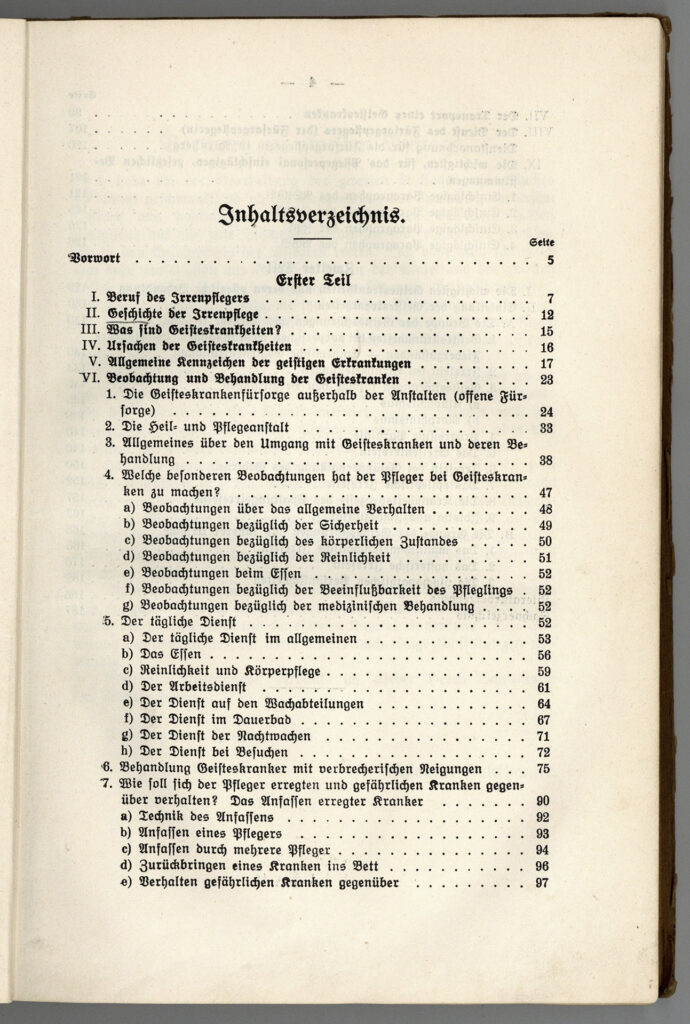
»Mental health care. A teaching and handbook for teaching and self-teaching for mental health nurses and for preparing for the nursing examination« by Valentin Faltlhauser (1925).
In 1925, »hereditary and racial care« played no role in the manual for carers. In the 1939 edition, a distinction was made between hereditary and externally caused diseases. The laws »for the protection of hereditary health« and »for the prevention of hereditary diseases« took up a separate chapter.
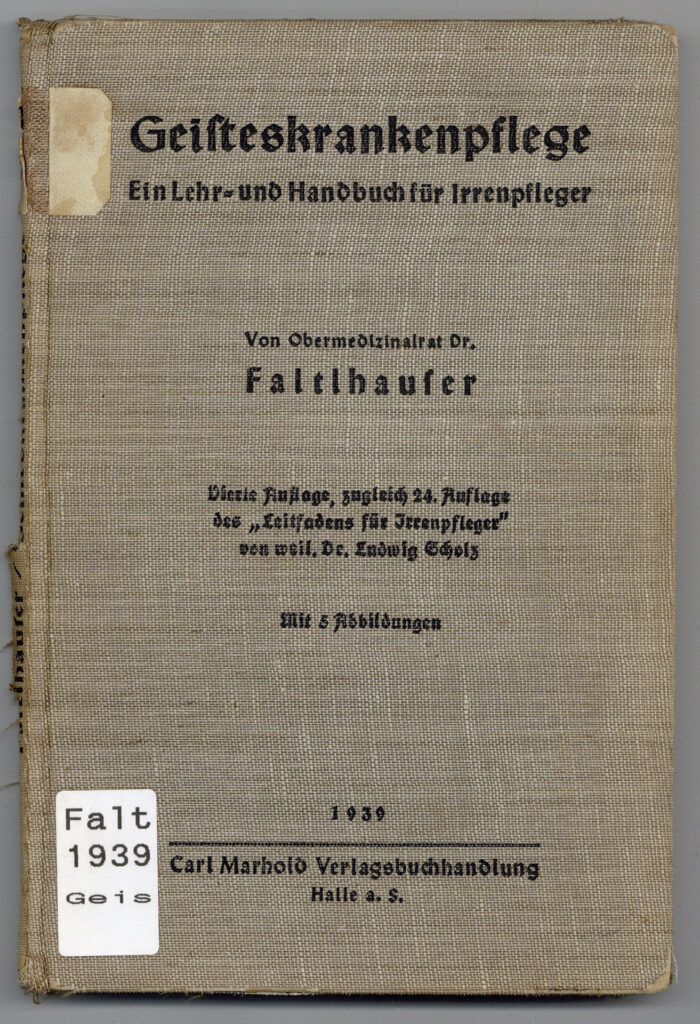
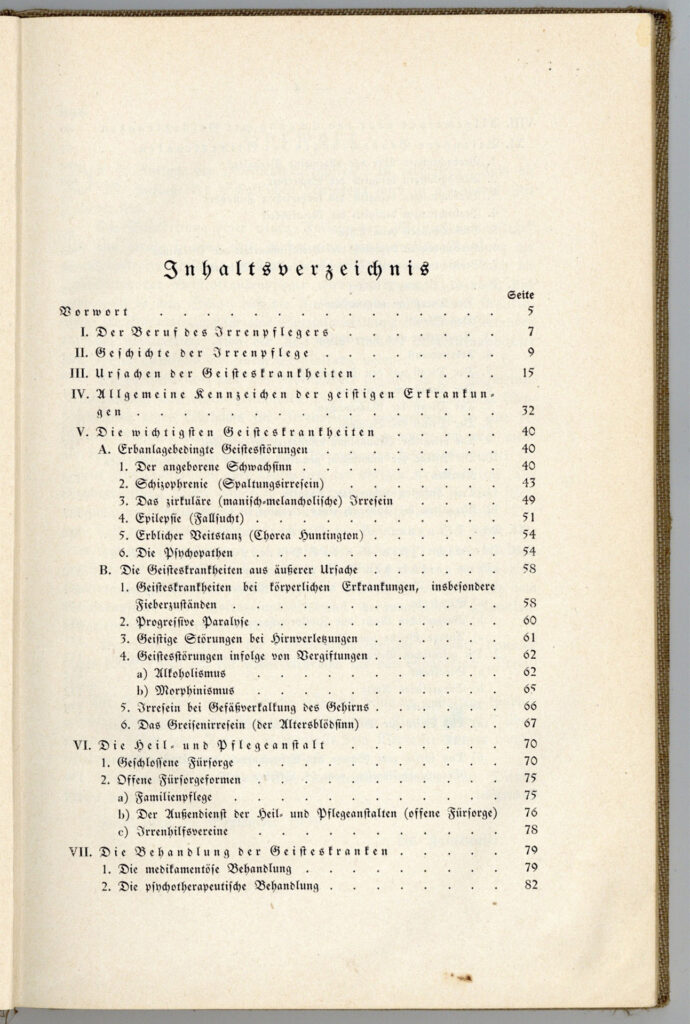
»Mental health care. A teaching and handbook for lunatic nurses« by Valentin Faltlhauser (1939).
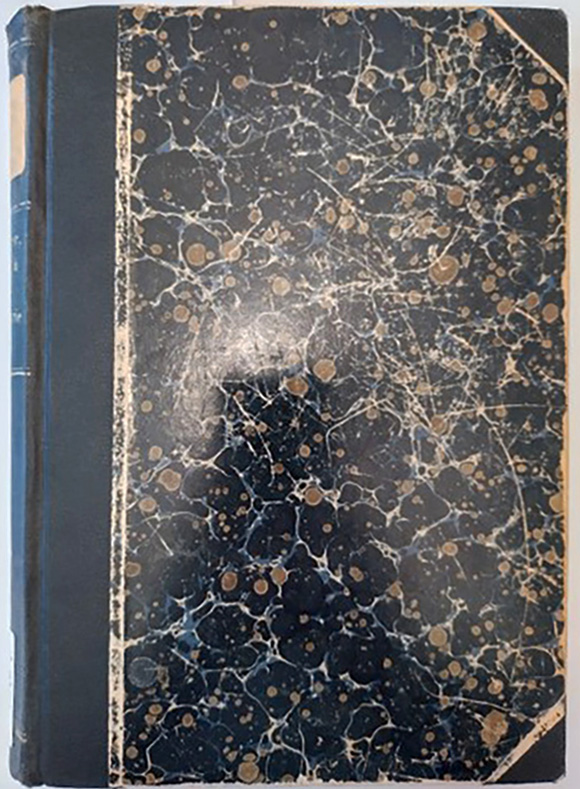
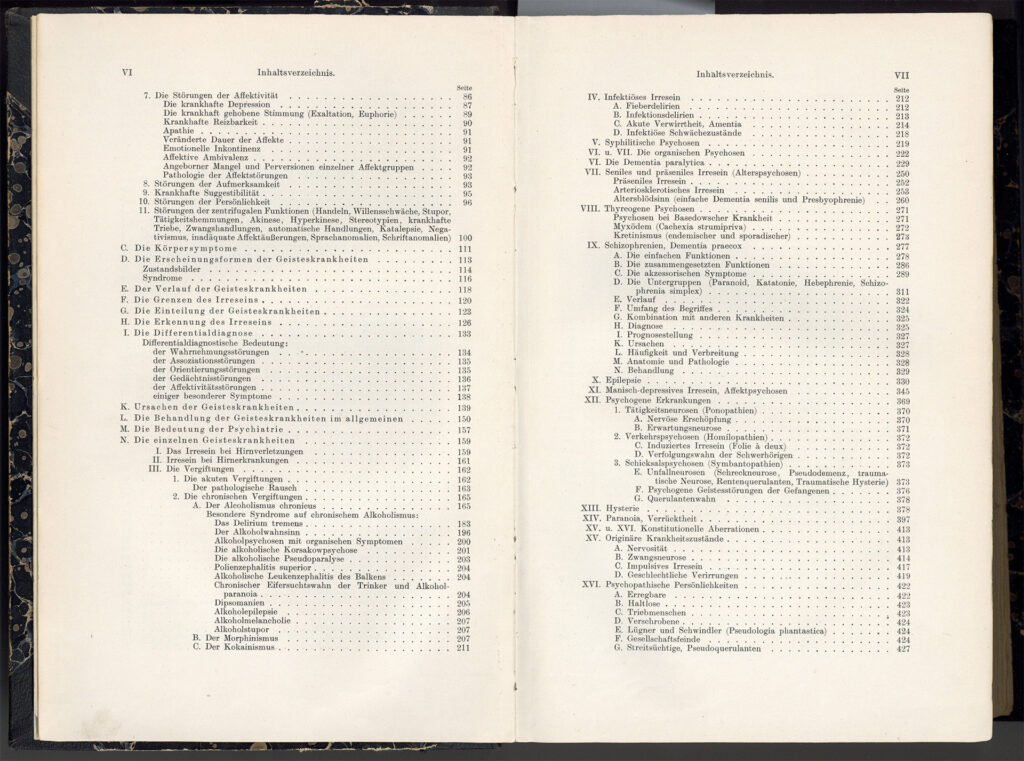
»Textbook of Psychiatry« by Eugen Bleuler (1916).
In 1916, there were no references to »hereditary and racial hygiene« in Eugen Bleuler’s standard work on psychiatric care. In 1937, he devoted an entire chapter to »hereditary and racial hygiene«. In the edition published by his son in 1949, the chapter was retained, albeit shortened. In the foreword, he explained that not everything about »hereditary and racial hygiene« was wrong. For many years after the Second World War, the subject continued to be characterised by National Socialist thinking.
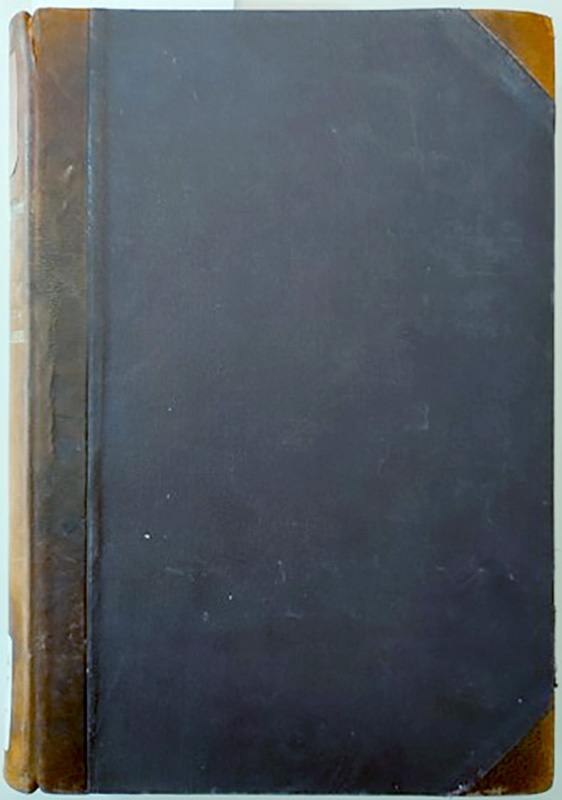
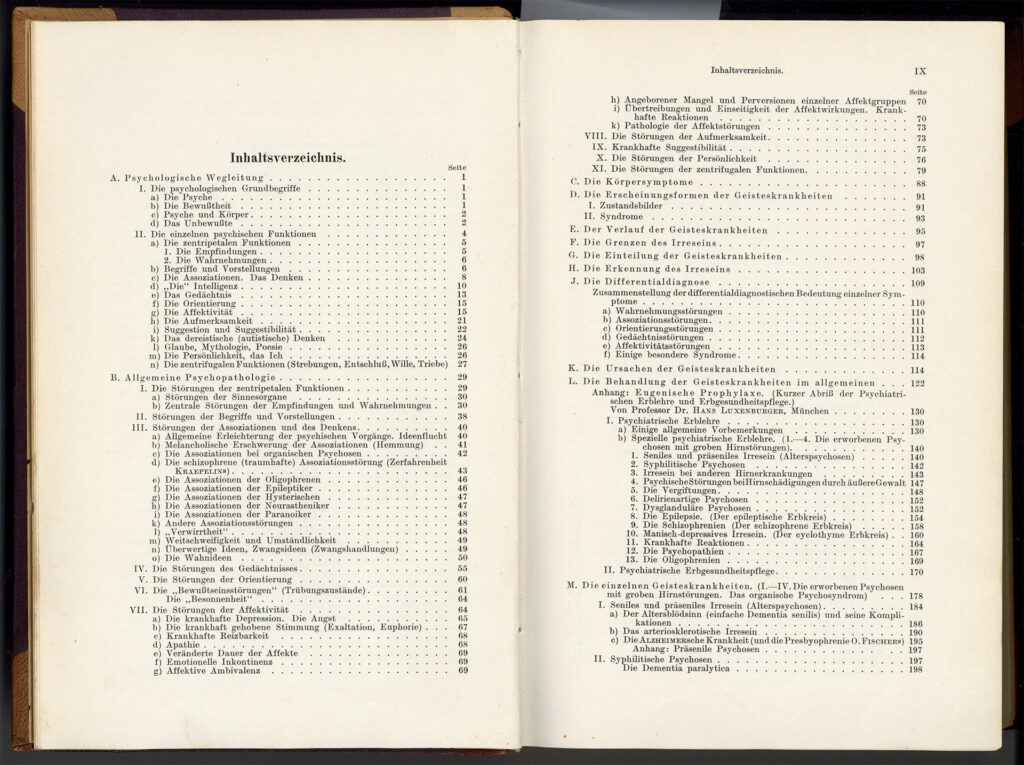
»Textbook of Psychiatry« by Eugen Bleuler (1937).
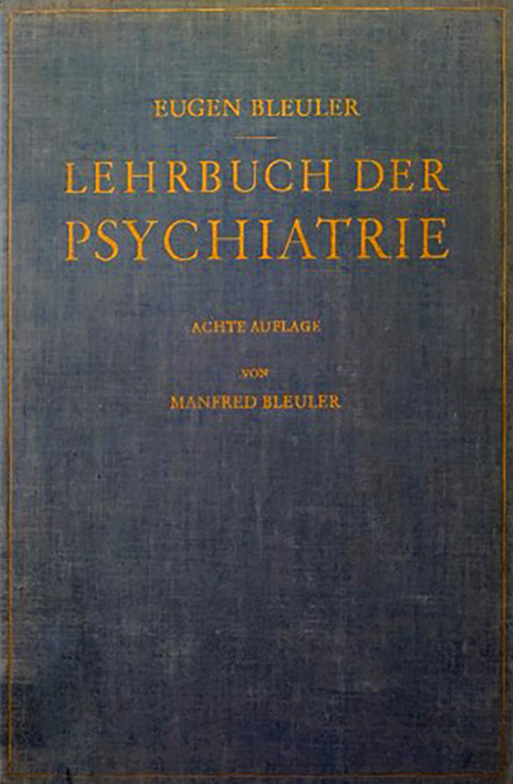
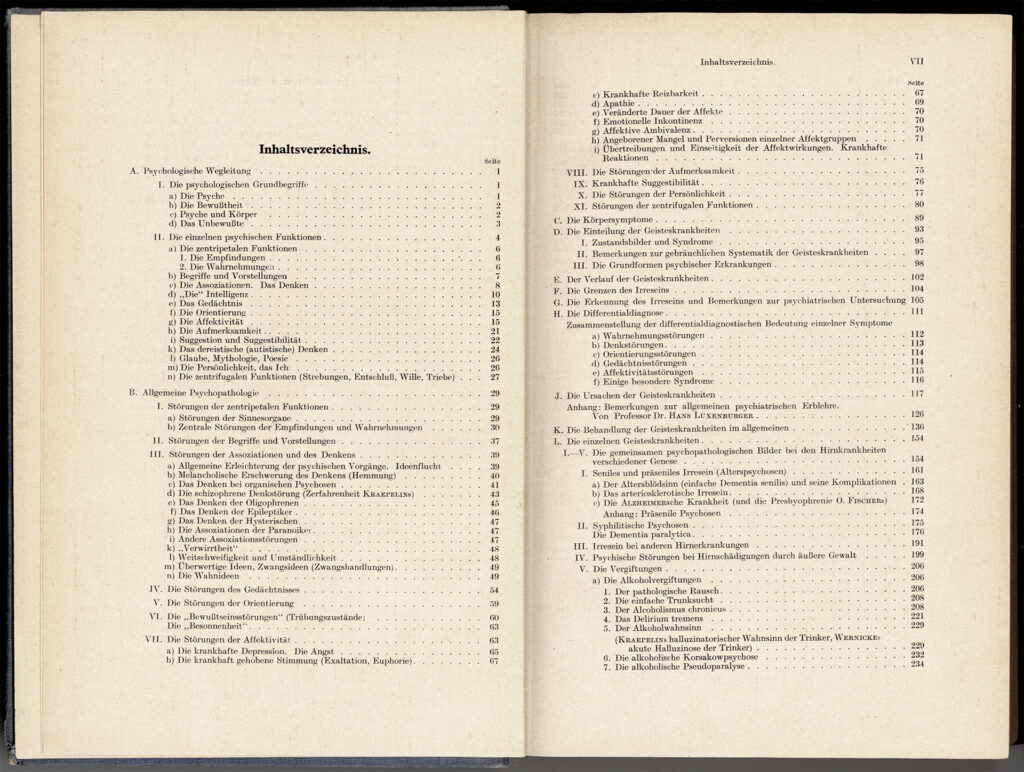
»Textbook of Psychiatry« by Eugen Bleuler, revised by Manfred Bleuler (1949).
