DECISIVE EVENTS
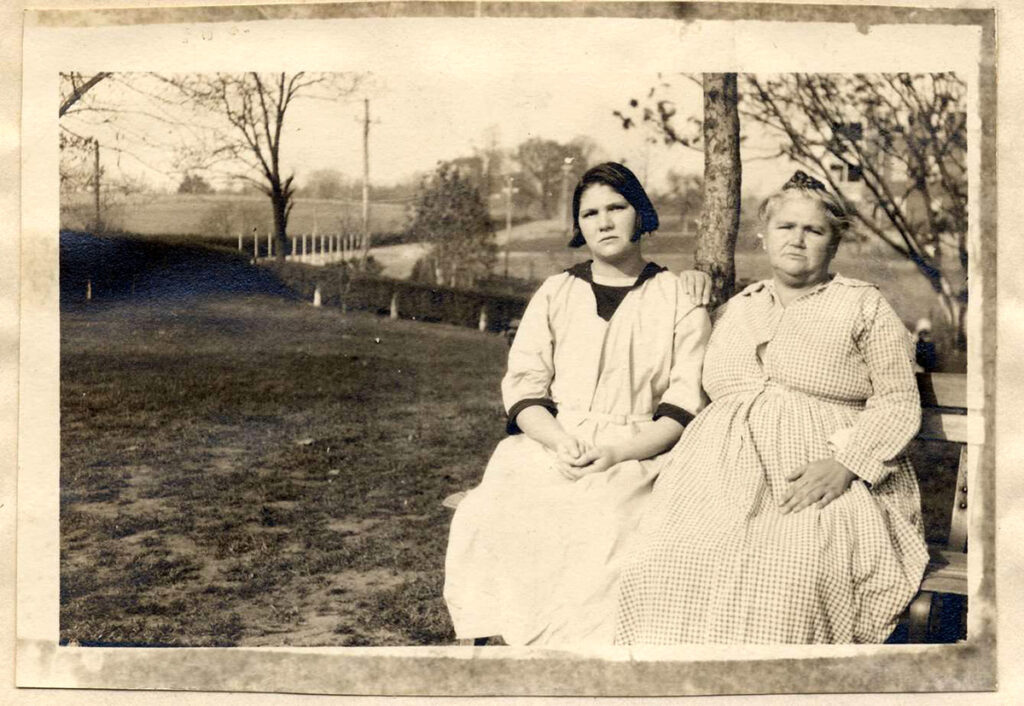
Carrie and Emma Buck at the Virginia Colony for Epileptics and Feeble-Minded before the Buck v. Bell trial in Virginia, November 1924. Photographer Arthur Howard Estabrook.
Archiv University at Albany, State University New York.
By 1933, sterilisation laws existed in 30 US states. In 1927, the US Supreme Court ruled that sterilisation could be carried out even against the will of those affected. The decisive case involved Carrie Buck, an American woman who unsuccessfully fought her sterilisation in court. After that, in principle, anyone could be sterilised against their will.
As early as the beginning of the 1930s, active euthanasia was supported worldwide by doctors as a »release« from a serious, incurable illness. In Denmark and Czechoslovakia, »painless death by sleeping« was already exempt from punishment. In the United States, doctors called for a law that would make »mercy killing« legal. The Nazis took this as an example.
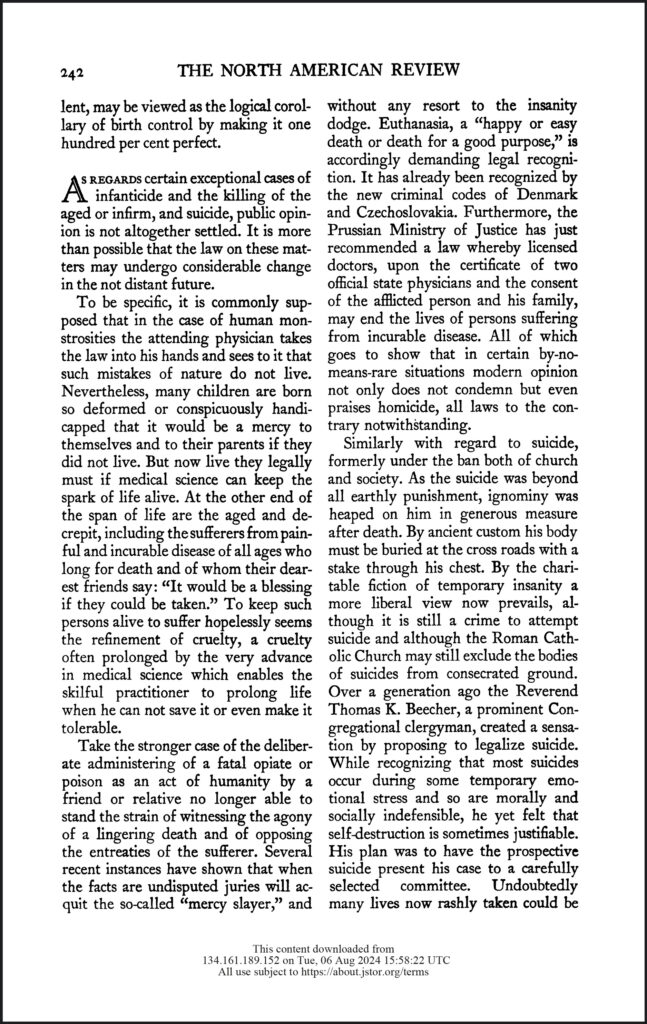
Auszug aus W.W. Gregg: The Right to Kill. North American Review Nr. 237, 1934, S. 242.
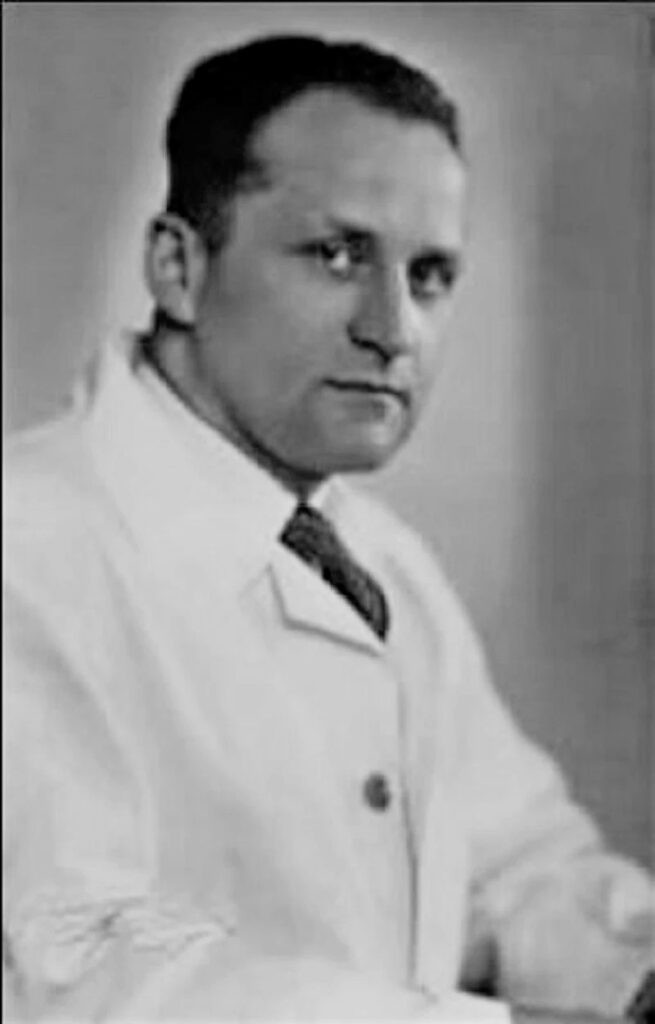
Werner Catel, Leipzig University Hospital, c. 1931.
Copy ArEGL.
The first child to become a victim of »Euthanasia« due to an impairment died on 25 July 1939 at the age of five months. The infant had a physical defect and was visually impaired. The father therefore asked for a »Mercy killing« to be granted. Karl Brandt, Hitler’s doctor, examined the child, who was born in Pomssen on 20 February 1939. He was then murdered at Leipzig University Children’s Hospital under the medical direction of Werner Catel.
In autumn 1939, the »Sonderkommando Lange« carried out the first killings with gas on behalf of the security police in the Poznan concentration camp in Fort VII and in a gas van under the direction of the Berlin Forensic Institute. Around 1,200 patients from the Treskau-Owińsk, Poznan and Tiegenhof institutions were murdered with carbon monoxide. On 12 or 13 December 1939, Heinrich Himmler decided to use this method to murder the sick in the German Reich.
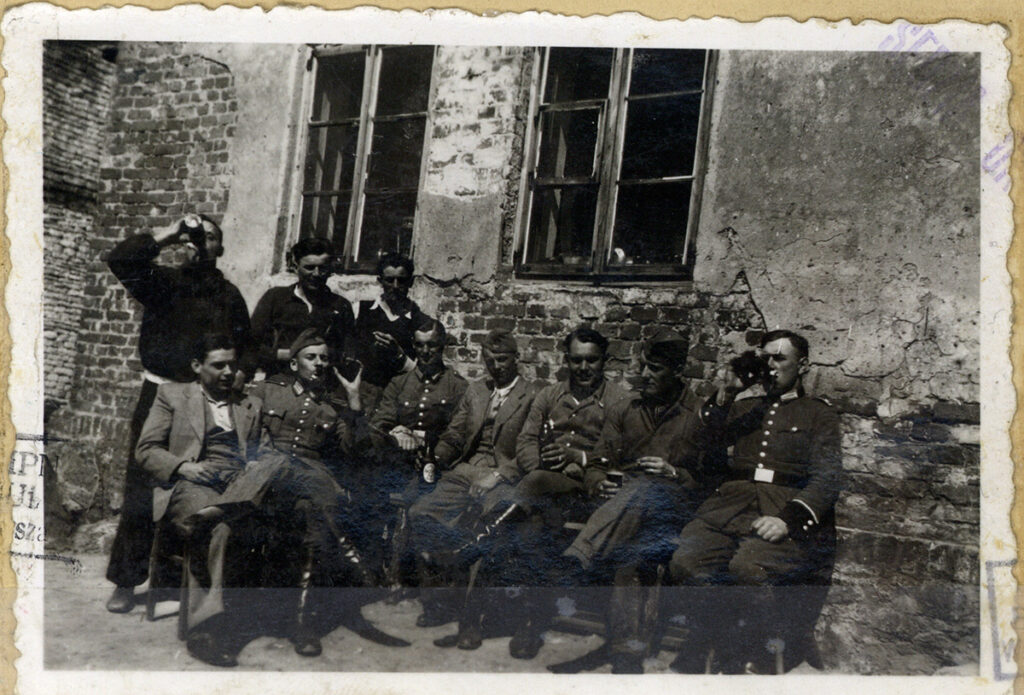
Group photo of the »Sonderkommando Lange«. It murdered thousands of Polish patients, later also Jews and Sinti and Roma in the Kulmhof extermination camp.
Foundation Memorial to the Murdered Jews of Europe.
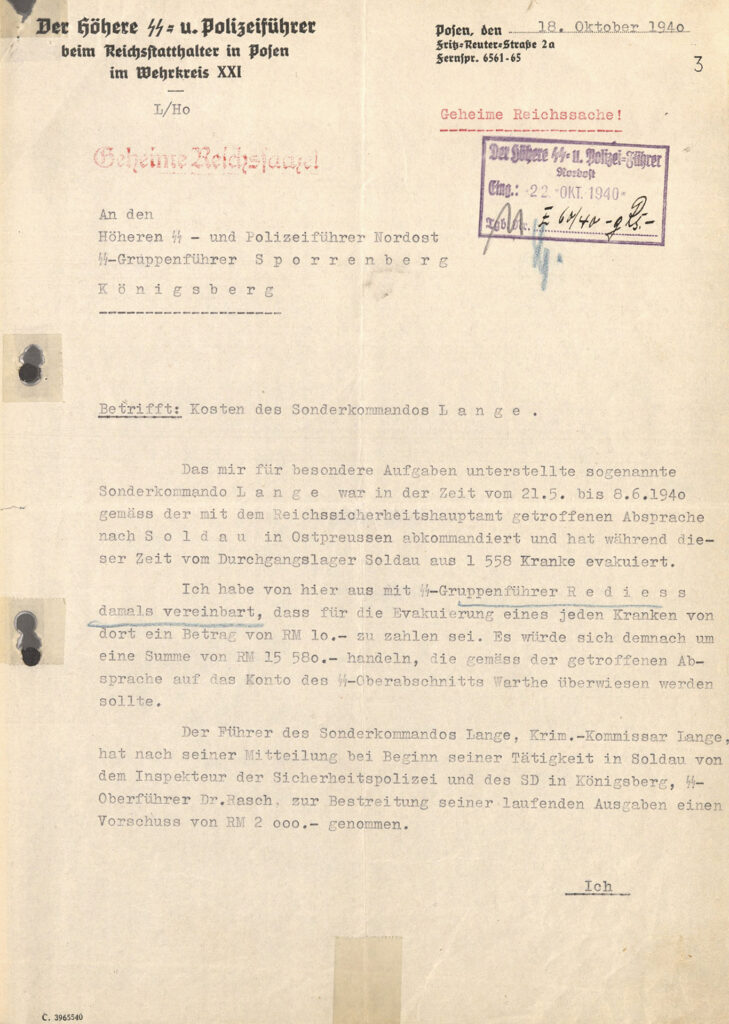
Extract from the letter from the Higher SS and Police Leader to the Reich Governor in Poznan, Jakob Sporrenberg, to the Higher SS and Police Leader North-East, 18 October 1940.
BArch NS 19/2576.
The implementation of the murder of the sick in the Warthegau with the »Central Office« and »Special Registry Office« under Gauleiter Arthur Greiser became the model for »Aktion T4«. In Warthegau, Danzig, East Prussia and Pomerania, the murder of the sick was continued after the trial gassings. In addition to the »Sonderkommando Lange«, the »Sonderkommando Eimann« was also deployed. All those involved received a bounty of ten Reichsmarks. Many were later deployed in extermination camps.
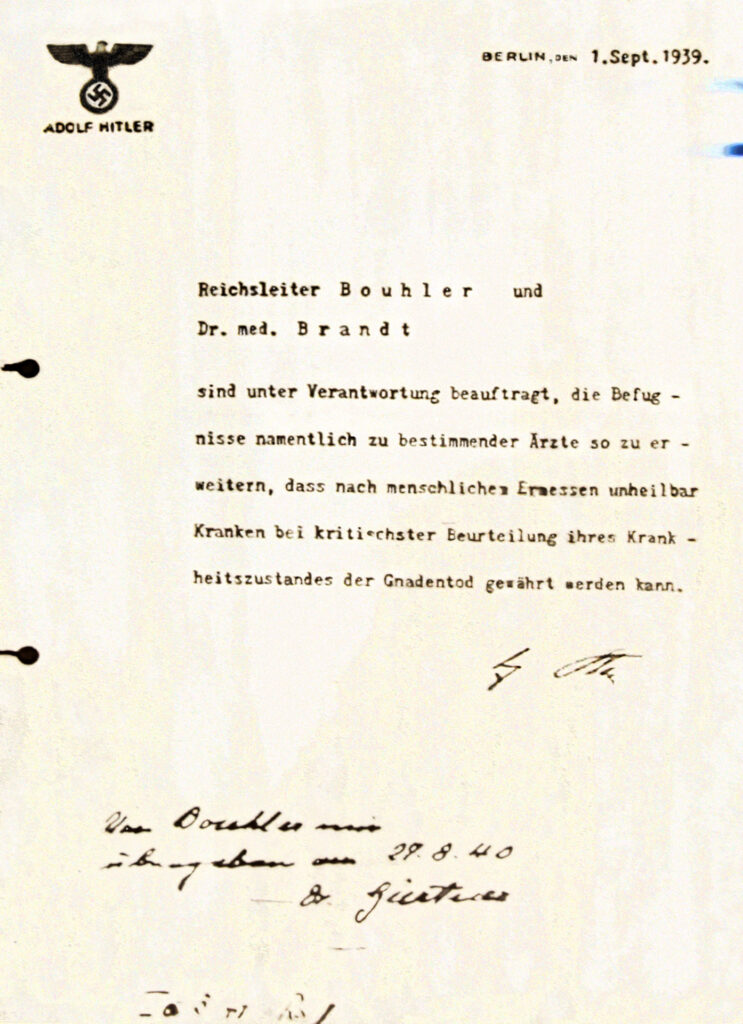
Letter from Adolf Hitler, October 1939, dated 1 September 1939.
Copy ArEGL.
This authorisation from Adolf Hitler was written in October 1939 and backdated. Adolf Hitler used it to justify the murders of the sick, which had already been taking place in Poland from 1 September 1939. As the »Euthanasia Act« was not passed, Adolf Hitler used this letter to create a pseudo-legal basis for various »Euthanasia« measures during the Second World War.
DECISIVE RIGHTS AND OBLIGATIONS
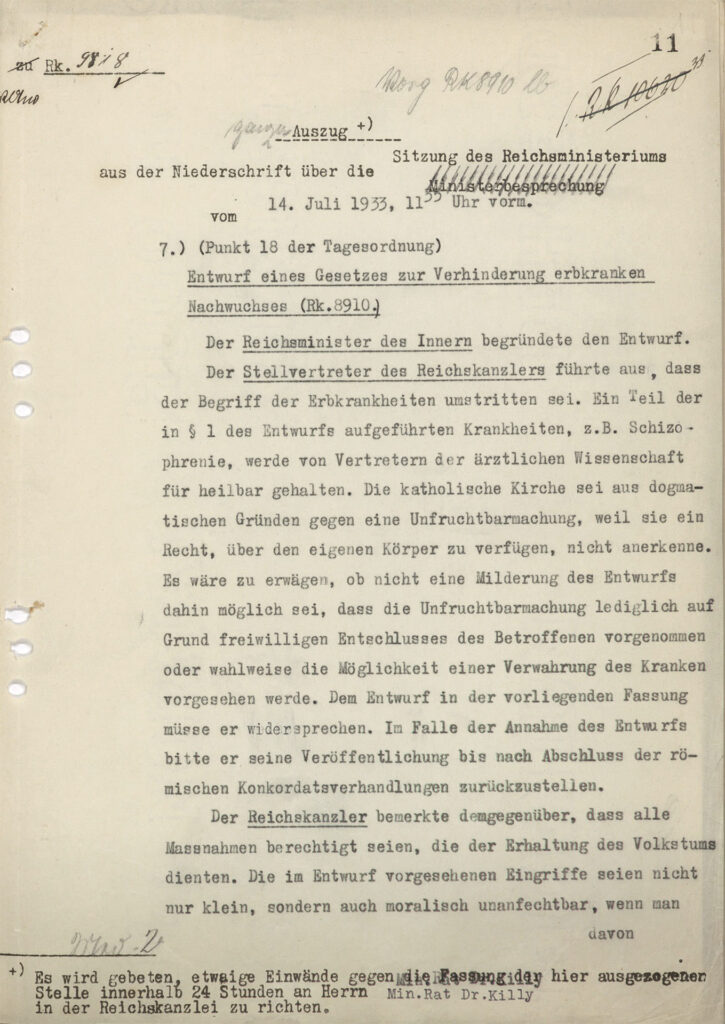
Excerpt from the transcript of agenda item 18 of the meeting on 14 July 1933 concerning the resolution on the »Law for the Prevention of Hereditary Diseases in Offspring«.
BArch R 43-II/720.
The »Law for the Prevention of Hereditary Diseases« was passed on 14 July 1933 and came into force on 1 January 1934. It regulated compulsory sterilisation. Only one person opposed the bill in the decisive session: Vice Chancellor Franz von Papen demanded that sterilisation remain voluntary. Adolf Hitler overruled him and ordered that the law be passed as proposed by Arthur Gütt, Ernst Rüdin and Falk Ruttke.
Women were often pregnant when they were to be sterilised. In 1935, the »Law for the Prevention of Hereditarily Diseased Offspring« was extended. It now also regulated involuntary abortion from the 6th month of pregnancy. In 1936, »Social imbecility« was also included as a further reason for sterilisation.
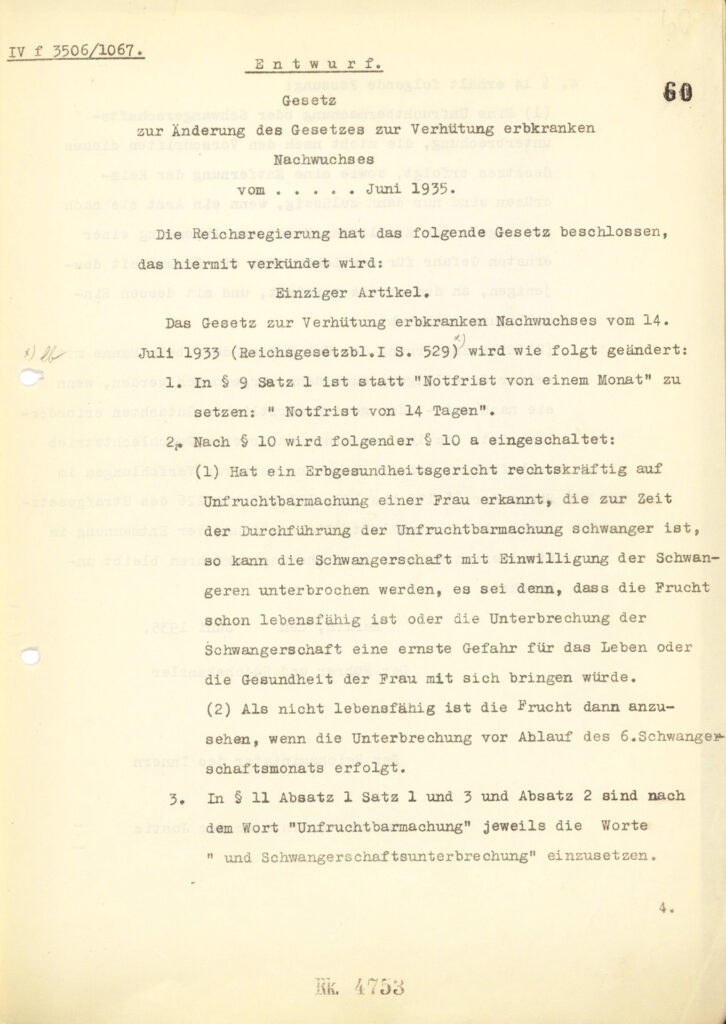
Excerpt from the draft of the »Law for the Prevention of Hereditarily Diseased Offspring« of 26 June 1935.
BArch R 43-II/720.
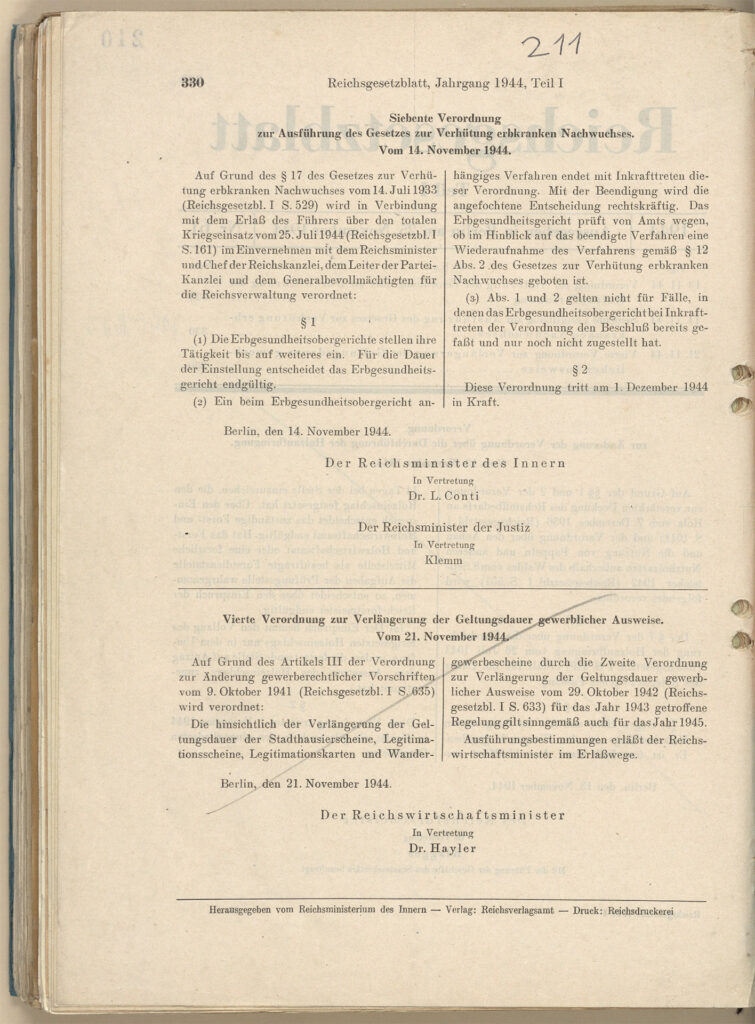
Ordinance of the »Law for the Prevention of Hereditary Diseases in Offspring« of 14 November 1944.
BArch R 43-II/722.
After the declaration of total war, decisions on sterilisation were only to be made in emergencies. The Reich government hoped that this would save money, as there were now only a few doctors left and the surgery room were needed for the wounded.
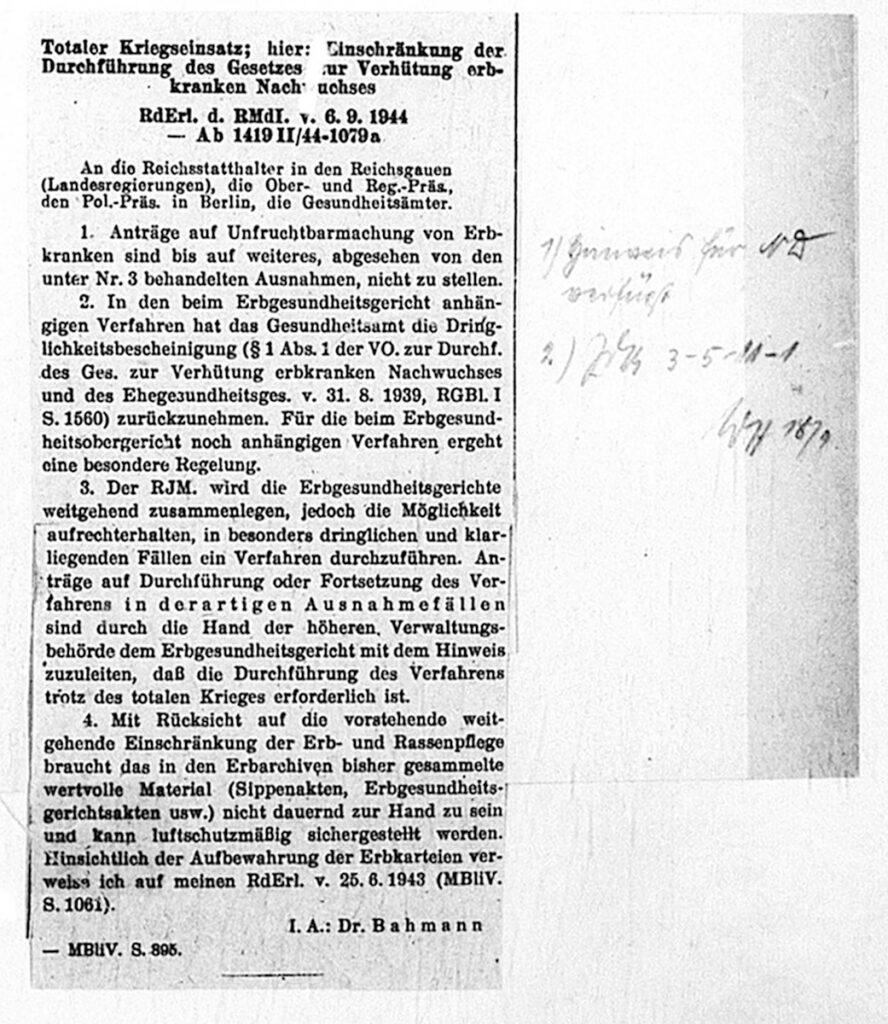
Newspaper report: Total war effort; here: Restriction of the implementation of the »Law for the Prevention of Hereditarily Diseased Offspring« of 6 September 1944.
BArch R 36/1369.
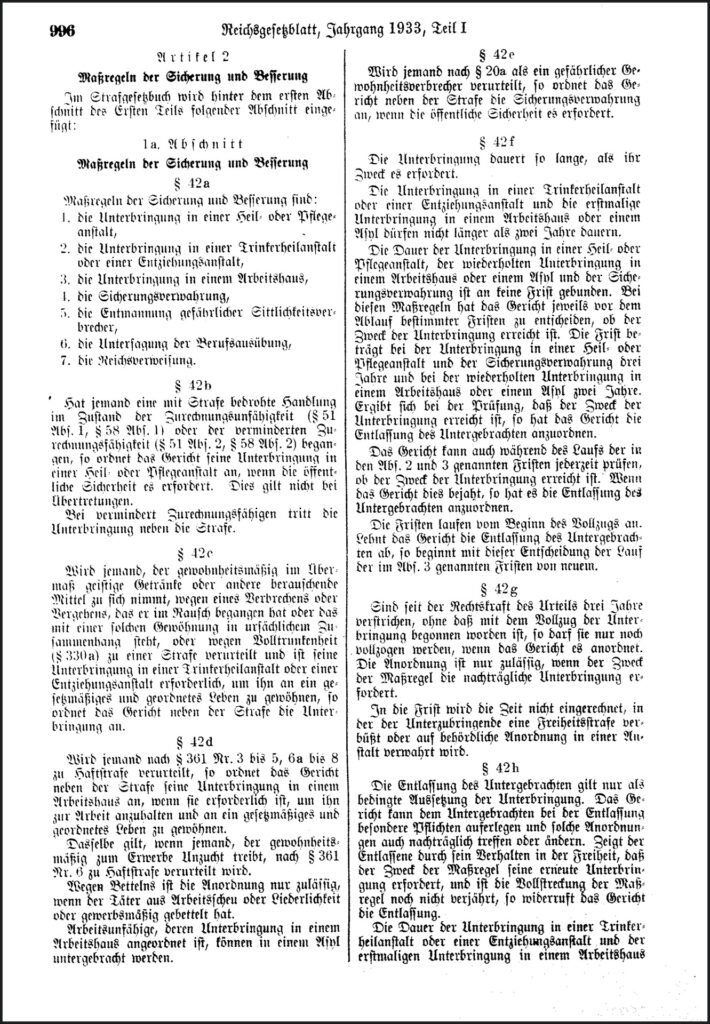
Excerpt from the Reichsgesetzblatt No. 133 of 27 November 1933, pages 996 – 999.
Copy ArEGL.
The »Law against dangerous habitual criminals and on measures of security and correction« of 24 November 1933 introduced secure placement in a institution. In §42a (5) and §42k, the »Emasculation of dangerous moral criminals« (castration) was also provided for as a punishment.
Until 1933, there was no authority to register and manage the sick. Under National Socialism, the »Law on the Standardisation of the Healthcare System« created health authorities throughout the Reich for the first time. They are still attached to the district administrations today. Their main tasks at the time were the »Hereditary-biological registration« and counselling in matters of »Hereditary and racial care«. Other tasks were subordinated to this.
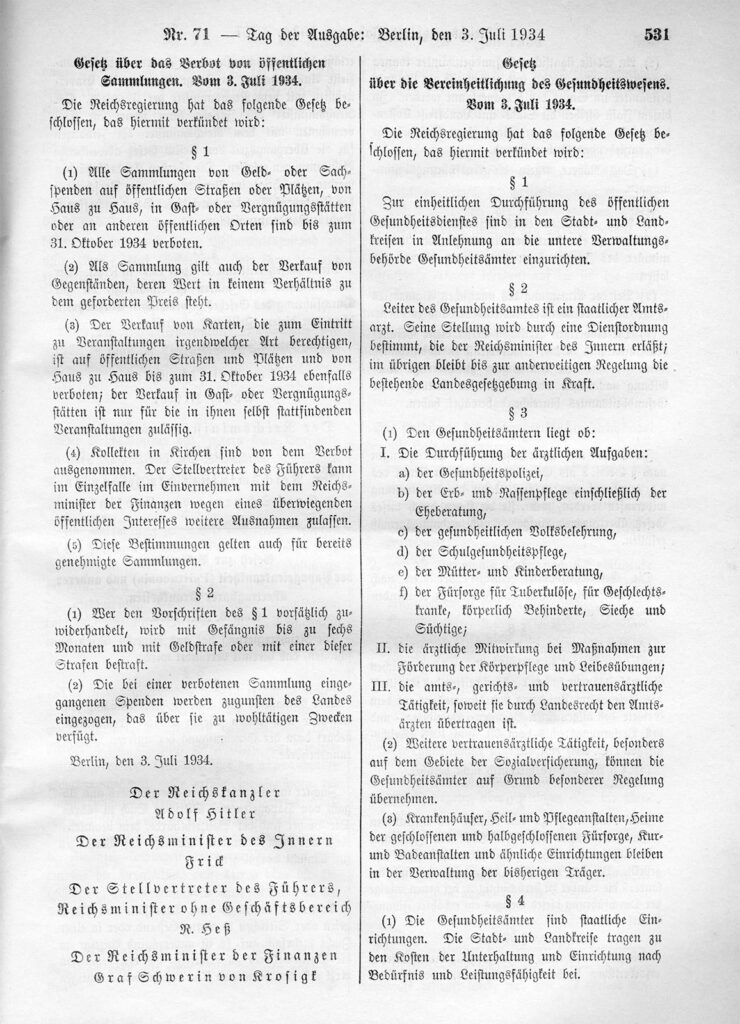
Extract from the Reichsgesetzblatt »Gesetz über die Vereinheitlichung des Gesundheitswesens« of 3 July 1934.
Copy ArEGL.
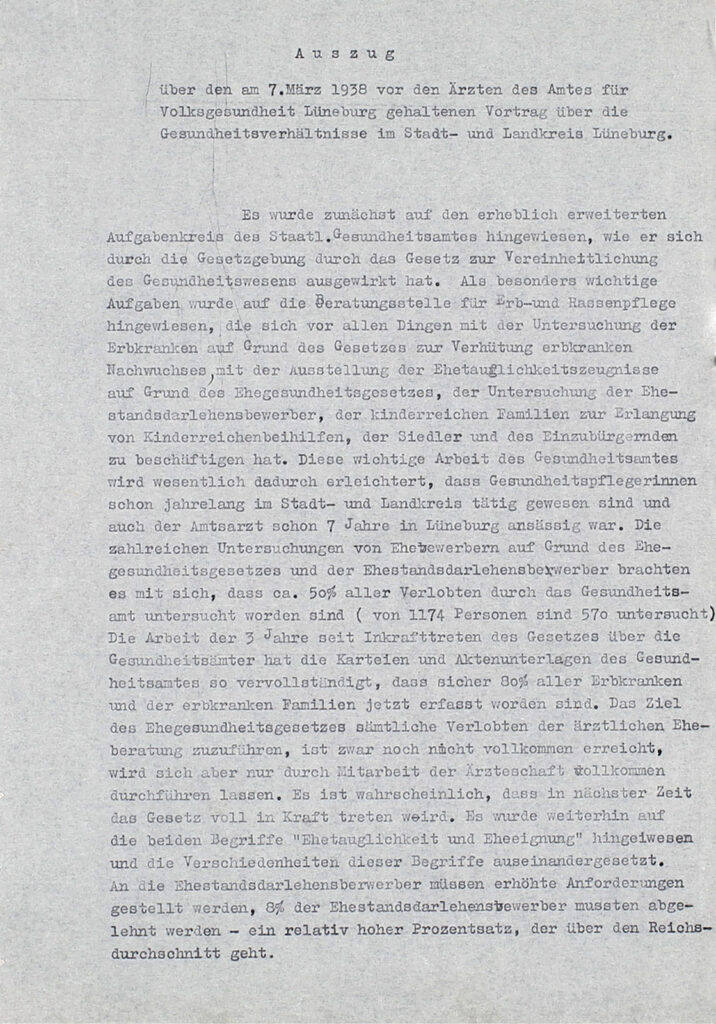
Excerpt from the lecture given on 7 March 1938 to the doctors of the Lüneburg Public Health Office on health conditions in the city and district of Lüneburg.
NLA Hannover Hann. 138 Lüneburg Acc. 101/88 Nr. 275.
As early as March 1938, the head of the Lüneburg health department announced that 80 per cent of the sick and their families had been registered. By then, he had also rejected around eight per cent of all marriage applicants on the grounds of hereditary health. This figure, the director boasted, was far above the national average.
This stipulated that only people who had not been declared to have a hereditary disease had the right to marry. The decisive factor was whether the marriage was expected to produce »Healthy« offspring. If one was considered »hereditarily sick«, marriage was not permitted. Even sterilisation did not lead to a subsequent marriage licence.
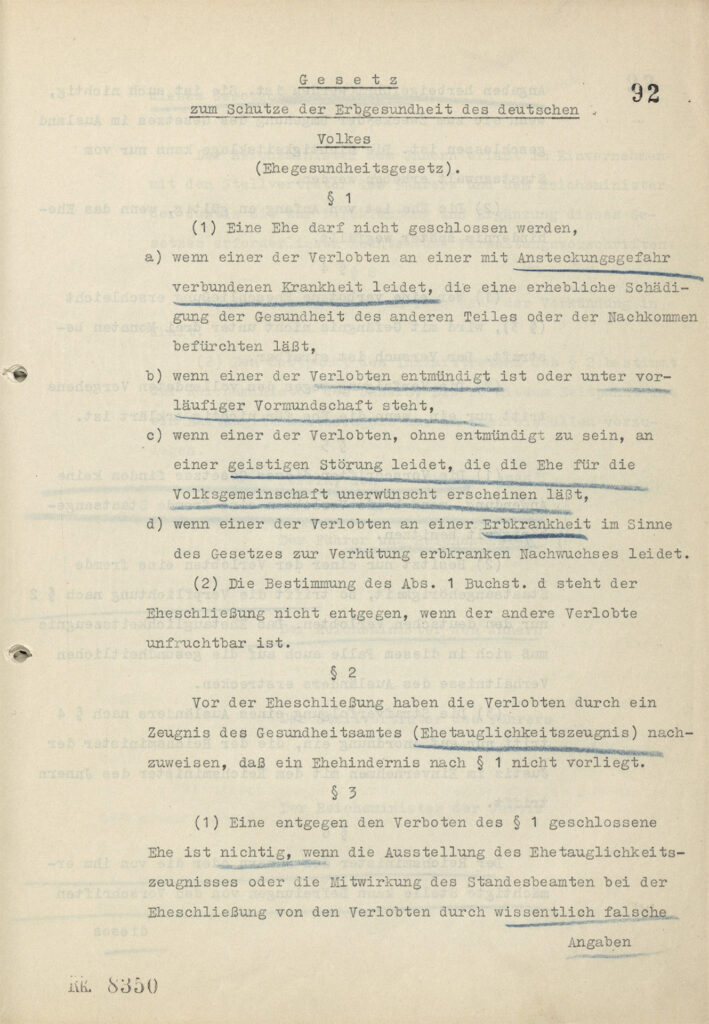
Excerpt from the »Law for the Protection of the Hereditary Health of the German People« of 18 October 1935.
BArch R 43-II/722.
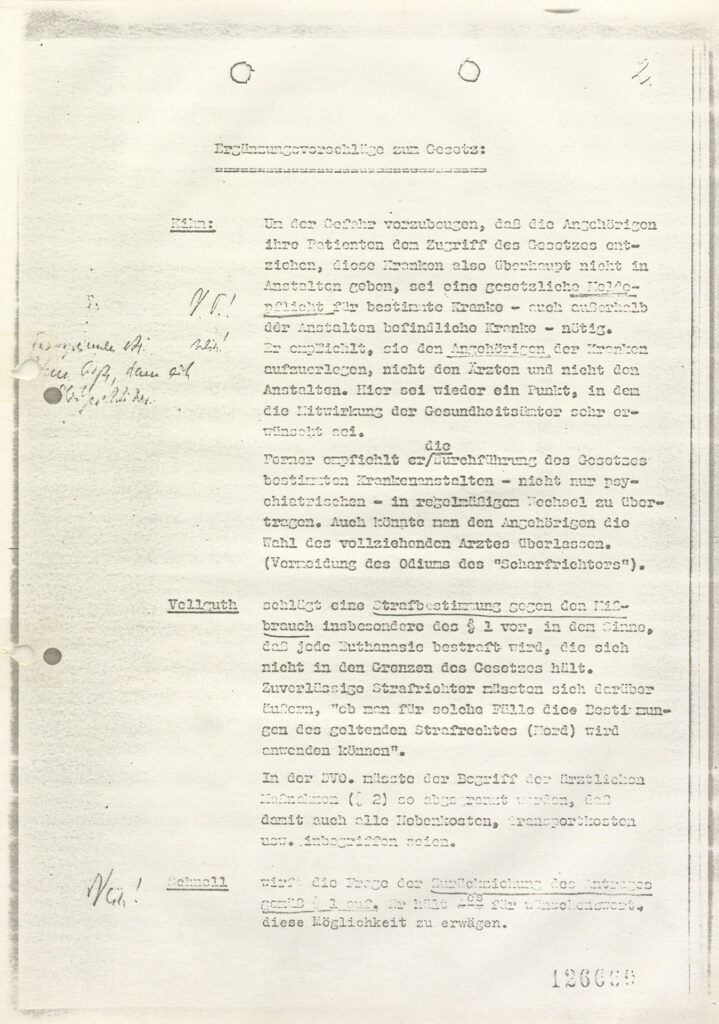
Excerpt from a transcript on the »Assisted Dying Act«, circa 1939.
BArch R 96-I/2.
An »Euthanasia law« drafted before the outbreak of the Second World War, but never passed, was intended to make the murder of the sick and people with disabilities unpunishable. In order to be able to murder as many people as possible with the help of a »painless euthanasia«, even against the wishes of their relatives, the draft law provided for mandatory reporting and an ordered placement in a designated sanatorium and nursing home.
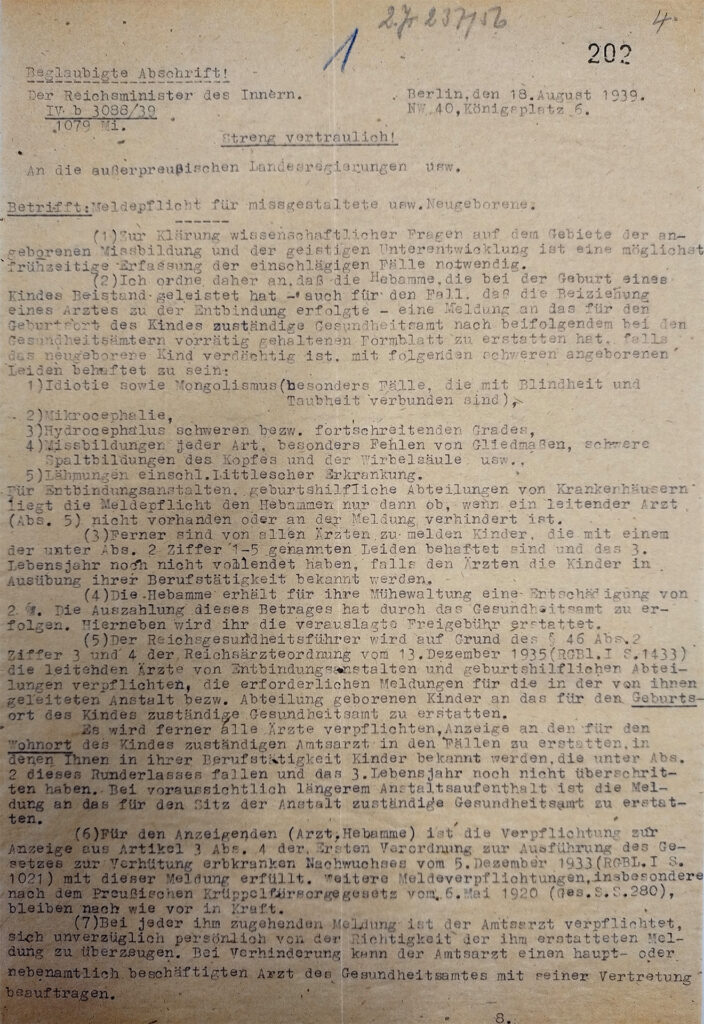
Excerpt from the »Decree of the Reich Minister of the Interior concerning the obligation to report malformed children« of 18 August 1939.
NLA Hannover Nds. 721 Lüneburg Acc. 8/98 No. 3.
Before the outbreak of war, the plan was to also kill children with disabilities. To realise this, compulsory registration was initially only introduced for children under the age of three. In 1941, the obligation was extended to adolescents up to the age of 16. The registration of children was decisive in determining whether they were forcibly placed in a newly created »Specialised children’s ward«, where they were at risk of being murdered.
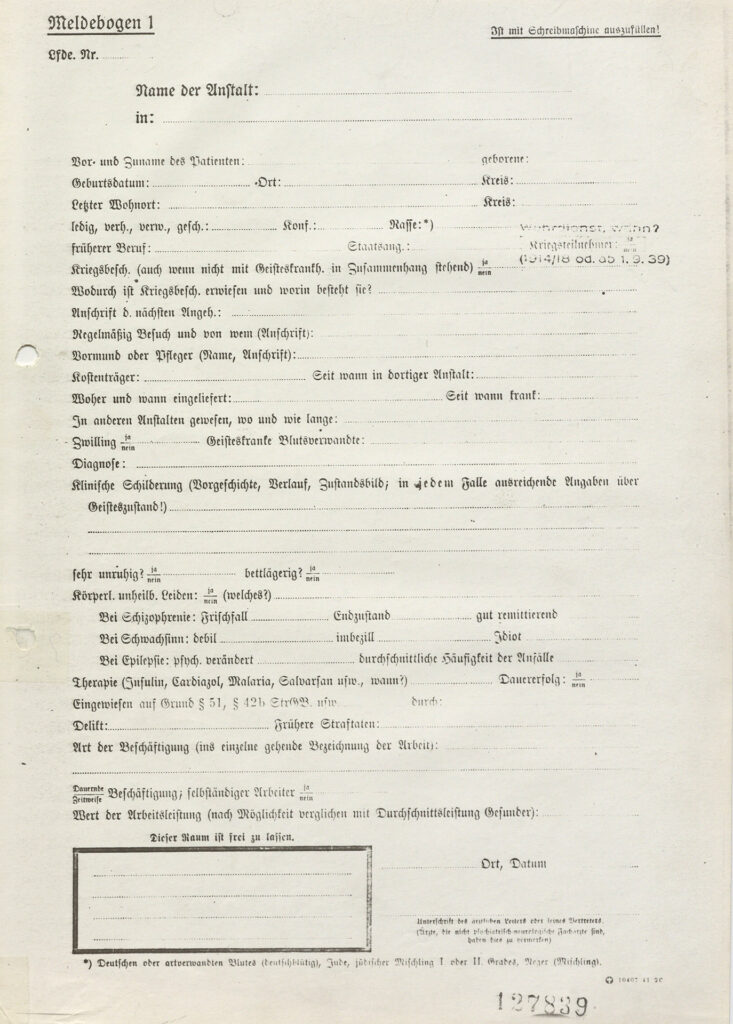
Uncompleted registration form for adult with a disease.
BArch R 96-I/2.
The notification was made using a form. Among other things, the person was asked how long they had been in the institution and whether they had received any visitors. This information was essential for the assessment and decision as to whether someone was selected to be murdered.
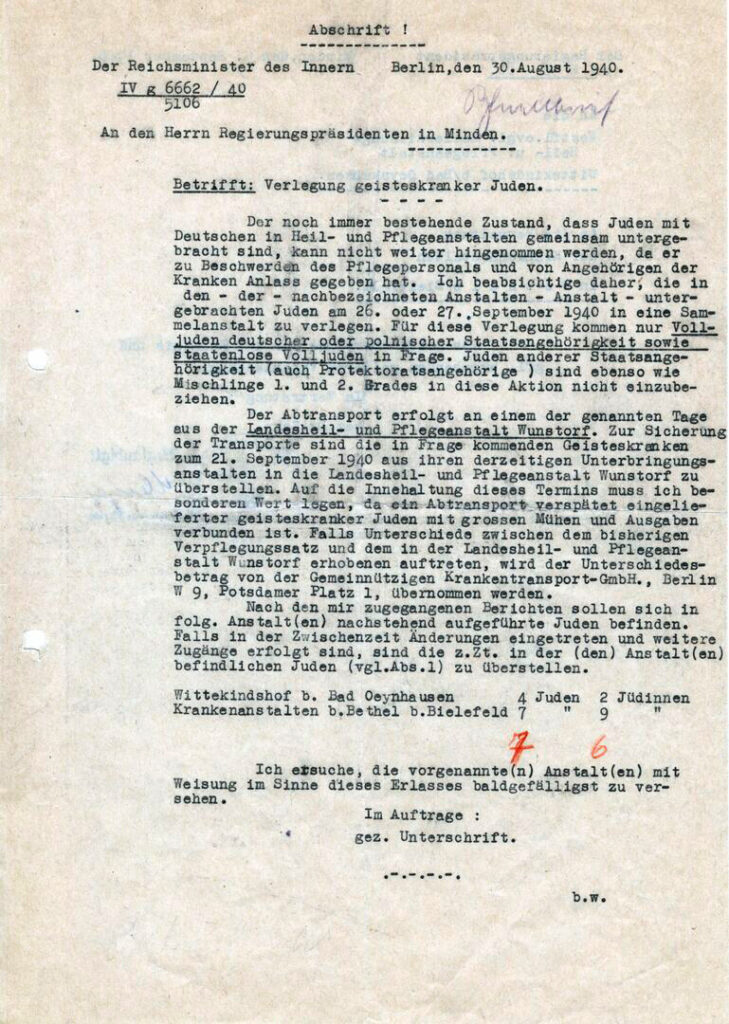
Decree on the transfer of mentally ill Jews, 30 August 1940 (copy).
Main archive Bethel. HAB BeKa1, 38.
For the killing of Jewish patients, reports had to be made to the »Zentraldienststelle« at Tiergartenstraße 4 (Berlin) in the spring of 1940. The Reich Minister of the Interior, Wilhelm Frick, ordered that so-called »Sammelstellen« for Jewish patients be set up throughout the Reich. The sanatorium and nursing home in Wunstorf had to set up such a »Sammelstellen« for the regions of Hanover and Westphalia.
Herbert Linden from the Reich Ministry of the Interior called on all sanatoriums and nursing homes in the province of Hanover to report their respective patients who were eligible for murder by 1 August 1940. This also included the patients in the Lüneburg sanatorium and nursing home.
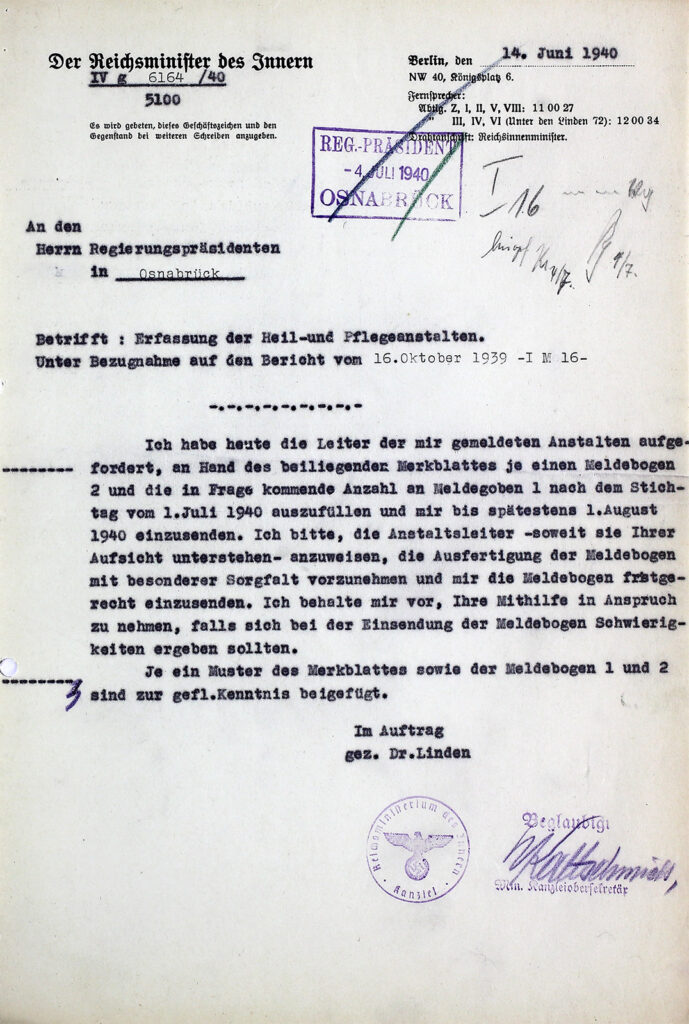
Letter from the Reich Minister of the Interior, Herbert Linden, to the District President of Osnabrück dated 14 June 1940.
NLA OSnabrück Rep. 430 Dez. 303 Akz. 19/56 No. 237.
»There are too many rather than too few sick people to report.«
A sentence from the letter from the Reich Ministry of the Interior dated 26 July 1940.
NLA Hanover Hann. 155 Göttingen Acc. 58/83 No. 10.
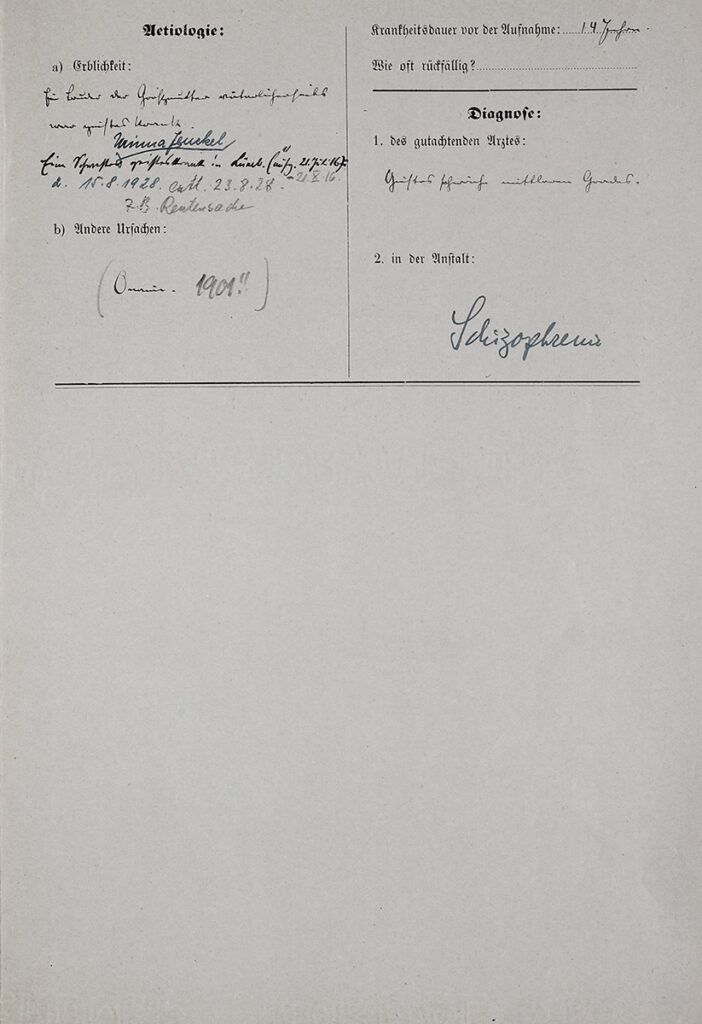
Excerpt from Theodor Jenckel’s medical record. His »Mental weakness of medium degree« became »Schizophrenia« in the course of the report.
NLA Hannover Hann. 155 Lüneburg Acc. 2004/066 Nr. 07981.
As the reports had to comply with the requirements of the Reich Ministry of the Interior, the doctor Rudolf Redepenning falsified the medical records. He changed the initial diagnosis or added the entry »Schizophrenia«. In this way, the Lüneburg institution managed to report the required 480 patients.
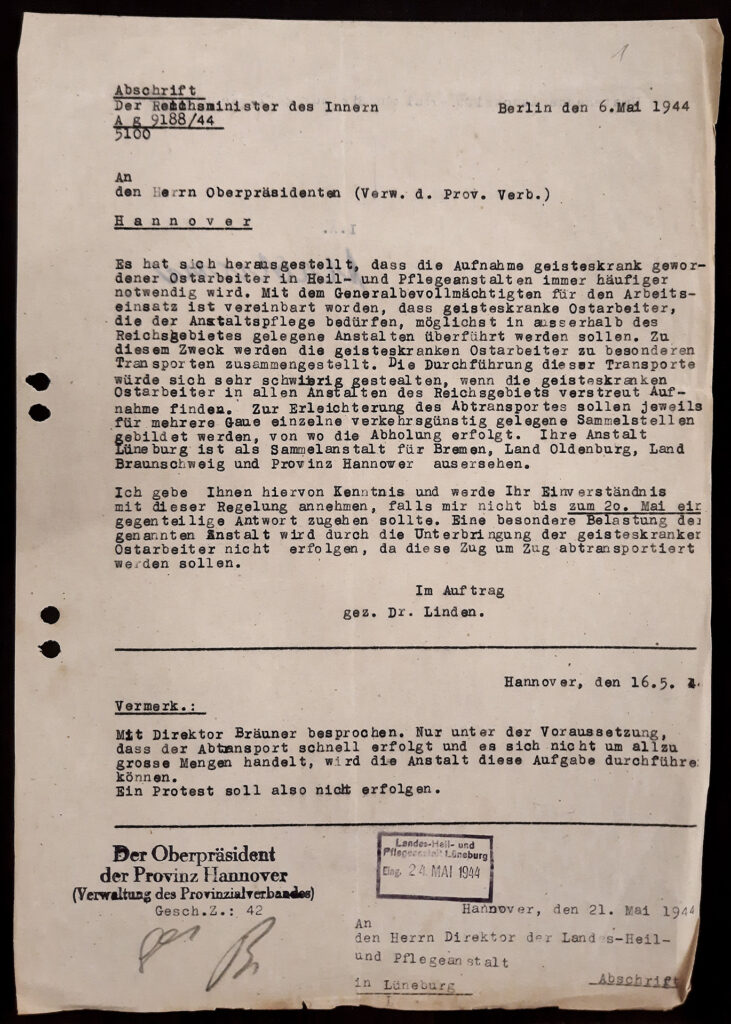
Decree of the Reich Minister of the Interior dated 6 May 1944 (copy).
NLA Hannover Hann. 155 Lüneburg Acc. 56/83 No. 8/2.
This decree stipulated that mentally unfit forced labourers were to be »transferred« to institutions located outside the Reich territory. Those affected were to be organised into special transports for this purpose. To facilitate this, the establishment of »Sammelstellen« was planned. The decree was therefore a decisive prerequisite for the establishment of so-called »Ausländersammelstellen«.
