SCOPE FOR ACTION
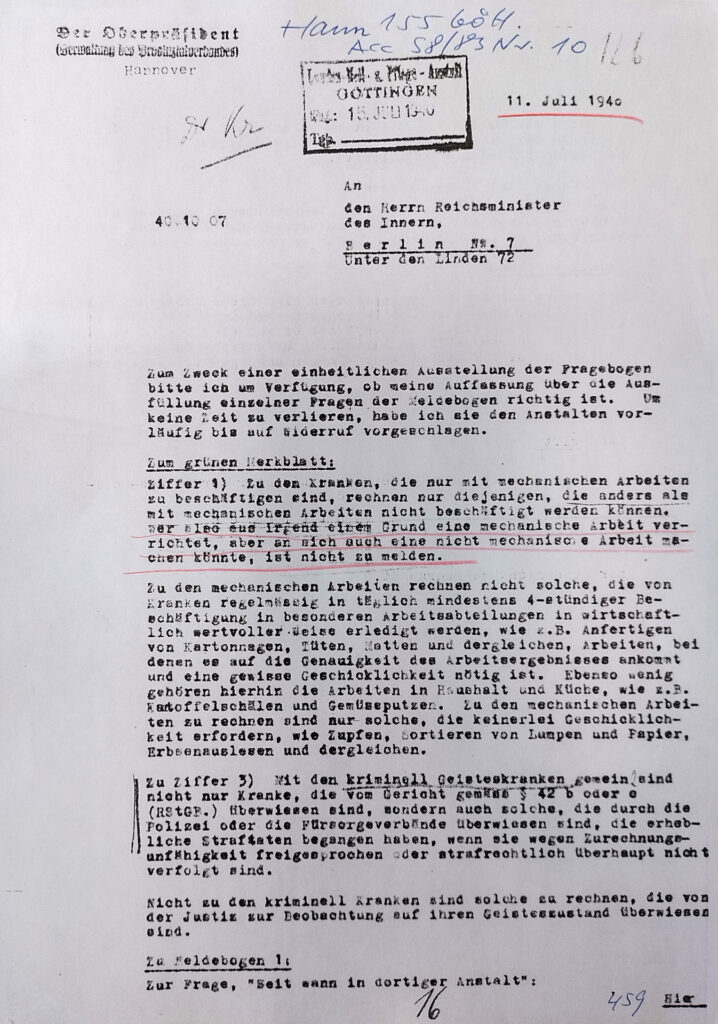
Letter from Georg Andreae, Chief President of the Province of Hanover, to the Reich Ministry of the Interior, dated July 11, 1940.
NLA Hanover Hann. 155 Göttingen Acc. 58/83 No. 10.
Georg Andreae from the provincial administration in Hanover traveled to Berlin to delay reporting the sick. There, he succeeded in ensuring that individual patients could be postponed from being transferred to a killing center. He also wanted to ensure that the assessment of »usefulness« would be interpreted very broadly. However, he was unsuccessful in this endeavor. He allowed himself to be convinced that there was a Führer order and did not use his discretion to defer as many people as possible.
As experts, Georg Andreae, Ludwig Geßner, and Gottfried Ewald knew that »euthanasia« was planned murder. They were opposed to it. In their opinion, people with disabilities should not be murdered, but instead receive only the most necessary care and assistance. Together, they wrote a memorandum to Reich Interior Minister Wilhelm Frick opposing »euthanasia.« However, this had no effect.
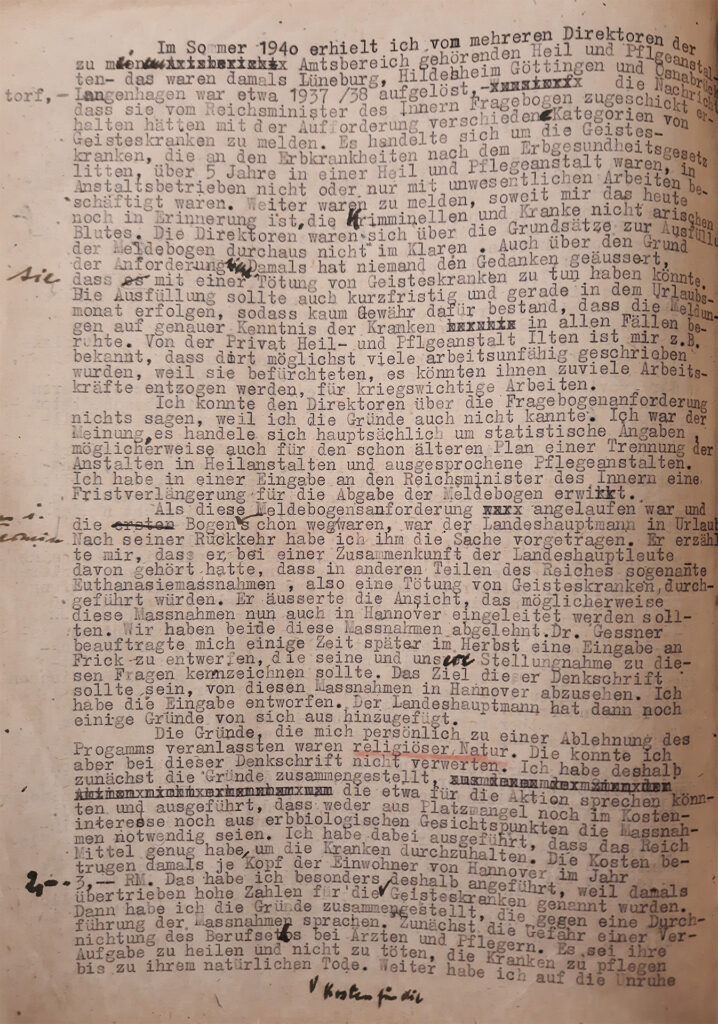
Excerpt from the transcript of the public prosecutor’s interrogation of Georg Andreae on May 11, 1948.
NLA Hanover Nds. 721 Hanover Acc. 61/81 No. 28/1.
GEORG ANDREAE (1888 – 1983)
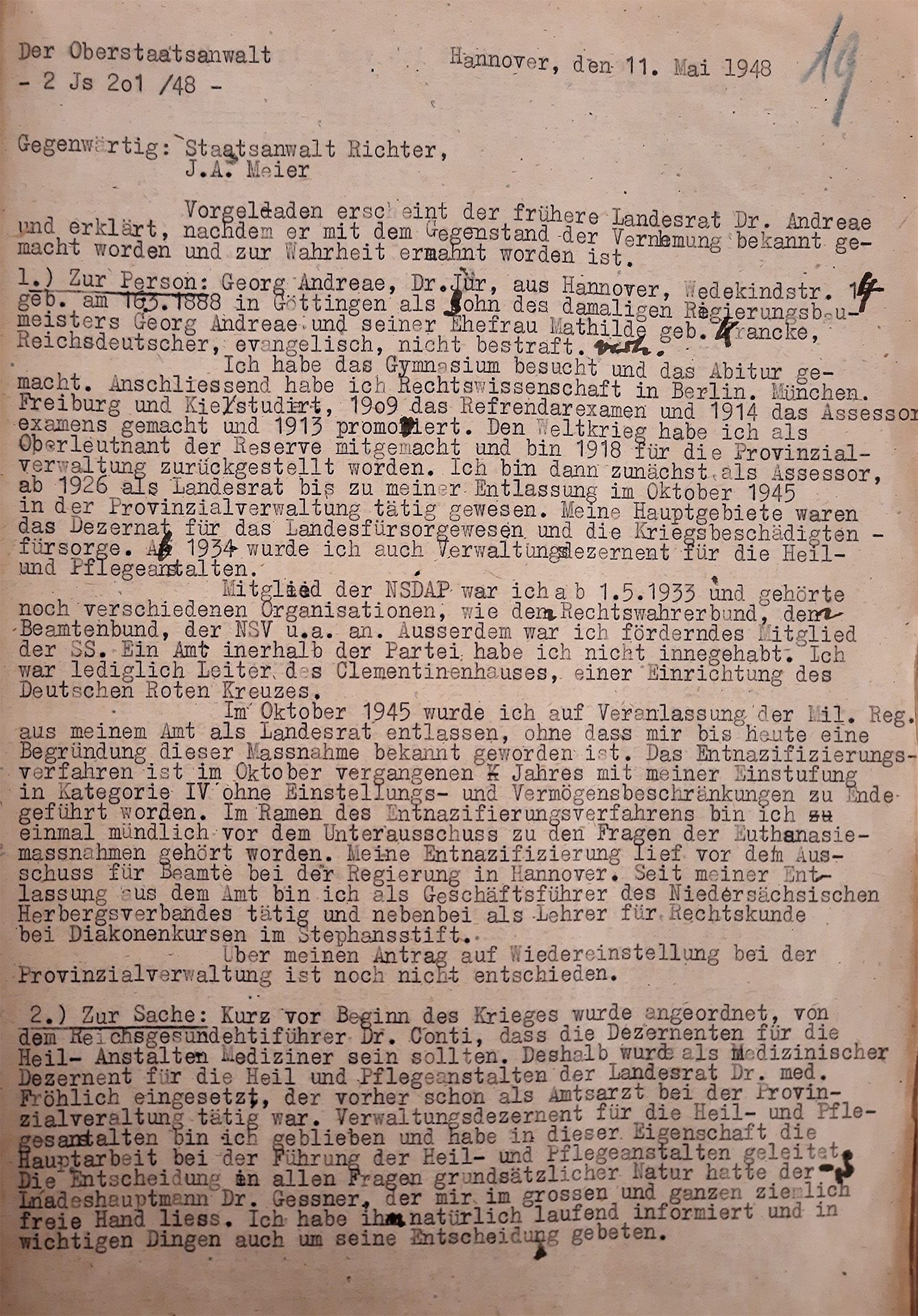
Excerpt from the minutes of the public prosecutor’s interrogation of Georg Andreae on May 11, 1948.
NLA Hanover Nds. 721 Hanover Acc. 61/81 No. 28/1.
Due to her experience in caring for children and adolescents, senior nurse Marie Jürgen (1891–1994) took over the management of the »children’s ward« in Lüneburg. Shortly thereafter, she took a vacation. When she returned two weeks later, Max Bräuner exercised his authority and replaced her with Wilhelmine Wolf, whom he believed would provide the necessary determination and attitude.
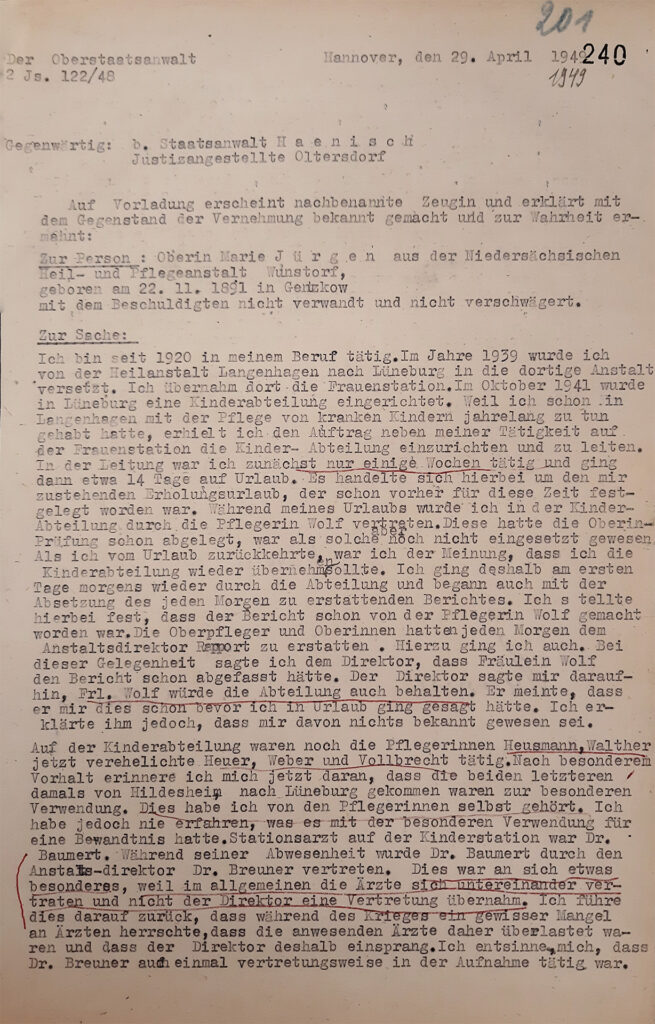
Excerpt from the interrogation of Marie Jürgen on April 25, 1949.
NLA Hanover Nds. 721 Lüneburg Acc. 8/98 No. 3.
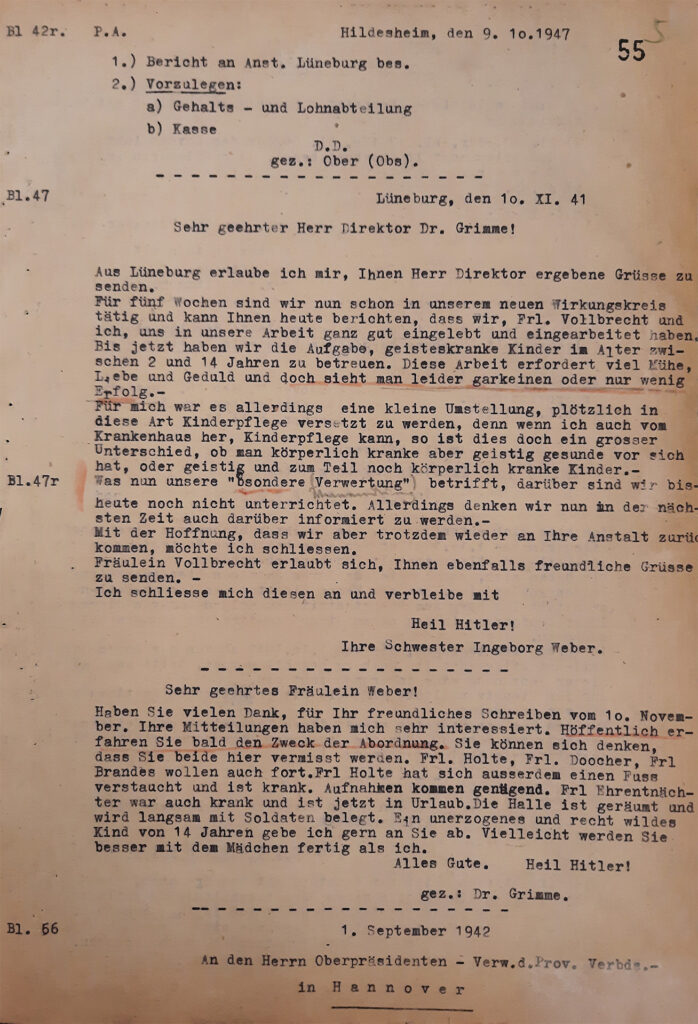
Letter from Ingeborg Weber to the Hildesheim Mental Hospital, Director Grimme, dated November 10, 1941.
NLA Hanover Nds. 721 Lüneburg Acc. 8/98 No. 3.
Ingeborg Weber reluctantly accepted her transfer to Lüneburg. She was just starting her career and had only completed her training in June 1941. When she realized that her »special assignment« meant killing children, she asked to be transferred back to Hildesheim. Her request was denied, and she was permanently transferred to Lüneburg instead. When Max Bräuner also rejected her request for leave and she had to remain in Lüneburg, she was so desperate that she took her own life in 1942.
SCOPE FOR ACTION
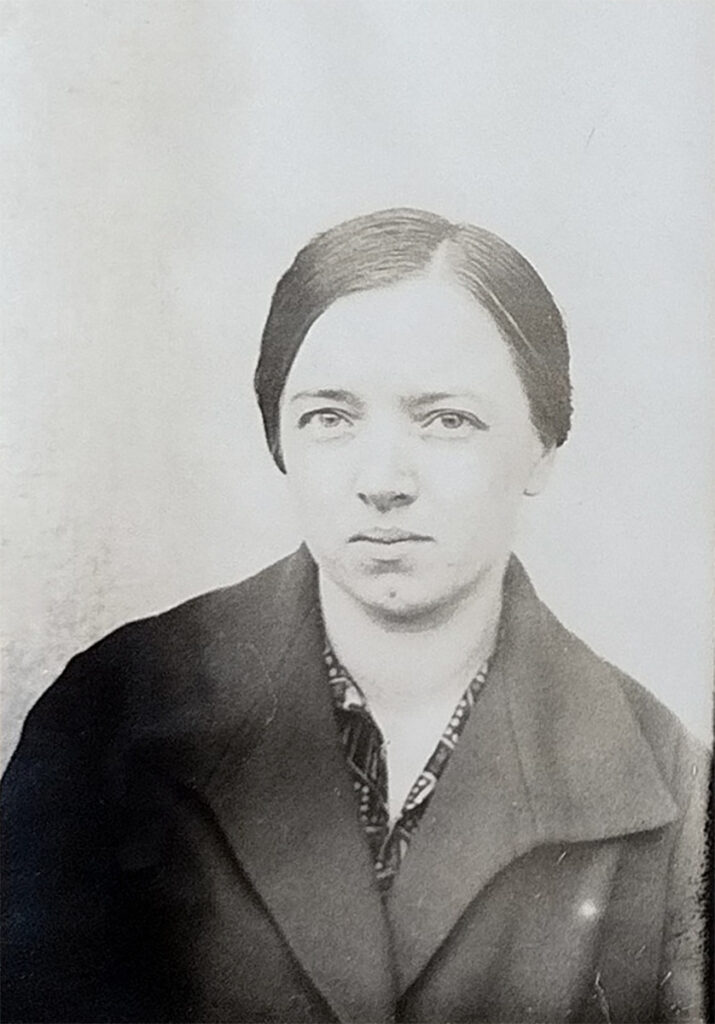
Herta Braun, 1924.
NLA Hanover Nds. 330 Lüneburg Acc. 2004/134 No. 03270.
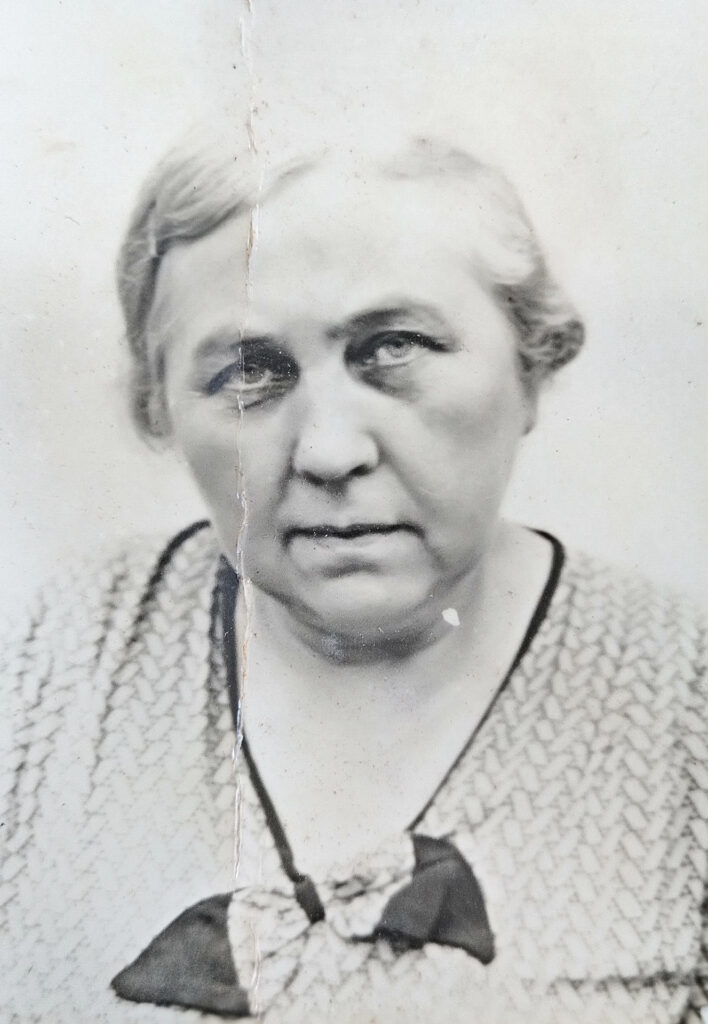
Paula Jahn, 1937.
NLA Hanover Nds. 330 Lüneburg Acc. 2004/134 No. 01135.
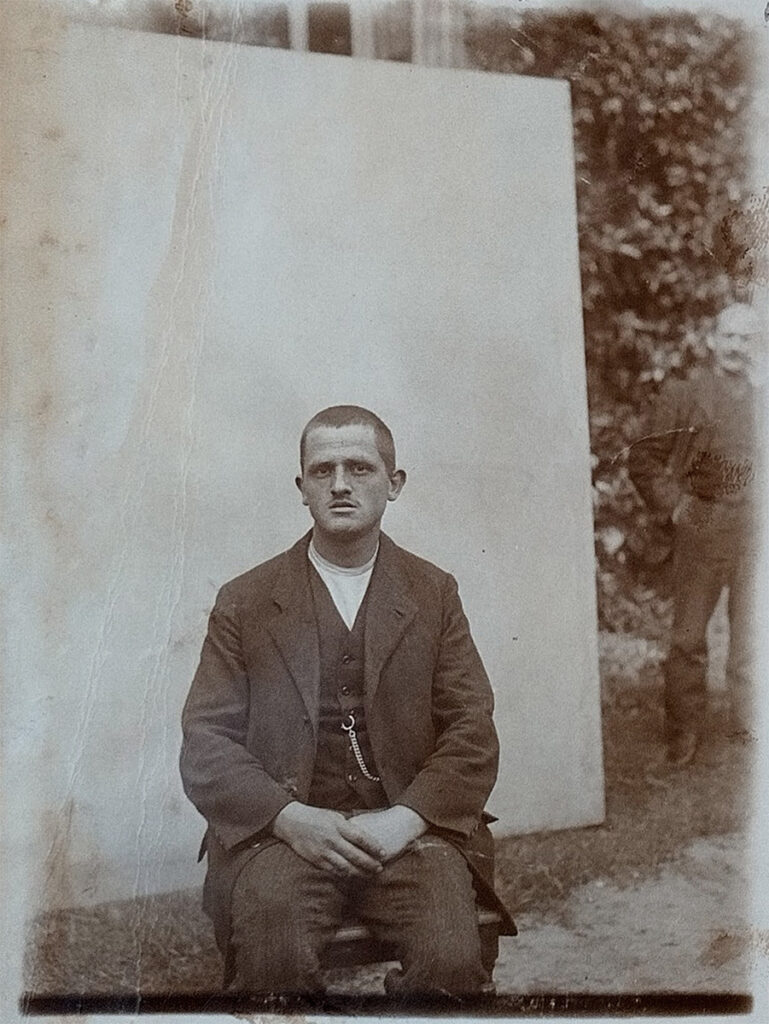
Karl Reich, around 1922.
NLA Hanover Hann. 155 Lüneburg Acc. 2004/066 No. 08339.
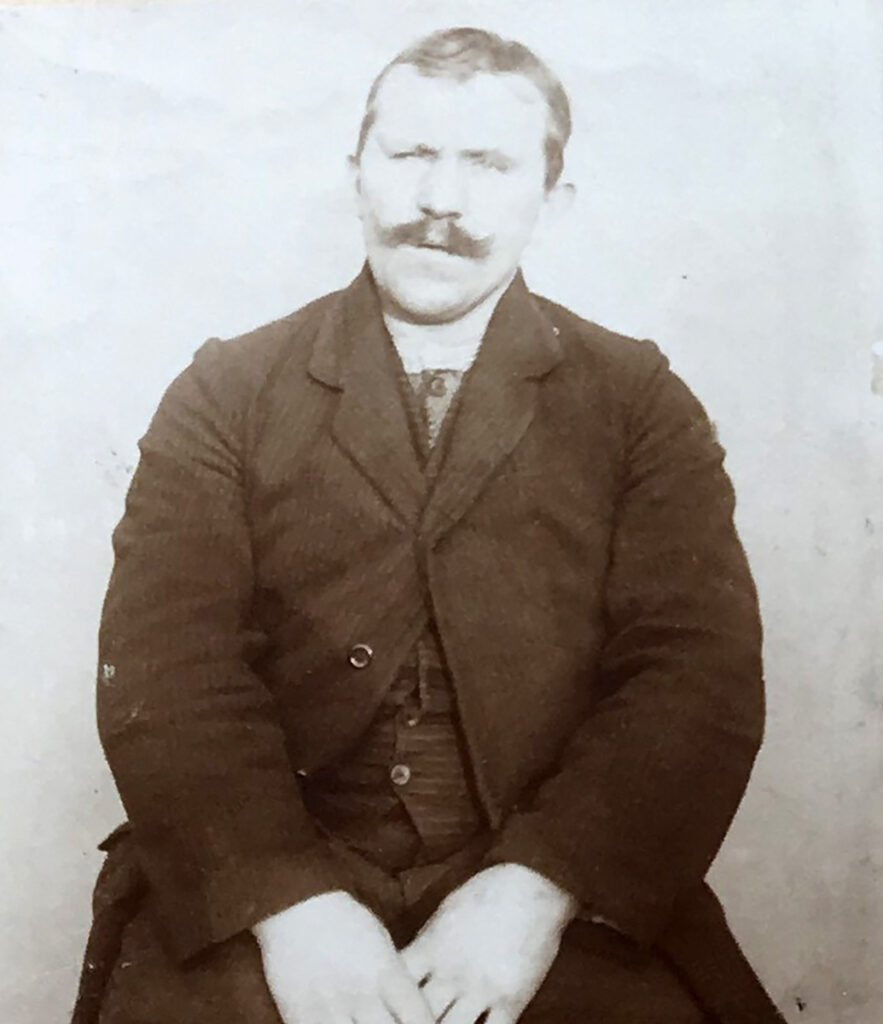
Heinrich Brandt, around 1914.
NLA Hanover Hann. 155 Lüneburg Acc. 2004/066 No. 07628.
Only a few patients were not transferred from the Herborn intermediate institution to the Hadamar »T4« killing center. Two women were brought back from Herborn to Lüneburg. Two men managed to be removed from the gas chamber at the Hadamar killing center. They were needed as laborers on the institution’s own farm in Schnepfenhausen. These four patients survived.
HEINRICH BRANDT (1882 – 1957)
»The court is convinced that the defendant does not suffer from intellectual inferiority.«
Decision of the Stade Regional Court dated January 10, 1936.
Hadamar Memorial Archive. Ref. 12/K2978.
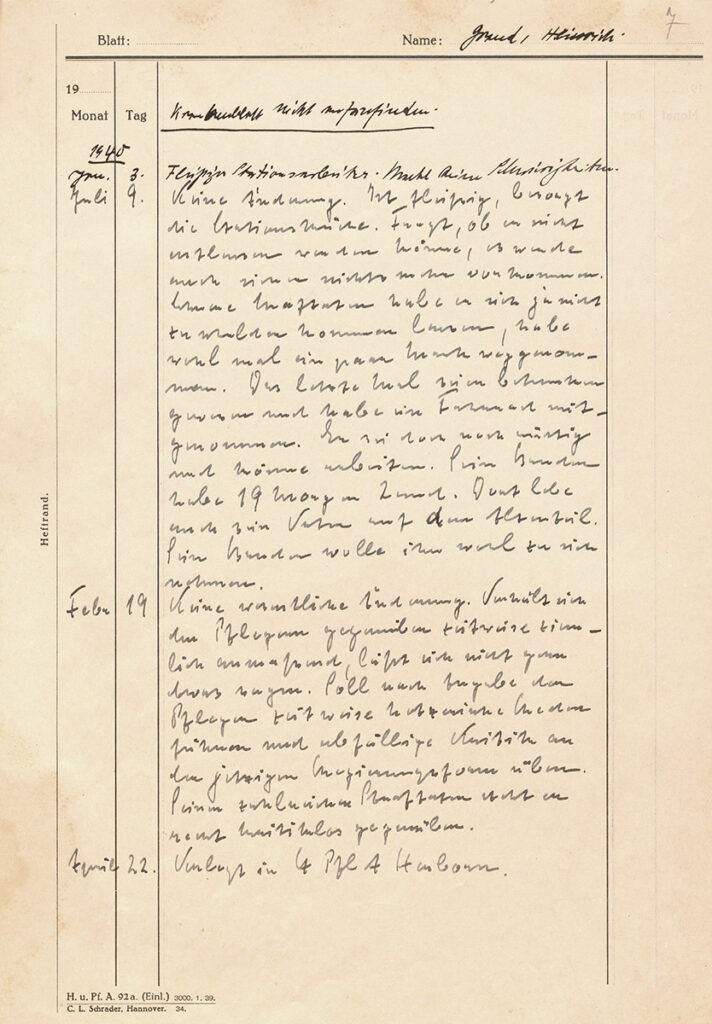
Entry by Gustav Marx in Heinrich Brandt’s medical records.
Hadamar Memorial Archive. Ref. 12/K2978.
After undergoing alcohol withdrawal treatment, Heinrich Brandt behaved in an exemplary and »useful« manner. Nevertheless, he was transferred to »Aktion T4.« This was probably also because he had become inconvenient:
»Behaves rather arrogantly towards the nurses at times, does not like to be told what to do. According to the nurses, he sometimes makes highly censored speeches and expresses disparaging criticism of the current form of government.«
It can be assumed that Heinrich Brandt sensed what threatened him and his fellow patients. After his release from the gas chamber, he behaved as desired, almost overly conformist. This saved his life. In 1942, he helped Hedwig Siebert run her cinema. In 1945, she vehemently advocated for his release. On February 11, 1946, he was allowed to leave. He later moved back to his homeland and died on December 2, 1957, in Bornberg.
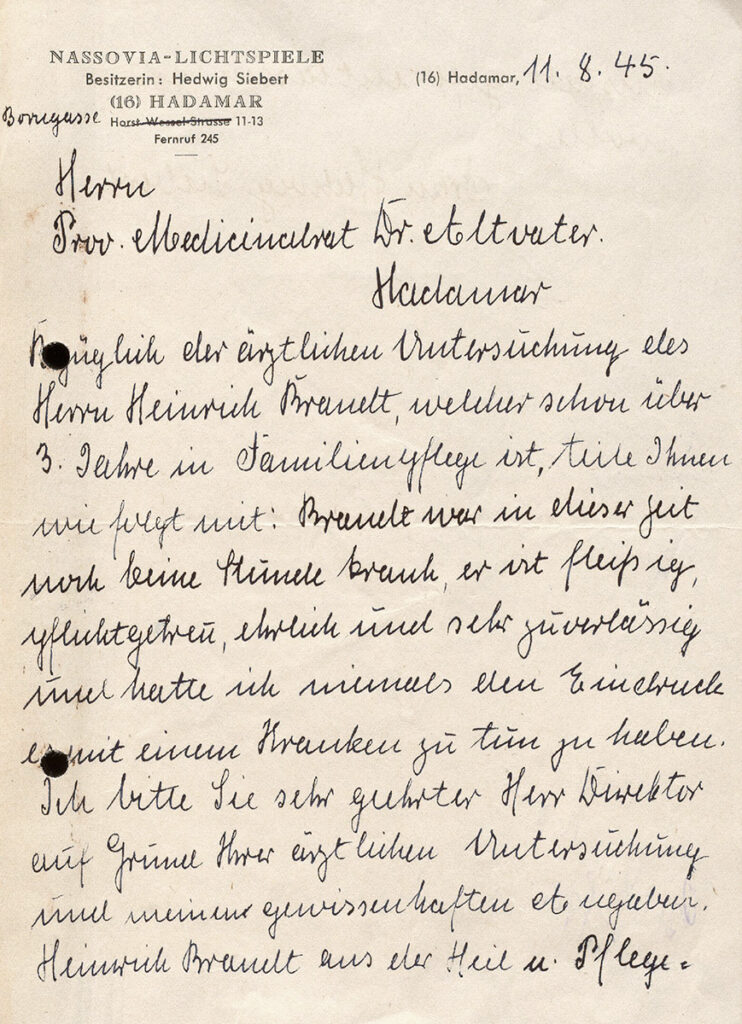
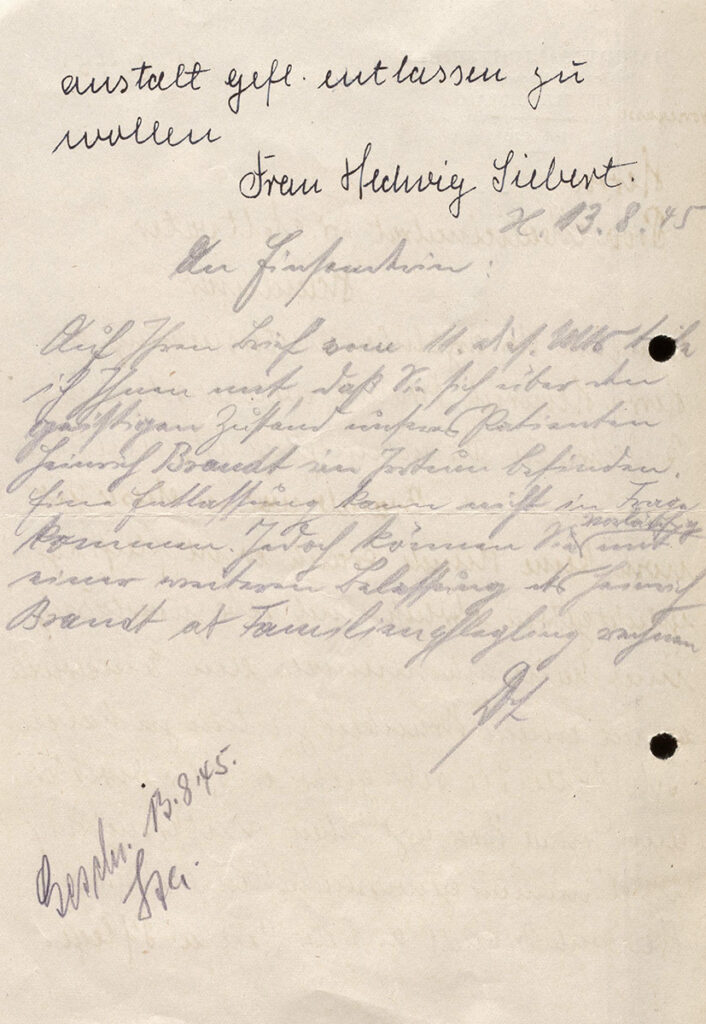
Letter from Hedwig Siebert with reply to the Hadamar Institution and Nursing Home dated August 11, 1945.
Hadamar Memorial Archive. Ref. 12/K2978.
DOROTHEA KALIWE (née GRIESBACH) (1890–1967)
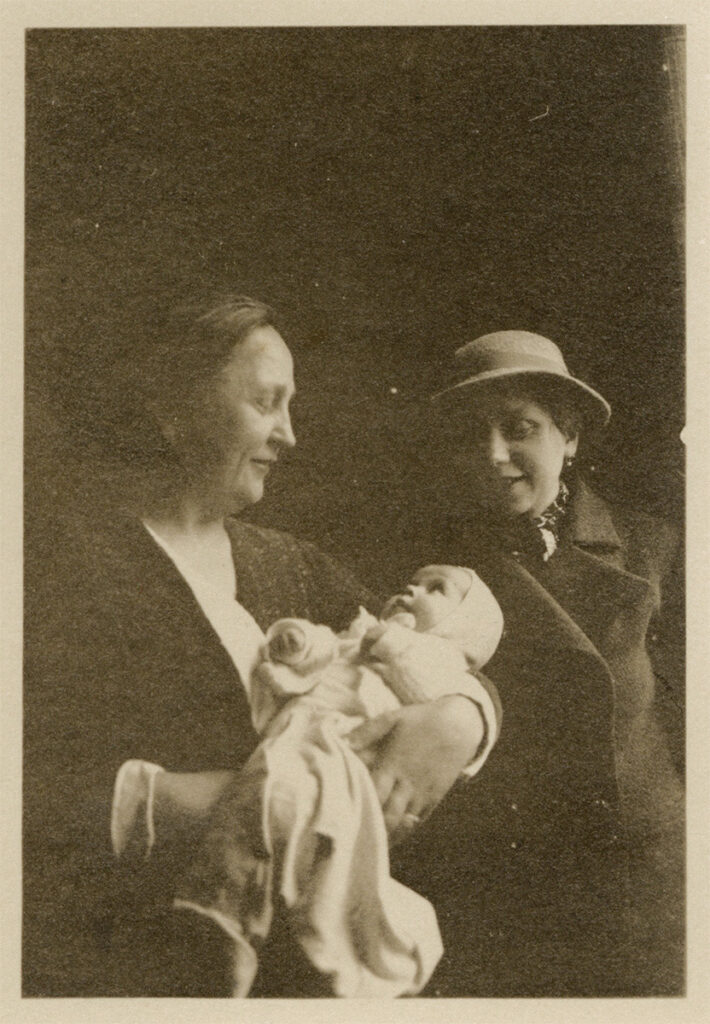
»I’m going through that door with my mother-in-law right now, and if you pick up the phone, we won’t leave this room alive.«
Interview with Ursula Becker, January 11, 2018.
ArEGL.
Dorothea Kaliwe was handed over to her family. She survived and died in 1967 in the apartment of her daughter, with whom she had been living since her rescue.
In the photo, Dorothea Kaliwe (left) is holding her newborn granddaughter Ursula Zobel. Dorothea’s daughter Ursula Zobel can be seen on the right. The photo was taken in December 1934 at the Lüneburg Institution and Nursing Home.
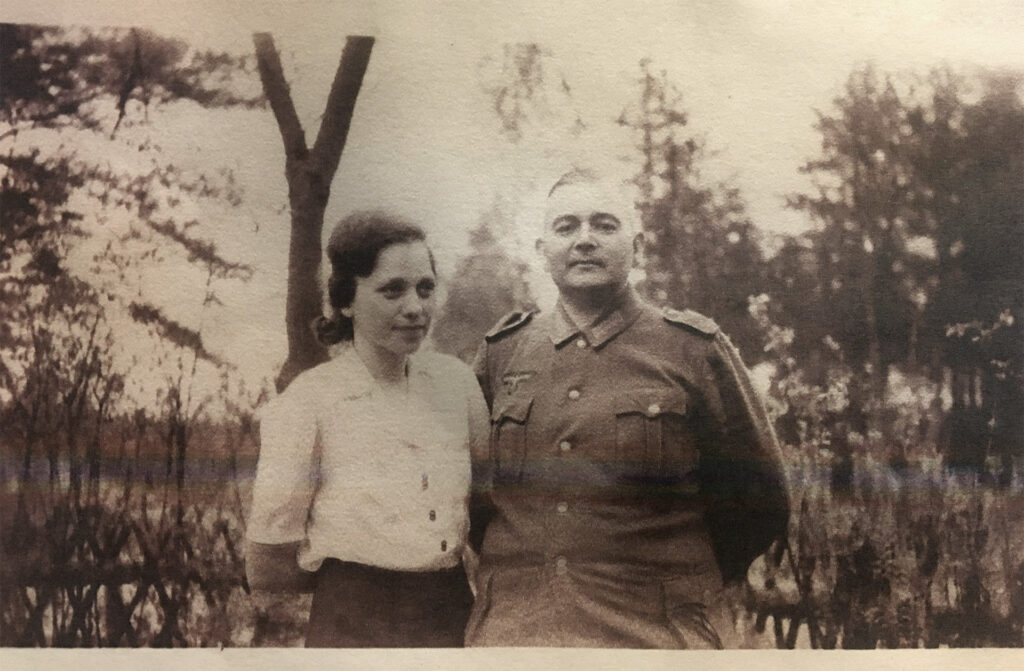
Photo of Ursula and Theo Zobel, taken before 1944.
ArEGL 64.
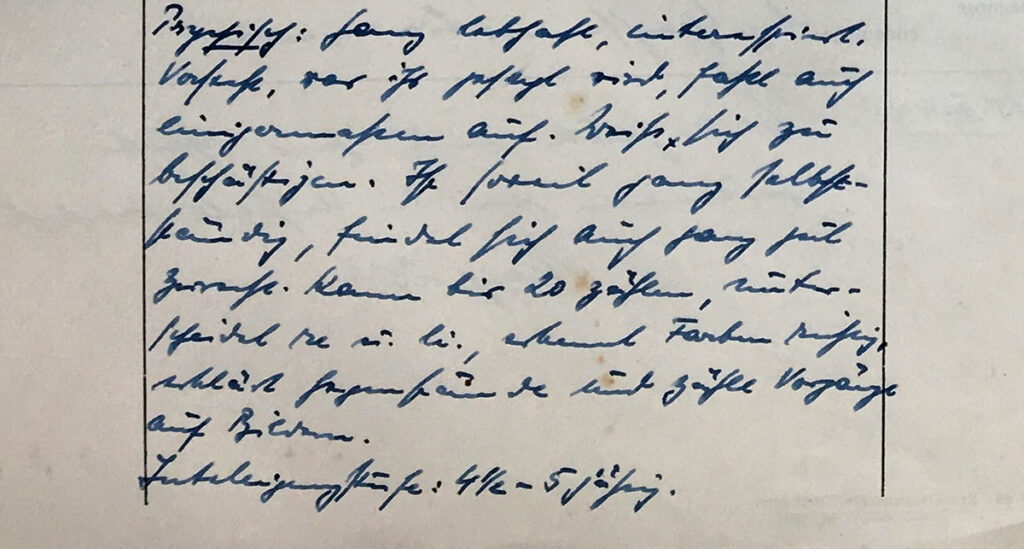
Excerpt from Käte’s medical history.
NLA Hanover Nds. 330 Lüneburg Acc. 2004/134 No. 02912.
The children transferred to Eben-Ezer had to be of school age. Younger and older children had no chance of escaping in this way – with one exception: Erika (born in 1940) was transferred to Eben-Ezer even though she was only four years old. Willi Baumert decided that she should not be separated from her older sister Käte (born in 1938). Thus, both sisters survived the »children’s ward« in Lüneburg.
Frieda Neumann could not be saved. Although her father tried everything to get her into Bethel, she was murdered by Willi Baumert.
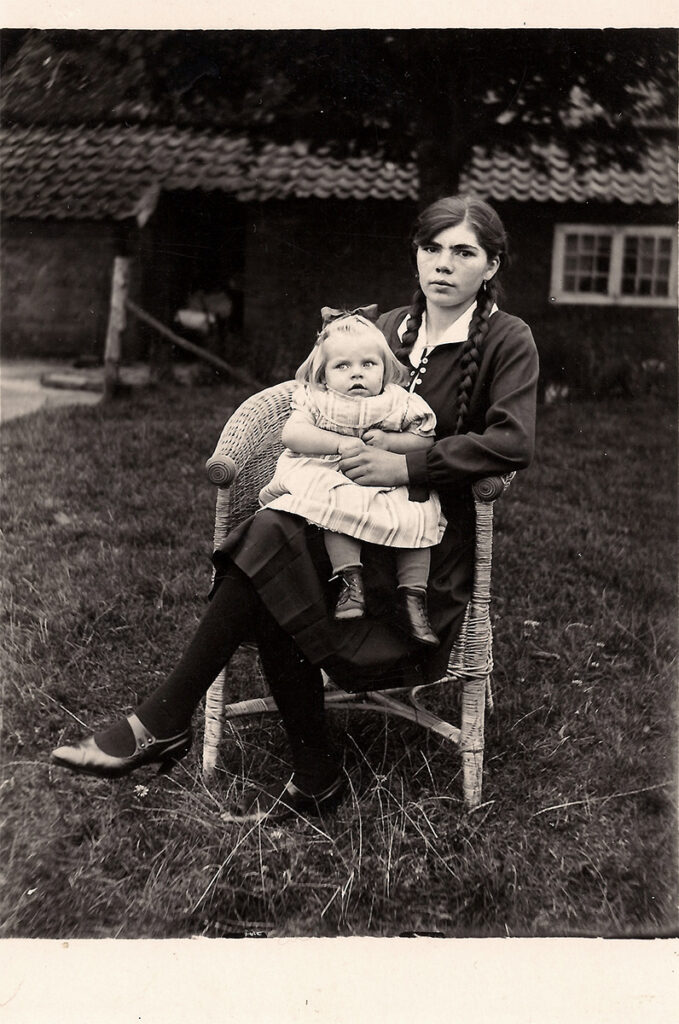
Frieda Neumann sitting on the lap of her older half-sister Hilda Janssen, presumably on Hilda’s 17th birthday on May 4, 1931.
Privately owned by the Alpha family.
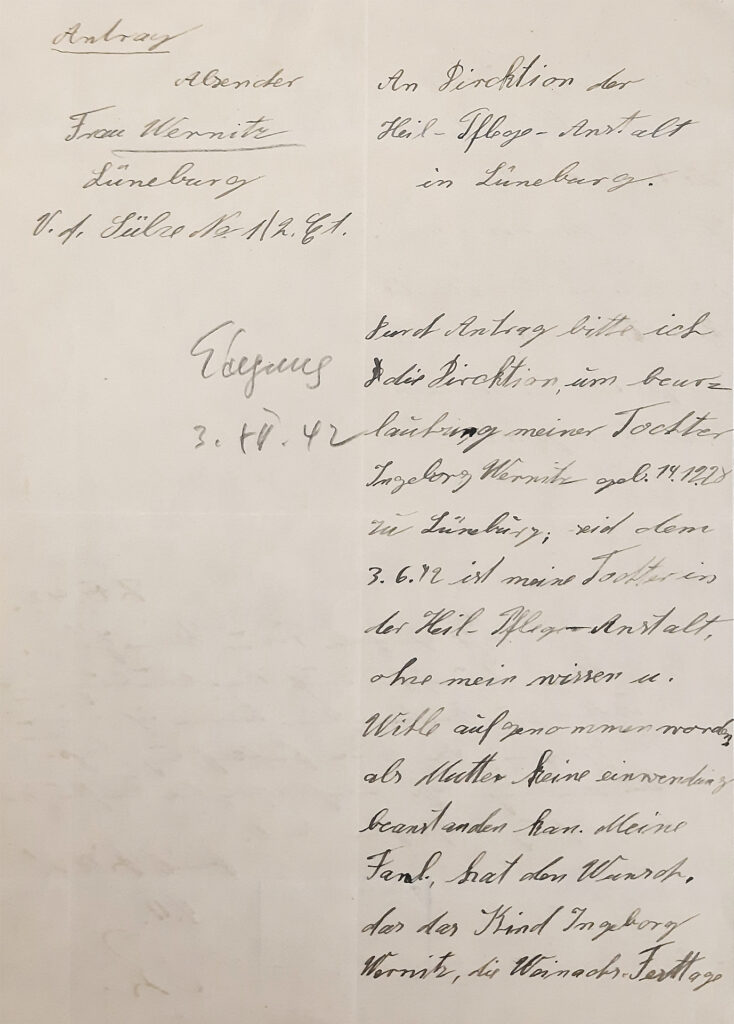
Vacation request from Frieda Wernitz dated December 2, 1942.
NLA Hanover Nds. 330 Lüneburg Acc. 2012/064 No. 2566.
Some parents even accepted the sterilization of their child so that it could be discharged from the »children’s ward.« The parents of Ingeborg Wernitz from Lüneburg did the same.
»On September 26, 1942, Ms. Wernitz appeared at the health care office of the city of Lüneburg […] and requested the release of her daughter Ingeborg Wernitz from the institution. She and her husband did not agree with the placement and would never give their consent to it. Her daughter could be cared for more cheaply at home, as she was not learning anything at the institution. She would also take good care of Ingeborg. On October 3, 1942, the Lüneburg Health Care Office sent a letter requesting information on whether I. W. could be released if she were to undergo sterilization.«
NLA Hanover Nds. 330 Lüneburg Acc. 2012/064 No. 2566.
Ingeborg Wernitz was sterilized on January 21, 1943, at the age of 14, and then discharged from the »children’s ward« on February 26, 1943.
