»DECENTRALISED EUTHANASIA«
Nine patients who had been admitted to the Lüneburg institution at some point in their lives were transferred to the Hadamar killing centre in 1942 and 1943. Among them were three people born in Lüneburg: Wilhelmine Dankert, Martin Bey and Heinz Eckhardt. Only Wilhelmine Dankert survived. The others starved to death or were murdered with medication.
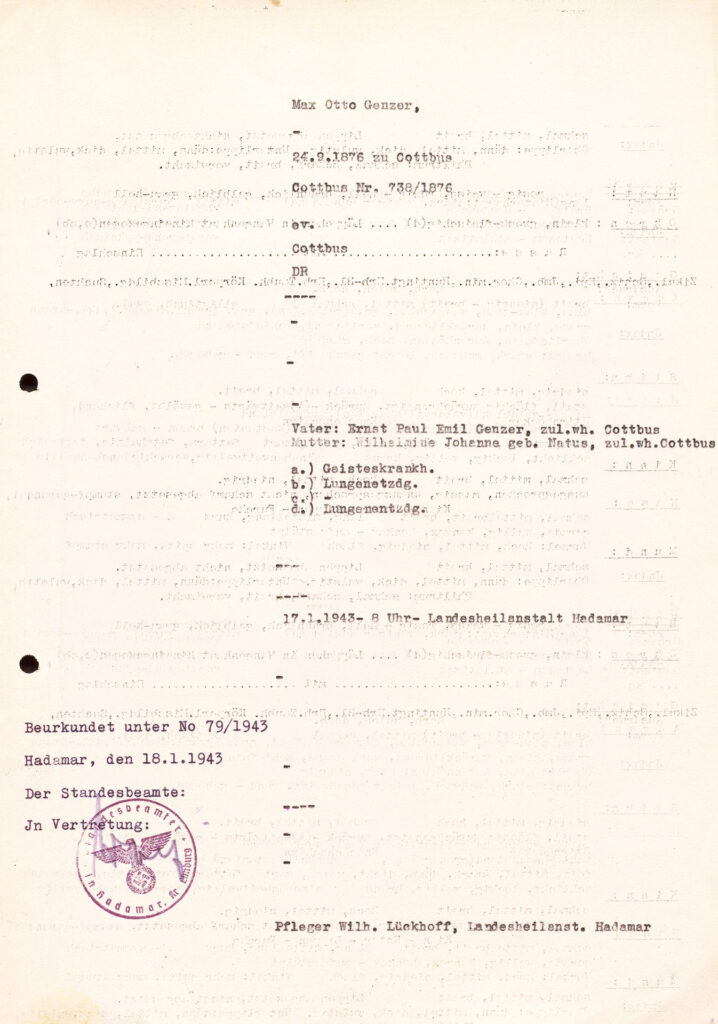
For Otto Genzer’s death certificate, the Hadamar registry office used the back of a form that was originally intended to evaluate sick people on the basis of racial biological characteristics.
Hadamar Memorial Archive. 12 K No. 3478.
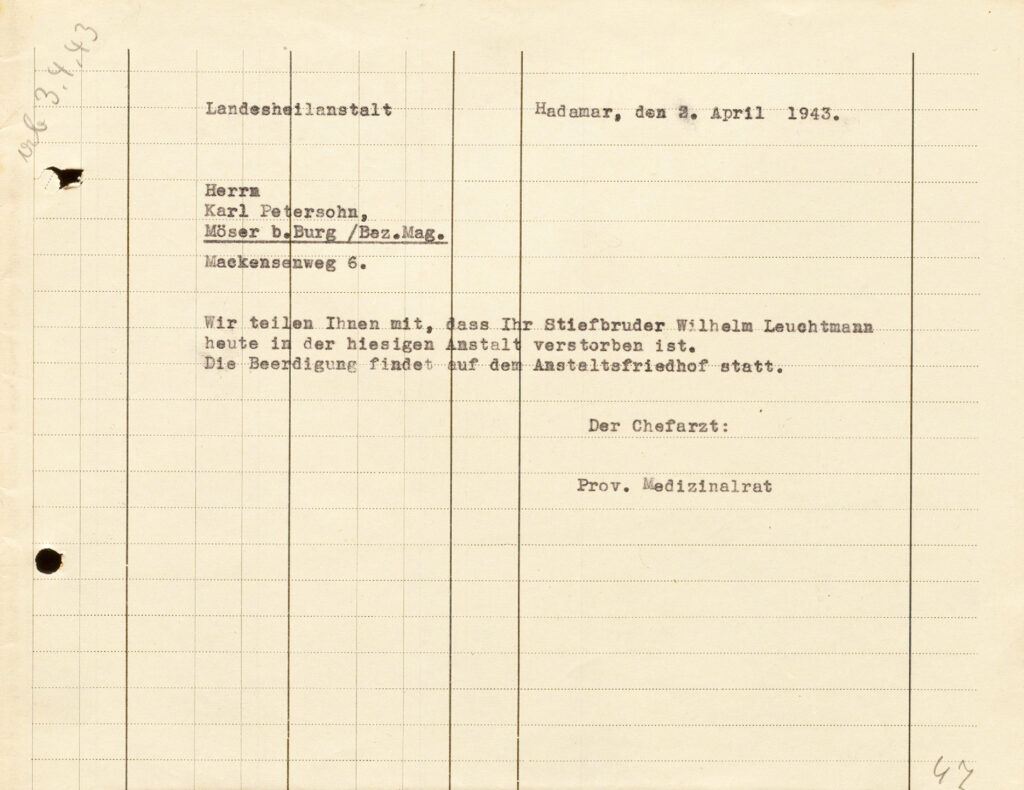
Wilhelm Leuchtmann’s death certificate was written on a torn-out page from an accounting ledger.
Letter to Karl Petersohn dated 2 April 1943.
Hadamar Memorial Archive. 12 K No. 1760.
After the First World War, many soldiers returned home with post-traumatic stress disorder, including Wilhelm Leuchtmann (1886–1943) from Bremen. He was admitted to the Lüneburg mental hospital in 1919 and transferred to Wunstorf. From there, he was taken to Hadamar in early 1943 together with Otto Genzer (1876–1943), a patient from Lüneburg. Otto Genzer was murdered five days after his arrival, Wilhelm Leuchtmann four weeks later.
On 8 September 1943, 298 patients from the Lüneburg institution and nursing home were transferred to the Pfafferode killing centre (Mühlhausen). Around 250 of them were murdered. This corresponds to a mortality rate of over 80 percent. It is highly likely that the patients were murdered in Pfafferode with medication and by starvation.
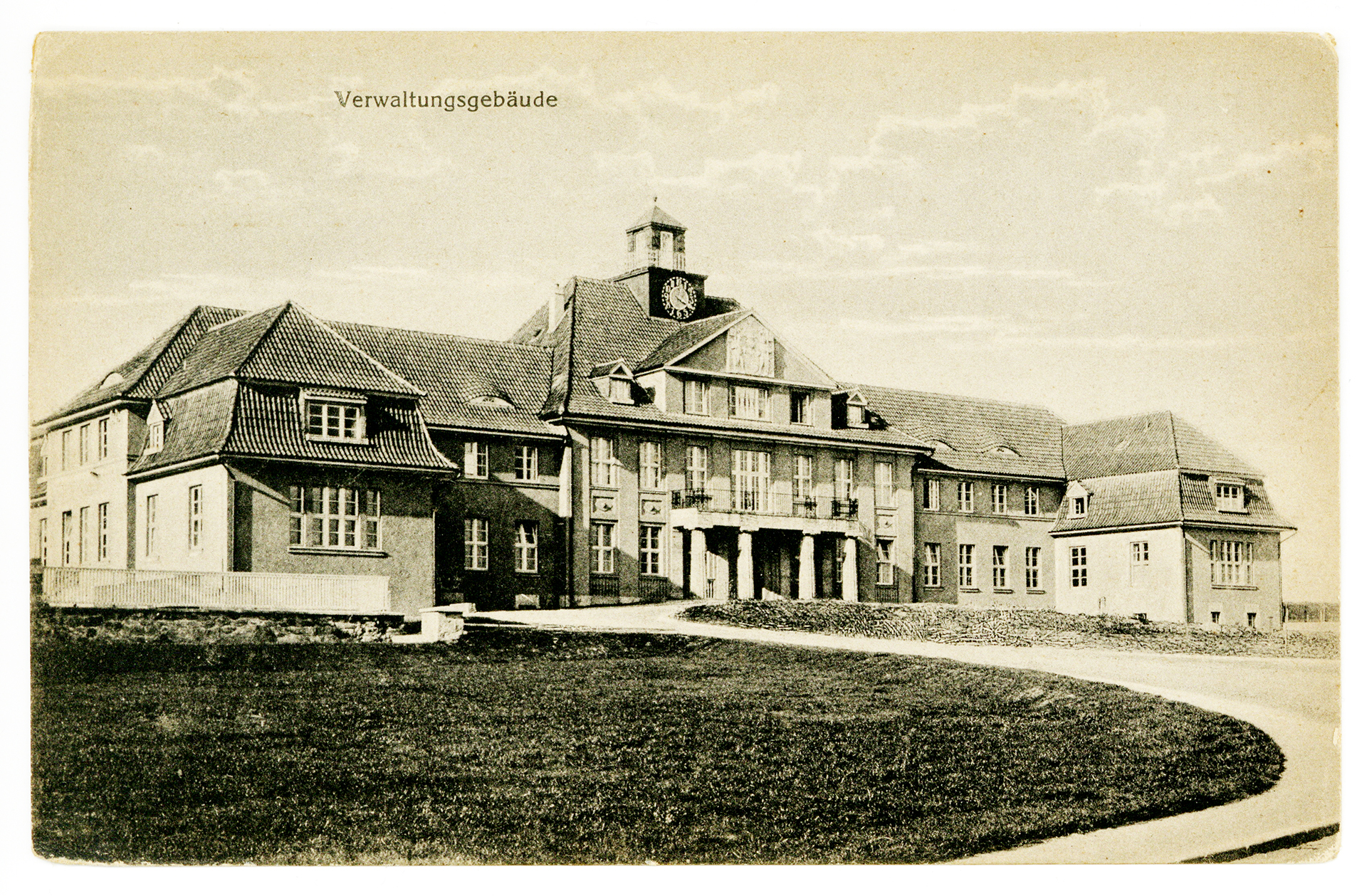
Postcard of the Pfafferode State Hospital in Mühlhausen, administration building, around 1912.
ArEGL 99.
ANNA GOLLA (1918 – 1944)
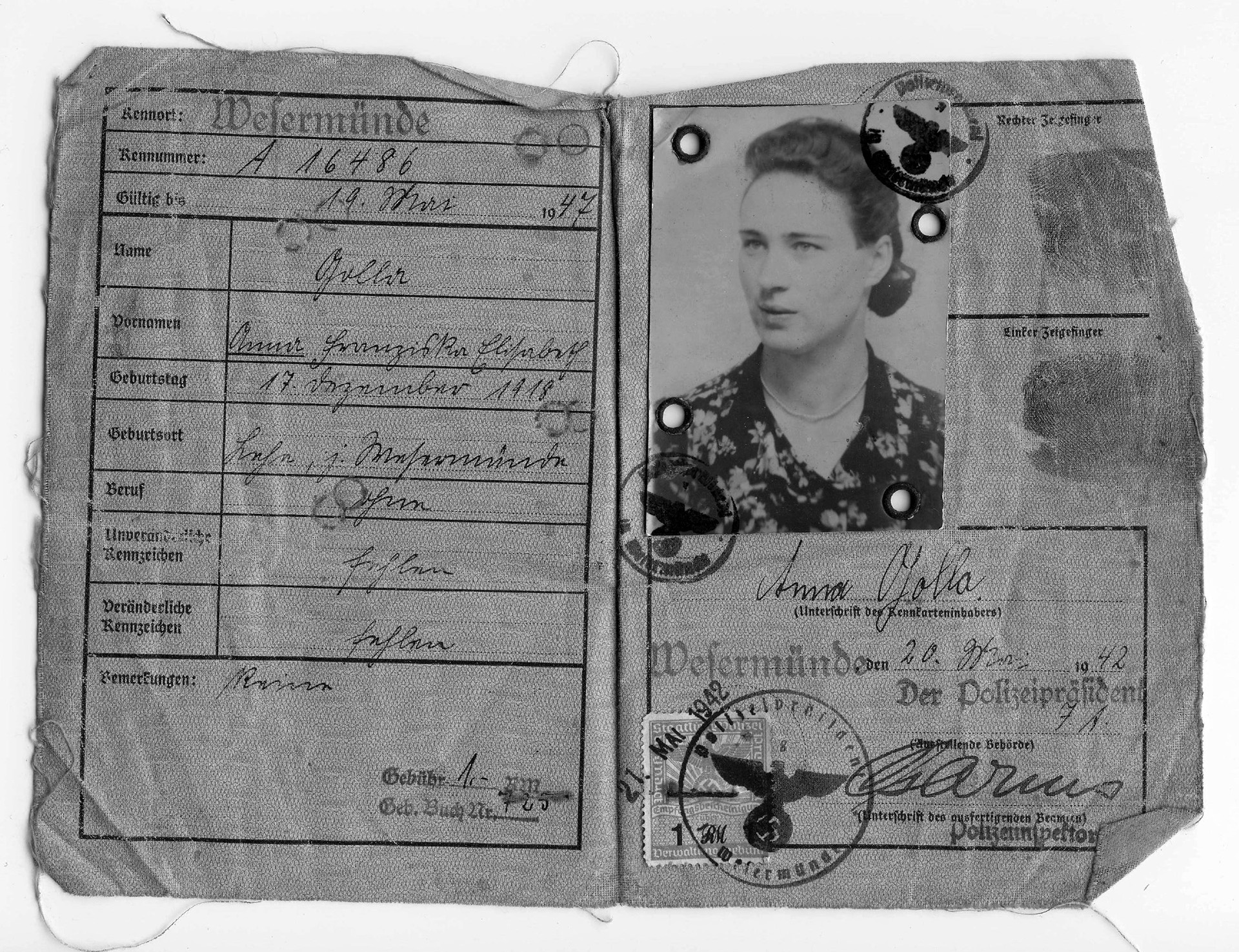
Anna Gollas‘ identity card from the German Reich, 20 March 1942.
Private property of Angelika Beltz.
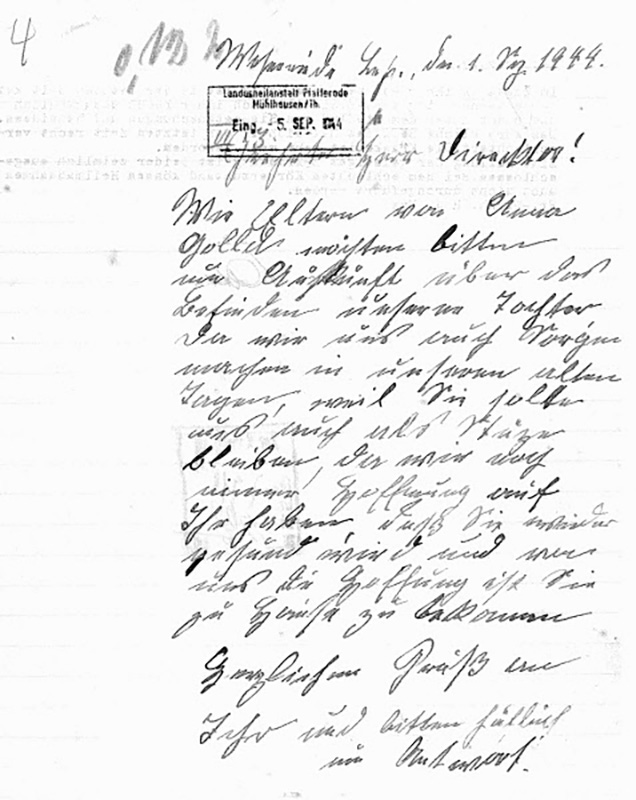
Letter from Christine Golla to Anna Golla, 1 September 1944. Anna Golla died on 11 October 1944 due to malnutrition.
Copy privately owned by Angelika Beltz.

Five days after his mother Katharina was admitted to the institution, Karl Mählmann was transferred to Pfafferode on 8 September 1943. A crossed-out entry clearly shows that he should have been transferred to the Pirna-Sonnenstein killing centre two years earlier.
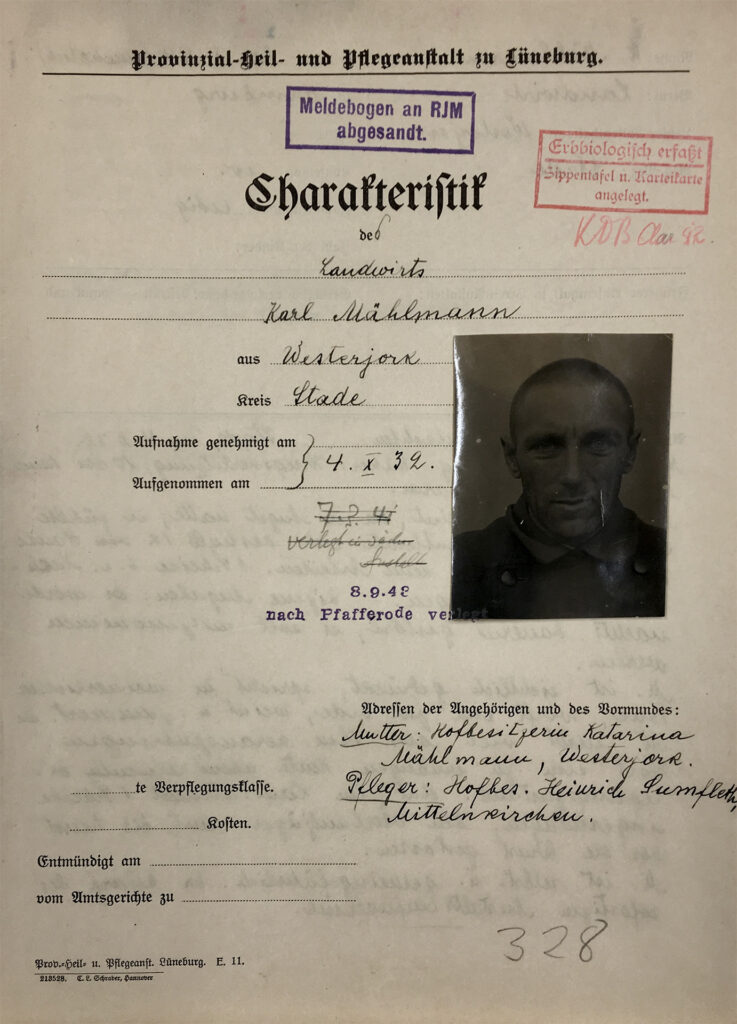
Excerpt from Karl Mählmann’s medical records.
NLA Hanover Lower Saxony 330 Lüneburg Acc. 2004/134 No. 01334.
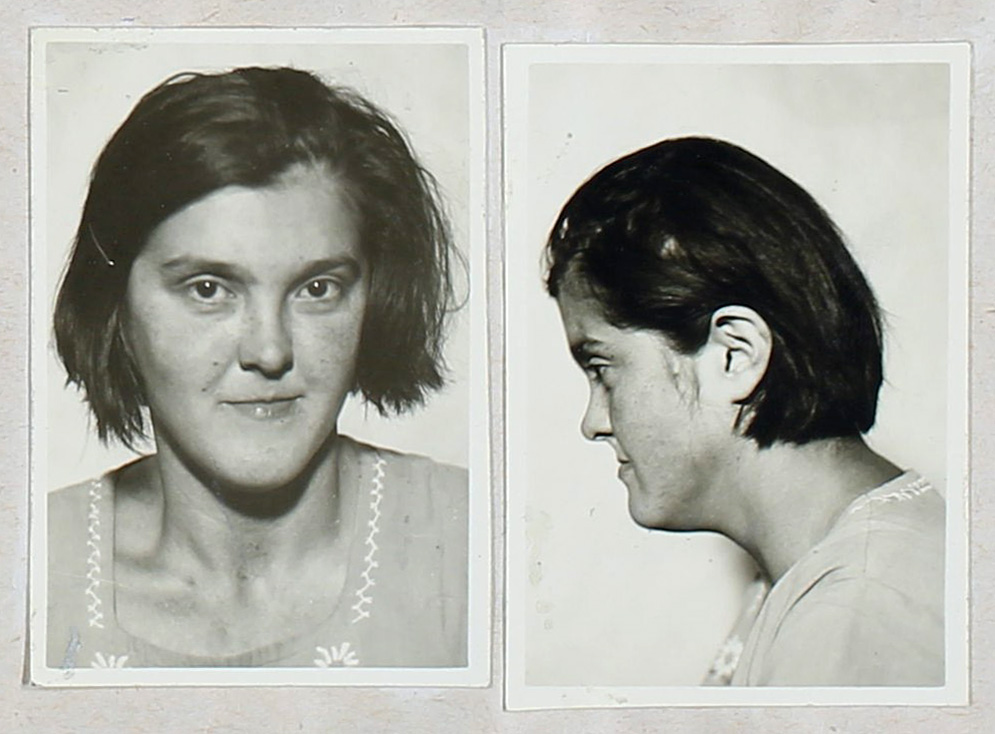
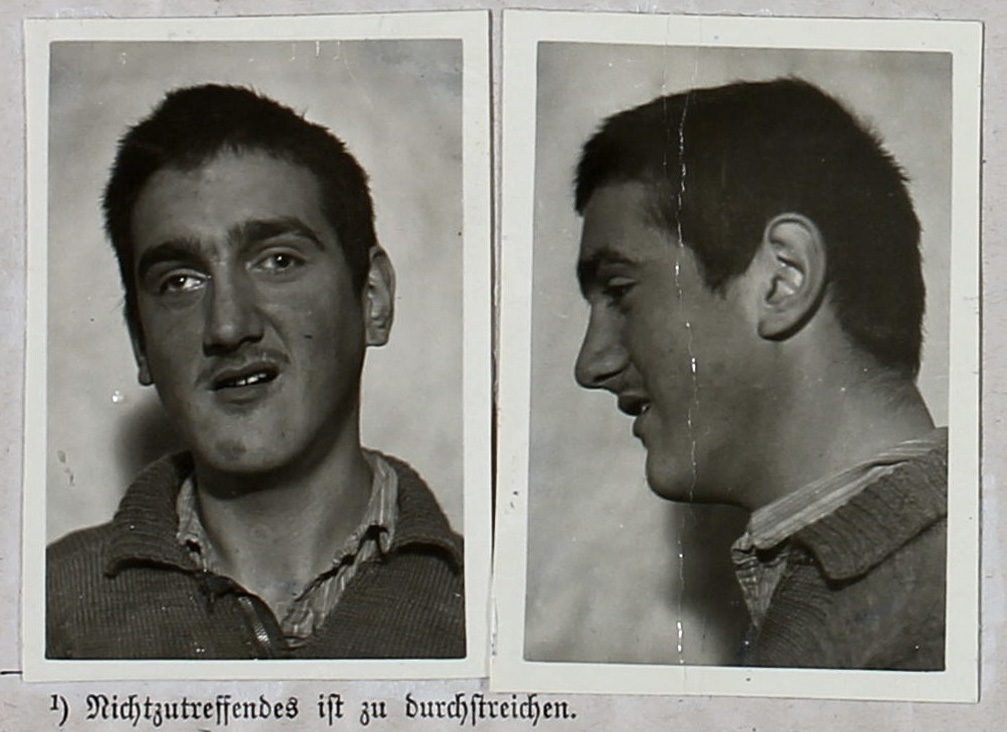
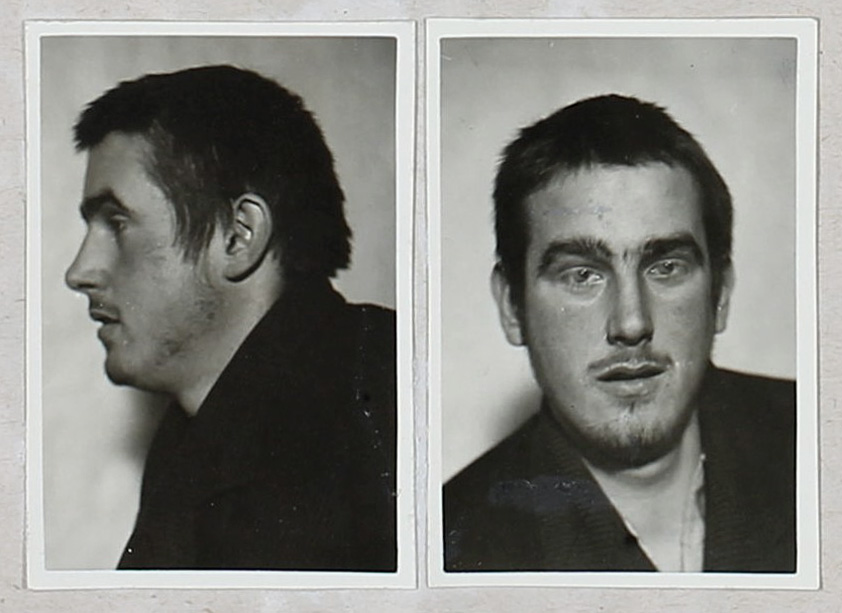
Gertrud, Herbert and Gerhard Glass, 1938.
NLA Hanover Hann. 138 Lüneburg Acc. 102/88 No. 1560,
NLA Hanover Hann. 138 Lüneburg Acc. 103/88 No. 441,
NLA Hanover Hann. 138 Lüneburg Acc. 102/88 No. 1630.
GERTRUD (1916–1945), HERBERT (1919–1945) AND GERHARD GLASS (1921–1944)
ANASTASIA IWANOWA (1890 – 1944)
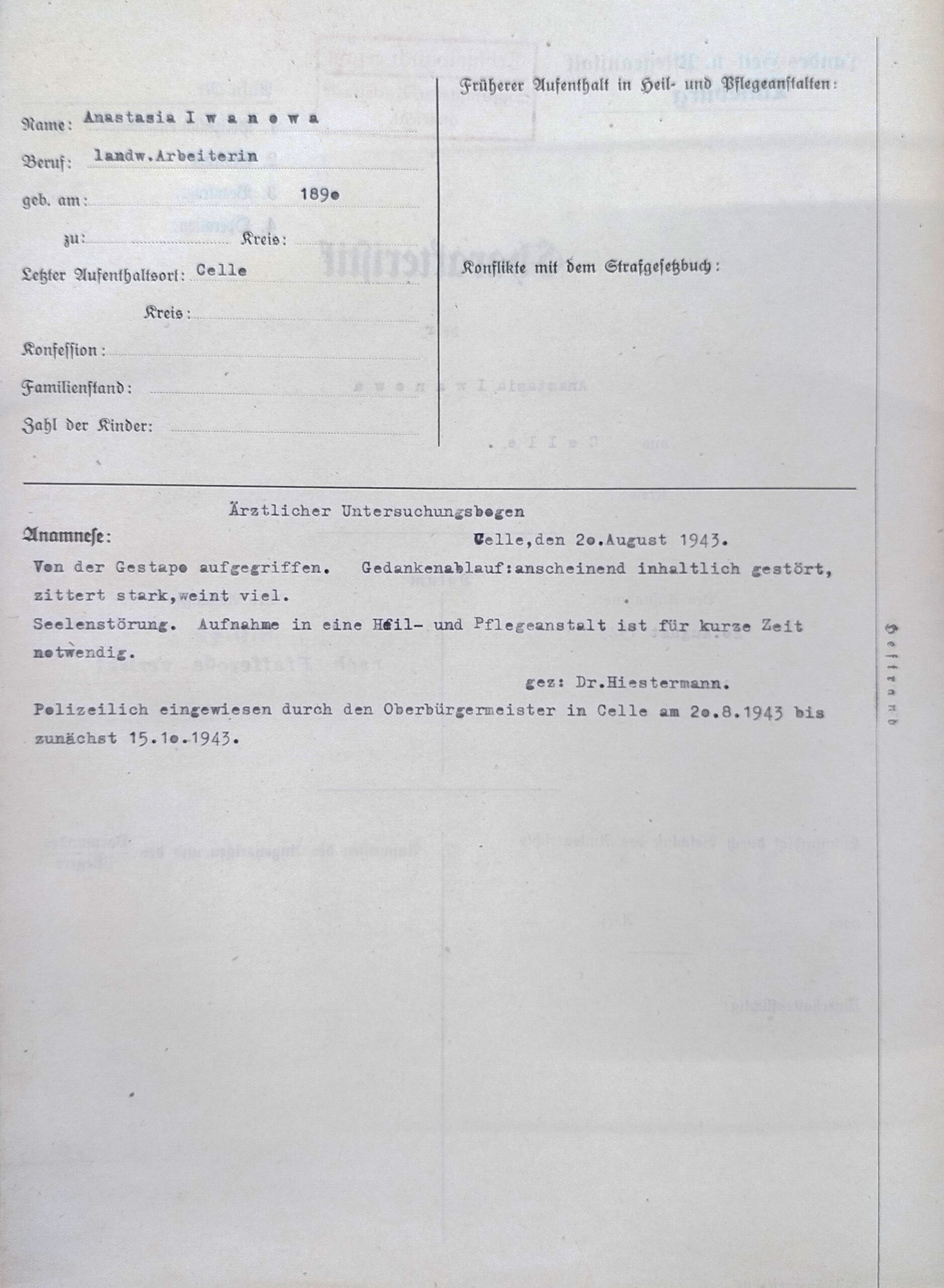
Excerpt from the description of Anastasia Ivanova.
NLA Hanover Hann. 155 Lüneburg Acc. 2004/085 No. 00879.
EKATHARINA TARANOWA (1926 – 1944)
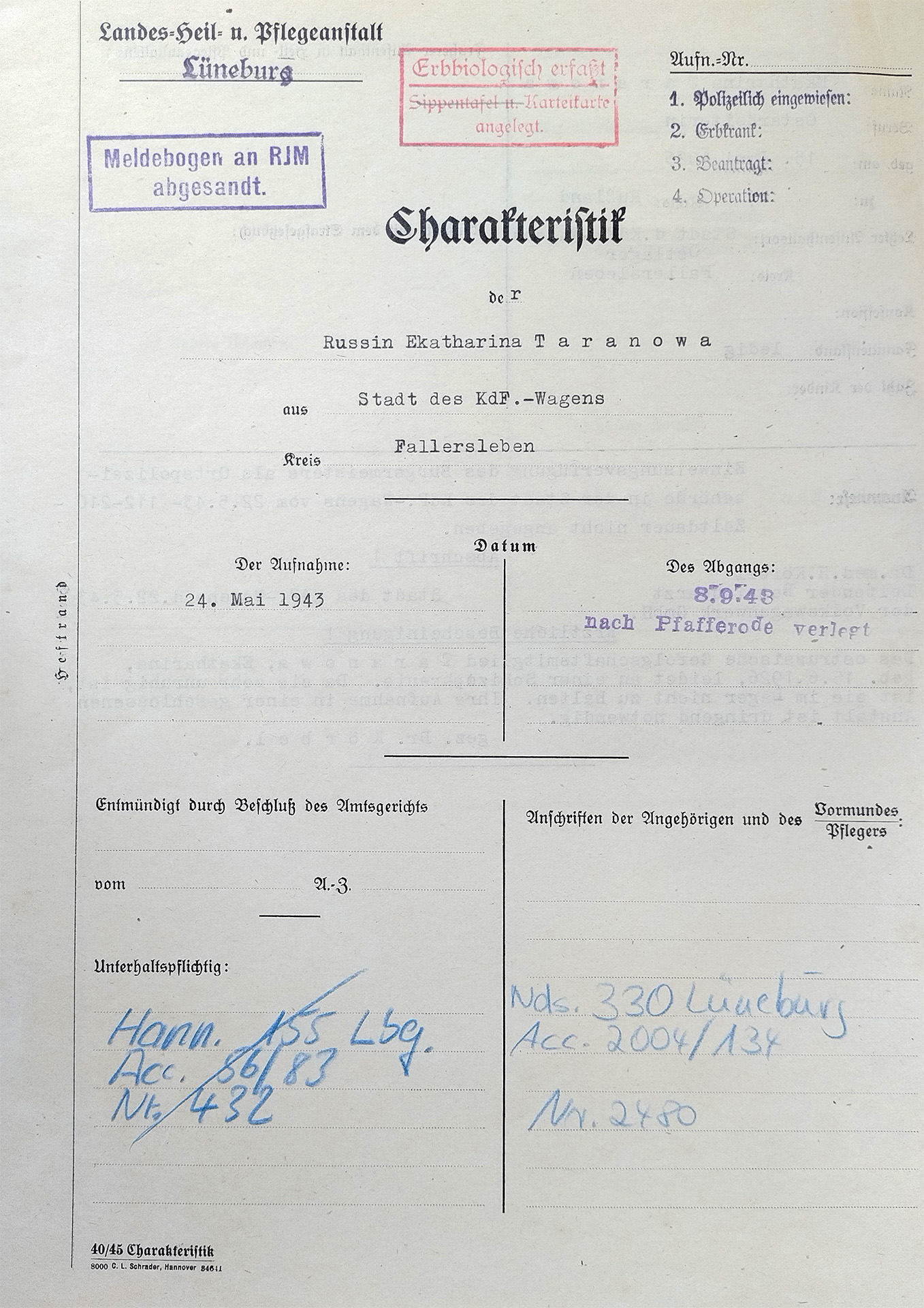
Excerpt from the characteristics of Ekatharina Taranova.
NLA Hanover Lower Saxony 330 Lüneburg Acc. 2004/134 No. 02480.
For many, the transfer to the »alternative hospital« in Lüneburg did not mean salvation. More than one in three patients did not survive their stay. On 8 September 1943, 35 patients were transferred to the Pfafferode killing centre. Twenty-five of them were murdered there. Only 207 of the approximately 475 patients from Hamburg-Langenhorn returned there. Many of these returnees were murdered shortly afterwards in the Meseritz-Obrawalde killing centre.
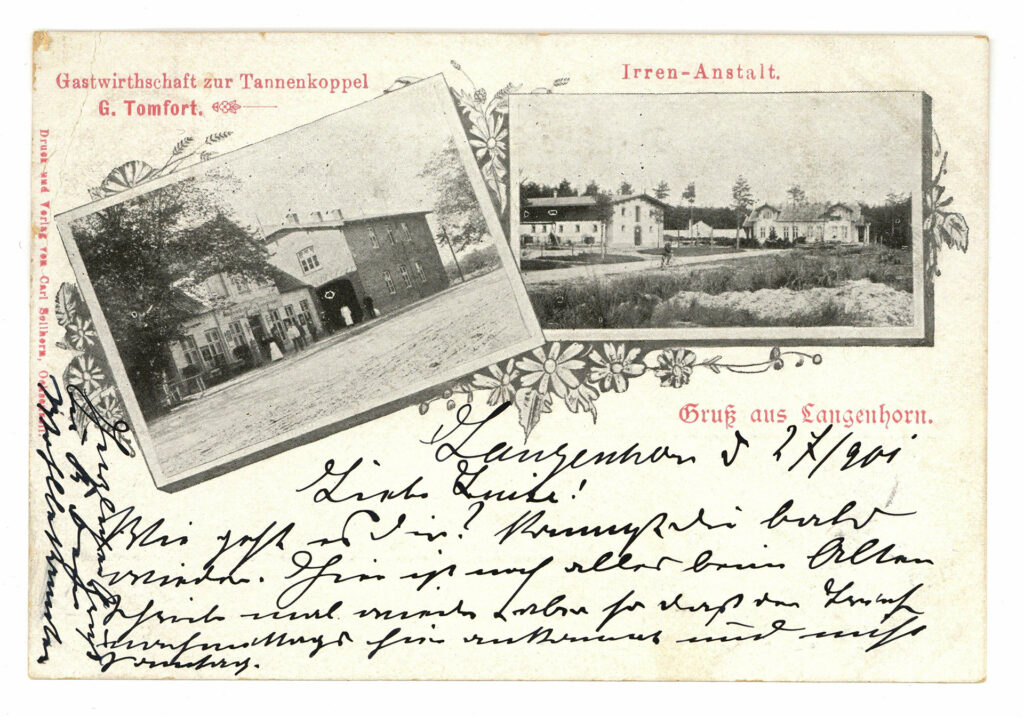
Postcard of the Langenhorn Institution (Hamburg), 1901.
ArEGL 99.
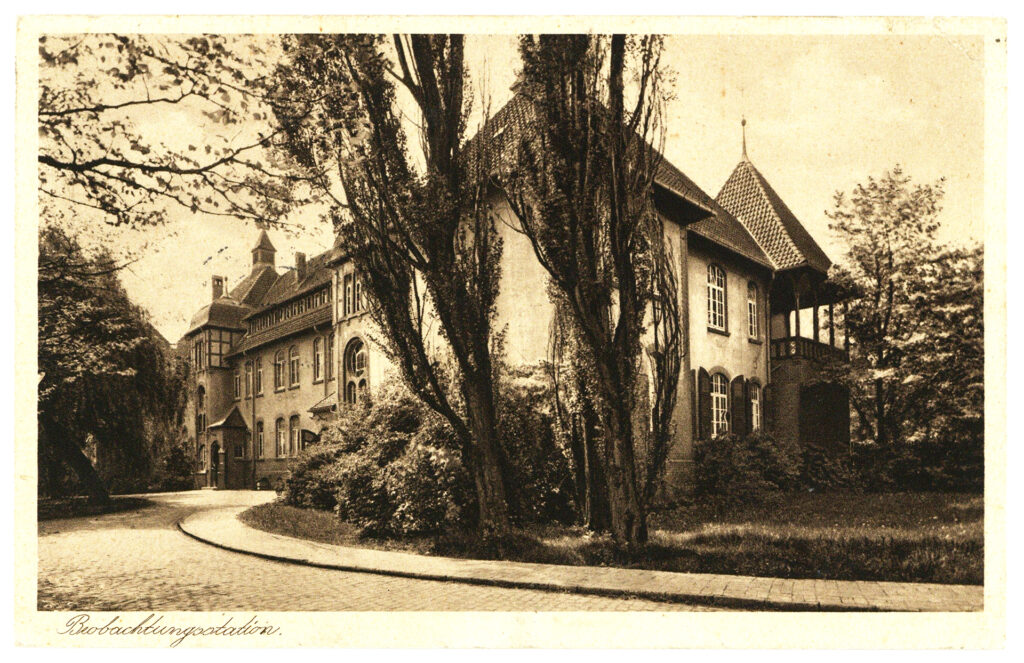
Postcard from the Langenhagen Institution and Nursing Home (Hanover), 20 January 1939.
ArEGL 99.
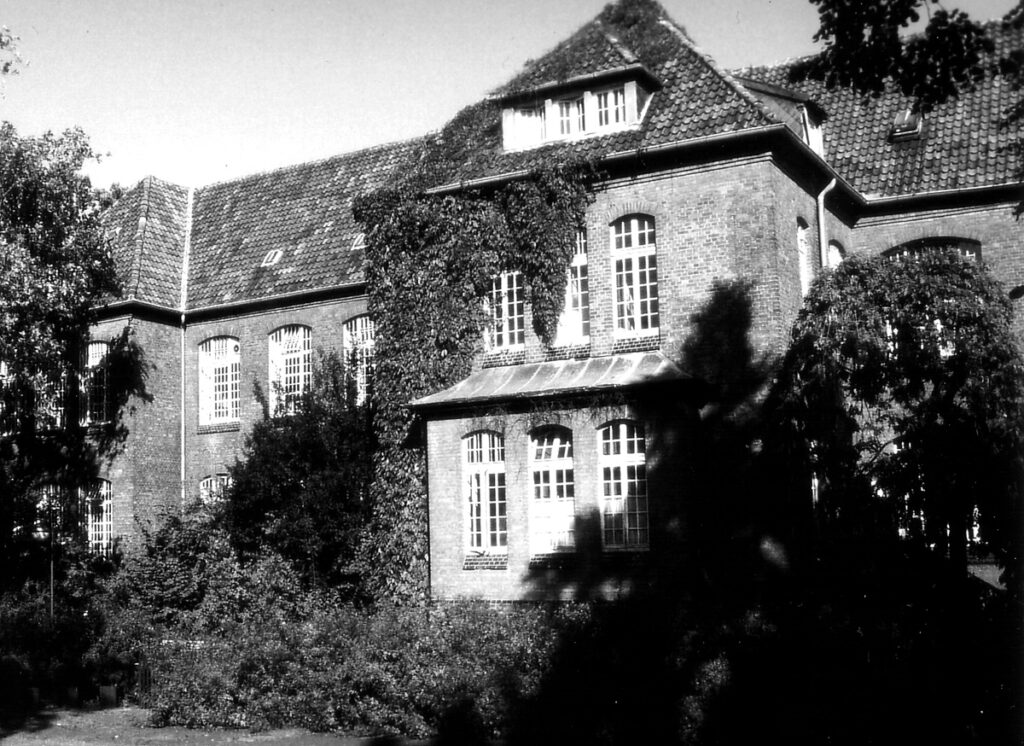
Men’s ward at the Wunstorf institution and nursing home, around 1945.
Private property of Heiner Wittrock.
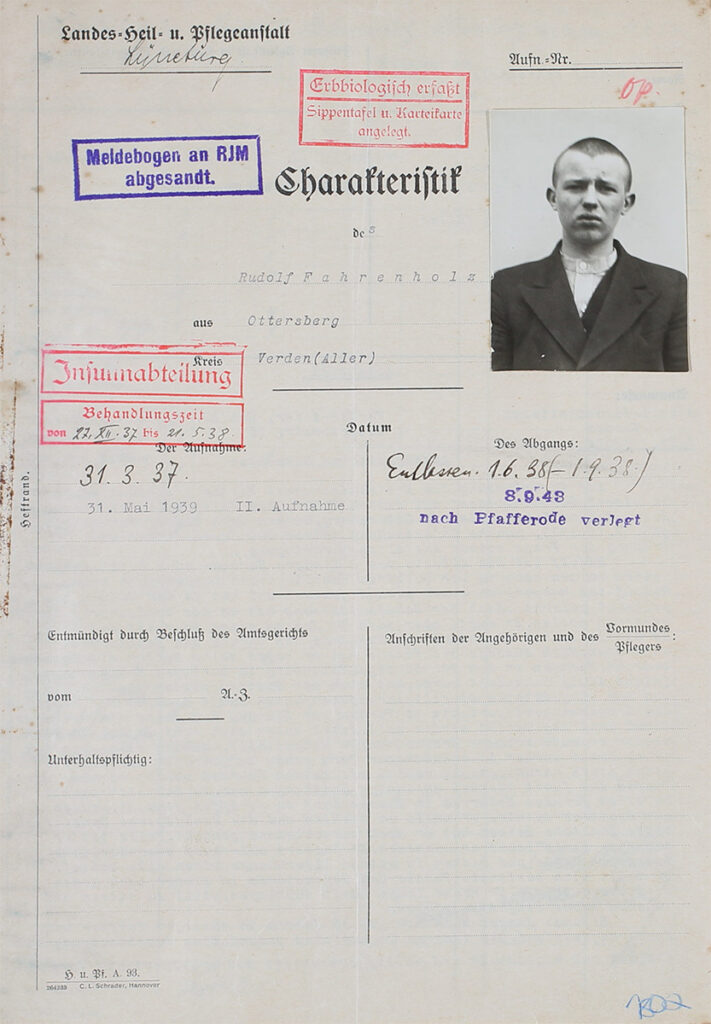
Excerpt from Rudolf Fahrenholz’s medical records.
NLA Hanover Hann. 155 Lüneburg Acc. 2004/085 No. 01802.
Rudolf Fahrenholz (1920–1944) from Ottersberg (Verden) was admitted to the Lüneburg mental hospital for the first time at the age of 16. After his release, he was forcibly sterilised. When he suffered another crisis, he was admitted a second time and tortured for five months with insulin shock treatments. On 8 September 1943, he was transferred to the Pfafferode killing centre, where he died violently on 3 February 1944.
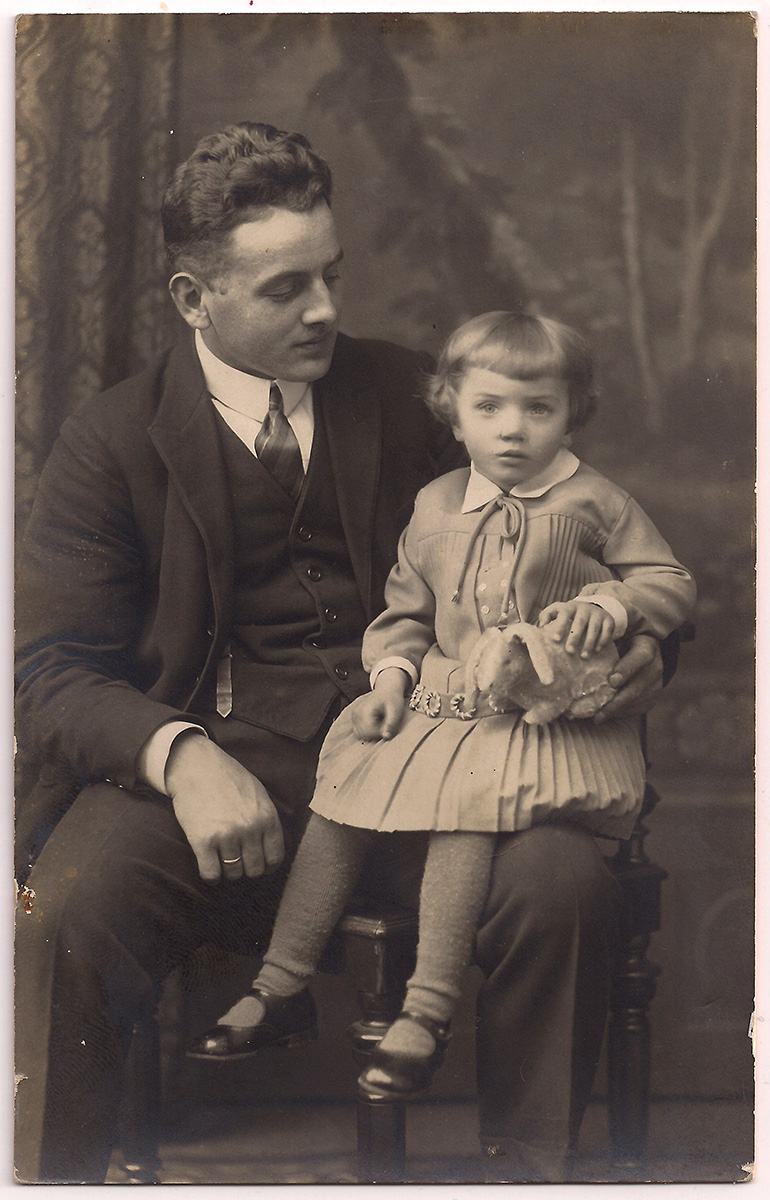
Martha Ossmer on her father’s lap, around 1928. It is the only picture of her.
Private property of Christel Banik.
As a result of the Allied air war, at least 121 patients from Bremen were transferred to Lüneburg in collective transports between January 1944 and March 1945. Half of them did not survive their stay at the Lüneburg institution and nursing home. Twenty-year-old Martha Ossmer was one of them. During a temporary stay at the Bremen clinic, where her mother was recovering from the effects of the bombing, she was transferred to Lüneburg against her parents‘ will and murdered.
MARTHA OSSMER (1924 – 1945)
Martha Ossmer at the age of four on her father Christian’s lap, 1928.
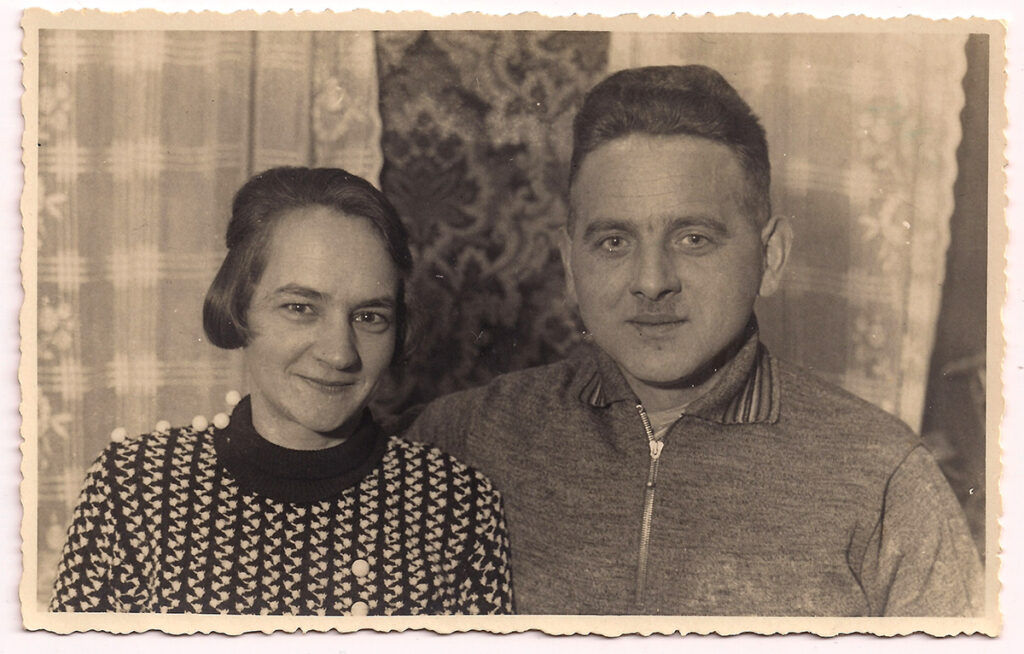
Bertha and Christian Ossmer, Christmas 1933.
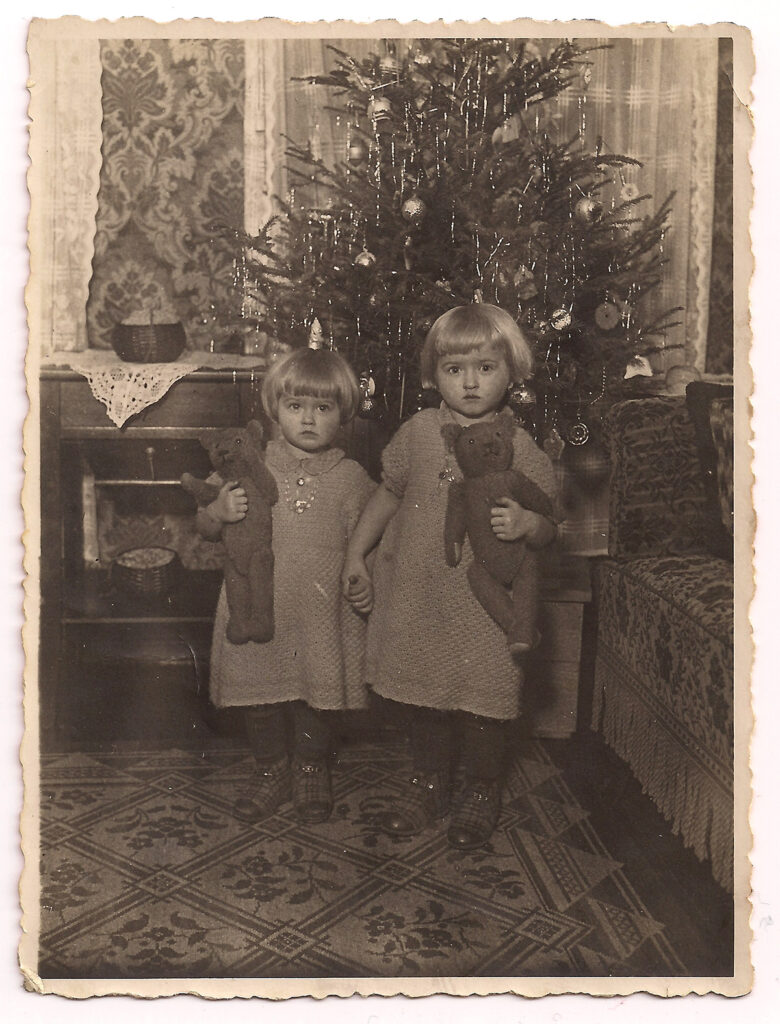
Martha’s sisters Käthe and Elfriede Ossmer, Christmas 1933.
Private property of Christel Banik.
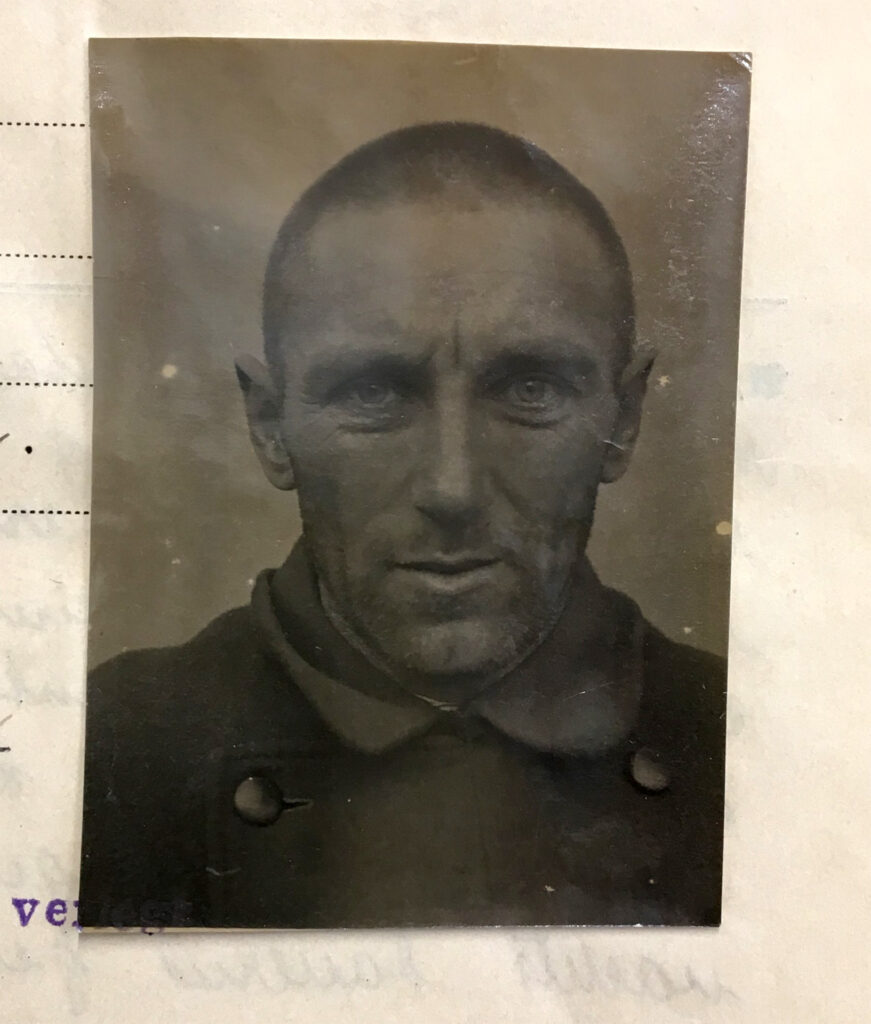
After 33 previous convictions, Willi Demmer was sent to Wolfenbüttel Prison in 1940. From there, he was transferred to the Lüneburg Mental Hospital for preventive detention at his own request. After his early release to the Neuengamme concentration camp, he was promoted to »Kapo« (guard) at the Husum-Schwesing satellite camp in November 1944. He was later brought before a military court for this.
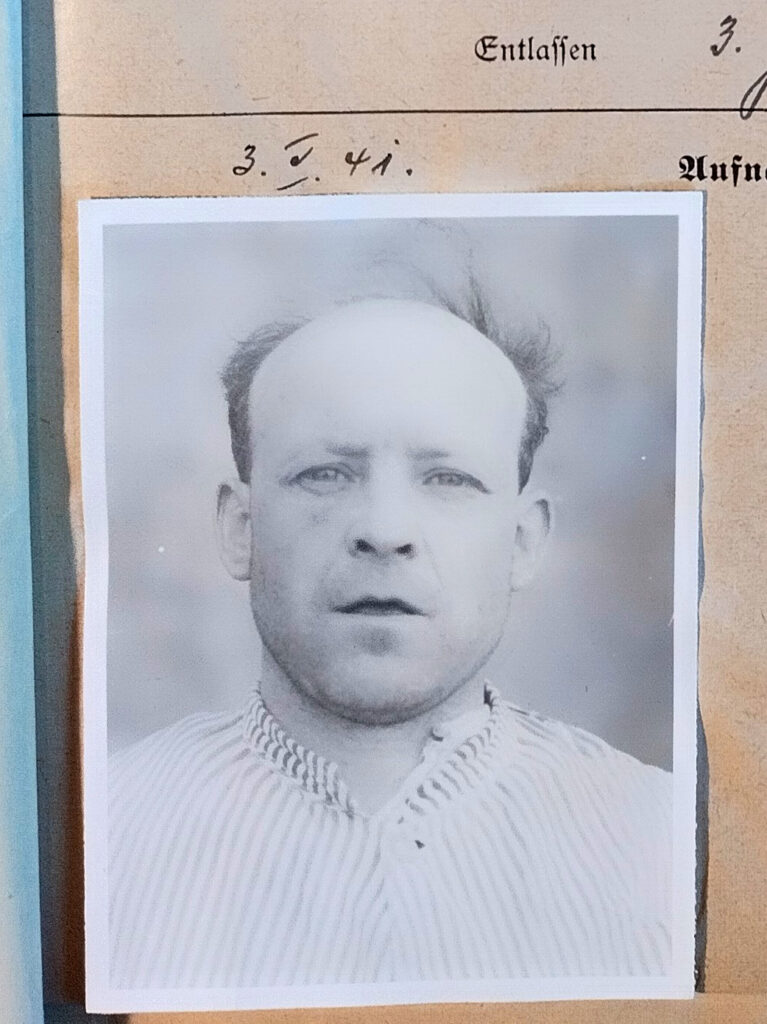
Portrait from the medical records of Willi Demmer, Langenhorn Sanatorium, around 1941.
Hamburg State Archives 352-8/7 Langenhorn State Hospital No. 30590.