No end
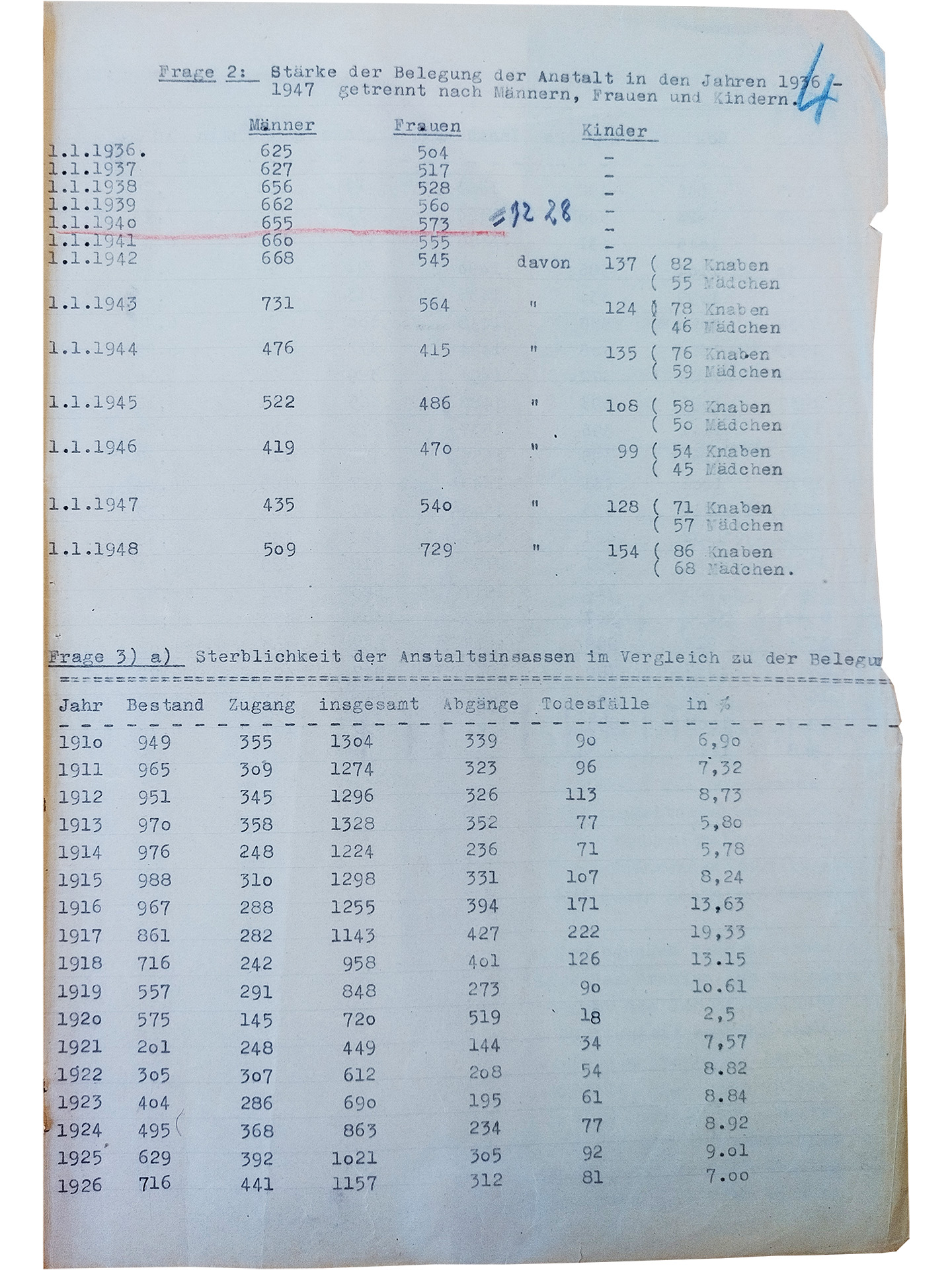
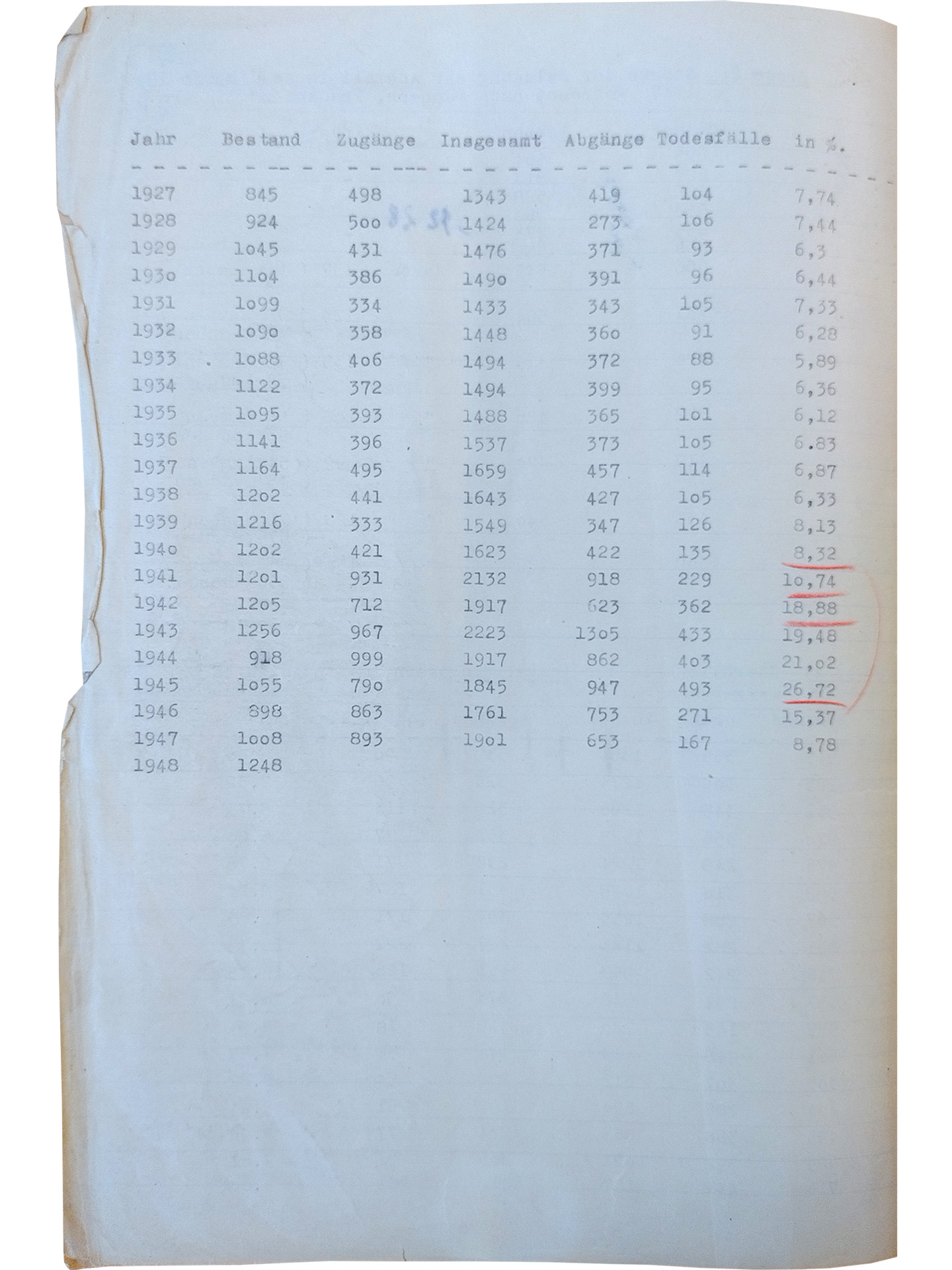
Occupancy rates and mortality at the Lüneburg sanatorium and nursing home from 1910 to 1947, with calculation errors.
NLA Hannover Nds. 721 Hannover Acc. 61/81 N. 28/7.
For decades, there was only one calculation of mortality at the Lüneburg sanatorium and nursing home. This calculation was used in all preliminary investigations and research without being checked, even though it contains a fundamental error. The calculation assumes that there were no transfers of patients. The transport of patients to other institutions was not taken into account in the calculation. However, if one takes the actual, significantly lower number of patients in Lüneburg as a basis, the mortality rates are considerably higher.
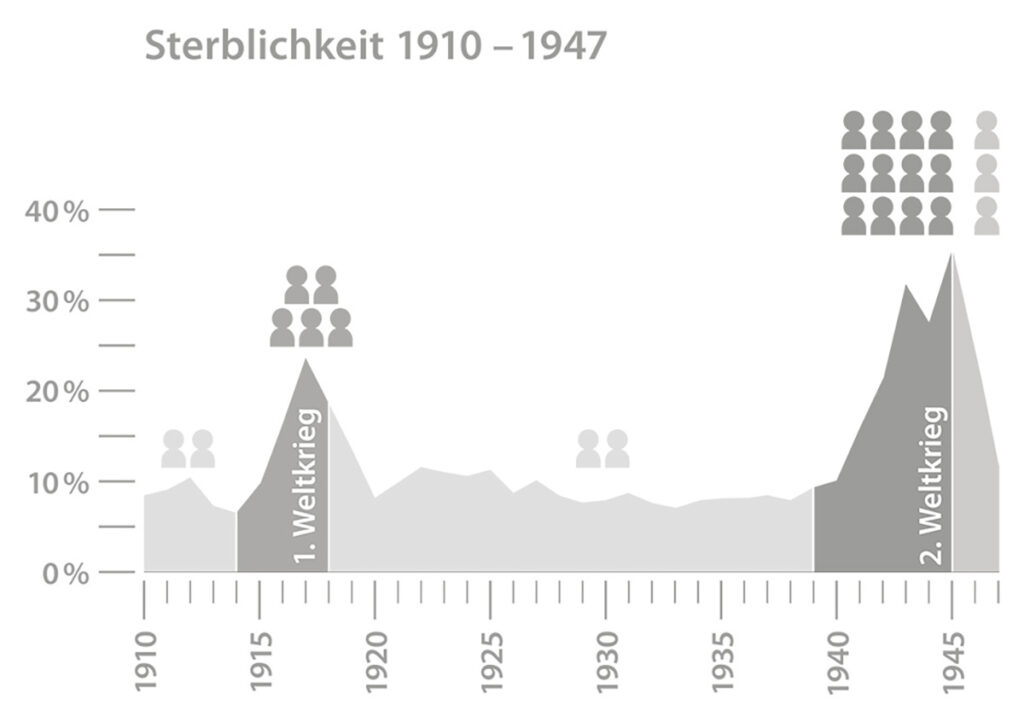
After Willi Baumert was seconded full-time to Lüneburg in 1943, the mortality rate rose to over 30 per cent. Because he was called up for military service in September 1944, it fell to 27 per cent in 1944. 1945 is the year of the highest mortality rate in the Lüneburg sanatorium and nursing home. As a result of mass deaths, it was over 35 per cent. In 1946, one in five patients died, in 1947 still more than one in ten.
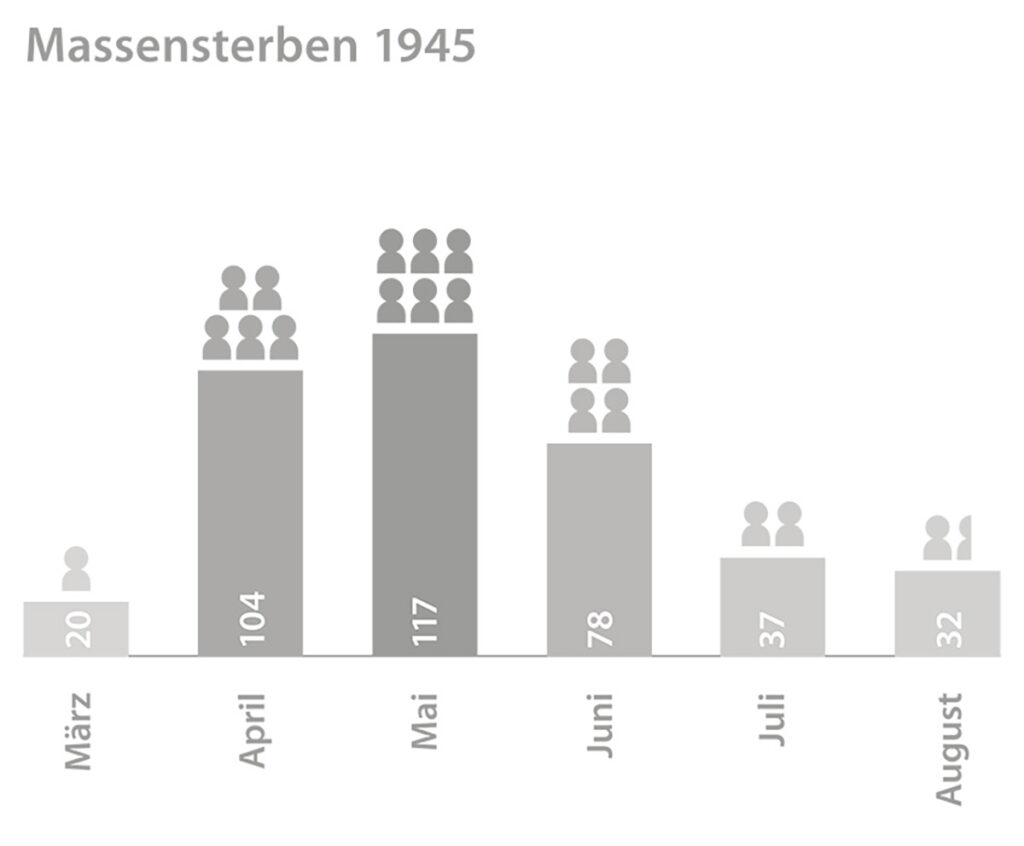
During the war, no more than three patients died per day. That changed at the beginning of April 1945. On certain days in April, May and June, an unusually high number of patients died. There were veritable ‘days of death.’ A natural or disease-related death is unlikely. The killings did not end until the end of August 1945. Until the summer of 1946, the deaths of many patients due to hunger and severe malnutrition and inadequate care were accepted as inevitable.
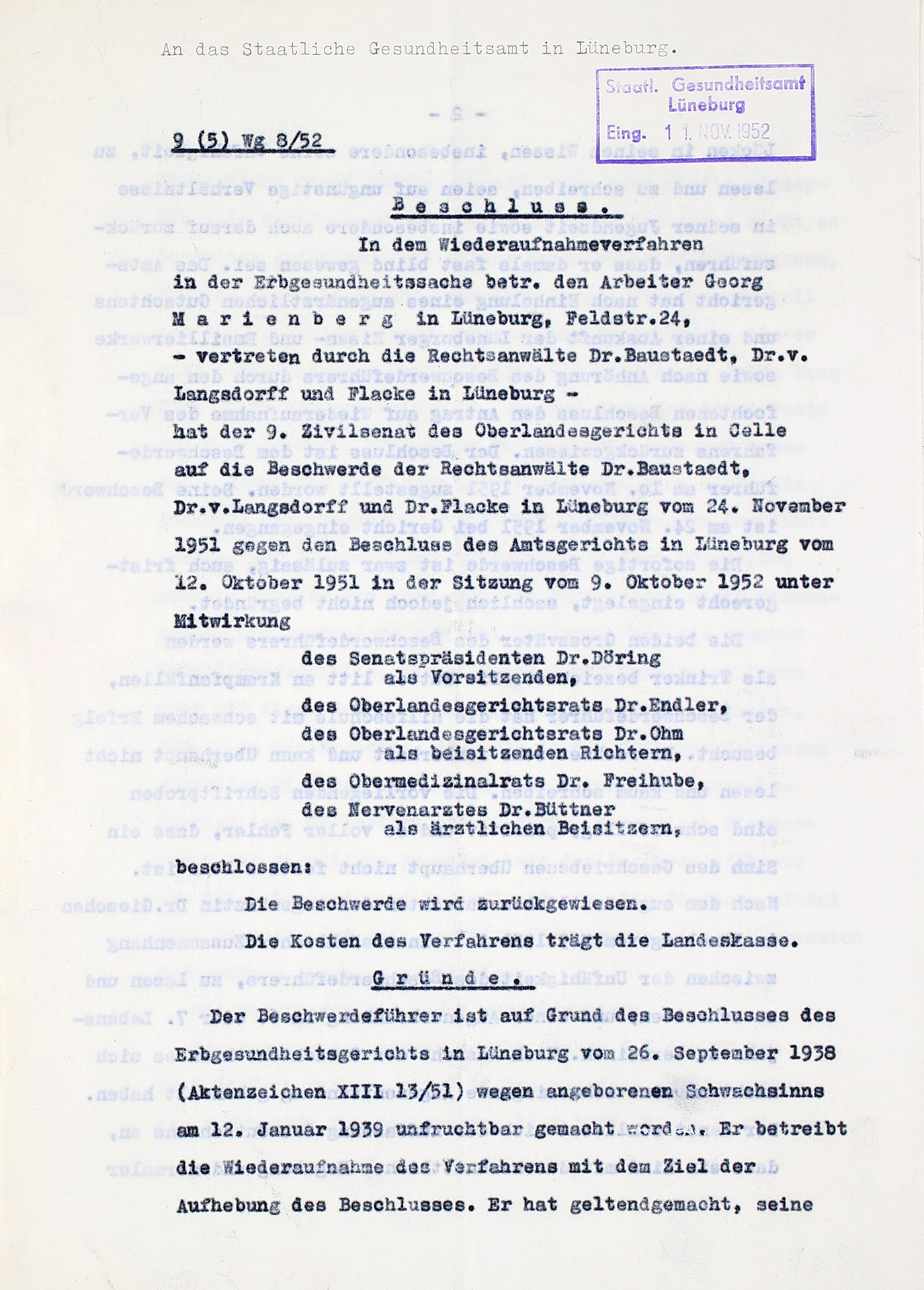
Excerpt from the decision of the Higher Regional Court of Celle on the reopening of the Georg Marienberg inheritance case dated 9 October 1952.
NLA Hannover Hann. 138 Lüneburg Acc. 102/88 N. 1324.
In 1951, Georg Marienberg sought to have his hereditary health case reopened and hoped to receive compensation. District court director Jahn, who had been a judge at the Lüneburg Hereditary Health Court since 1940, concluded that his decision at the time had been lawful. Georg Marienberg appealed this decision to the Higher Regional Court in Celle. The appeal was rejected in 1952. The proceedings were not reopened.

In the retrials, the victims often faced the same judges who had previously ruled on the forced sterilisations. They also had to undergo an intelligence test again. This was also the case for Emmi Nielson, who, like her half-brother Georg Marienberg, applied for a retrial. Her application was rejected and she had to pay the costs of the procedure herself.
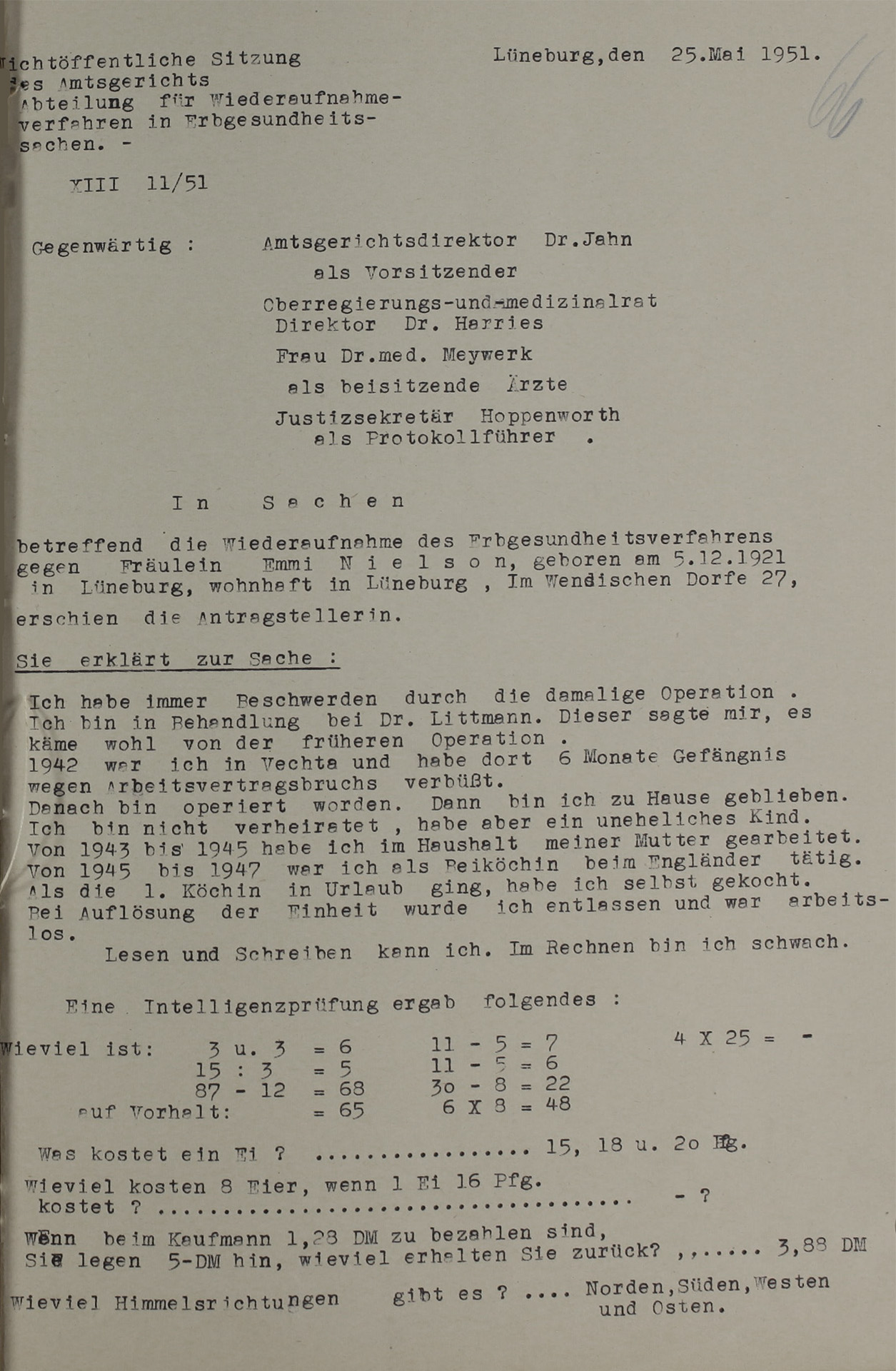
Excerpt from the transcript of the non-public meeting on the reopening of the Emmi Nielson hereditary health case of 25 May 1951.
NLA Hannover Hann. 138 Lüneburg Acc. 103/88 Nr. 662.
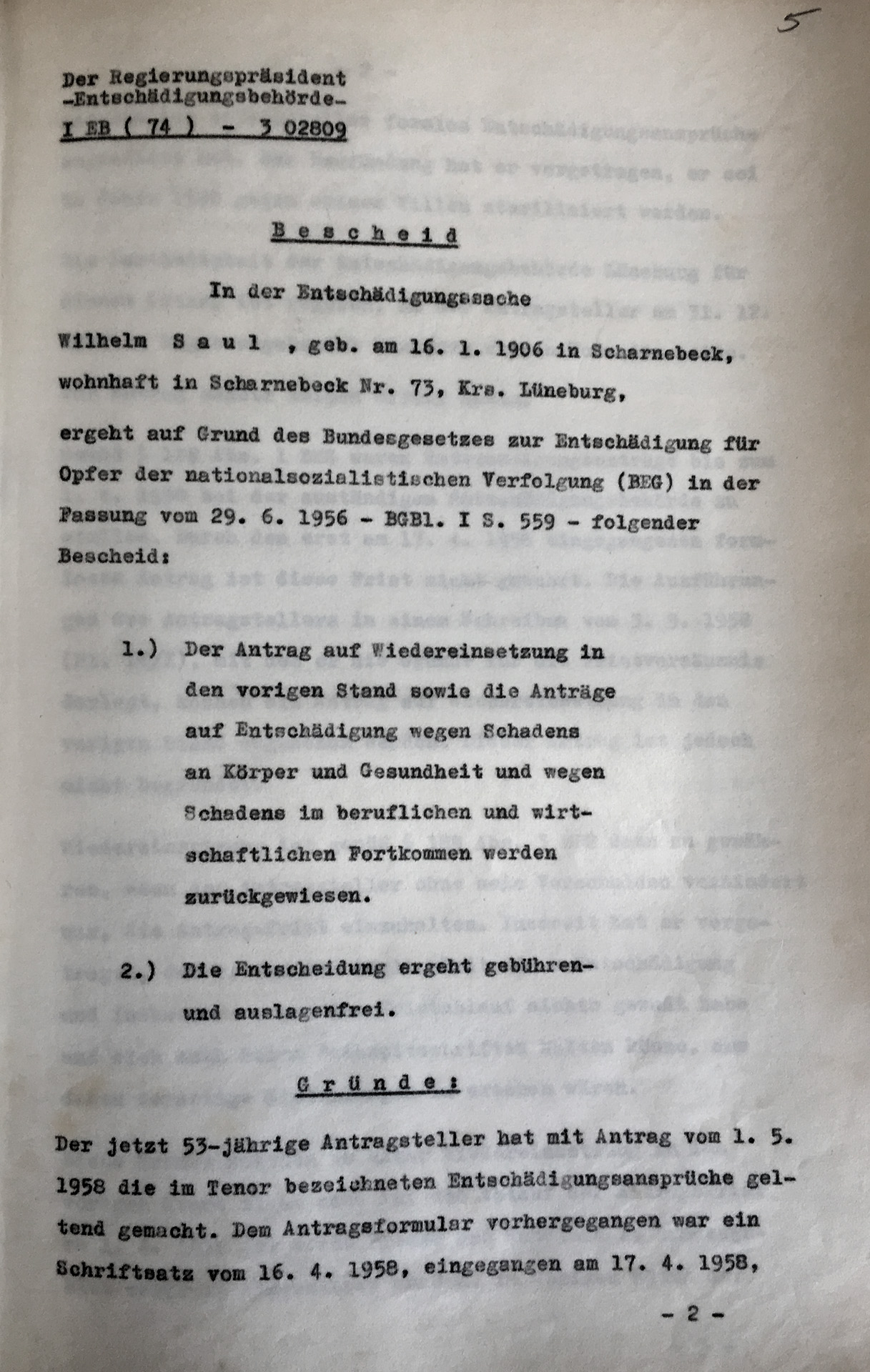
Excerpt from the decision in the compensation case Wilhelm Saul jun. dated 19 September 1959.
NLA Hannover Nds. 720 Lüneburg Acc. 139/90 N. 107.
In 1958, Wilhelm Saul’s sister sought compensation and redress for her brother’s forced sterilisation. She filed a lawsuit with the civil division of the Lüneburg Regional Court. The lawsuit was dismissed because the deadline for filing had been exceeded by a few days and the »eugenic reasons« established by law in 1933 were not questioned.
The rulings from the period between 1934 and 1949 were upheld without exception for decades. Because other countries had similar sterilisation laws, the »Law for the Prevention of Hereditary Diseases« was not considered to be a Nazi policy.
»The Law for the Prevention of Hereditary Diseases in Offspring of 14 July 1933 is not a typical National Socialist law, as similar laws exist in democratically governed countries such as Sweden, Denmark, Finland and some states in the USA. However, the Federal Compensation Act generally only grants compensation to victims of persecution under the Nazi regime and, in a few exceptional cases, to victims who suffered damage as a result of particularly serious violations of the principles of the rule of law.«
German Bundestag, Plenary Protocol 2/191, p. 10876 of 7 February 1957.
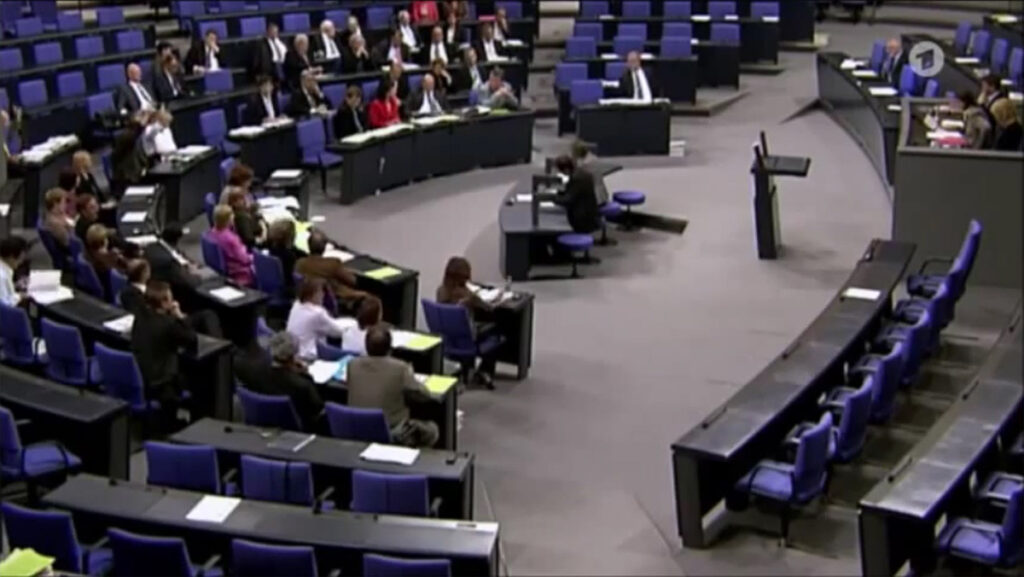
German Bundestag, vote on the repeal of the »Law for the Prevention of Hereditary Diseases in Offspring«, 2007. Several members of parliament vote against it and several abstain.
Film »Brave New Human: Racial Hygiene as a State Objective«
(NDR, 2015); timecode 00:41:27.
In 1980, those affected were able to apply for a one-off payment of DM 5,000. In 1988, the German Bundestag described forced sterilisation as a Nazi injustice for the first time. It was not until 1992 that it became illegal to sterilise people against their will. The judgements of the Hereditary Health Courts were overturned in 1998. Compensation totalling 291 euros per month was paid out for the first time in 2011.
The survivors of the »children’s ward« and the relatives of the victims of the euthanasia programme were largely excluded from the belated investigation of the crimes. For decades, the families often knew nothing about the actual fate of their relatives. When they learn about the circumstances of their deaths today, they are no longer entitled to compensation or reparations. The crimes are considered time-barred. The victims and their families are among those who suffered under the Nazis and whose losses were never compensated.

The intelligence test introduced under National Socialism continued to be used well after 1945. Only the questions relating to political events were changed. The author, Gerhard Kloos, headed the Stadtroda »children’s department« during the Nazi era. Before 1945, he had also made a name for himself in the medical profession with »step-by-step treatment« (forced labour, malnutrition and denial of therapy) and the poisoning of political dissidents. When the third edition of his intelligence test was published, he was head of the Bad Pyrmont hospital in southern Lower Saxony.
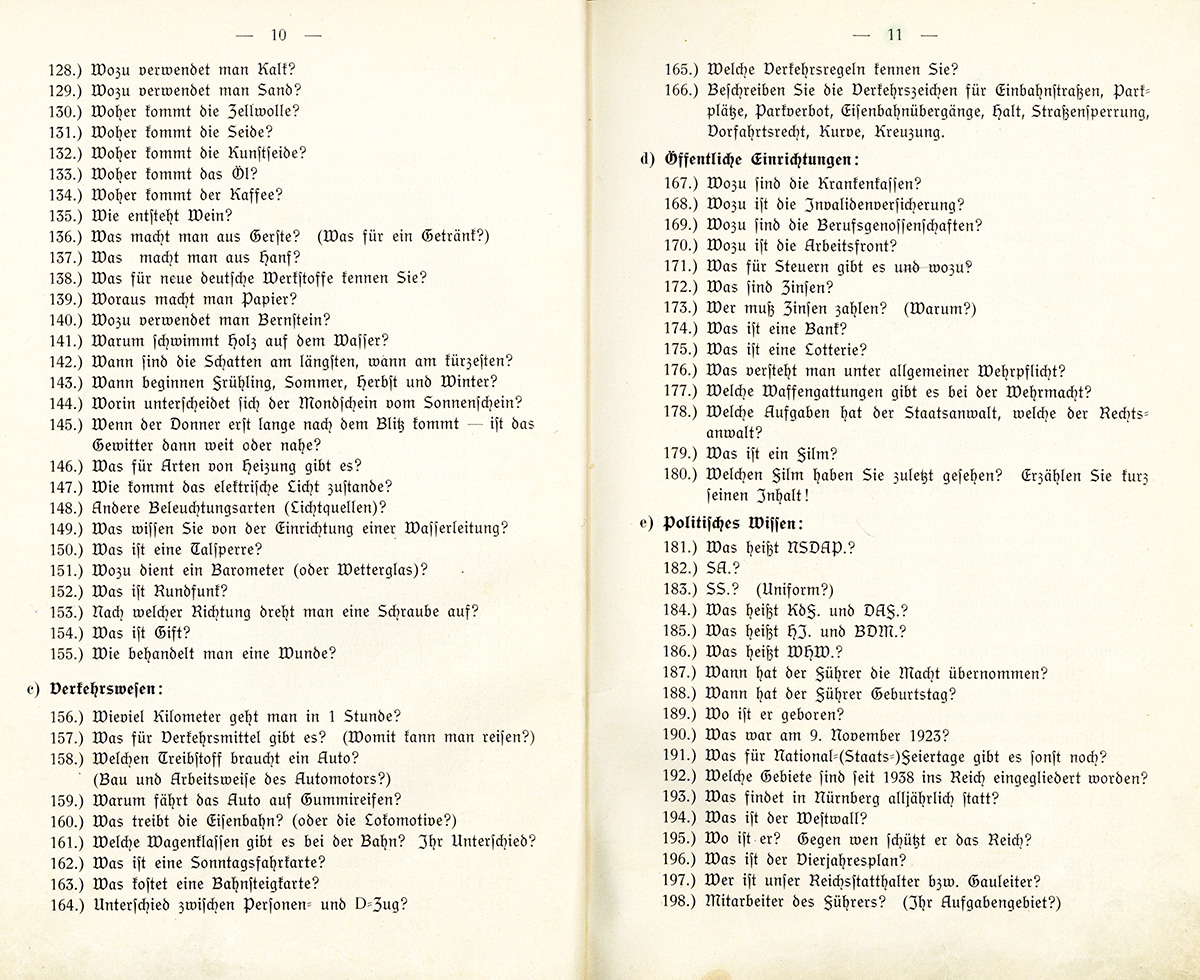
Gerhard Kloos: Guide to intelligence testing in
hereditary health court proceedings, Jena 1941.
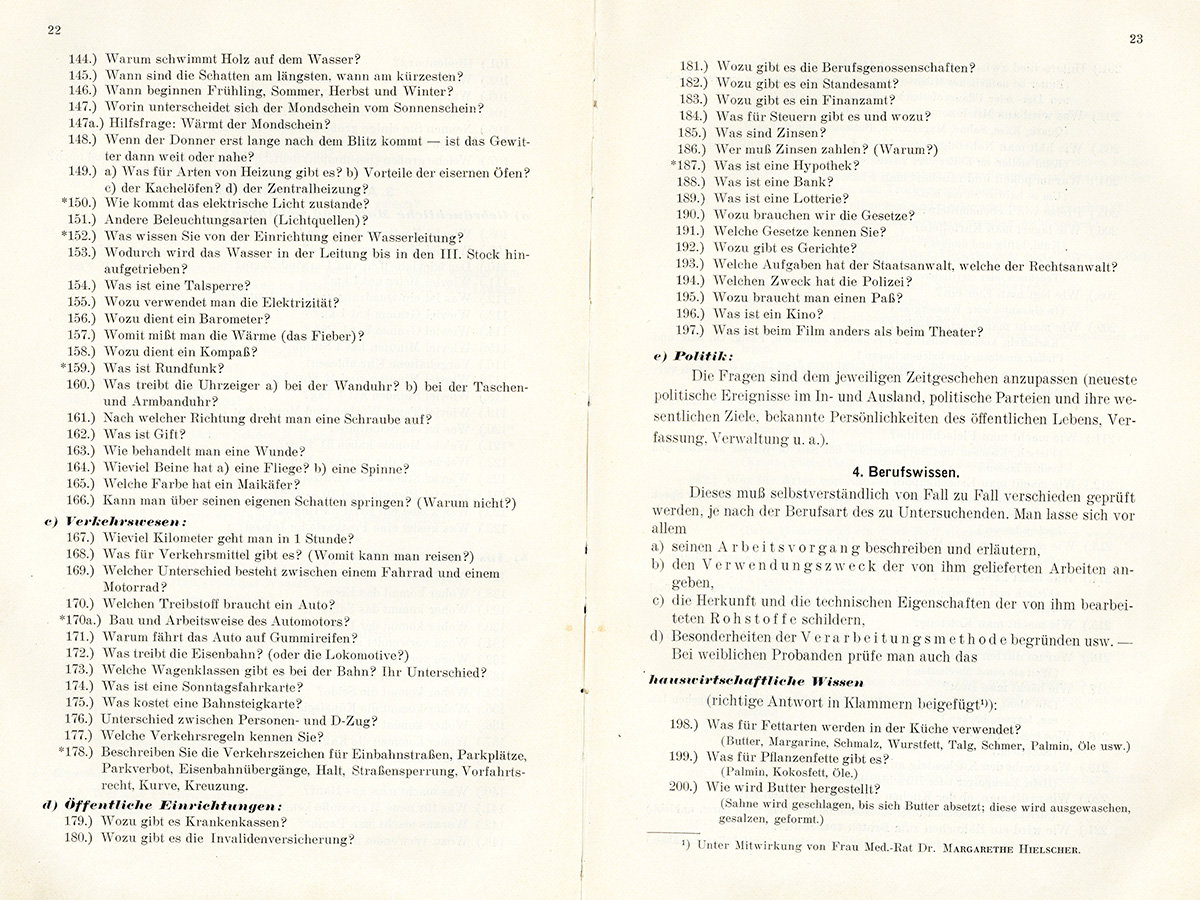
Gerhard Kloos: Guide to Intelligence Testing in
Psychiatric Diagnostics, Stuttgart 1952.
Even today, there are intelligence tests that sometimes fail to take into account whether a test subject is of foreign origin. For this reason, far too many children of foreign origin are identified as having a »need for support in intellectual development«. Bilingualism is also considered to be a disadvantage. Nevertheless, such tests are a useful tool for identifying support needs.
The 1975 report by the Psychiatric Investigation Commission led to a shift away from the institutional care that had been the norm up to that point. For the first time, the needs and difficulties of those affected and their families were taken into account. Coercive measures were used less frequently. Much was done to break down prejudices against mental illness and disability. Nevertheless, there is still a perception that people with mental illness and disabilities are not equal to healthy people. Profit-oriented institutions reinforce this thinking, as those affected quickly become »ballast« again.
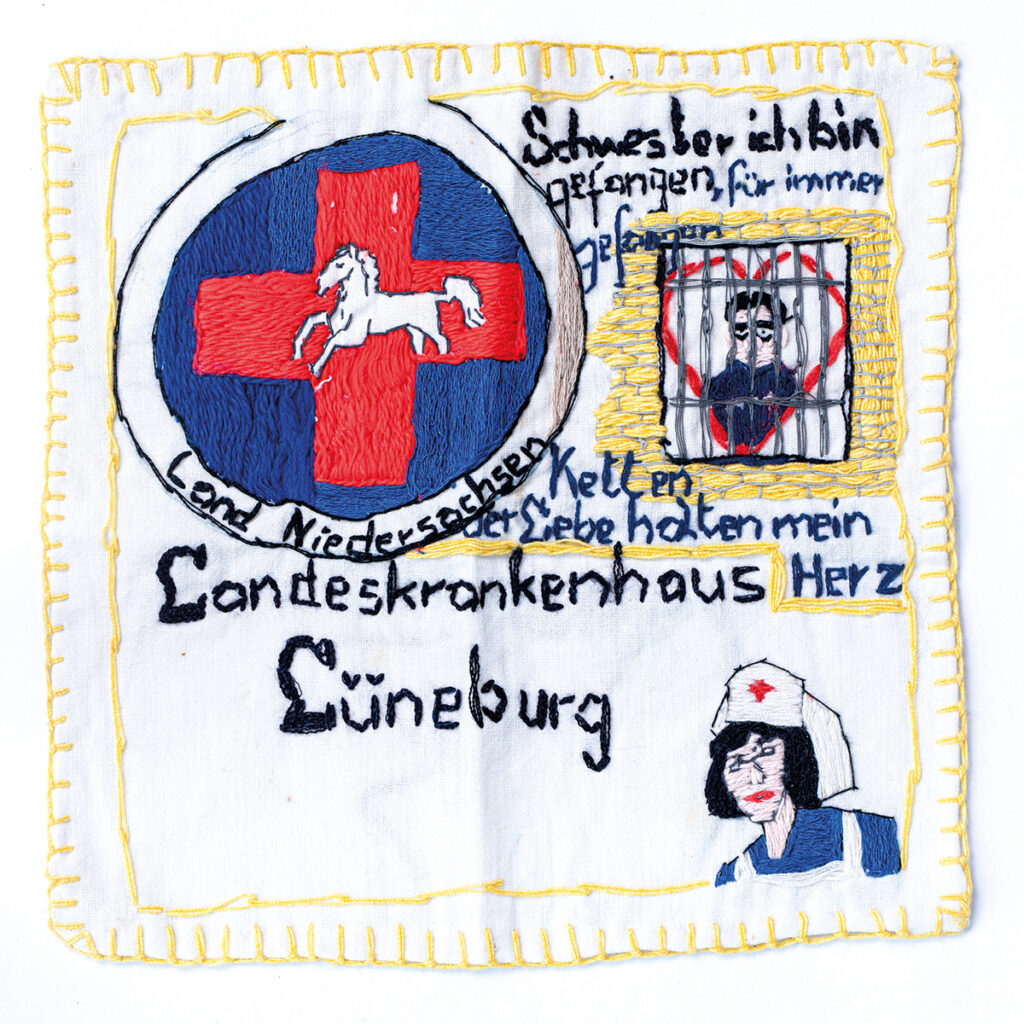
Embroidered doily, patient’s work, provenance unknown, transmitted by Helga Guddat, 1975.
StArEGL 21.
It is not known who embroidered this handkerchief.
But as with Martha Kaufmann’s embroidery in the
HANDELN room, the motifs and lettering reflect
the experience of psychiatry in 1975.
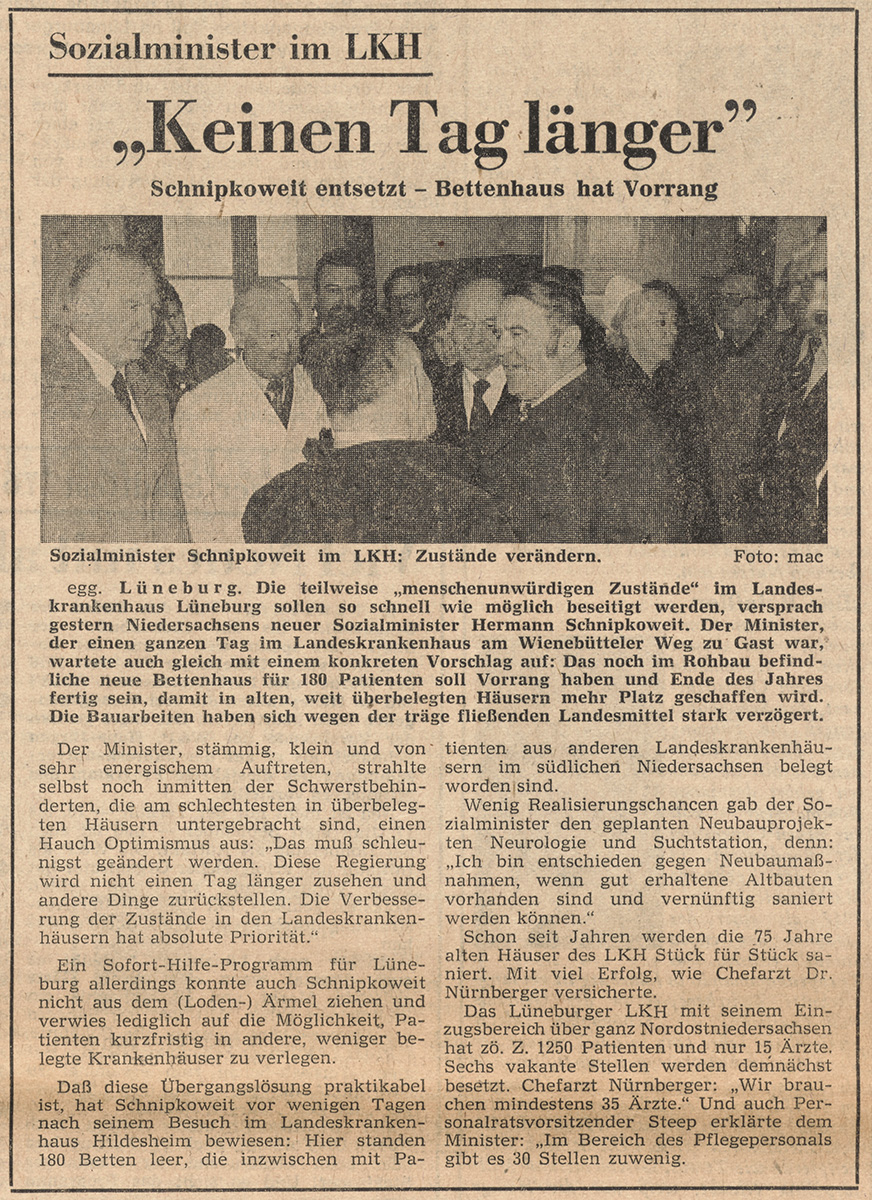
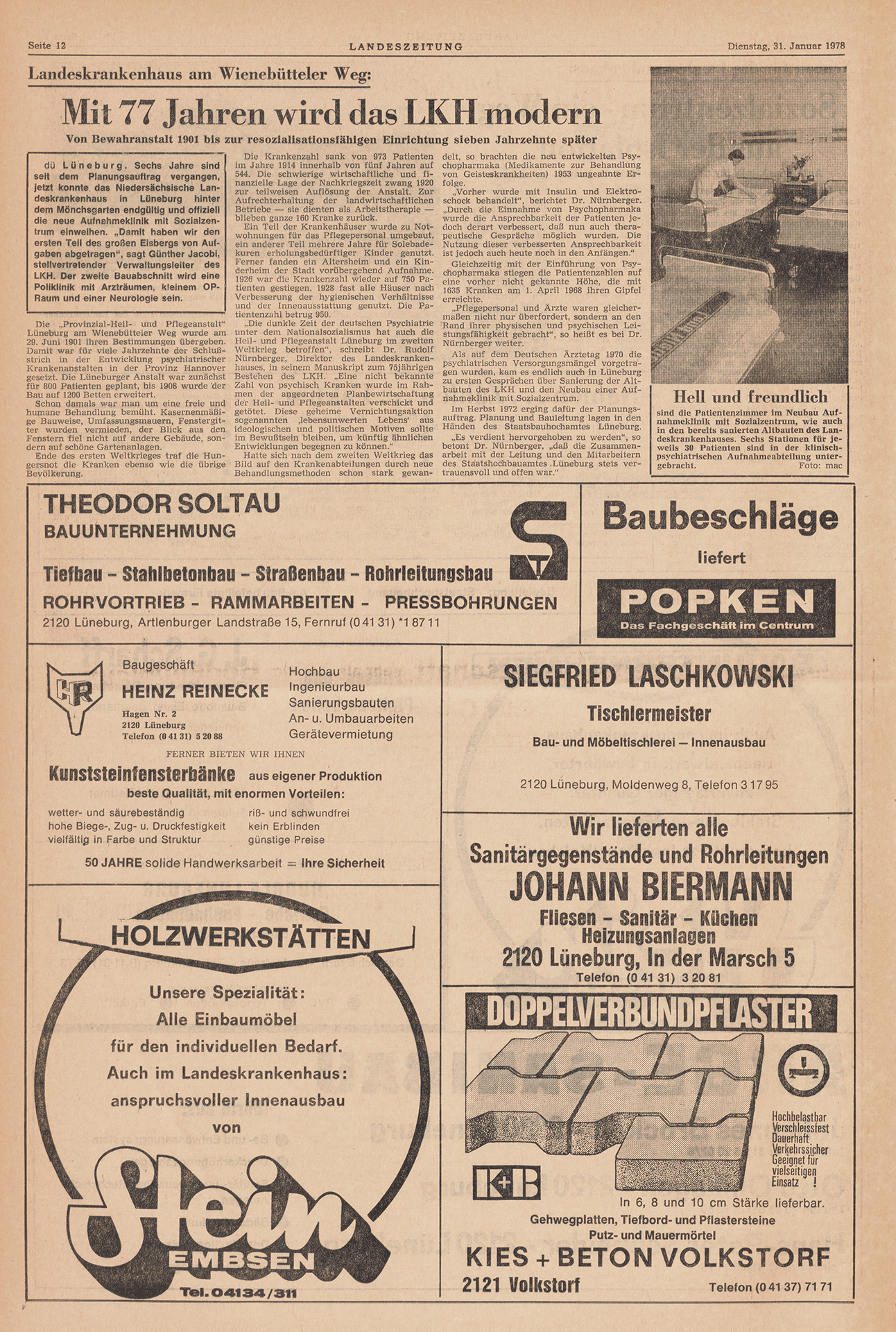
»At 77 years of age, the LKH is becoming modern«, in: Lüneburger Landeszeitung, 31 January 1978, p. 12.
StadtALg, 8.2-LLA-B, 498.
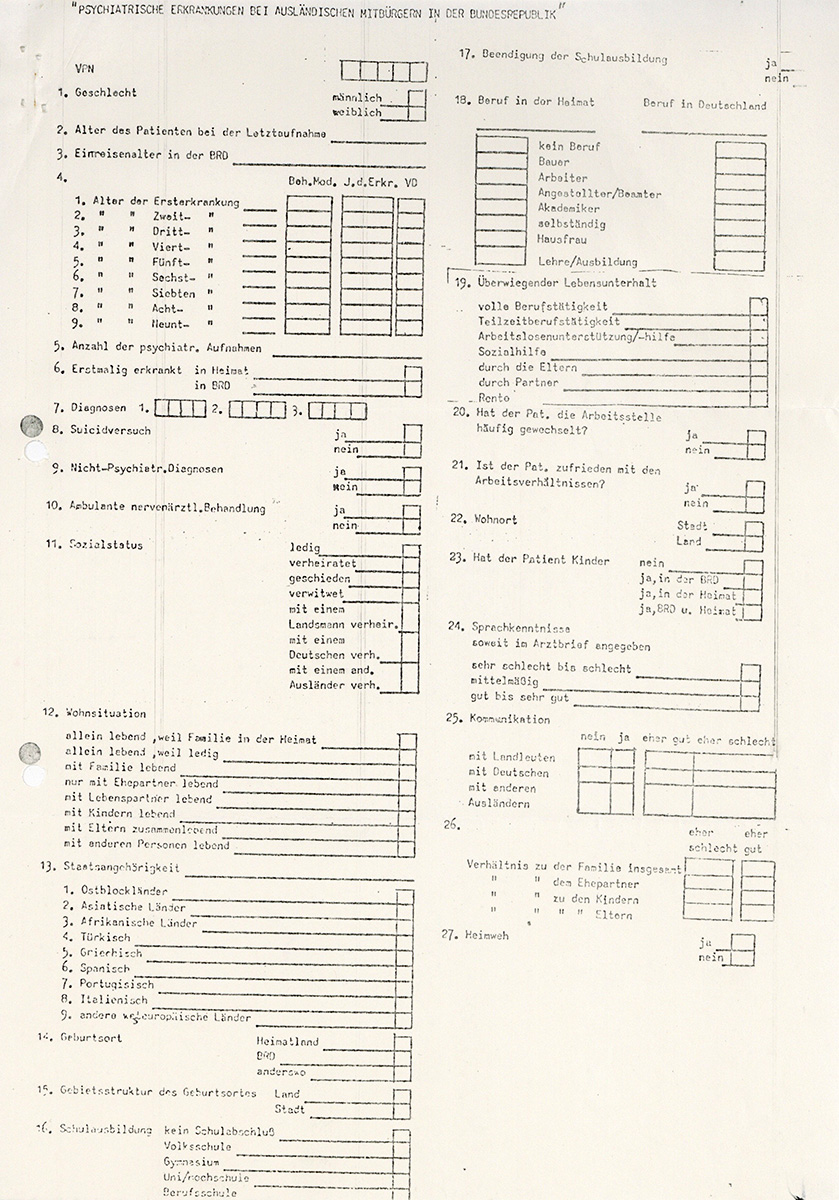
Questionnaire from Hannover Medical School on the research project »Psychiatric disorders among foreign citizens in the Federal Republic of Germany«, spring 1984.
ArEGL 19.
Even after 1975, people of foreign origin who fall ill are still met with prejudice. A research project at the University of Hanover assumed that there was a connection between foreign origin and mental illness. The hospital in Lüneburg was the only one that did not participate in this study. However, the decisive factor was not ethical reasons, but data protection. To this day, supporting patients of foreign origin and avoiding multiple discrimination are not a matter of course everywhere.
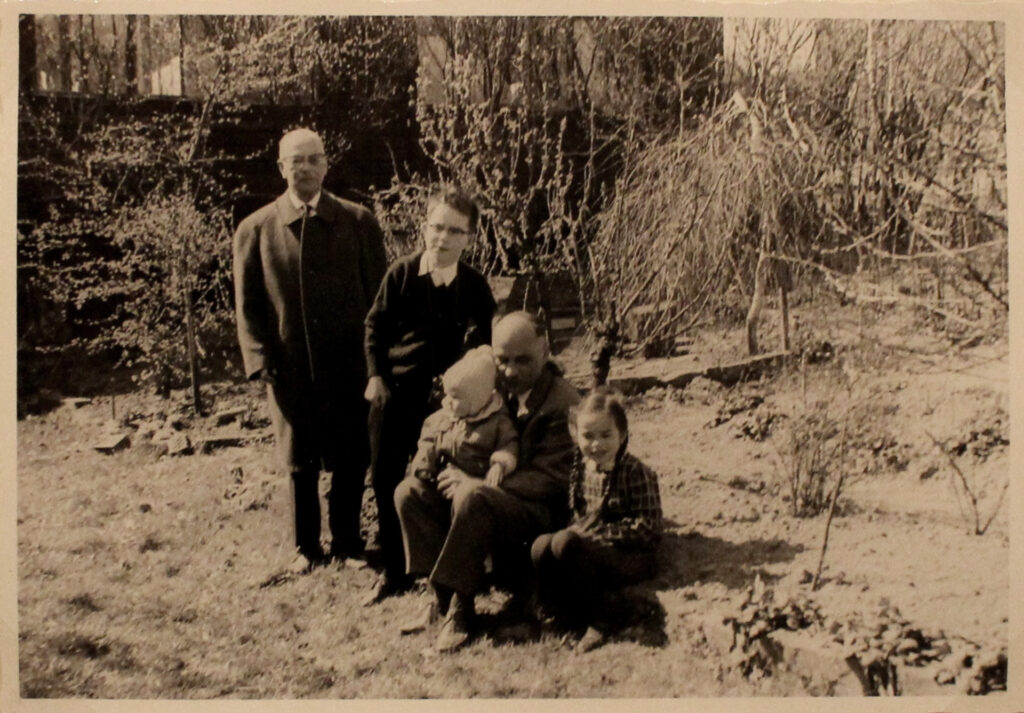
Hans Heinze senior (left) with his son Hans Heinze junior (second from right) and his three grandchildren, circa 1966.
Private property of Hilde Winkelmann | Stolpersteine Rehburg-Loccum Working Group.
From 1954 to 1978, at least 18 drug and vaccine studies were conducted on infants, children and adolescents at the Wunstorf Child and Adolescent Psychiatric Clinic and in homes that received medical care from there. These studies were conducted without the consent of those affected. The doctor in charge was initially Hans Heinze senior and, from 1966, Hans Heinze junior. Through collaboration with Fritz Stöckmann, senior physician at the Rotenburg institutions from 1960 to 1974, drug trials were also conducted there. An investigation commissioned by the Lower Saxony Ministry of Social Affairs in 2017 concluded two years later that, among other things, it was no longer possible to determine the number of children and adolescents who had been harmed. The investigation also made no statement about possible harm to children as a result of the studies.
