DETERMINE AND EVALUATE
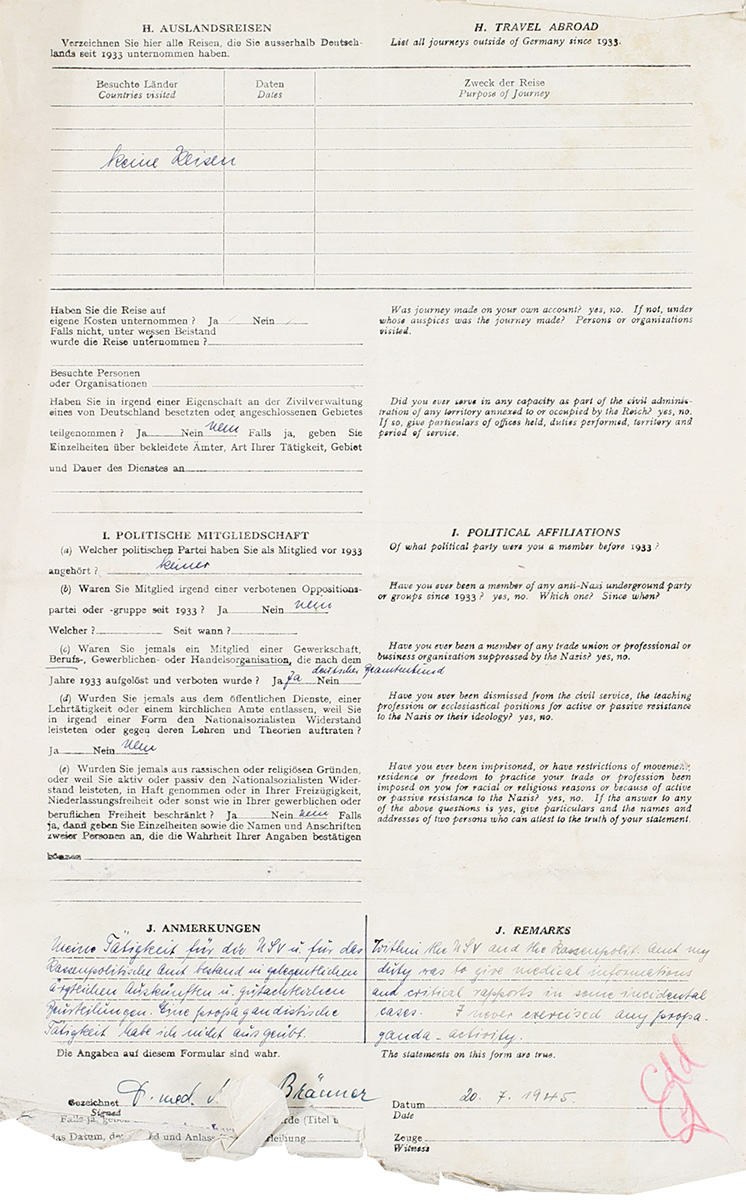
Extract from the British Military Government’s questionnaire on the denazification of Max Bräuner.
NLA Hannover Nds. 171 Lüneburg Nr. 29889.
Carola Kleim filled out the British Military Government’s questionnaire for the political investigation of Max Bräuner. She omitted the special allowances for his involvement in the murder of the sick. His work as an assessor for the Hereditary Health Court also went unmentioned. His duties for the Racial Policy Office were played down.
On 24 August 1945, Max Bräuner and Wilhelmine Wolf were the only employees to be dismissed from their duties at the Lüneburg sanatorium and nursing home. Members of the British security police held them responsible for the catastrophic conditions on the wards. The British considered the doctor Rudolf Redepenning to be unsuspicious and untainted. He became the new medical director.
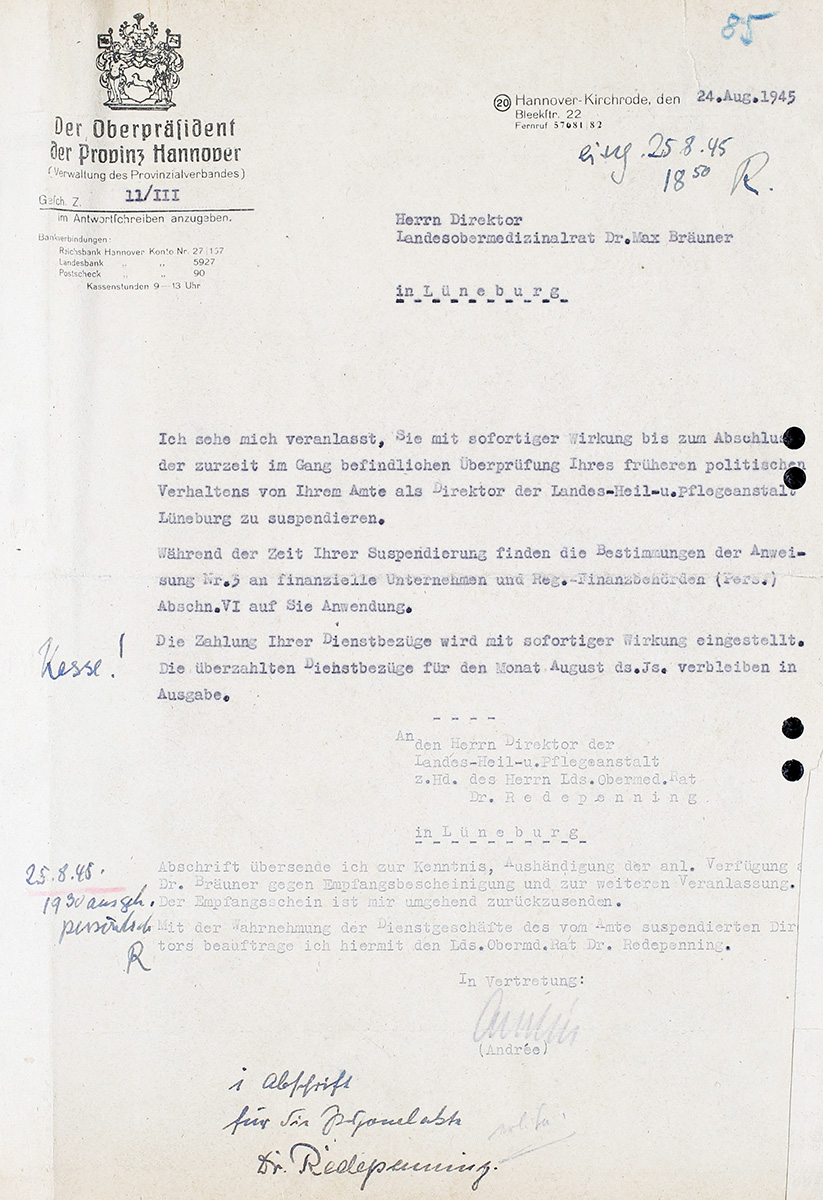
Letter from the Chief President of the Province of Hanover (Georg Andreae) dated 24 August 1945.
NLA Hannover Nds. 300 Acc. 2005/128 Nr. 16.
RUDOLF REDEPENNING (1883 – 1967)
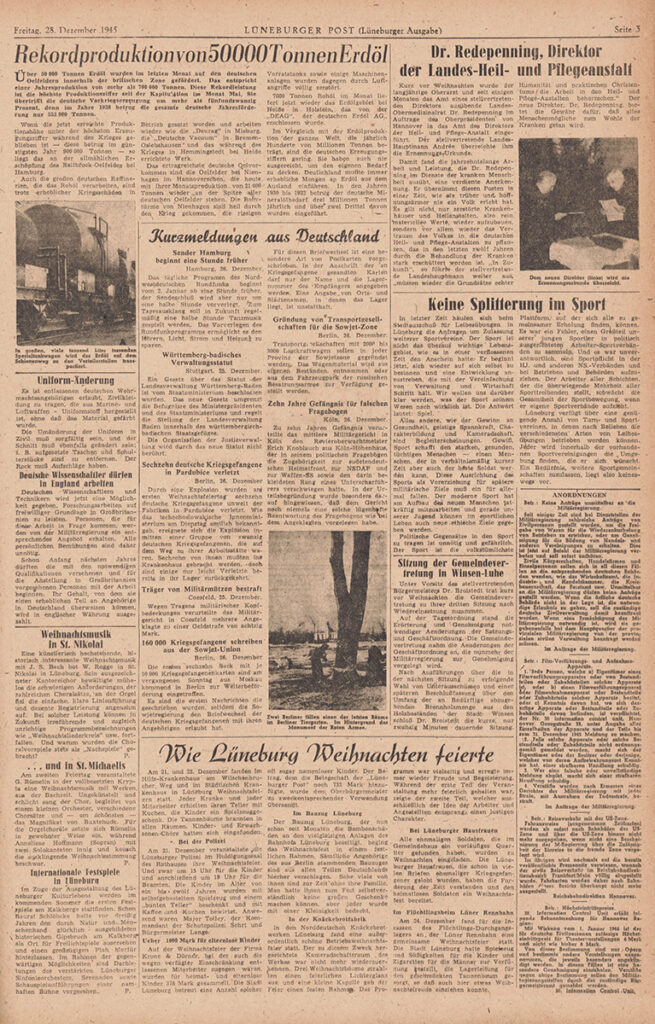
Lüneburg Post of 28 December 1945.
ArEGL.
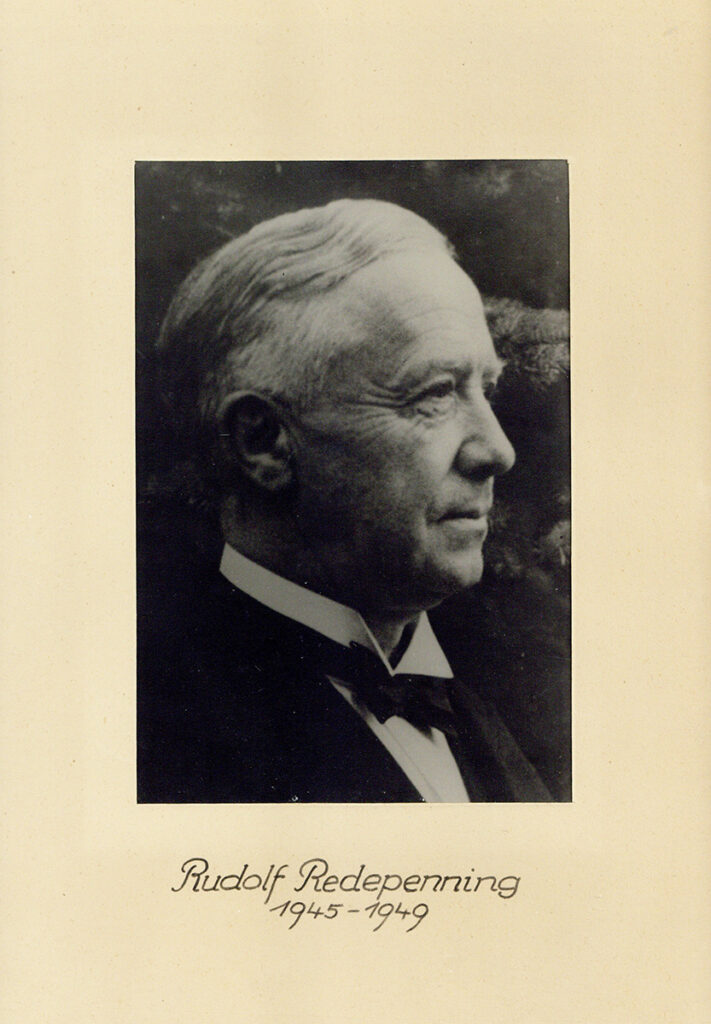
Rudolf Redepenning, around 1955.
ArEGL 151.
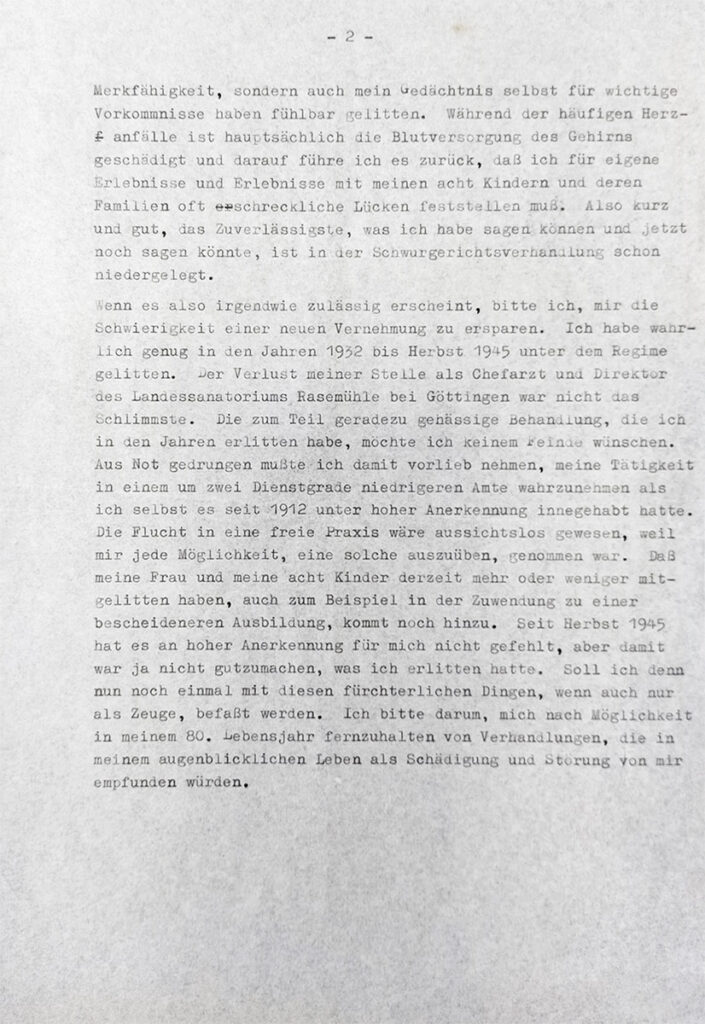
Letter from Rudolf Redepenning to the Frankfurt am Main Regional Court dated 26 October 1962.
ArEGL.
Nobody considered that Rudolf Redepenning might have been complicit in the crimes and therefore did not take part in the second investigation. He blamed memory lapses and illness.
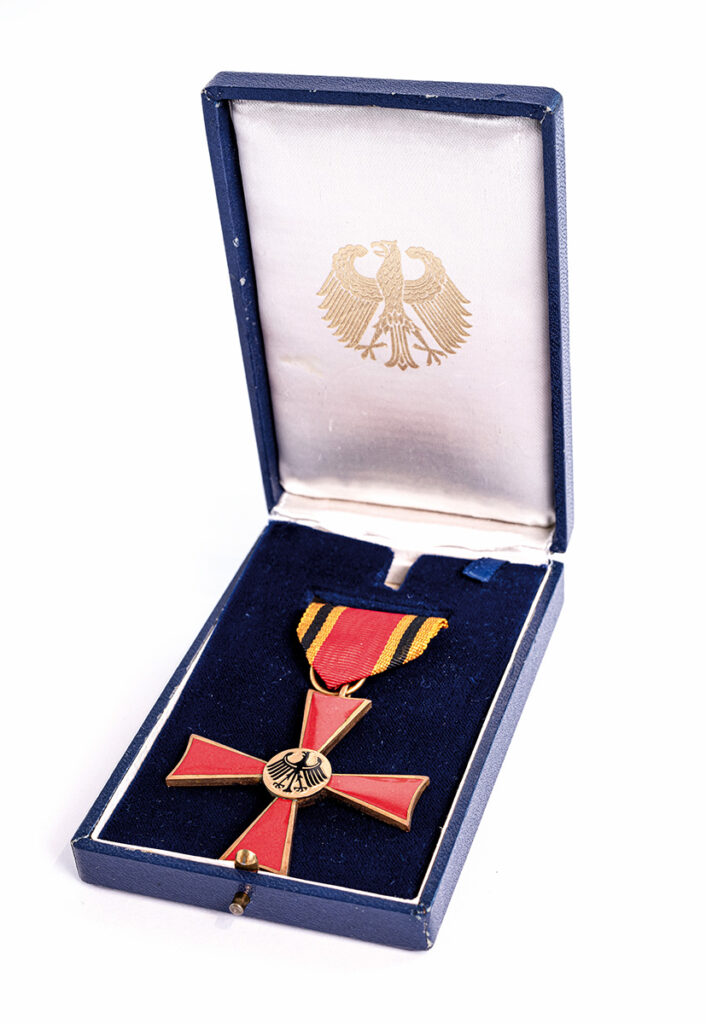
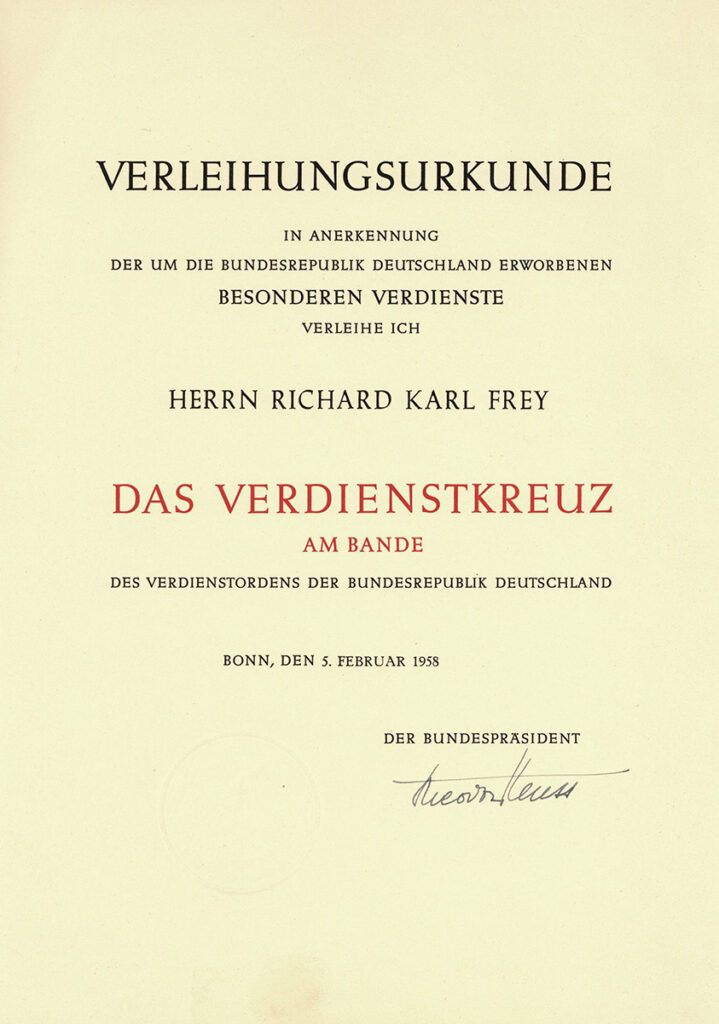
Original box for the Federal Cross of Merit on Ribbon with certificate of appointment, 1958. Rudolf Redepenning received a similar certificate.
ArEGL 203.
In December 1958, Rudolf Redepenning was awarded the Federal Cross of Merit on Ribbon by the then Federal President Theodor Heuss for his involvement in rebuilding the institutional system. At that time, it was not publicly known that he had been involved in medical crimes and the killing of patients. Rudolf Redepenning was never stripped of this award.
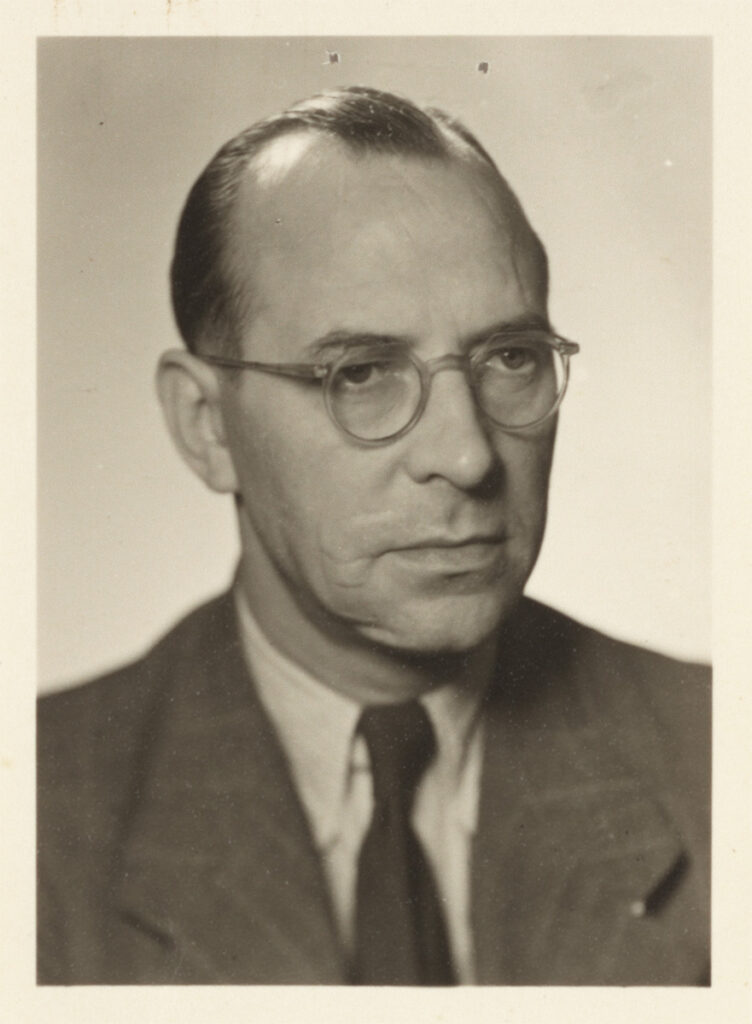
Willi Baumert as Medical Director of the Königslutter Regional Hospital, circa 1964.
NLA Hannover Nds. 300 Acc. 2005/128 Nr. 4.
Many of those involved in the crimes continued to work after a brief interruption in the post-war period. Margret Dehlinger returned to Lüneburg Municipal Hospital as a senior physician in 1949. Hans Rohlfing remained at the health department until his retirement. He was highly regarded as a prison doctor for the regional court and as a medical examiner for health insurance companies. Willi Baumert enjoyed a successful career as the former head of the ‘paediatric department’ at the Königslutter Regional Hospital. In 1958, he became the medical director there.
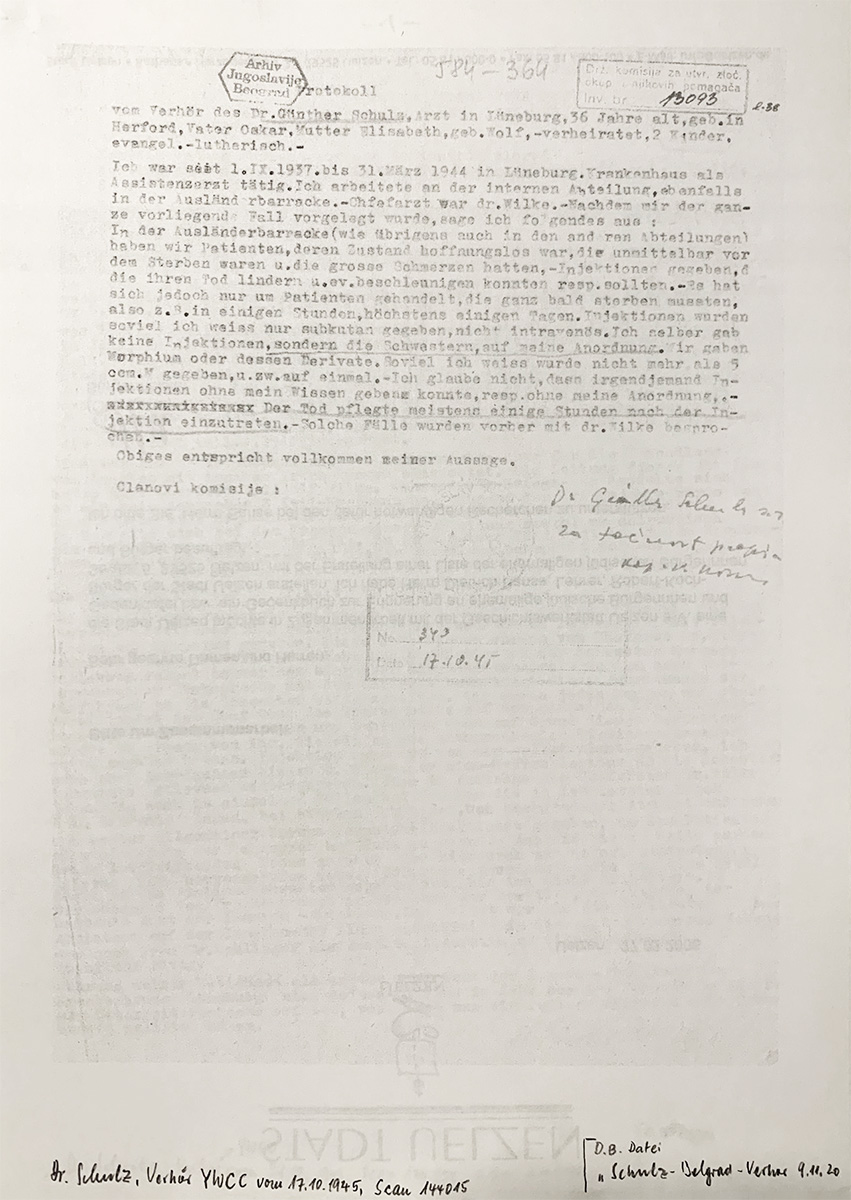
Interrogation protocol of Günter Schulz from 17 October 1945.
Archive of Yugoslavia Belgrade Inv. No 13093.
Doctors and nurses were questioned by the British military police about the murders of forced labourers that had been committed at Lüneburg Municipal Hospital from 1943 onwards. There were several witness statements. The doctor Günter Schulz was subsequently extradited to Belgrade and was imprisoned there. He made a statement.
In October 1946, a second interrogation of Günter Schulz took place in Belgrade prison. A trial was held there before the military court. The defendants Helmut Bock, Günter Schulz and Margarete Dethlefsen did not succeed in making the now deceased medical director Adolf Wilke solely responsible for the murder.
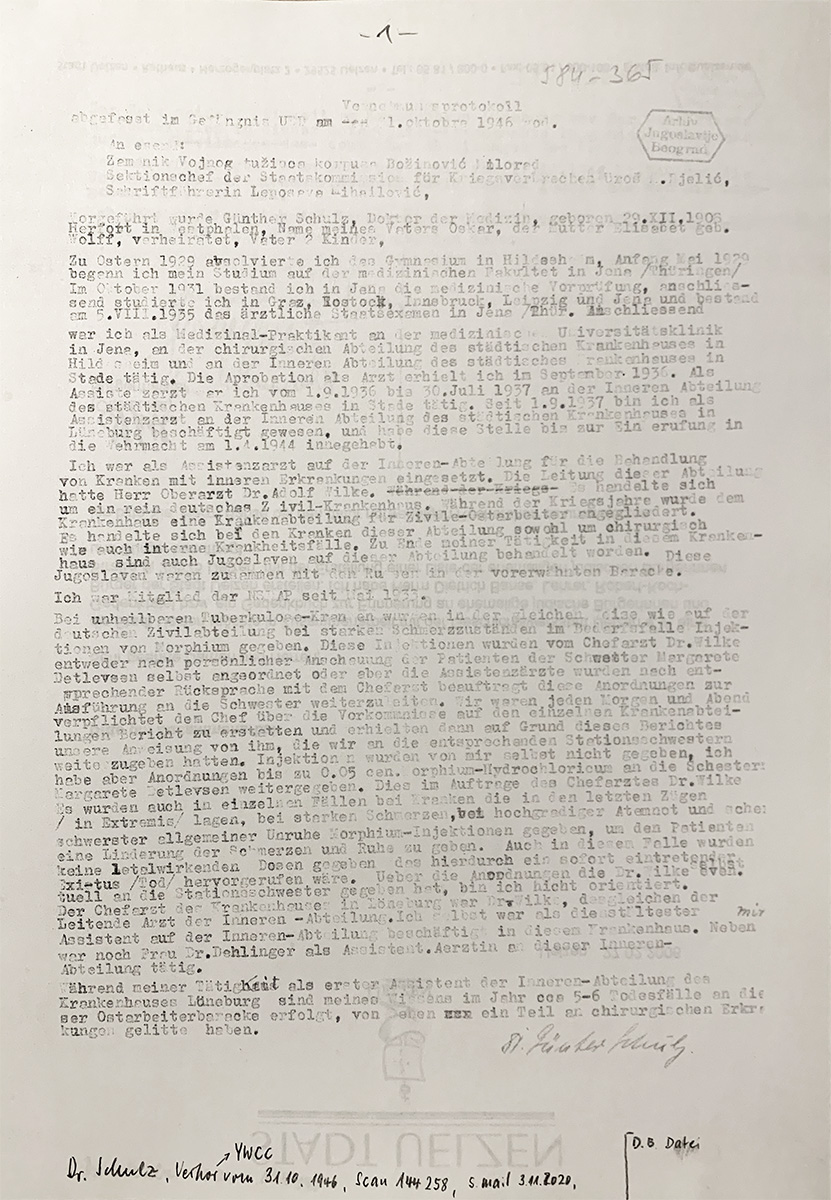
Excerpt from the interrogation protocol of Günter Schulz from 31 October 1946.
Archive of Yugoslavia Belgrade Inv. No 13093.
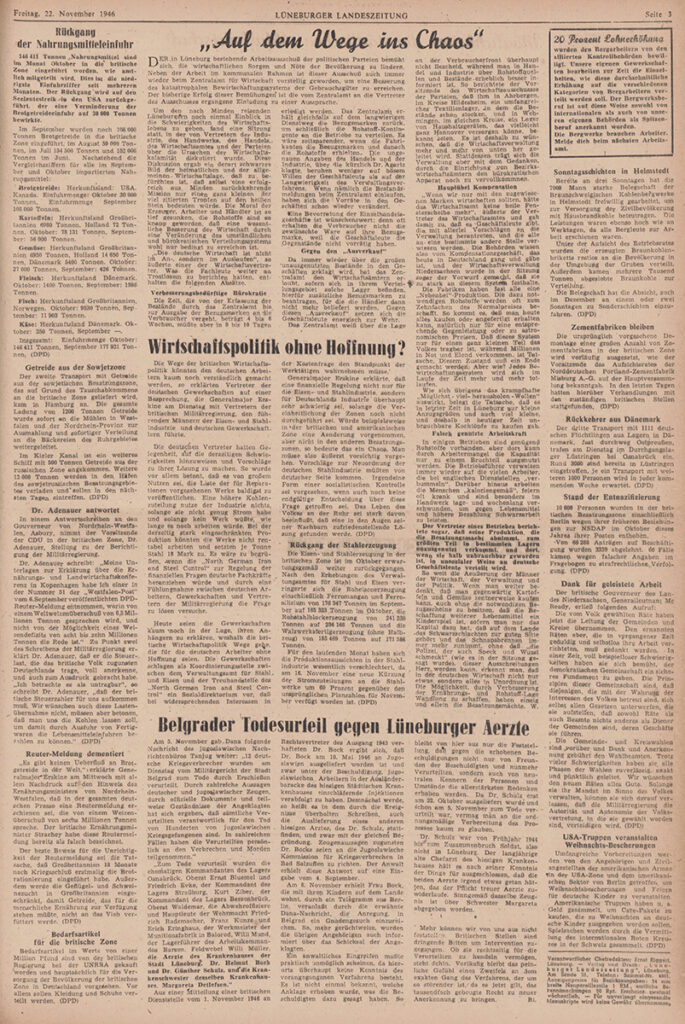
Lüneburger Landeszeitung of 22 November 1946, p. 3.
StadtALg, 8.2-LLA-B, 276.
The nurse Margarete Dethlefsen confessed to the offences and heavily incriminated the doctors. The administration of an overdose of morphine resulting in death was recognised as a war crime by the United Nations War Crime Commission. The legal basis was the Hague Land Warfare Convention (1907) and Control Council Law No. 10 (1945). Helmut Bock, Günter Schulz and Margarete Dethlefsen were sentenced to death on 5 November 1946. The sentence was carried out eleven days later.
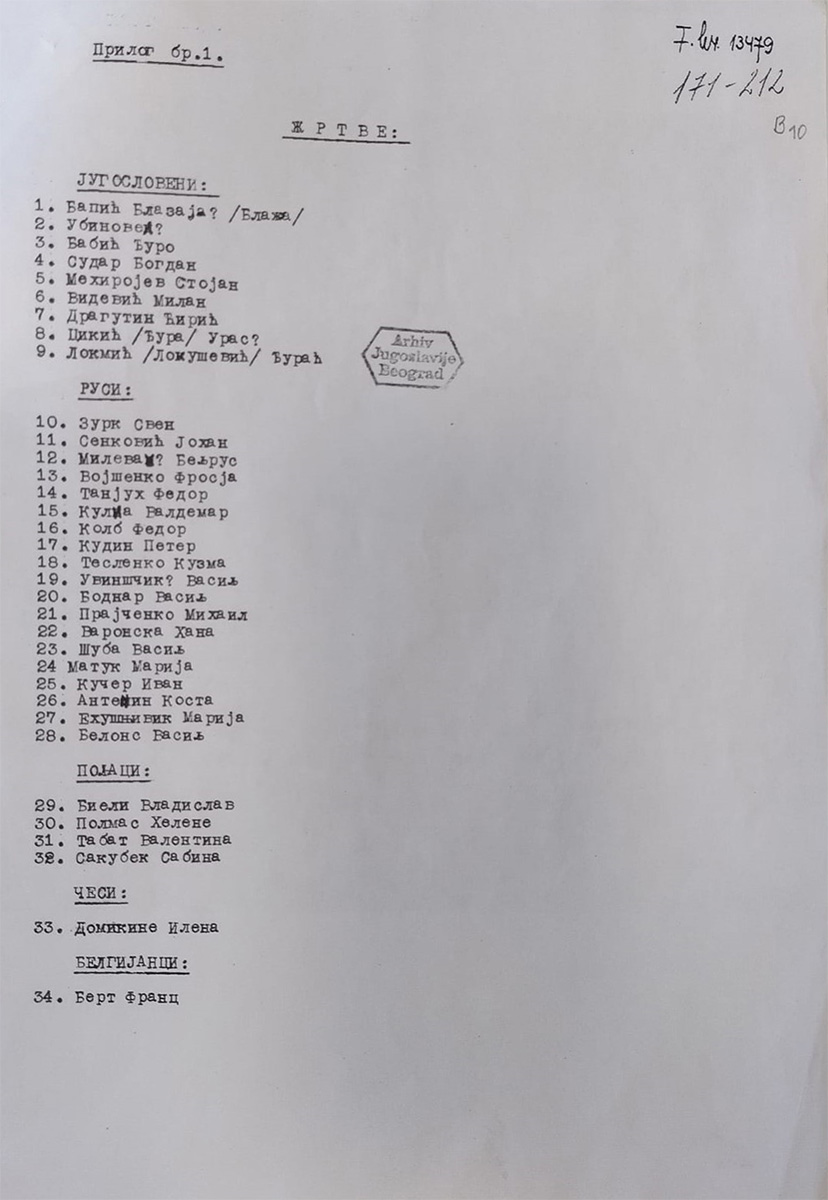
Interrogation protocol of Günter Schulz from 17 October 1945.
Arhiv Jugoslavije Beograd Inv. Nr. 13093.
n patients of foreign origin, 34 people could be named who had been murdered in Lüneburg Municipal Hospital:
YUGOSLAVIA
Babic, Blagoje
Ubinovel [ohne Namensprüfung]
Babic, Gjuro Petrov
Sudar, Bogdan
Milivojac, Stojan
Vidovic, Milan
Cikic, Dragilin
Cicic, Uros
Lokvić/Lokušević, Duran [ohne Namensprüfung]
RUSSEN
Zurk, Sven [ohne Namensprüfung]
Senkowetz, Johann
Milevan, Beljrus [ohne Namensprüfung]
Vojšenko, Frosja [ohne Namensprüfung]
Jannjuk, Fedor
Kula, Valdemar [ohne Namensprüfung]
Kolb, Theodor
Kudin, Peter
Teslenko, Kusima
Onitschuk, Wasily
Bodnar, Wasyl
Preytschenko, Michail
Varonska, Hana [ohne Namensprüfung]
Tschuba, Wasyli
Matuck, Maria
Kutscher, Iwan
Antein, Kosta [ohne Namensprüfung]
Ehušnjivik, Marija [ohne Namensprüfung]
Belons, Wassily
POLEN
Bialy, Wladyslaw
Premas, Helene
Tabat, Valentin
Sakubek, Sabina
TSCHECHIEN
Domeika, Elena
BELGIEN
Baert, Frans Hilaire
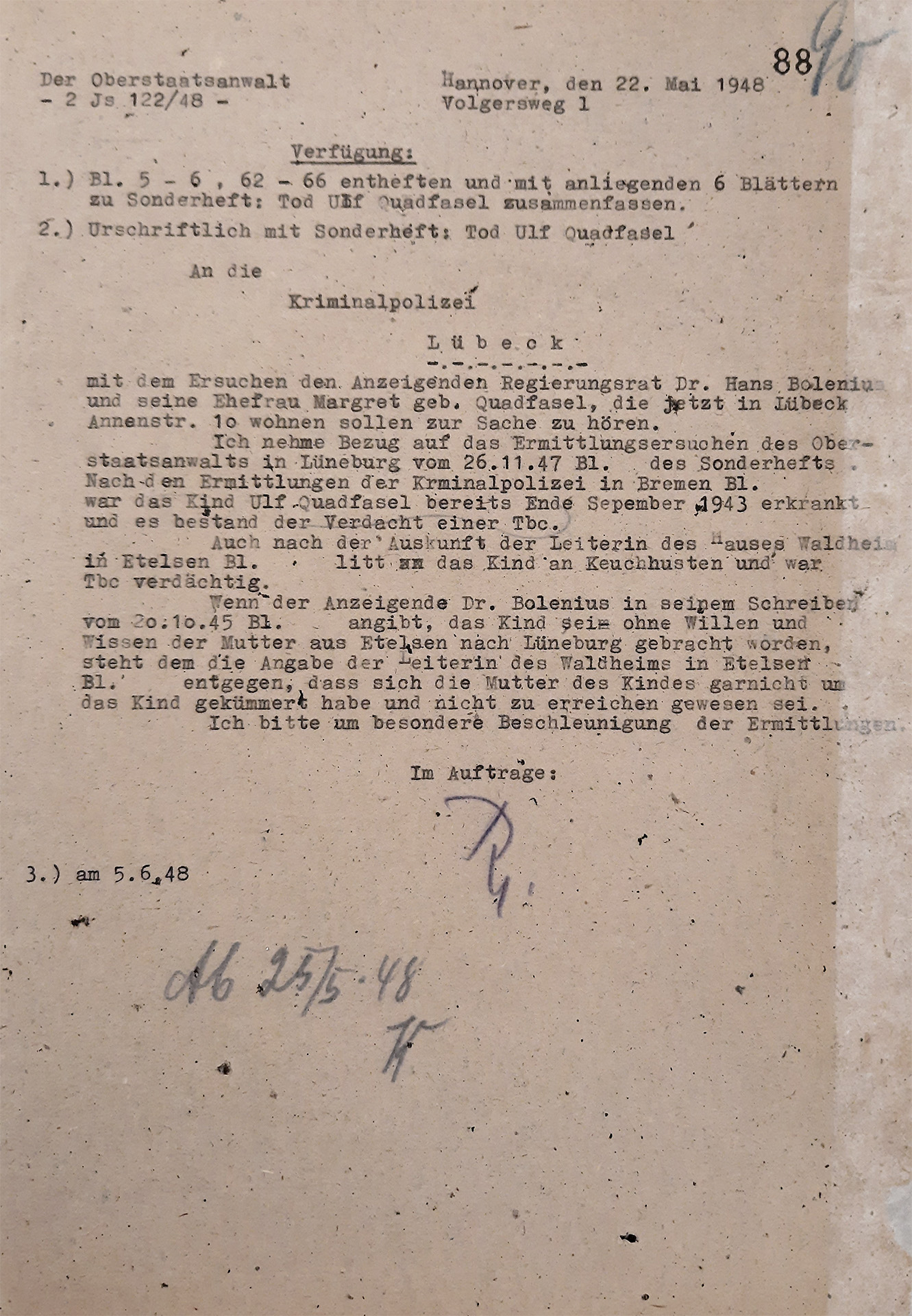
Order from the Chief Public Prosecutor’s Office in Hanover to the Lübeck Criminal Investigation Department dated 22 May 1948.
NLA Hannover Nds. 721 Lüneburg Acc. 8/98 Nr. 3.
As early as October 1945, lawyer Hans Bolenius filed charges against Max Bräuner and Willi Baumert. Bolenius suspected both of murdering children in the Lüneburg sanatorium and nursing home. This included Ulf Quadfasel, the son of his wife Margret. The public prosecutor’s investigation was not opened until 1948.
In 1952, Hans Heinze (former expert at the ‘Reichsausschuss’) was released early from prison and moved to West Germany. In 1953, he was reinstated in public service. A year later, he became head of the newly opened child and adolescent psychiatric clinic in Wunstorf. In October 1960, he took early retirement. Due to a preliminary investigation into murder, his pension payments were suspended in 1961. In 1965, he presented a medical certificate attesting that he was unable to ‘comment responsibly on any questions or physically endure lengthy conversations.’ As a result, the investigation against him was dropped, even though his involvement in ‘child euthanasia’ had been clearly proven.
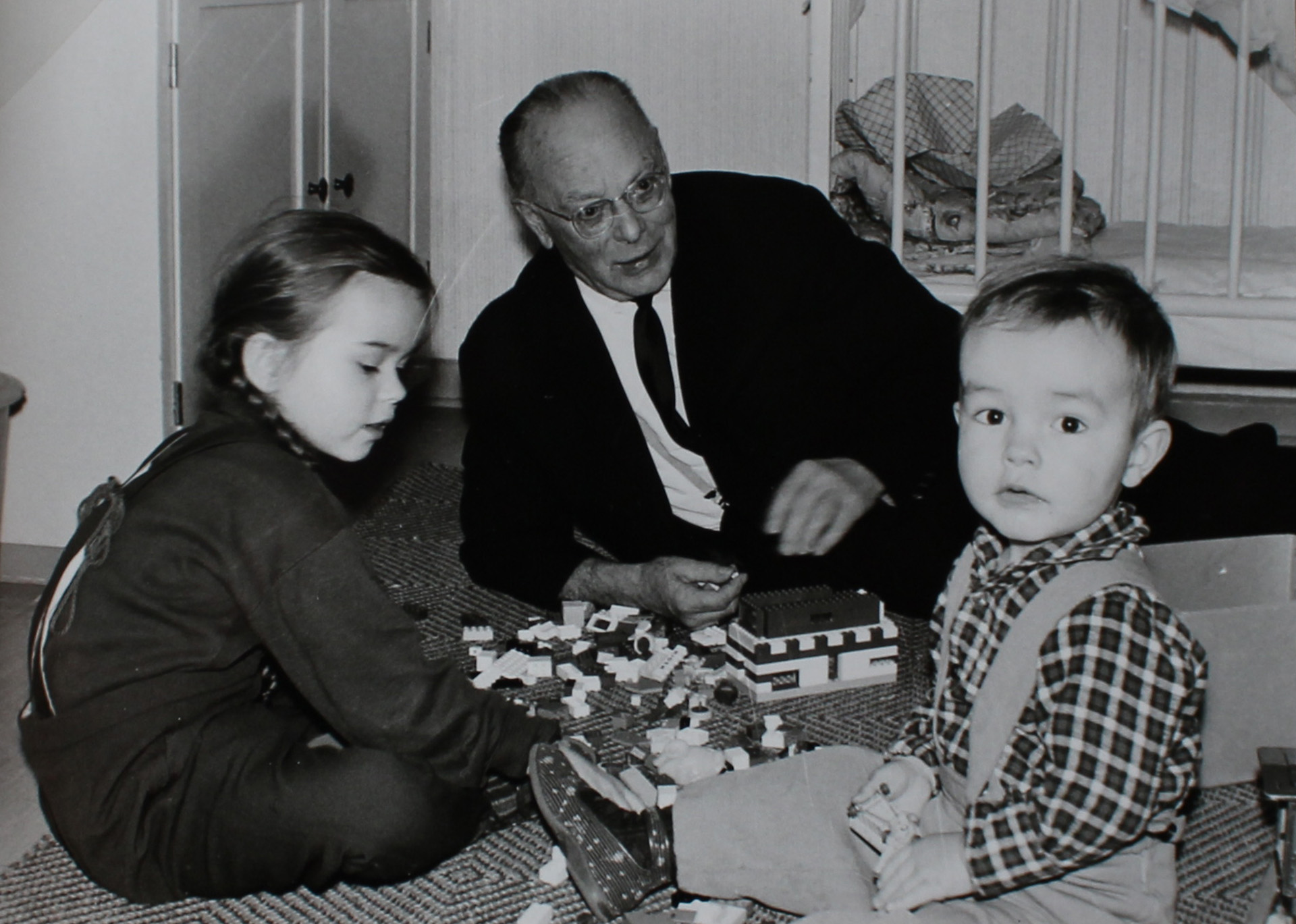
The family photo from 1965 of Hans Heinze playing with two grandchildren does not reveal the poor state of health that had been certified in expert reports.
Private property Hilde Winkelmann | Working Group Stumbling Stones Rehburg-Loccum.

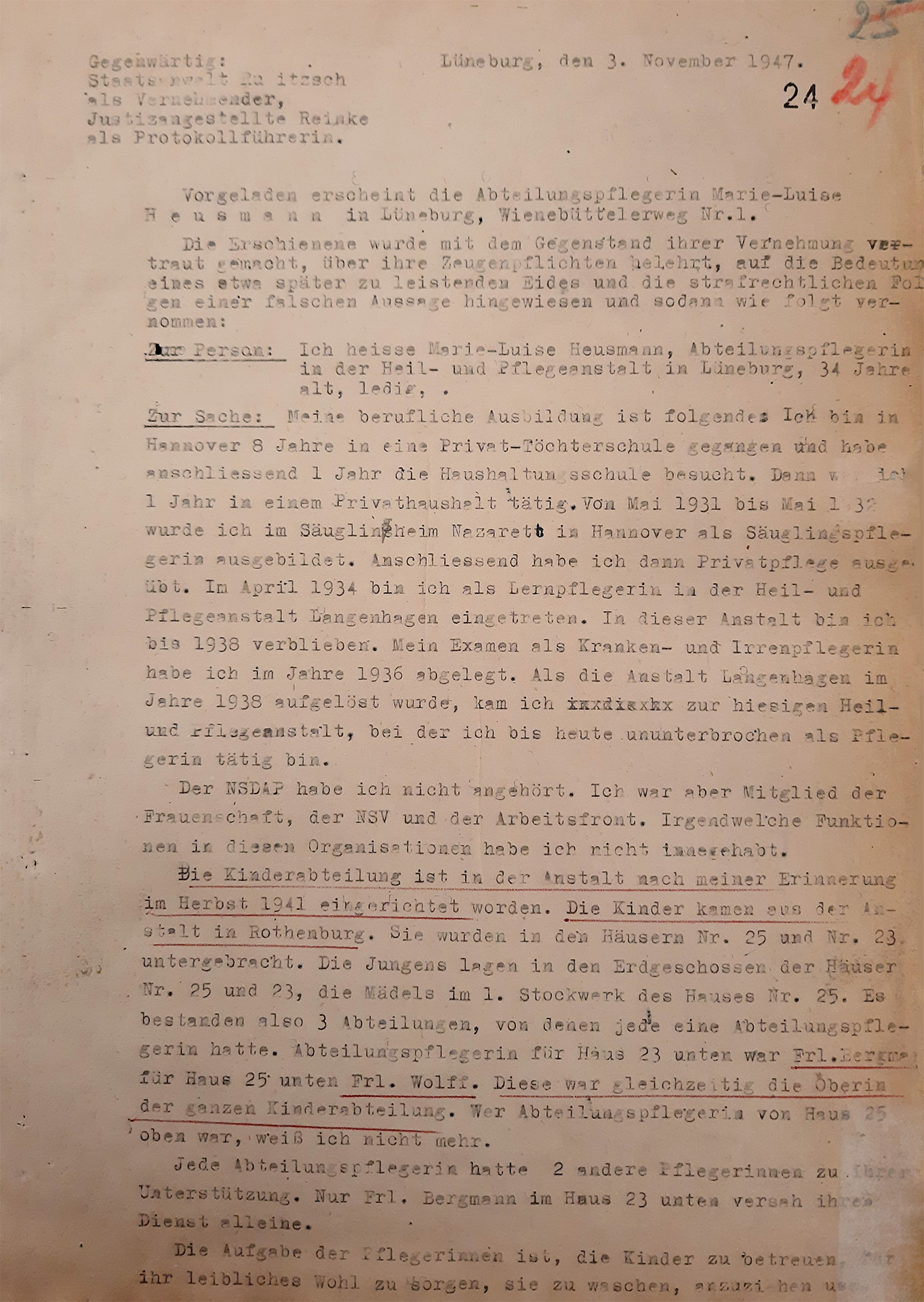
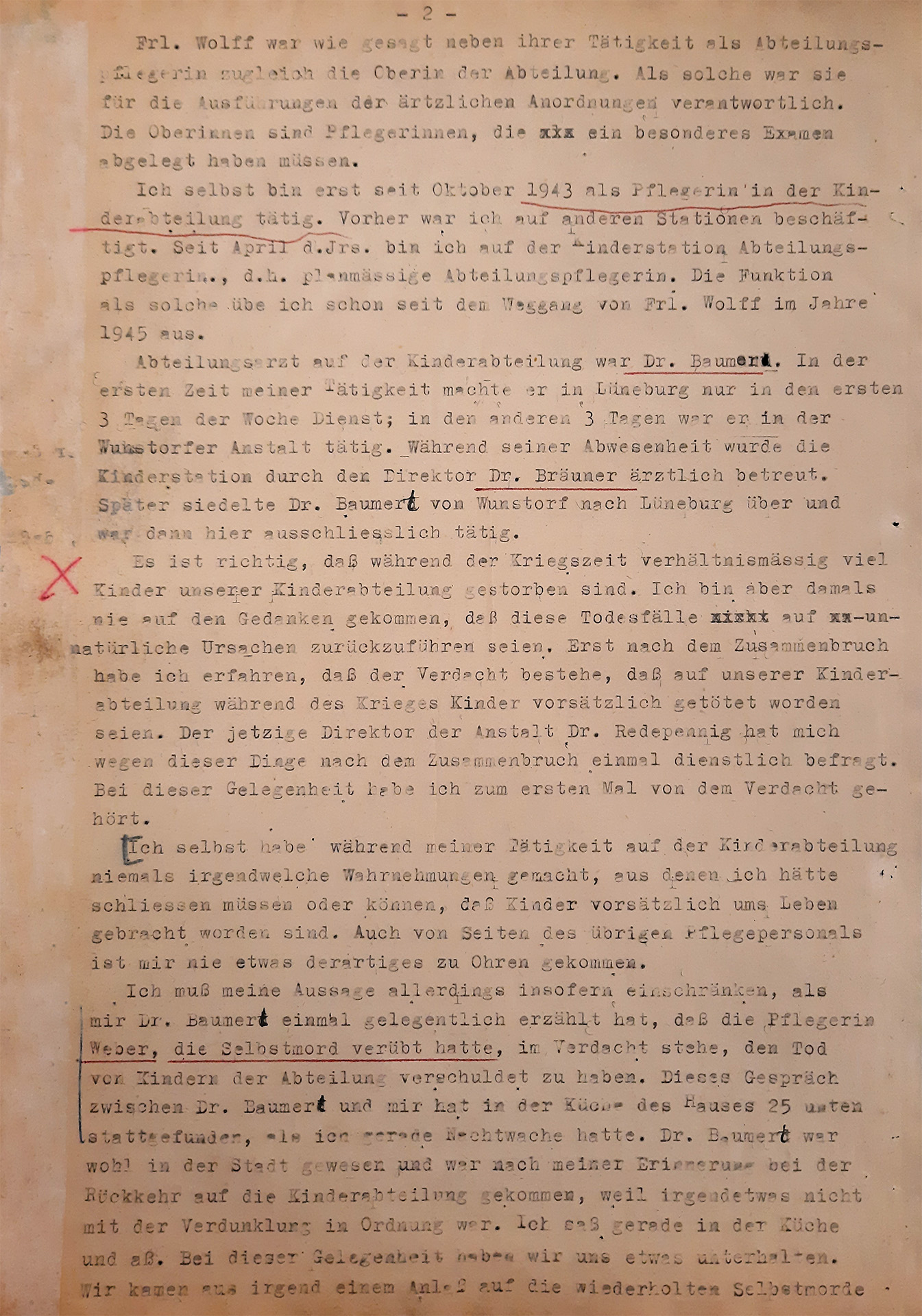
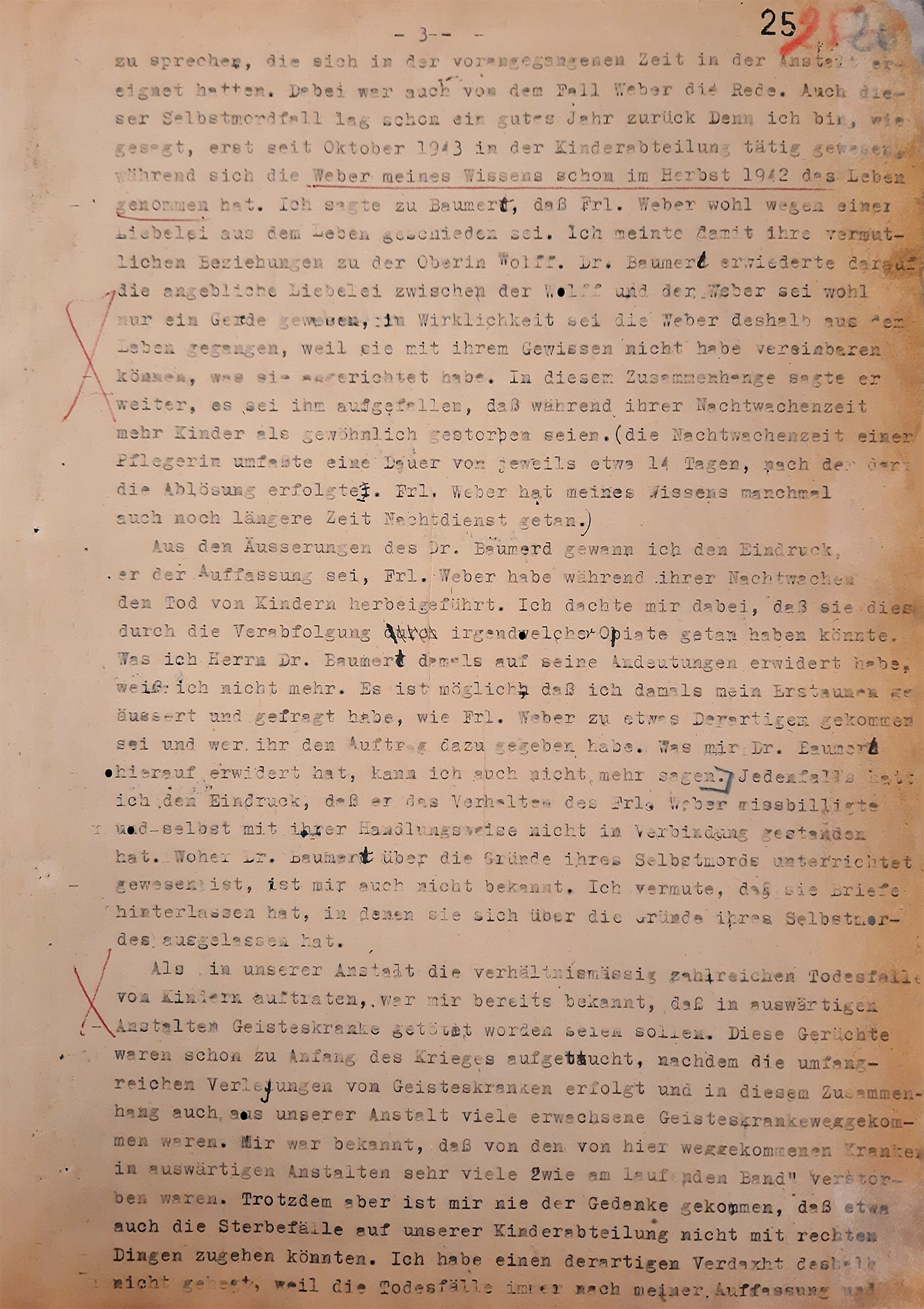
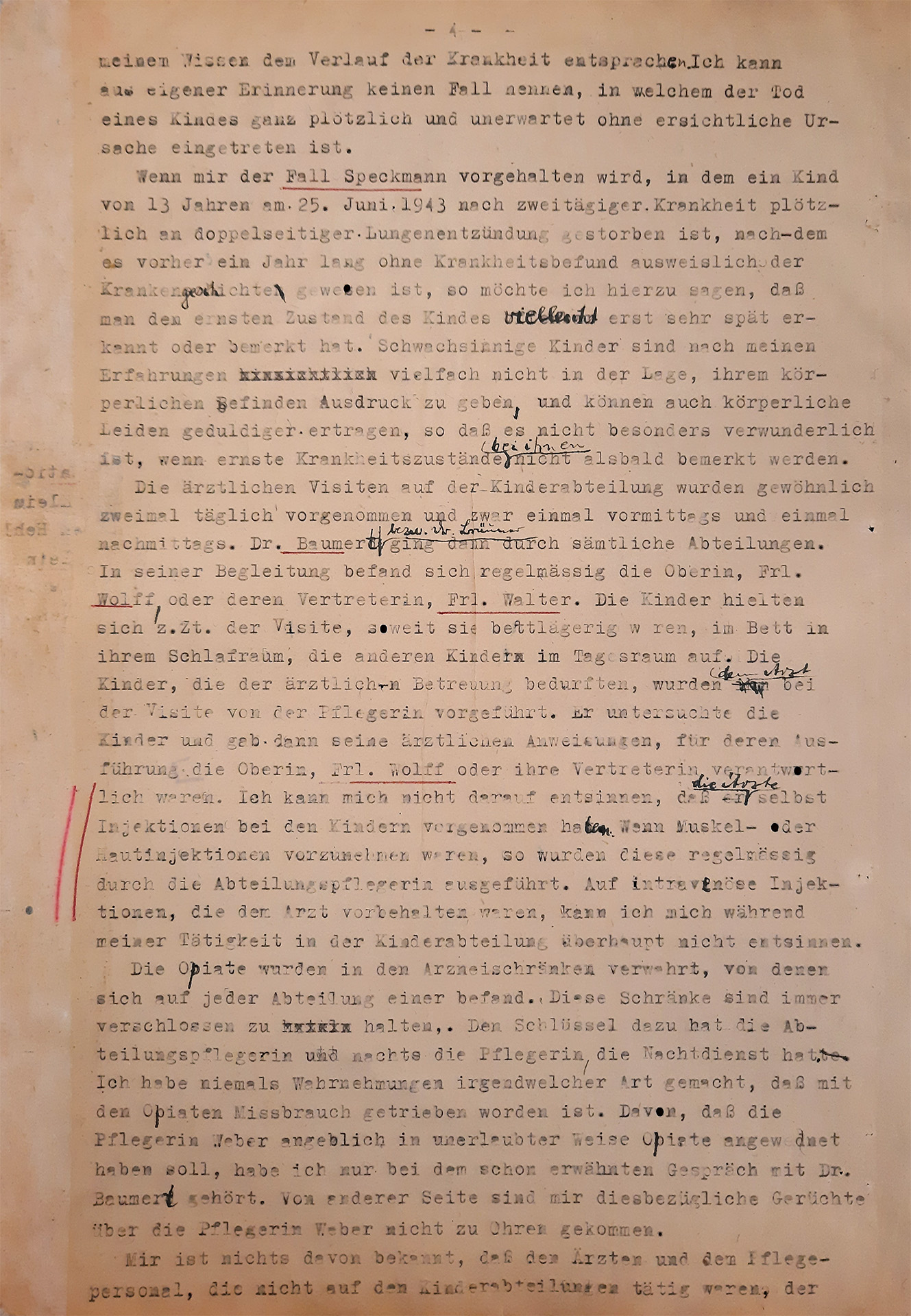
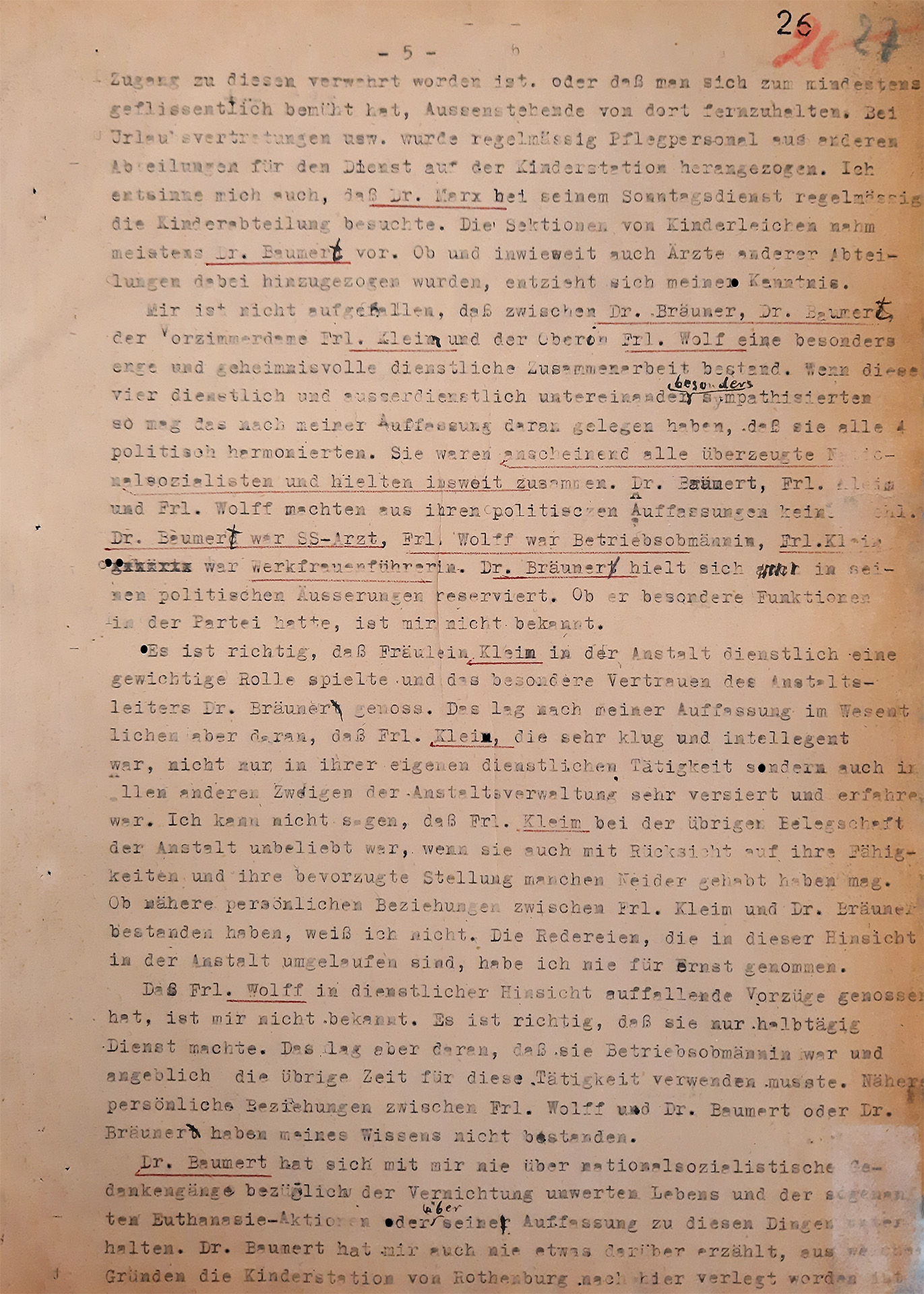
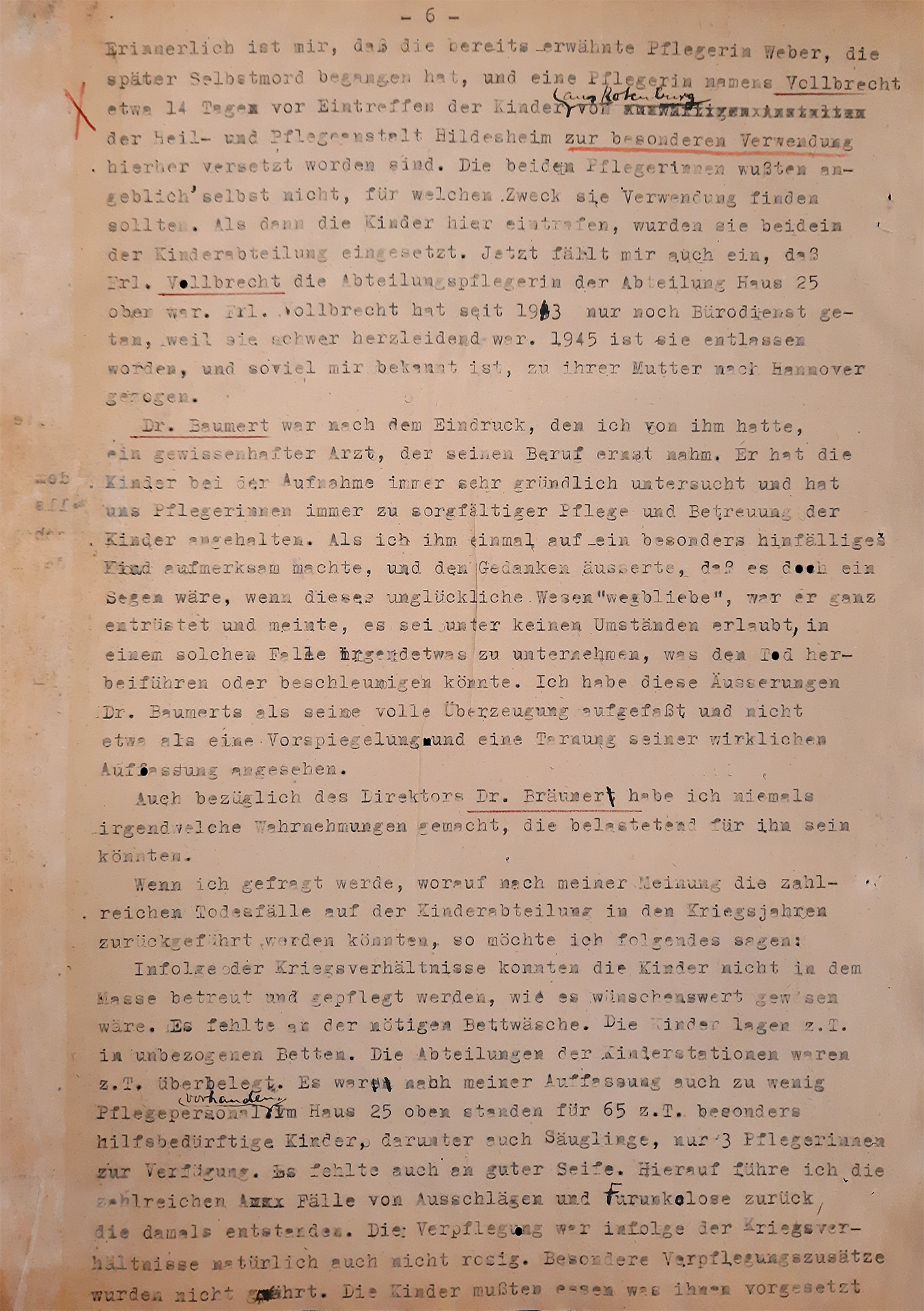
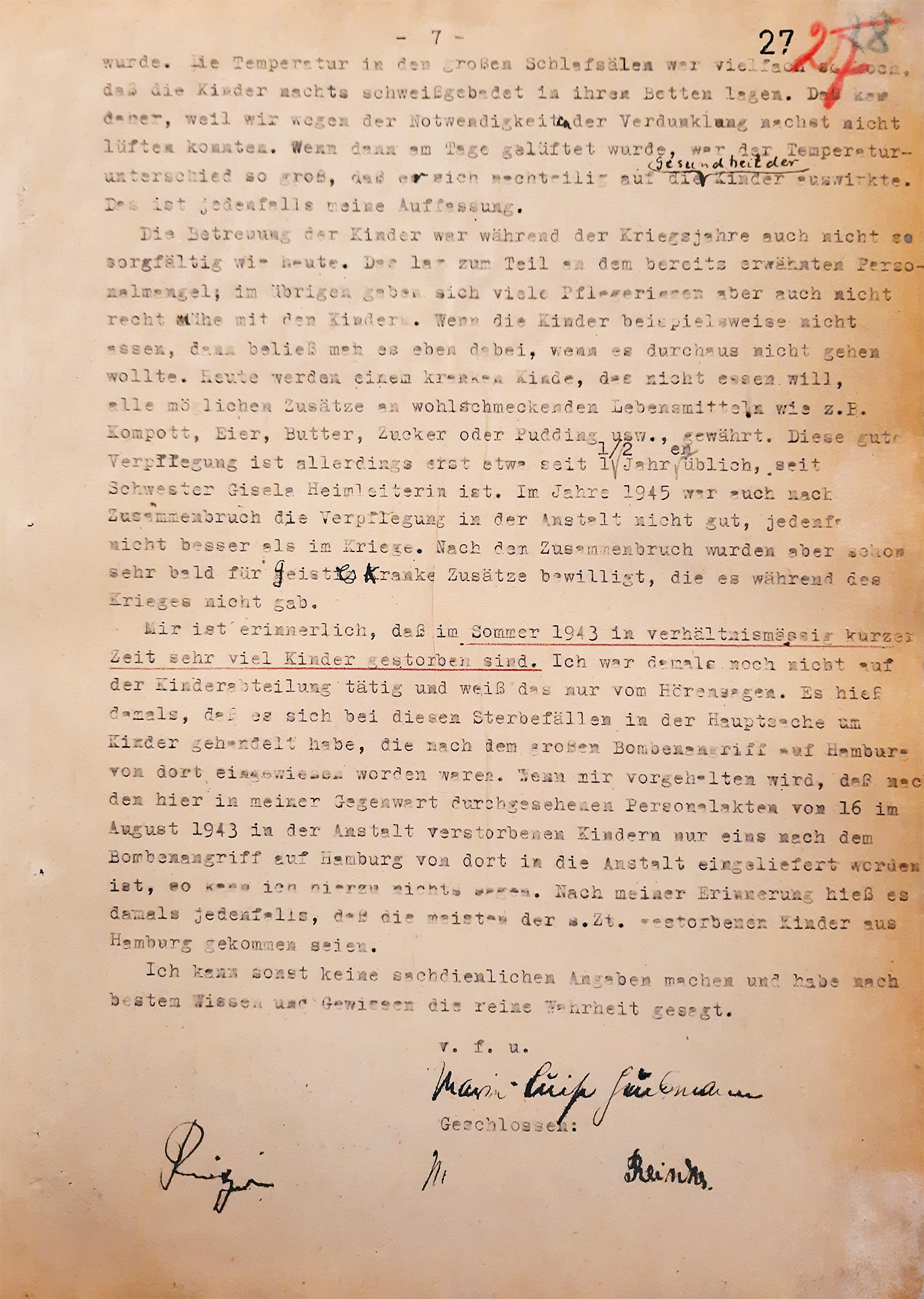
Interrogation of Marie-Luise Heusmann on 3 November 1947.
NLA Hannover Nds. 721 Lüneburg Acc. 8/98 Nr. 3.
In 1947, all employees were questioned about the events in Lüneburg. They responded with almost identical answers, stating that no patients had been murdered at the Lüneburg mental hospital. They explained the high number of deaths by citing poor care conditions and, later, the large number of bombing victims from Hamburg. A comparison of the interrogation transcripts shows that the statements had been coordinated. The investigators were deceived.
ULF QUADFASEL (1940 – 1943)
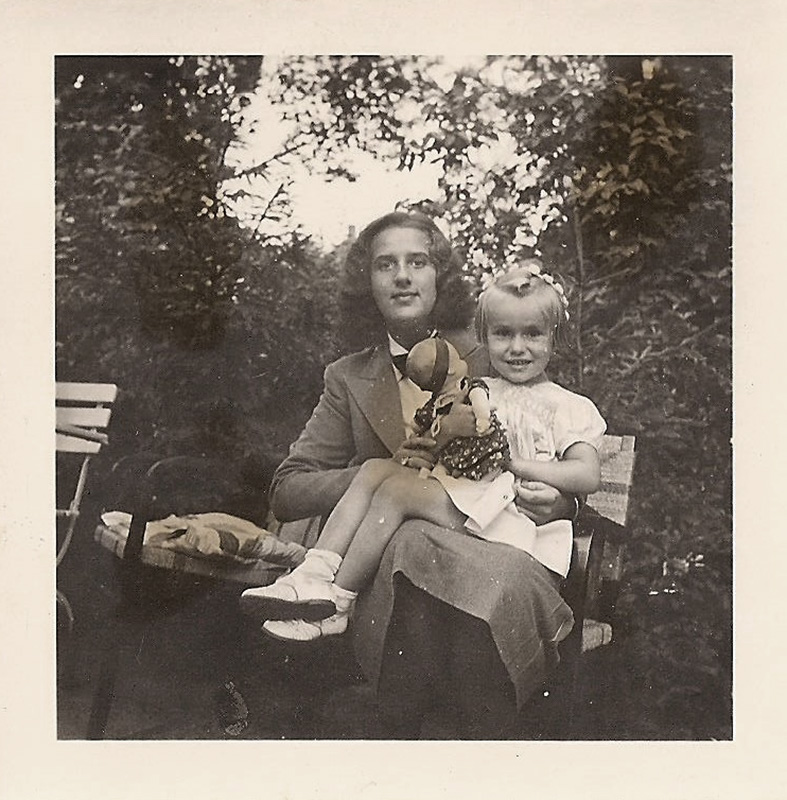
Margret Quadfasel with Karla Rust, Bremen, August 27, 1939.
Private property Karla Reinhart.
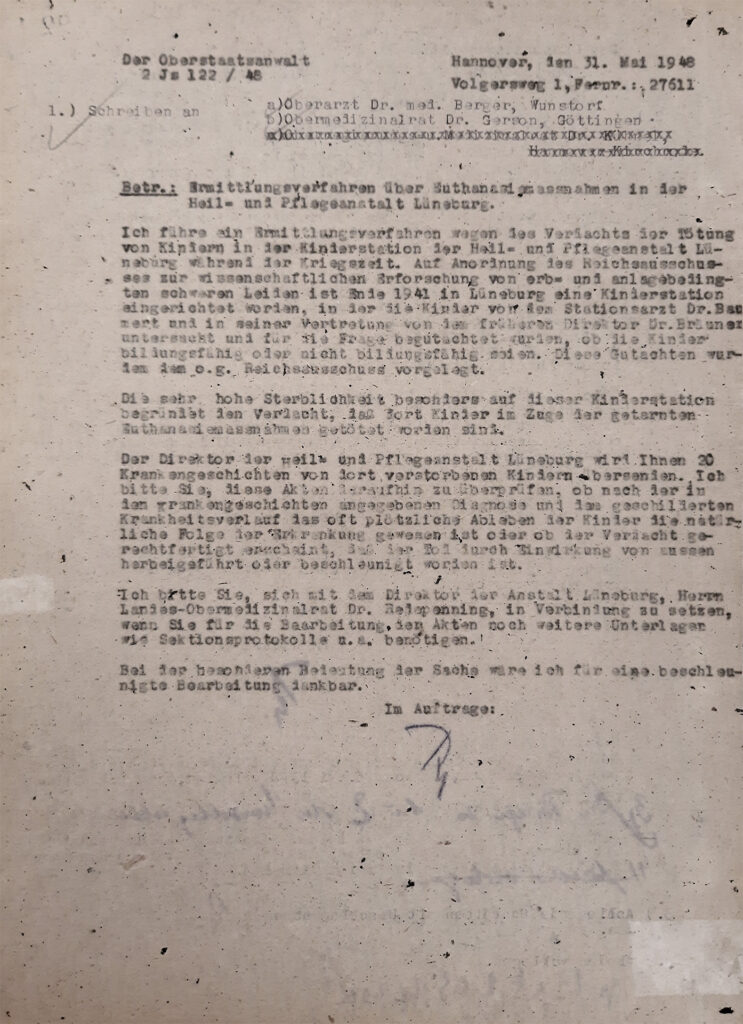
Letter from the senior public prosecutor’s office in Hanover to Doctors Berger and Gerson dated 31 May 1948.
NLA Hannover Nds. 721 Lüneburg Acc. 8/98 Nr. 3.
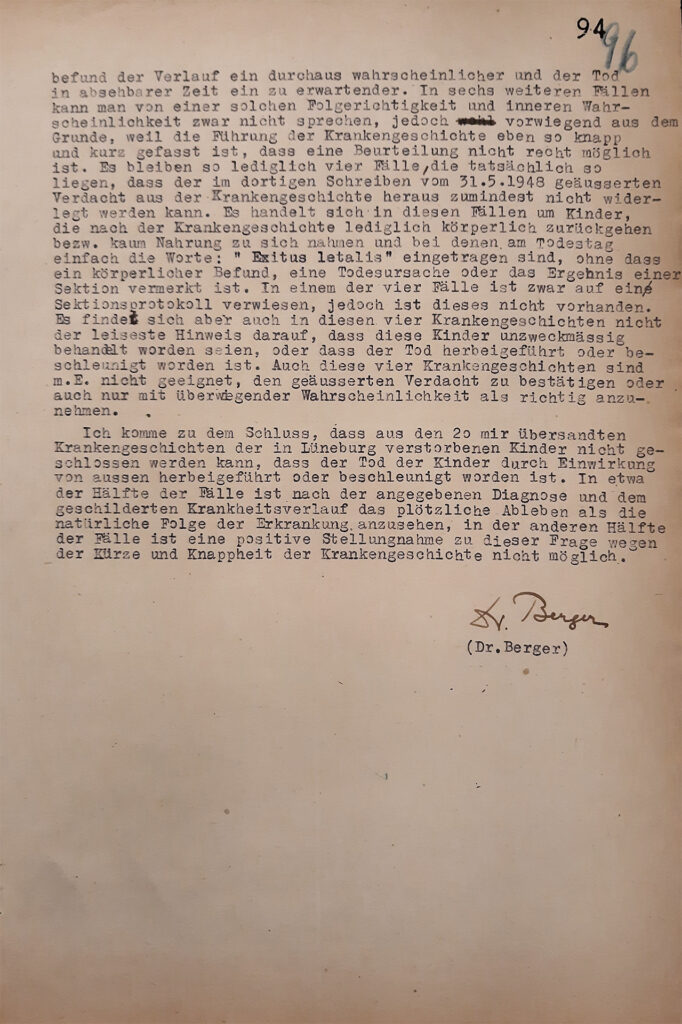
Extract from Berger’s medical report to the senior public prosecutor’s office in Hanover dated 1 July 1948.
NLA Hannover Nds. 721 Lüneburg Acc. 8/98 Nr. 3.
To verify the initial suspicion, two doctors from the Göttingen and Wunstorf sanatoriums were commissioned on 31 May 1948 to examine the causes of death of 20 children on the basis of the entries in the medical records. They came to the following conclusion: it could not be proven that the deaths had been caused by violence. As a result, the investigation was closed in 1949.
To verify the initial suspicion, two doctors from the Göttingen and Wunstorf sanatoriums were commissioned on 31 May 1948 to examine the causes of death of 20 children on the basis of the entries in the medical records. They came to the following conclusion: it could not be proven that the deaths had been caused by violence. As a result, the investigation was closed in 1949.
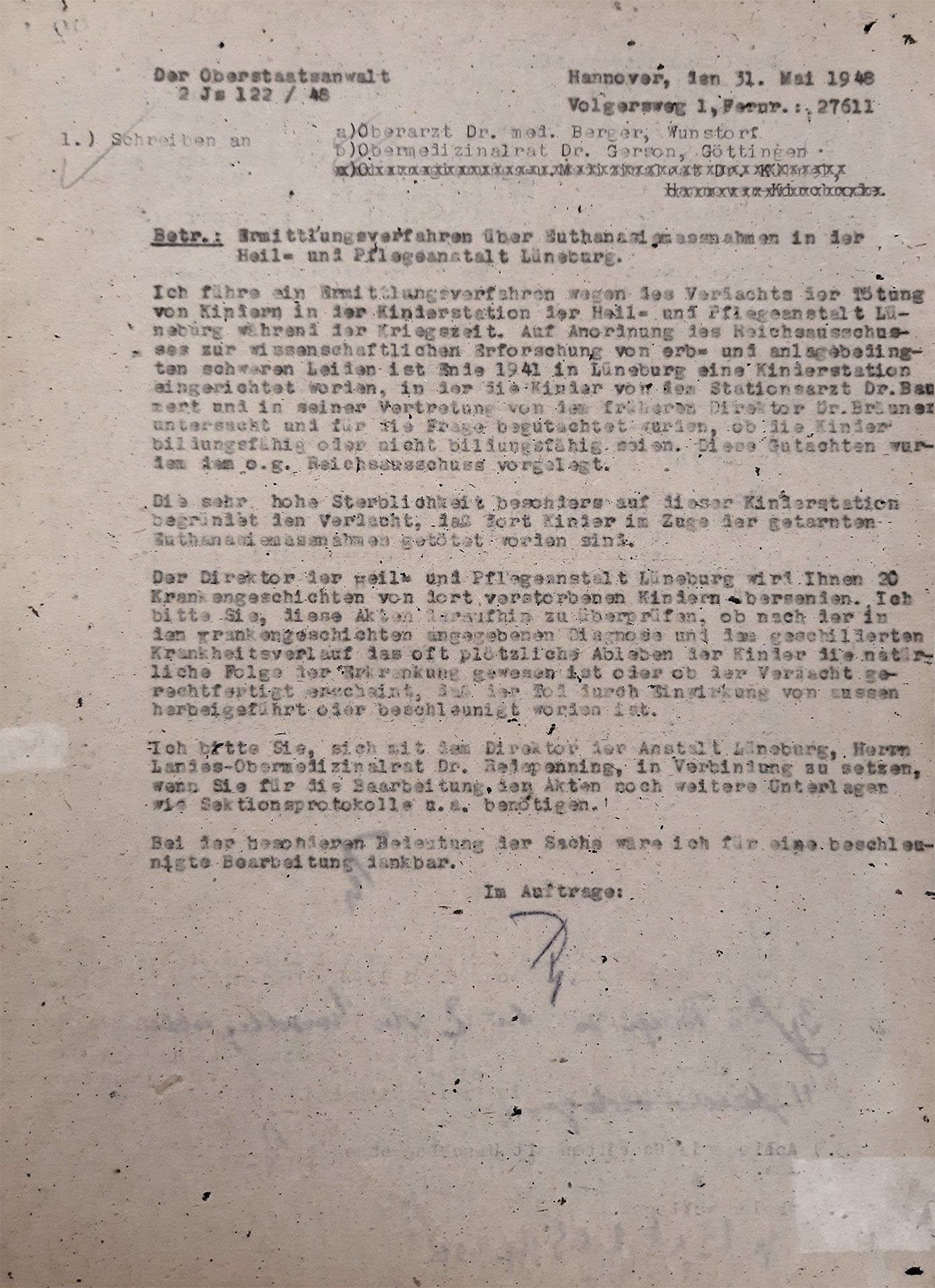
Letter from the senior public prosecutor’s office in Hanover to Doctors Berger and Gerson dated 31 May 1948.
NLA Hannover Nds. 721 Lüneburg Acc. 8/98 Nr. 3.
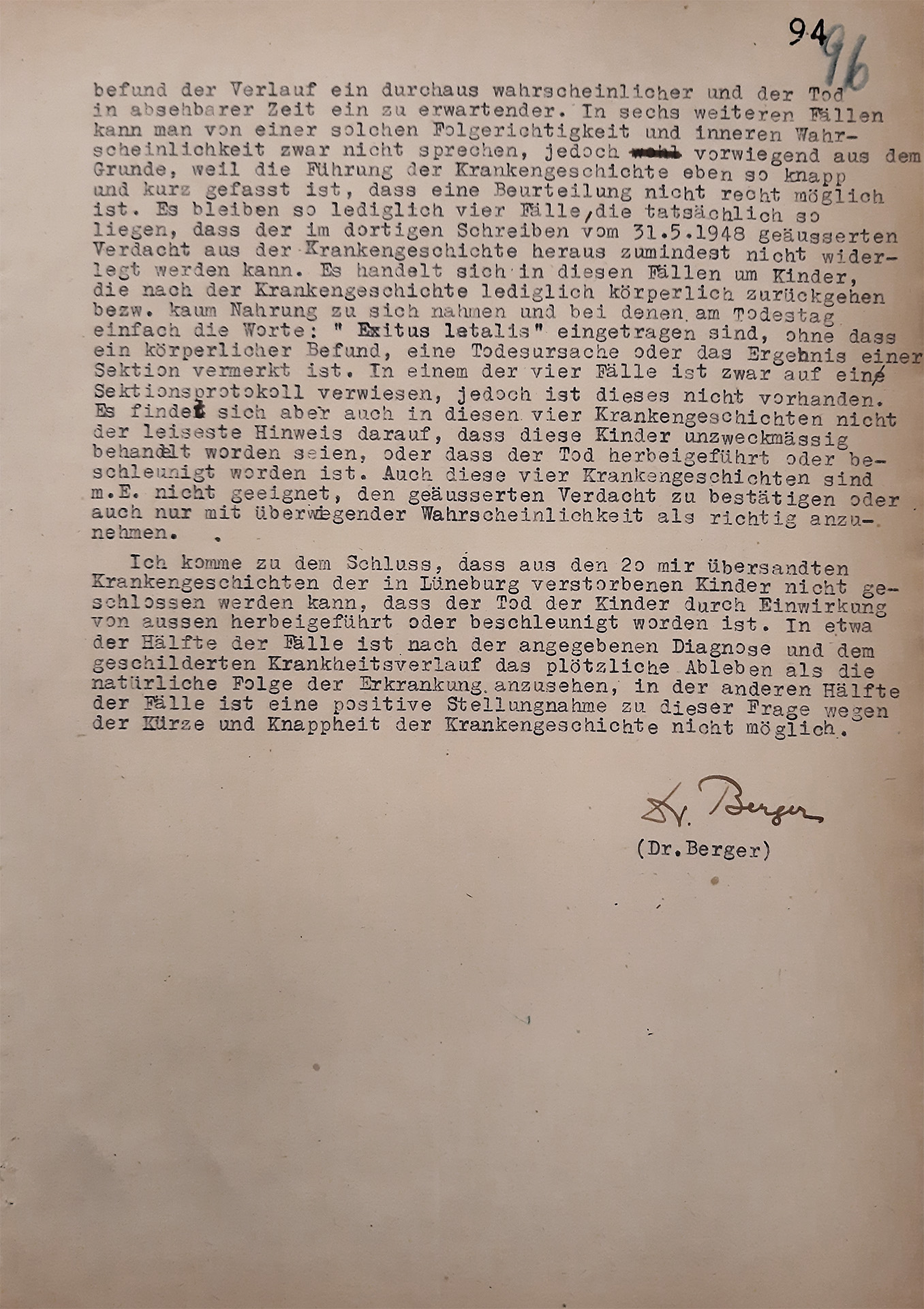
Extract from Berger’s medical report to the senior public prosecutor’s office in Hanover dated 1 July 1948.
NLA Hannover Nds. 721 Lüneburg Acc. 8/98 Nr. 3.
»I come to the conclusion that from the 20 medical histories of the children who died in Lüneburg that were sent to me, it cannot be concluded that the children’s deaths were caused or accelerated by external influences.«
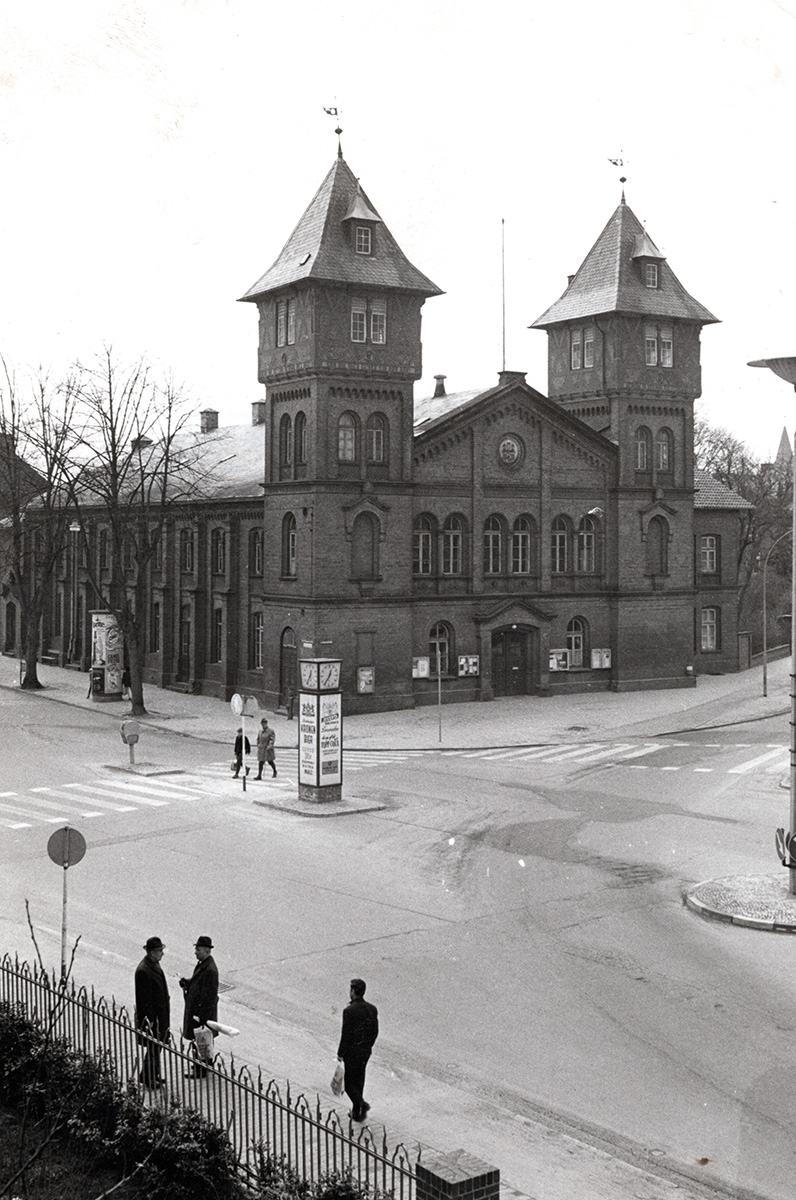
MTV hall, Lindenstraße 30 in Lüneburg, around 1965.
Private property Beckmann | ArGW.
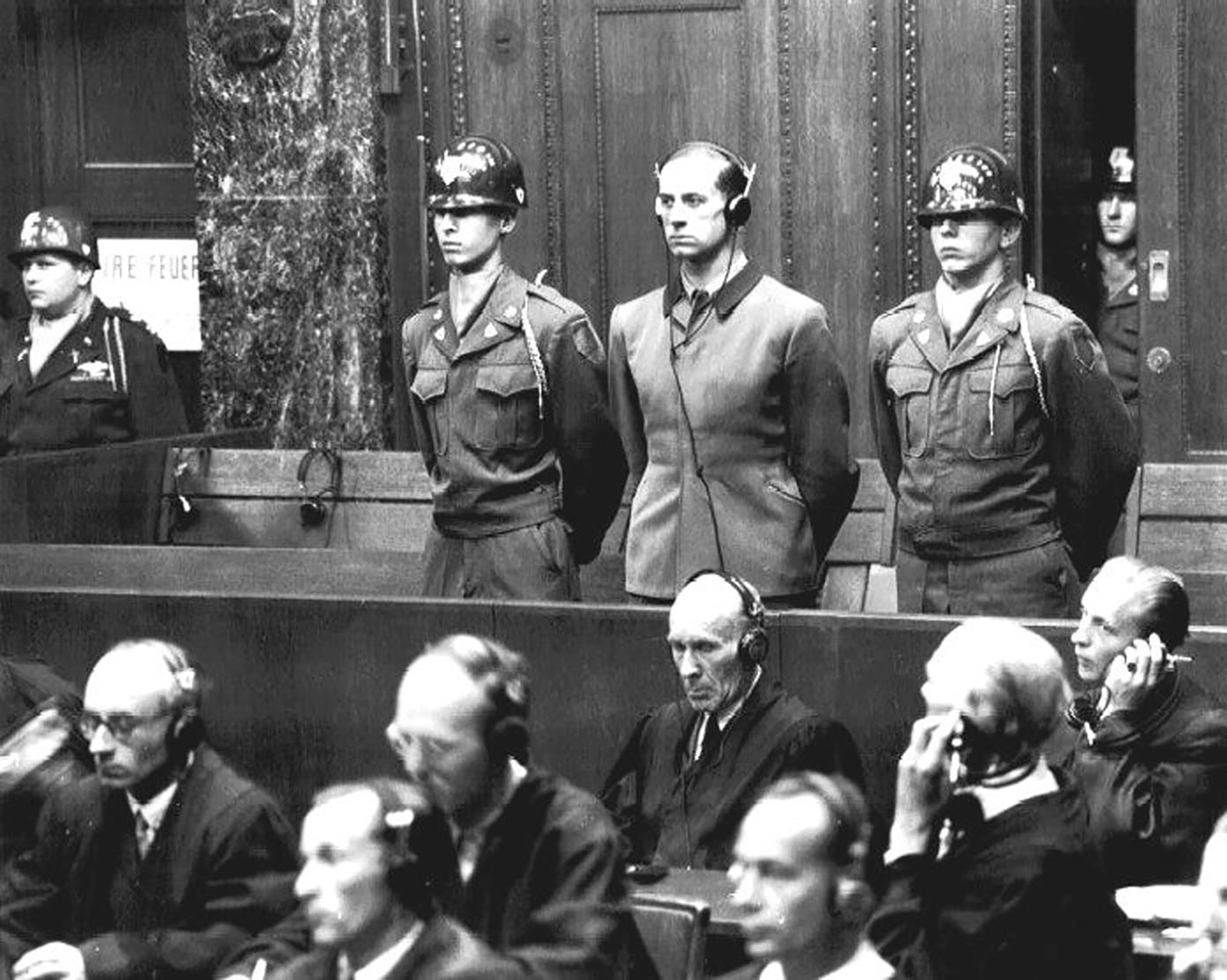
Karl Brandt (standing) at the sentencing at the end of the Nuremberg Doctors‘ Trial, 20 August 1947.
Copy ArEGL.
During the first investigations into the Lüneburg murders of the sick, the Bergen-Belsen trial took place in Lüneburg from September to November 1945. A further 13 „Nuremberg Trials“ were also held from October 1945 to April 1949. Only one of these trials related to the murder of the sick in the German Reich. The murder in „paediatric wards“ and of patients of foreign origin played a subordinate role. The focus was on „Aktion T4“.
ERGEN-BELSEN PROCESS (17.9. – 17.11.1945)
The first war crimes trial on German soil was held in the gymnasium of the Lüneburg MTV. It met with great international interest. The crimes committed in the Bergen-Belsen prisoner of war and concentration camp took centre stage. The trial also covered crimes committed in the Auschwitz-Birkenau concentration camp. The MTV hall was remodelled to accommodate around 200 journalists and trial observers in addition to the 45 defendants. This picture was taken a few days before the start of the trial.
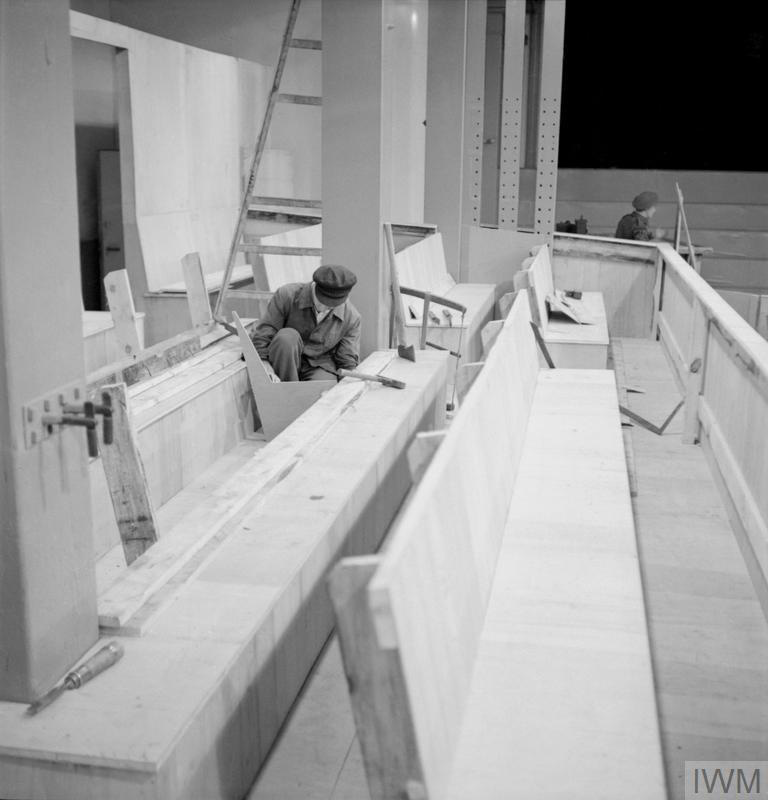
Carpentry work in the MTV gymnasium. A carpenter assembles the seats.
Photographer Sgt Wilkes.
IWM BU 10369.
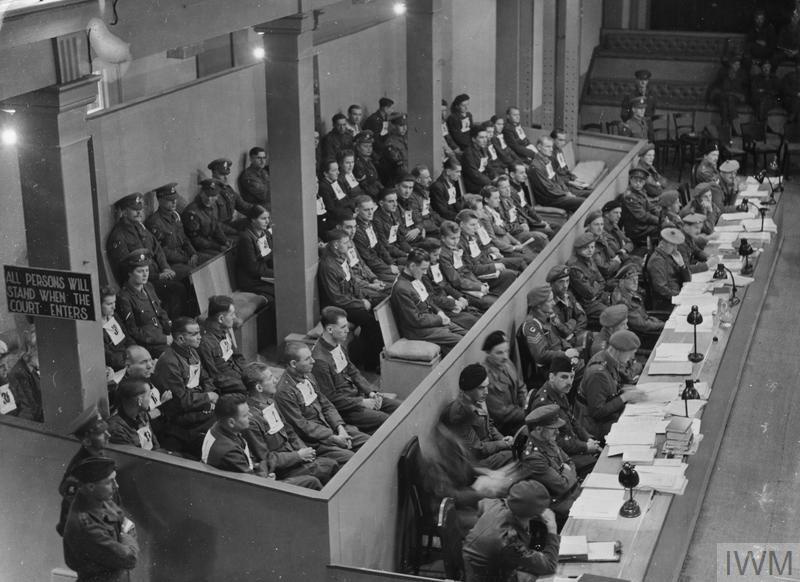
45 defendants in the Bergen-Belsen trial, 17 September 1945. The former camp commandant Josef Kramer, marked with the number 1, can be seen in the lower left front corner.
IWM HU 59545.
MEETING TRACKING IN BRANDENBURG
PROSECUTION OF PIRNA-SONNENSTEIN
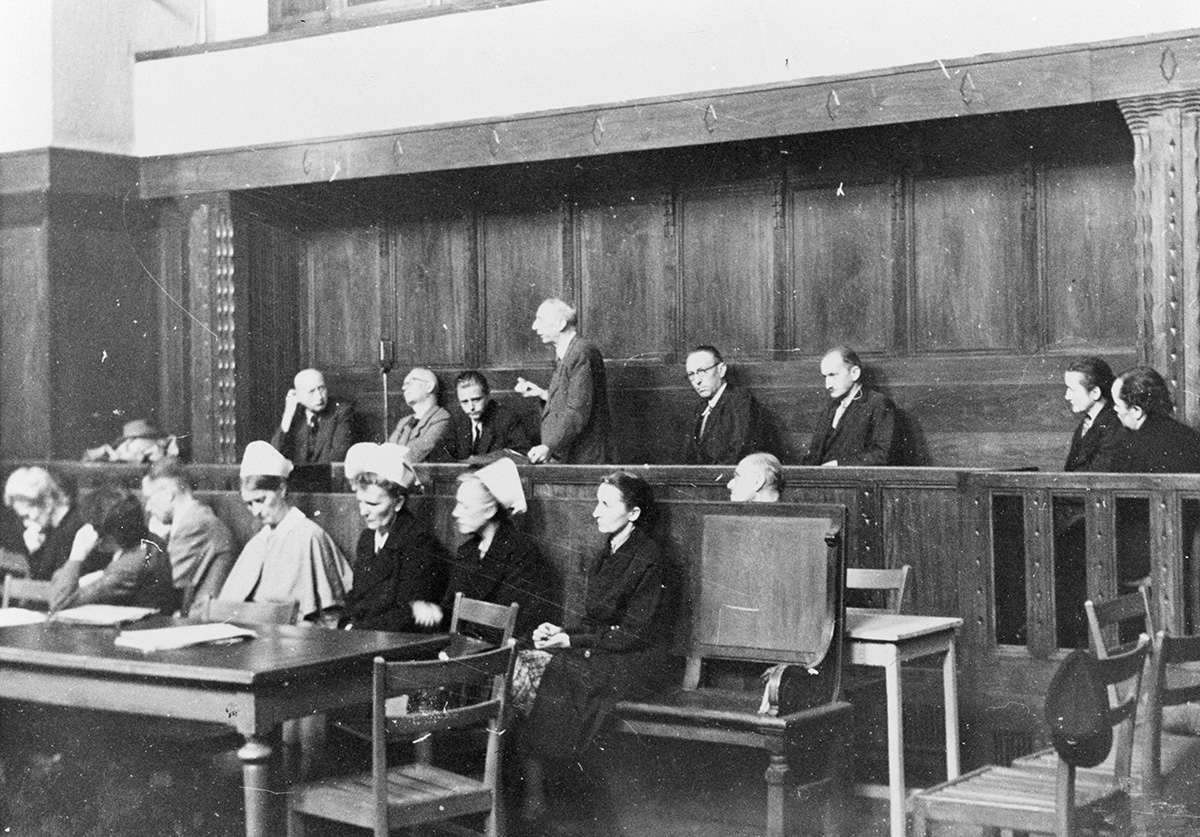
n the back row on the far right is Paul Nitsche, standing is the doctor Ernst Leonhardt, who escaped execution by suicide. Sixth from the right is the nurse Gäbler, who was executed on the same day as Nitsche.
BArch Bild 183-H26186.
PROSECUTION OF HADAMAR
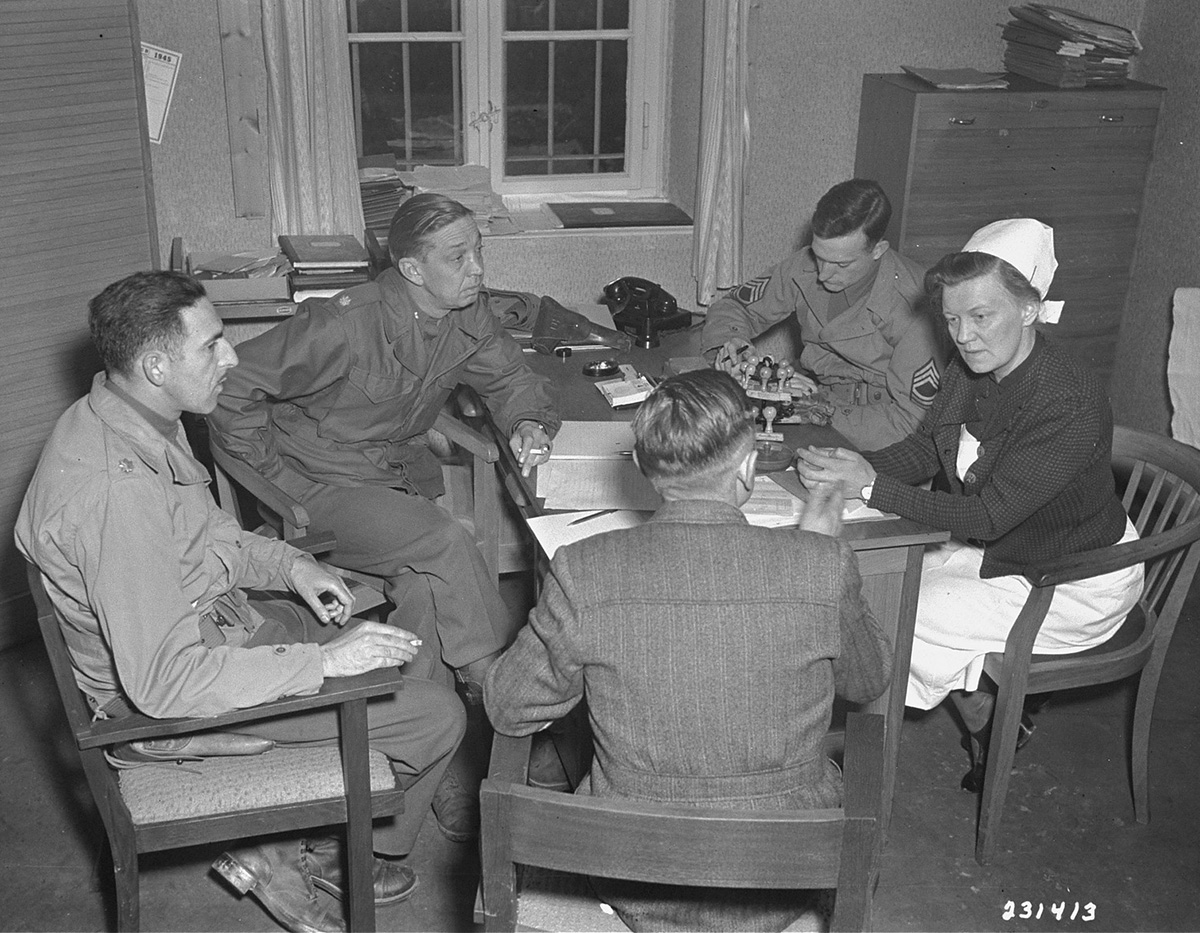
Nurse Irmgard Huber, Hadamar, 4 May 1945, photographer Troy A. Peters, US Army.
USHMM, Nr. 73720.
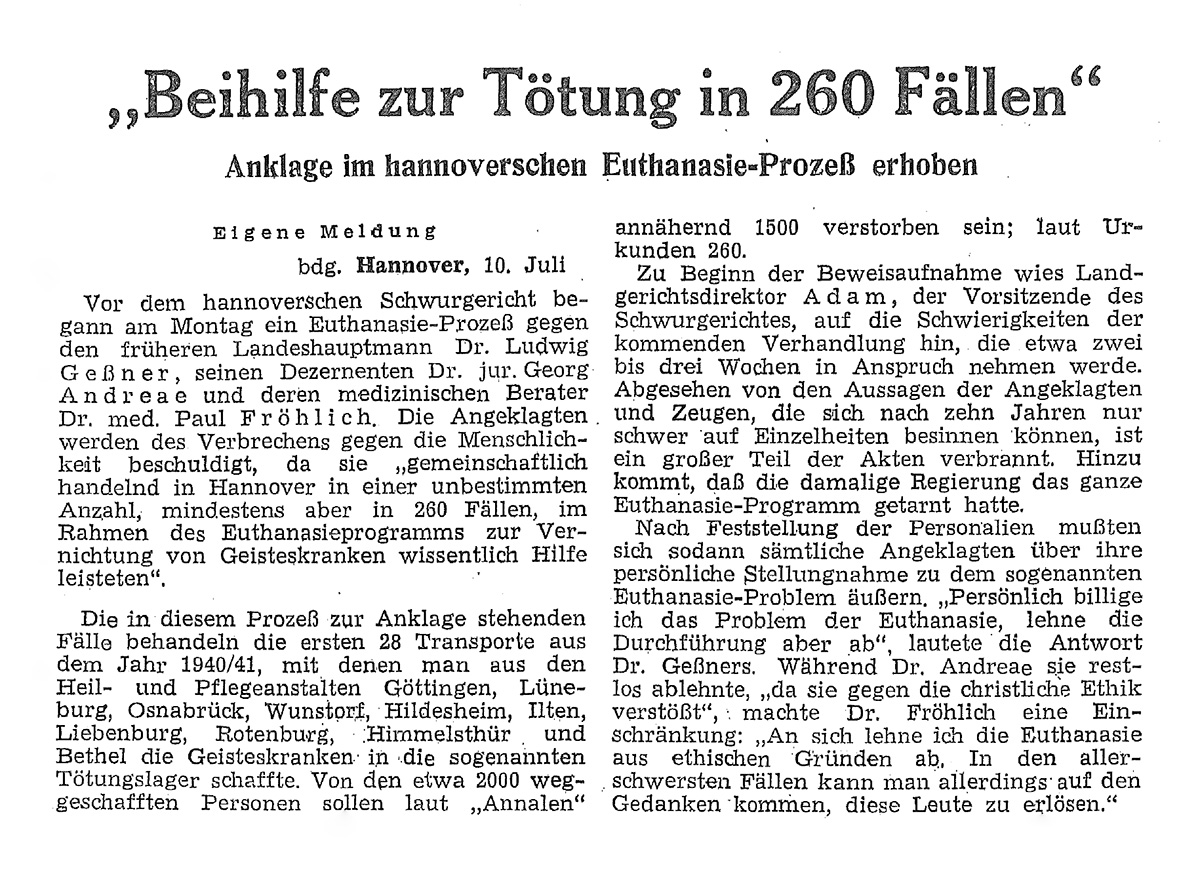
Newspaper report „Aiding and abetting murder in 260 cases“ in the Hannoversche Allgemeine Zeitung of 11 July 1950, p. 2.
ArEGL.
The trial ended just three weeks later with her acquittal. It was based on the personality of the accused and the „exceptional situation“ at the time.
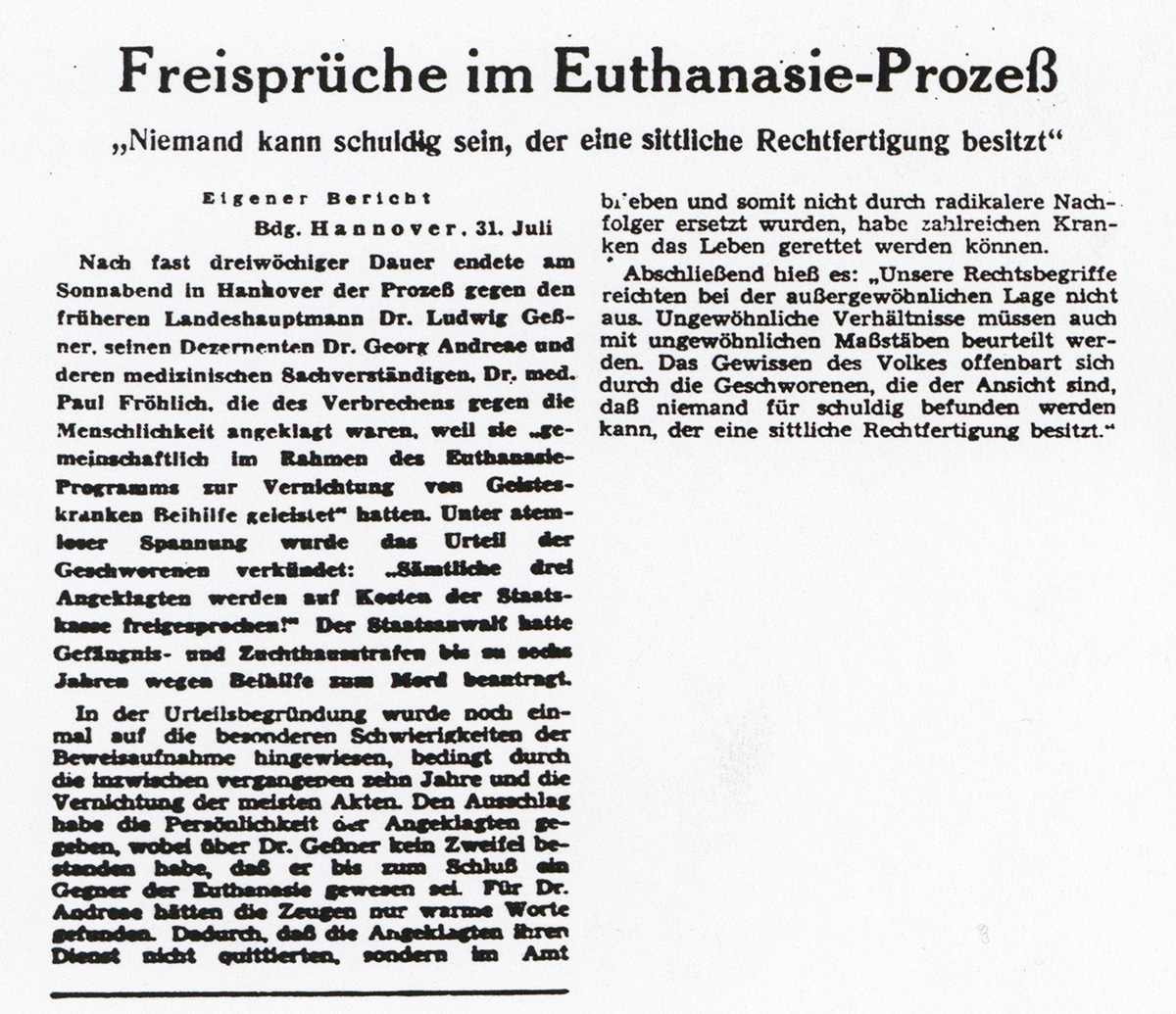
Newspaper report „Acquittals in the euthanasia trial“ in the Hannoversche Allgemeine Zeitung of 31 July 1950.
ArEGL.
»All three defendants are acquitted at the expense of the state treasury!«
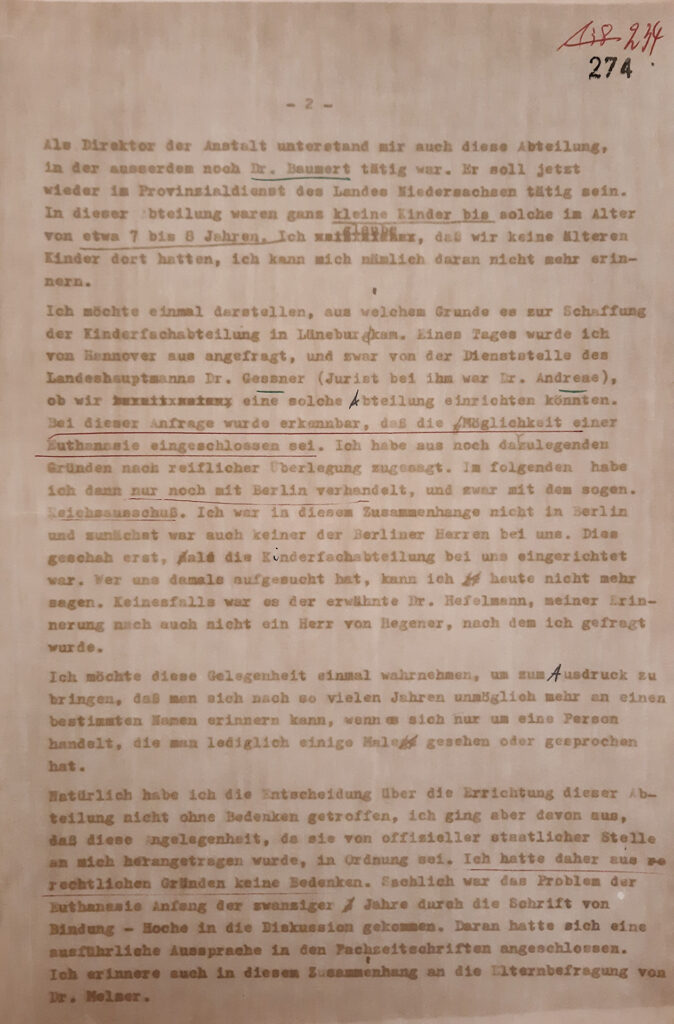
Excerpt from the transcript of the hearing of Max Bräuner on 30 November 1961 before the examining magistrate, Frankfurt am Main Regional Court.
NLA Hannover Nds. 721 Lüneburg Acc. 8/98 Nr. 3.
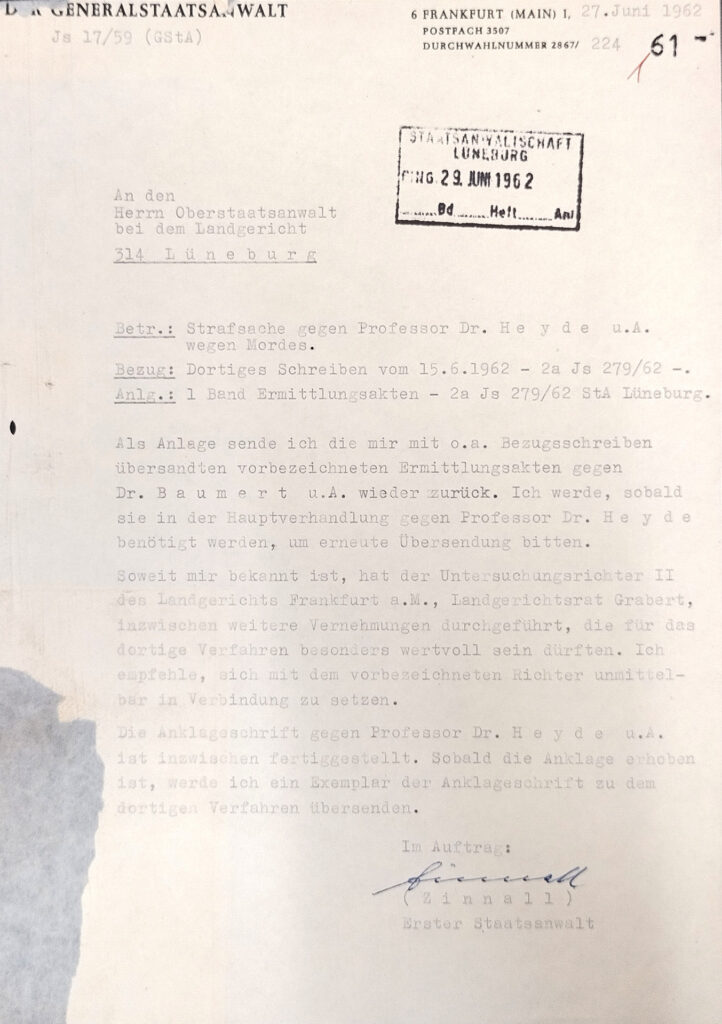
Letter from the Public Prosecutor General’s Office in Frankfurt am Main to the Public Prosecutor’s Office in Lüneburg dated 27 June 1962.
NLA Hannover Nds. 721 Lüneburg Acc. 8/98 Nr. 3/1.
»I would like to explain why the paediatric department was set up in Lüneburg. One day I received an enquiry from Hanover […]. This enquiry revealed that the possibility of euthanasia was included. For reasons still to be explained, I accepted after careful consideration.«
From the interrogation of Max Bräuner on 30 November 1961 before the examining magistrate, Frankfurt am Main Regional Court.
NLA Hannover Nds. 721 Lüneburg Acc. 8/98 Nr. 3.
QUESTIONING OF MAX BRÄUNER
Max Bräuner was summoned for questioning several more times. During his interrogation on 11 December 1962, he explained in detail why he had agreed to the establishment of a „children’s department“. He claimed that he had done it for the good of the institution. He also had no guilty conscience. He claimed that he had thought everything was lawful at the time. He acted as if he had been deceived and took no responsibility.
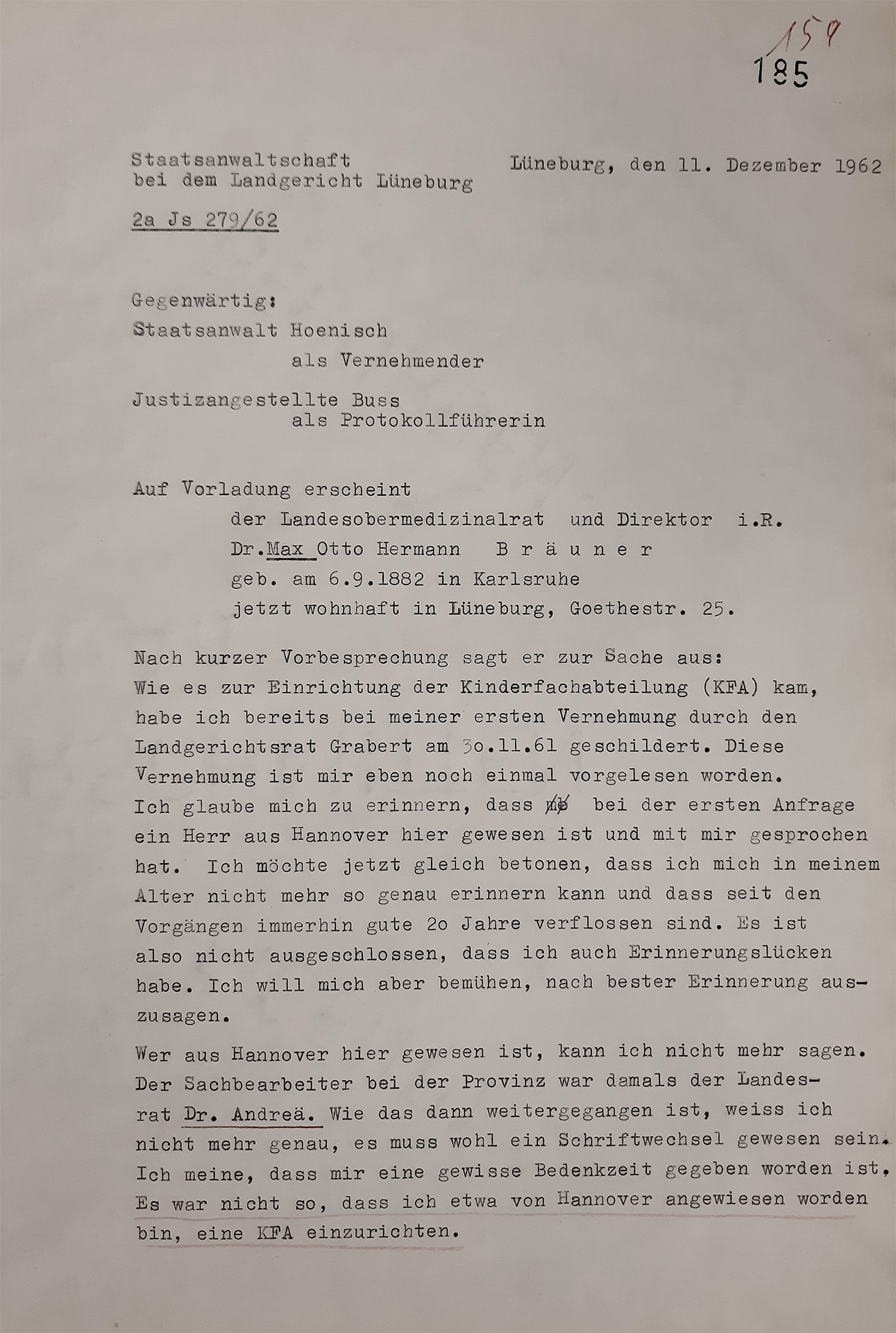
Interrogation of Max Bräuner on 11 December 1962.
NLA Hannover Nds. 721 Lüneburg Acc. 8/98 Nr. 3/1.
»I must add that for years before that, there had always been plans to turn the Lüneburg institution into a Gauschschule, at least for party purposes. With the Reich Committee in the background, I therefore hoped to have a powerful argument against these party plans. […] At the time, I agreed to the establishment of a KFA [specialised children’s department] because I was of the opinion that the planned measures were lawful«
From the interrogation of Max Bräuner on 11 December 1962, p. 2 | 8.
NLA Hannover Nds. 721 Lüneburg Acc. 8/98 Nr. 3/1.
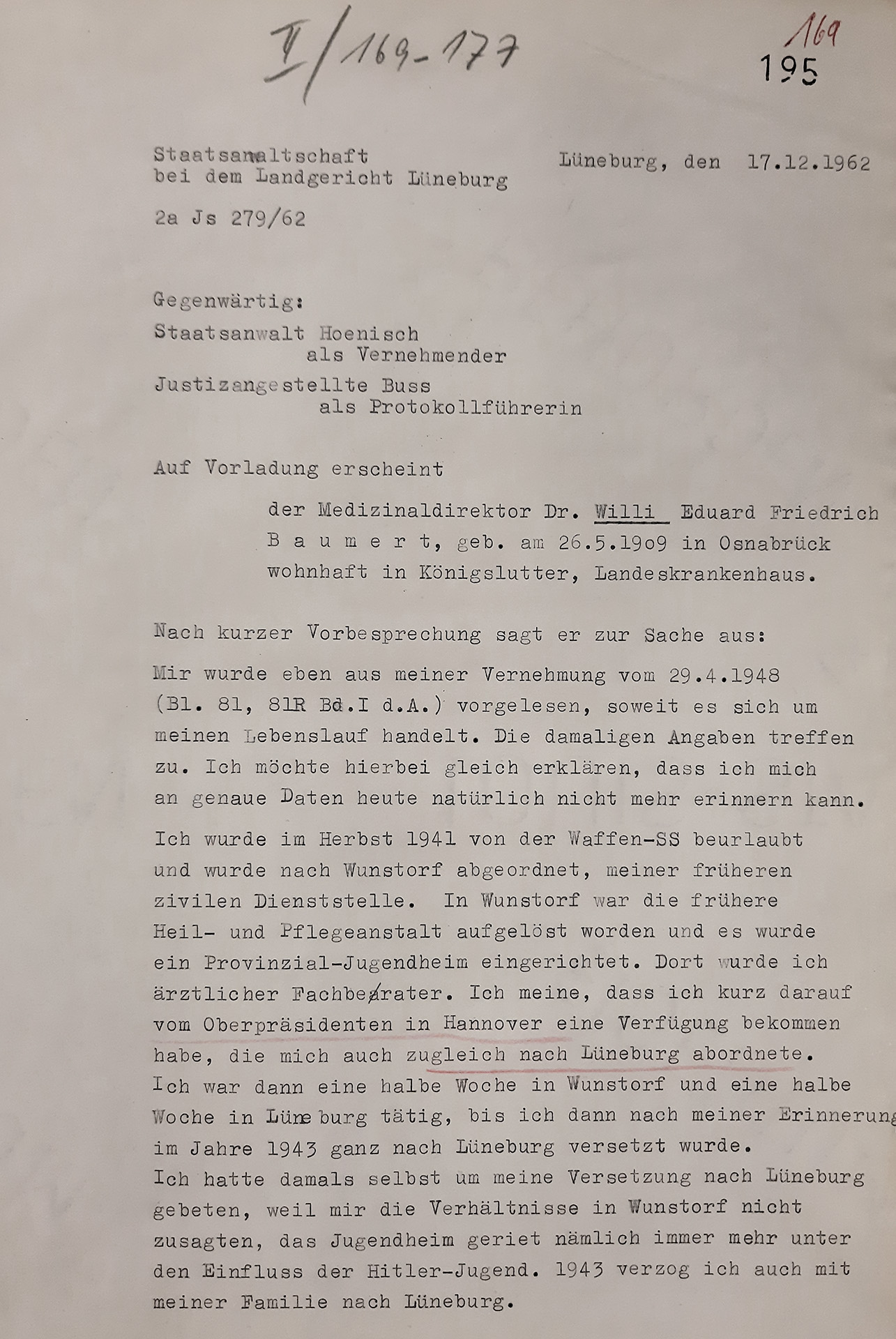
Interrogation of Willi Baumert on 17 December 1962.
NLA Hannover Nds. 721 Lüneburg Acc. 8/98 Nr. 3/1.
INTERROGATION OF WILLI BAUMERT
When the investigation against Willi Baumert was reopened, he had already been Medical Director of the Königslutter State Hospital and Chairman of the Association of Lower Saxony Institutional Physicians and Psychiatrists for six years. In December 1962, he admitted to having murdered hundreds of children. He took no responsibility for his actions. He said that he had acted on orders from above. He also glorified the murders as a service to science.
»I am accused of having labelled the boy ‚unworthy of life‘ in Wilhelm Schaffrath’s medical record. This word is not part of my vocabulary. Of course, I may have used it occasionally. […] In conclusion, I would like to point out once again that I became involved in this matter through no fault of my own. I always gave the orders to euthanise children reluctantly and only because I felt bound by the instructions issued by the Reich Committee. It was certainly a very unpleasant activity, but I didn’t have the feeling that I was doing anything illegal«
From the interrogation of Willi Baumert on 17 December 1962, p. 8.
NLA Hannover Nds. 721 Lüneburg Acc. 8/98 Nr. 3/1.
INTERROGATION OF DORA VOLLBRECHT
After Dora Vollbrecht lied during questioning by the examining magistrate on 22 May 1962, she was tormented by her guilty conscience. She confided in an acquaintance who convinced her to tell the truth. She then made a new statement on 4 June 1962 in which she described her involvement in the murder in the Lüneburg „children’s ward“ in detail.
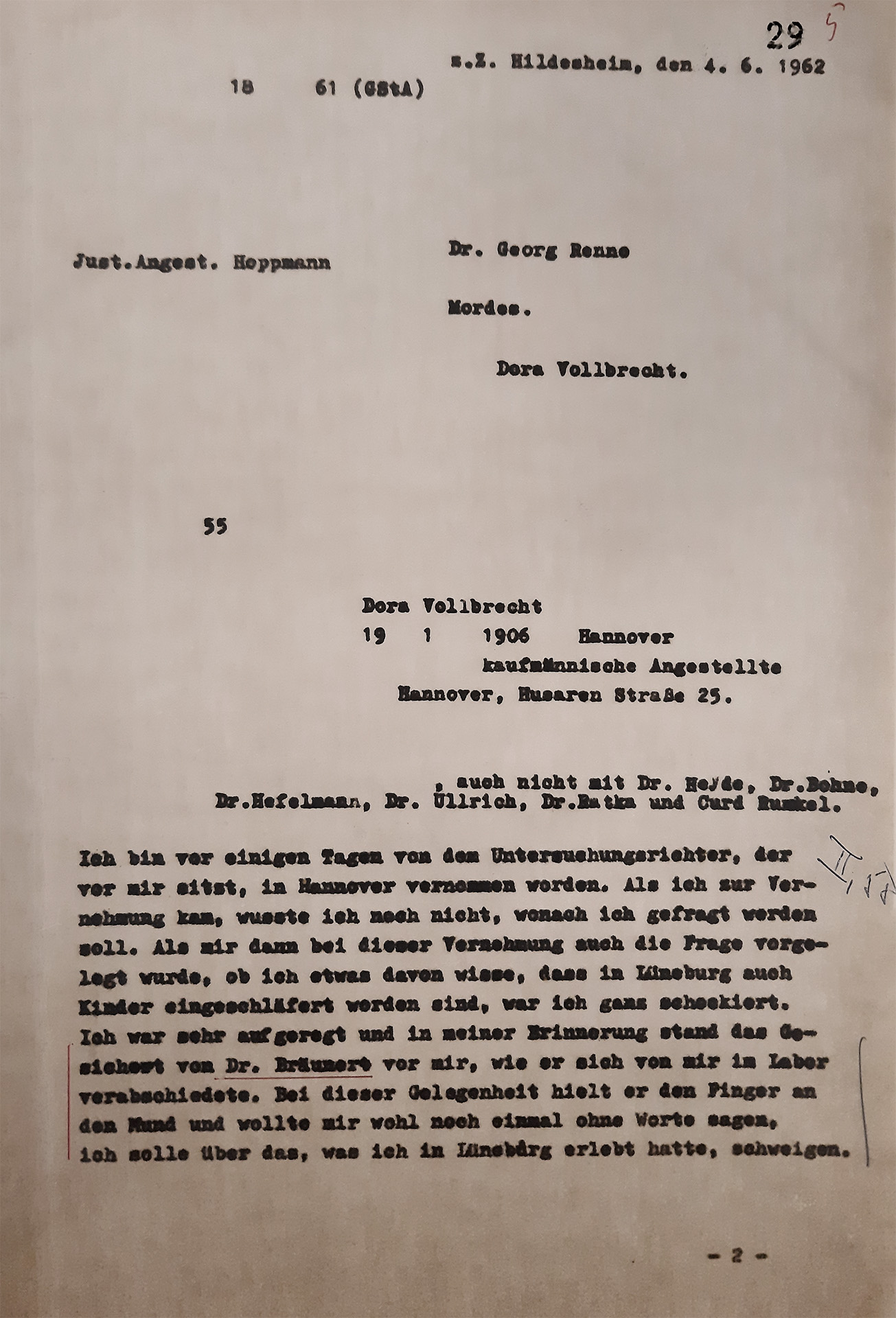
Interrogation of Dora Vollbrecht on 4 June 1962.
NLA Hannover Nds. 721 Lüneburg Acc. 8/98 Nr. 3/1.
»I would like to say today that these children did not know what they were alive for. I mean that these children were spiritually under the animal. […] When I am asked how I felt when Dr Bräuner told me what my task would be, I have to say that I am a person who swallows everything and can say nothing. […] Nor did I dare to disobey the doctors‘ instructions after being instructed […]. […] I didn’t like doing that […]. […] I am not a person who dares to contradict superiors. I can’t do that. I can’t even do that with my brother«
Dora Vollbrecht’s report of 4 June 1962, p. 5 | 8.
NLA Hannover Nds. 721 Lüneburg Acc. 8/98 Nr. 3/1.
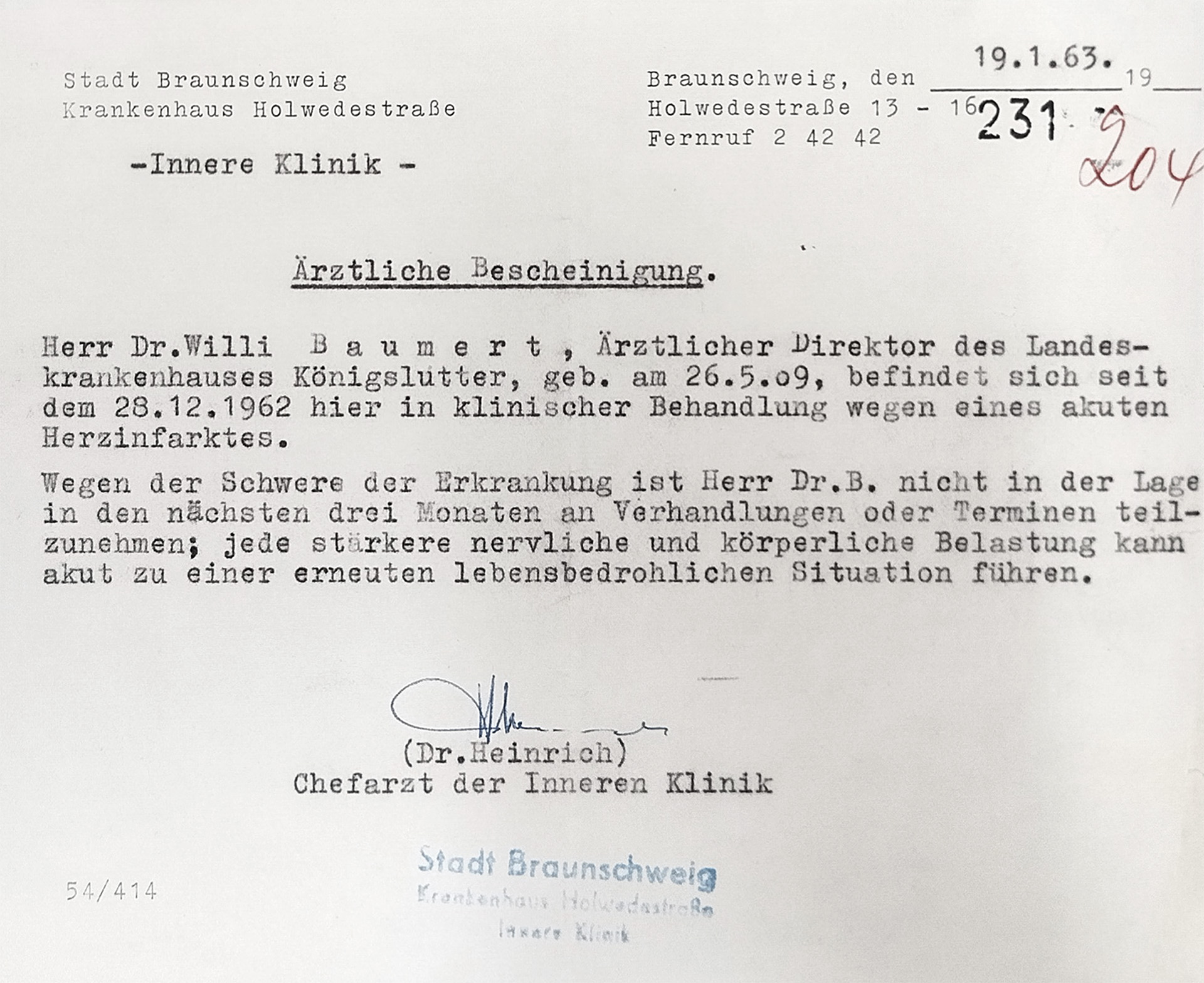
Medical certificate for Willi Baumert dated 19 January 1963.
NLA Hannover Nds. 721 Lüneburg Acc. 8/98 Nr. 3/1.
The investigations against Max Bräuner and Willi Baumert were dropped in 1966 and against Dora Vollbrecht in 1980. All three presented medical certificates stating that they were unable to stand trial for health reasons. As a result, no charges were brought and there was never a trial. Their offences were not punished.
During the investigations into the Lüneburg perpetrators, the criminal trial against Werner Heyde took place at Frankfurt am Main Regional Court. The trial attracted a great deal of public interest. In January 1964, DER SPIEGEL devoted a cover story to it on pages 28 to 38. One month later, Werner Heyde took his own life, thus avoiding judgement.
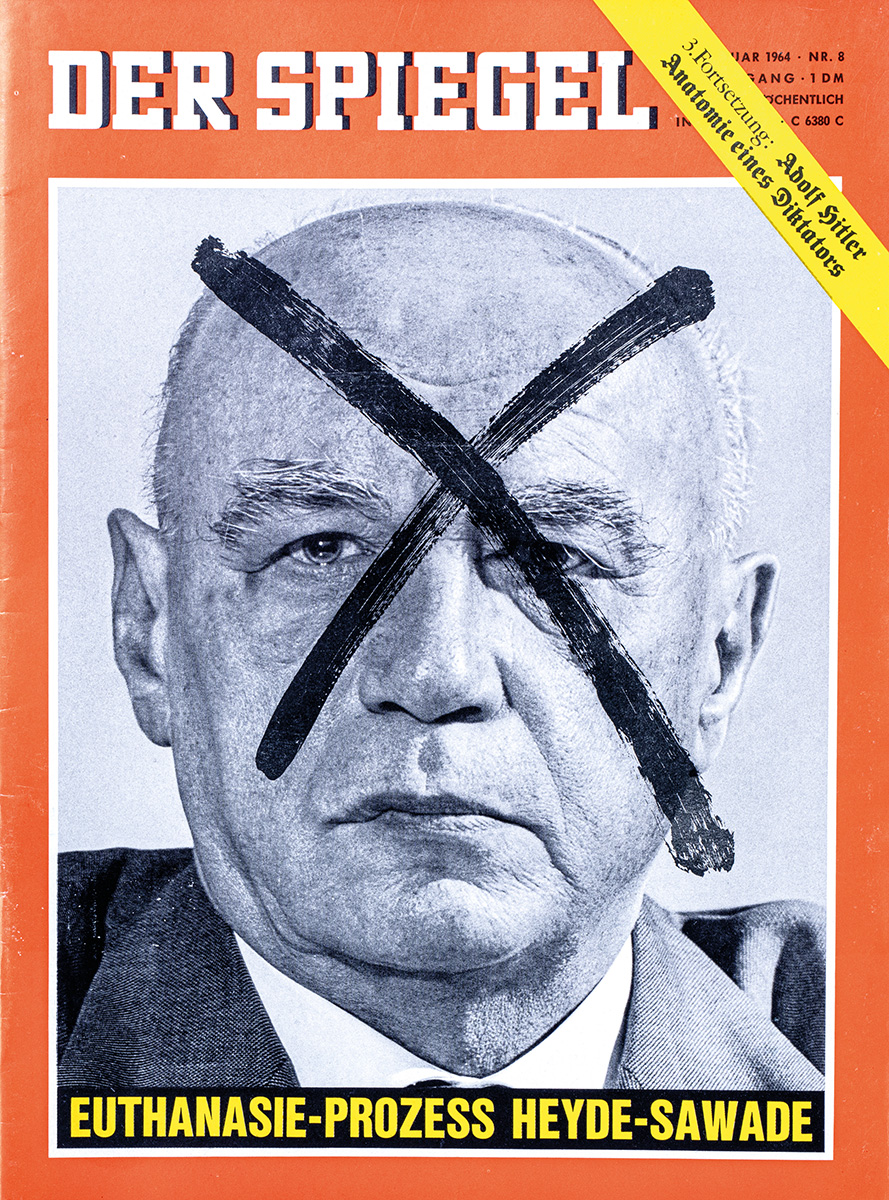
DER SPIEGEL, No. 8, January 1964.
ArEGL 191.
DORA VOLLBRECHT (1906 – 1984)
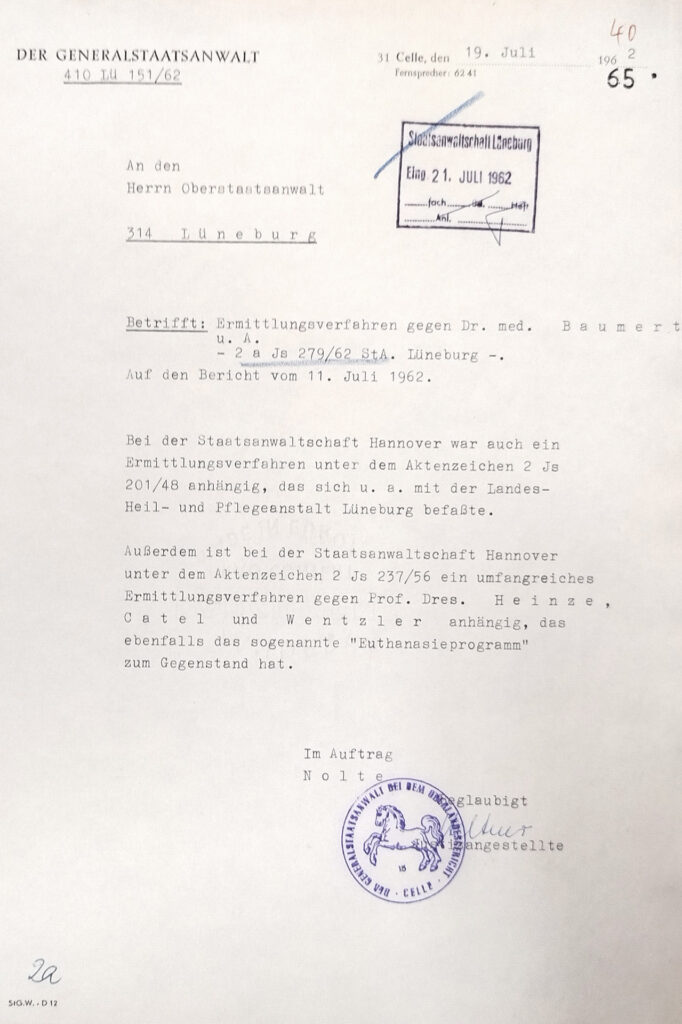
Letter from the Public Prosecutor General’s Office in Celle to the Chief Public Prosecutor about the ongoing „child euthanasia“ proceedings in Hanover dated 19 July 1962.
NLA Hannover Nds. 721 Lüneburg Acc. 8/98 Nr. 3/1.
KEINE STRAFVERFOLGUNG
PROSECUTION
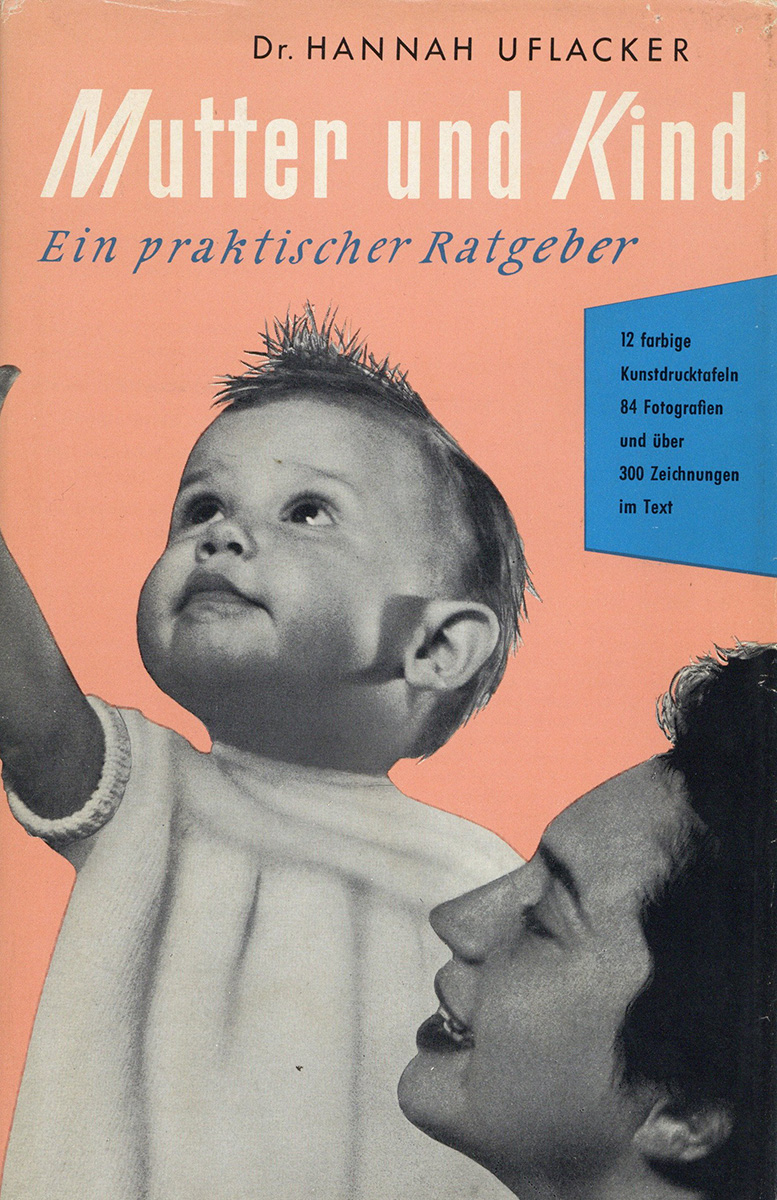
Hannah Uflacker: Mother and child. Gütersloh 1965.
CAREERS IN THE BRD AND THE GDR
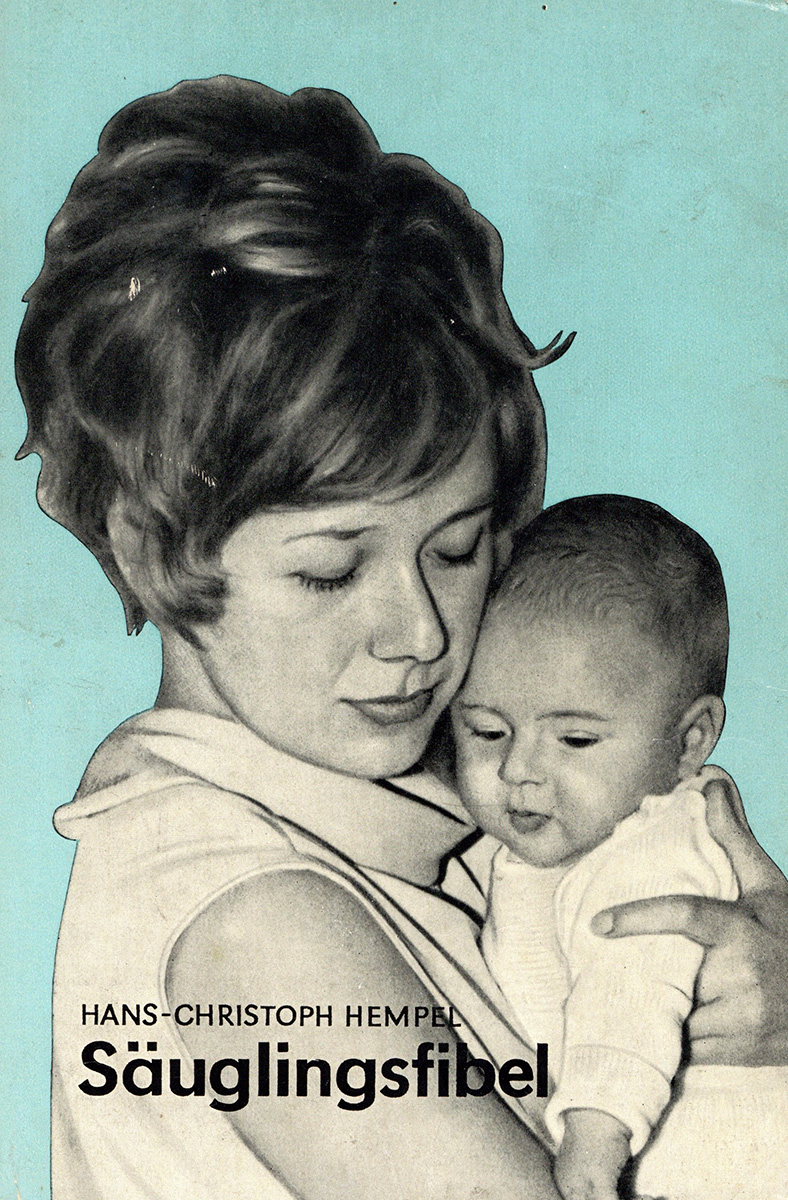
Hans-Christoph Hempel: Infant Primer. Leipzig 1970.
Hans-Christoph Hempel was a former head doctor at the Leipzig University Children’s Hospital and ran the Karl-Marx-Stadt (Chemnitz) District Children’s Hospital in the GDR. He was never investigated, although he was responsible for the »special treatment« of children and adolescents in the Leipzig »paediatric department«. He habilitated in 1960. In 1969, he published the »Infant Primer« as a »Meritorious Doctor of the People«. In it, he particularly emphasised the advantages of crèche care for very young children.
